Avoice: Product, team and how it was built
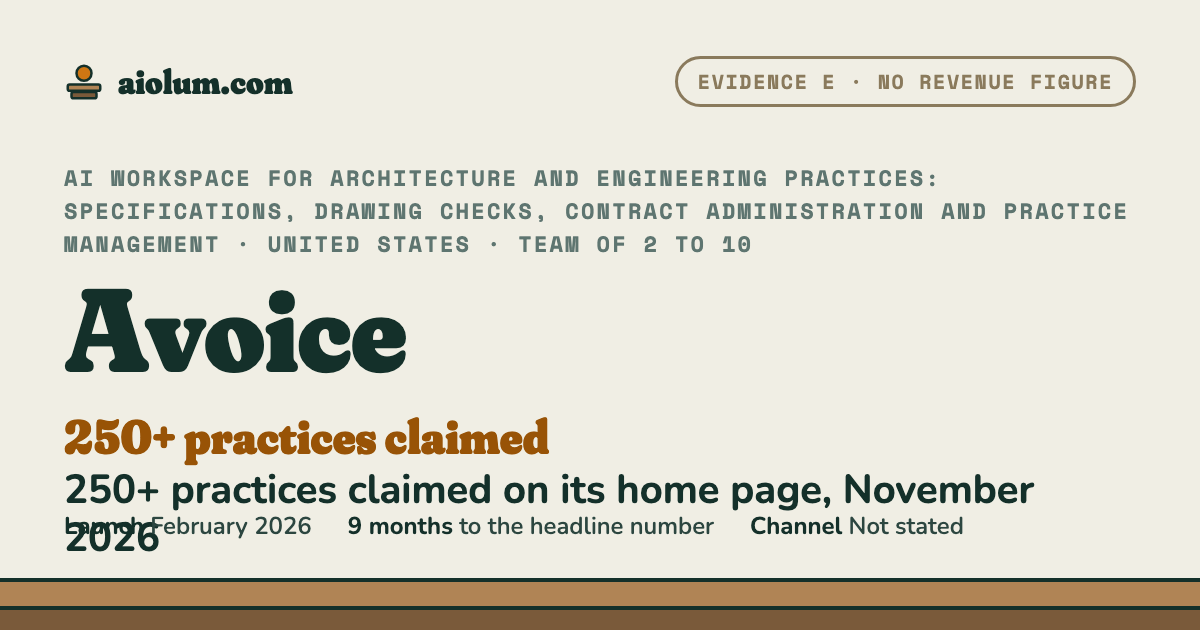
Avoice (AI workspace for architecture and engineering practices: specifications, drawing checks, contract administration and practice management, United States): 250+ practices claimed on its home page, November 2026. Evidence grade E: no revenue figure was checked. Team: 2 founders (YC launch post, March 2026); 7 people on the YC company page, November 2026. Launched February 2026; still running.Added 6 November 2026
- Outcome
- 250+ practices claimed on its home page, November 2026
- Evidence
- E no revenue figure was checked
- Launch
- February 2026
- Status
- Still running
- Team
- 2 founders (YC launch post, March 2026); 7 people on the YC company page, November 2026
- Outside funding
- Y Combinator (Winter 2026) and other investors; amounts not published
- Main channel
- Not stated
What is not verified
No revenue figure was found. The headline is the company's own home-page claim of '250+ practices', unchanged since July 2026, and the US$300 million figure is the value of customers' construction projects stated by the founders, not revenue. No payment-processor profile, founder interview with revenue, or filing was found. A reader could look for a funding announcement with traction figures or a case study by a named practice. This story is grade E: the business is real and its product, price and customers are described from public pages, but no revenue figure was checked. Aiolum shows it as an idea worth studying, not as proof that it makes money.
Avoice is an AI workspace for architecture firms. Its main job is the specification, the written part of a building's design documents that names every material, product, standard and workmanship rule, often running to hundreds of clauses. Avoice drafts the specification from the practice's own drawings, schedules and office master, a practice's standard library of clauses that it reuses on every project, and then checks the text against the drawings. It also checks drawing sets for clashes before issue, reviews submittals (the product data a contractor sends for approval) against the clauses they answer, and runs timesheets, fees and invoices.
Chawin Asavasaetakul (CEO) and Chawit Asavasaetakul (CTO) founded it; the YC company page gives 2025 as the founding year. In November 2025 the avoice.co domain showed a different product, AI sales intelligence; by February 2026 it showed the architecture workspace, and the first YC launch post for it is dated 11 February 2026. The company is in Y Combinator's Winter 2026 batch. In March 2026 the founders wrote that "Over $300M in construction projects" were run on the platform by firms in 5 countries, and in November 2026 the home page says it is "Trusted by 250+ practices". The YC page lists 7 people.
No revenue figure was found, so this story is grade E: the business is real, live and selling plans in pounds sterling, but how much it earns is not public. The page also shows earlier construction companies that raised large sums and failed.
How much revenue does Avoice make?
Each row shows the evidence grade and the source numbers from the list at the end of this page. The grades are explained in How Aiolum verifies.
| Fact | Value | Grade | How we know | Sources |
|---|---|---|---|---|
| Practices claimed on the home page, November 2026 | 250+ practices and in-house design teams | C | Home page read 6 November 2026: 'Trusted by 250+ practices and in-house design teams of all shapes and sizes'. The same sentence was on the home page in the Internet Archive copy of 29 July 2026. The company's own claim; not checked. | [4, 8] |
| Construction value run on the platform, March 2026 | over US$300 million in projects, firms in 5 countries | C | Founders' YC launch post of 8 March 2026: 'Over $300M in construction projects are currently operating on the platform across firms in 5 countries.' This is the value of the customers' buildings, not Avoice revenue. The 11 February 2026 post says '$300M+ in active projects'. | [3, 2] |
| Countries named by the company | UK, US, Australia and New Zealand | C | YC company description: practices 'from boutique studios to firms of several hundred people'. | [1] |
| Founders | Chawin Asavasaetakul (Founder/CEO) and Chawit Asavasaetakul (Founder/CTO) | C | YC company page and the March 2026 launch post. Chawin previously worked two years with architects as co-CEO of a coatings company; Chawit did AI research at UCSF and UC Berkeley and worked on Alexa+ at Amazon, the post says. | [1, 3] |
| Team size, November 2026 | 7 | C | YC company page, read 6 November 2026. | [1] |
| Funding | Y Combinator Winter 2026; Spot VC, Twenty Two Ventures, Accel Scout Fund and Alecla7 named on the about page | C | No amounts published. The YC group partner is Jared Friedman. | [1, 6] |
| Founded | 2025 | C | YC company page 'year_founded'. The architecture product's first YC launch post is dated 11 February 2026. | [1, 2] |
| Lowest price | £150 a month (about US$201), Specs Solo | calc | Calculated: the pricing page lists £150 a month excluding VAT; converted at US$1.3398 per pound (Federal Reserve H.10, 30 October 2026). | [5, 9] |
| Integrations | Revit, ArchiCAD and Vectorworks; Xero and QuickBooks | C | Pricing page and YC company description. | [5, 1] |
| Data hosting and audits | AWS UK region; Cyber Essentials Plus; SOC 2 Type II under way | C | Security page. AI model providers are not named; the page says they work under zero-data-retention terms. | [7] |
| Time from launch to the November 2026 claim | 9 months | calc | Calculated: February 2026 to November 2026. | [2, 4] |
How to read this table: company values are what Avoice's own pages and its YC launch posts said; YC values come from the YC company page read on 6 November 2026. Prices are converted from pounds on this page (grade X). No value is grade A or B.
| Plan | Per month, billed yearly (US$) | Per month, billed monthly (US$) | Limit |
|---|---|---|---|
| Specs, Solo | 201 | 1 spec licence, 1 person (£150) | |
| Specs, Pro | 469 | 3 spec licences, up to 10 people (£350) | |
| Specs, Team | 670 | 5 spec licences, up to 25 people (£500) | |
| Full Suite, Solo | 268 | 1 person (£200) | |
| Full Suite, Pro | 670 | 3 licences (£500) | |
| Full Suite, Team | 938 | 5 licences (£700) | |
| Enterprise | quoted | 26+ people |
The pricing page lists prices in pounds a month, excluding VAT: Specs at £150 (Solo, 1 licence), £350 (Pro, 3 licences, practices of 2 to 10) and £500 (Team, 5 licences, 11 to 25 people); Full Suite at £200, £500 and £700. Extra licences cost £60 to £110 a month, Suite seats £30 and Timesheet seats £8 to £10. The first two months are billed monthly, then quarterly; the page says an annual licence is cheaper but gives no amount, so the yearly column is empty. Conversion at US$1.3398 per pound, the US Federal Reserve H.10 noon buying rate for 30 October 2026, rounded to whole dollars.
When did Avoice launch, and how did it grow?
From an AI sales product on the same domain in late 2025 to an architecture workspace with published prices in 2026. Each entry carries its grade.
- November 2025CThe avoice.co home page, in an Internet Archive copy of 28 November 2025, shows 'AVoice', an AI sales intelligence product that captures sales calls, texts and visits. [8]
- February 2026CThe home page now reads 'AI Workspace For Architects'. On 11 February the first YC launch post, 'Avoice: The AI workspace for architects', says firms manage $300M+ in active projects on it. [8, 2]
- 8 March 2026CSecond YC launch post, 'Harvey for Architecture', in the Winter 2026 batch: firms in 5 countries, over $300M in construction projects. [3]
- July 2026CThe home page says 'Trusted by 250+ practices and in-house design teams'. [8]
- November 2026CThe site is live with published prices in pounds, an offer of up to 12 months free for practices switching from other specification software, and 7 people on the YC page. [4, 5, 1]
Why did Avoice work?
Four causes, in the order they mattered. Each one is a reusable lesson.
One painful document, in one industry
Specifications carry contractual weight and take weeks to write by hand, the company says. Avoice starts from that one document, built on the practice's own office master and drawings, and adds the neighbouring work (drawing checks, submittals, compliance records) around it.
Priced per specification writer
The pricing page charges for the people who write specifications, not for everyone in the office, with cheaper seats for people who only use project tools or timesheets. A small practice can start at the Solo plan.
Switching offer against incumbents
The site offers up to 12 months free on an annual plan to practices that already pay for specification software, aimed at moving customers from the older tools that the about page criticises for lock-in.
How it was built
Few build details are public. These come from the company's own pages. [7, 5, 1, 4]
- Project data is stored in the AWS UK region on every plan, with encryption in transit and at rest.
- Third-party AI model providers process prompts under zero-data-retention terms; the pages read here do not name them.
- Connectors for Revit, ArchiCAD and Vectorworks (building design programs) and for Xero and QuickBooks (accounting); Pro and higher plans can connect outside AI tools through MCP, a standard protocol for giving AI assistants access to data.
- UK and Irish building regulations are built in, with calculators such as stair, ventilation and overheating checks.
Tools named in the sources
Each one opens its page in the Tools tab, with every story that uses it.
Who tried this before Avoice, and why did they fail?
Three companies in our database of failed startups tried to change how buildings are designed and built, and failed. The values below are from that database and are not independently verified.
Katerra
The promiseOne company for the whole building process, from architecture and design to factories and construction.
Why it diedIt built factories and supply chains before it had the demand, and the losses outran even SoftBank's money.
Social Construct
The promiseTechnology and streamlined processes to build housing faster and cheaper.
Why it diedPhysical construction scaled slowly, regulation was complex, and the pandemic hit before more money came.
Veev
The promiseFactory-made wall panels with built-in services, assembled on site in days.
Why it diedPremium homes for a market that buys on price, and a costly factory when higher interest rates cut demand.
The failed startups come from our database of 1,749 dead startups, retold here in our own words. Its entries are AI-assisted summaries of public sources, so these cards carry no evidence grade.
What changed
The three predecessors tried to change the physical building: factories, panels and their own construction crews, which needed hundreds of millions of dollars before the first sale. Avoice changes only the paperwork of the people who design the building and leaves construction to the existing industry.
That makes it a software business with low marginal cost per customer. The risk has moved from factories to adoption: architects must trust AI-drafted clauses that carry contractual weight, and the pricing page says the practice stays responsible for every specification it issues.
Can one person copy Avoice now?
Hard for one person; it needs deep domain knowledge.
The idea of taking one long, rule-heavy professional document and drafting it from a firm's own past work fits many industries. Avoice's founders spent years with architects first, the launch post says, and the product depends on national standards, regulation libraries and design-software connectors.
Where it is still open: Other professional documents built from standards and past work: engineering calculations reports, tender packs for contractors, operation and maintenance manuals, planning applications.
- 1Pick one long document that a profession writes by hand on every job and that follows written standards.
- 2Build drafting on the customer's own past documents, so the output uses their wording.
- 3Add checks against the source drawings or data, because a professional signs the result.
- 4Price per writer, and offer a switching deal to customers of the incumbent software.
What could go wrong for Avoice?
The risks are the mirror image of the causes above.
What is not verified
No revenue figure was found. The headline is the company's own home-page claim of '250+ practices', unchanged since July 2026, and the US$300 million figure is the value of customers' construction projects stated by the founders, not revenue. No payment-processor profile, founder interview with revenue, or filing was found. A reader could look for a funding announcement with traction figures or a case study by a named practice.
A different product on the same domain in 2025
In the Internet Archive copy of 28 November 2025, avoice.co showed 'AVoice', a sales intelligence product for sales reps that captured 'calls, texts, and visits' and offered 'real-time visibility into on-site activity'. The pages read in 2026 sell only the architecture workspace; no source explains the change.
Customer claims
The home page shows four named testimonials, including a senior architect at Marriott International, and the YC description mentions firms of several hundred people. None of these could be checked with the customers.
Competition and model providers
On this site the closest stories are Fenestra and Archifruits (AI renders for architects) and Blueprint Crusher (AI reading of construction tender documents); Avoice works on the written specification instead. The security page says it uses third-party AI model providers under zero-data-retention terms but does not name them, so the dependence on any one provider could not be checked.
Team and funding
Two founders started it and the YC page lists 7 people in November 2026; the about page names YC and four other investors without amounts. This fits the site's rule for funded teams of 6 to 10 that began with 1 to 5 founders.
Sources
The grade next to each source is the best grade that the source can support. "Read in full" means that the text of the page was downloaded and the numbers were checked in it.
- C Y Combinator company page: Avoice, AI-native workspace for AECRead in full, including the page data, downloaded by the pipeline on 6 November 2026. Source for the founders, founding year, team size, batch, location and company description.
- C YC launch post, 11 February 2026: Avoice: The AI workspace for architectsRead in full in the launch data embedded in the YC company page. Source for the first launch date and the '$300M+ in active projects' claim.
- C YC launch post, 8 March 2026: Avoice: Harvey for ArchitectureRead in full in the launch data embedded in the YC company page. Source for the five-country claim and the founders' backgrounds.
- C Avoice home pageRead in full on 6 November 2026. Source for the '250+ practices' claim, the features and the testimonials.
- C Avoice pricing pageRead in full on 6 November 2026. Source for the plans, prices, billing terms and the responsibility statement.
- C Avoice about pageRead in full on 6 November 2026. Source for the investors and the company's view of incumbent software.
- C Avoice security pageRead in full on 6 November 2026. Source for AWS UK hosting, certifications and the model providers' data terms.
- C Internet Archive copies of avoice.co, 28 November 2025, 8 February 2026 and 29 July 2026Read the three copies in full. Source for the earlier sales product, the switch to architecture and the July 2026 practice count.
- A US Federal Reserve H.10 Foreign Exchange Rates, release of 2 November 2026Read the United Kingdom row. Rate for 30 October 2026: US$1.3398 per pound.
- C Database of failed startups, local exportLocal export. AI-written summaries, not independently verified. Source for the failed predecessors.
Run this company? Send corrections or a verified figure to aiolum@livyden.com