Chariot: Revenue, team and how it was built
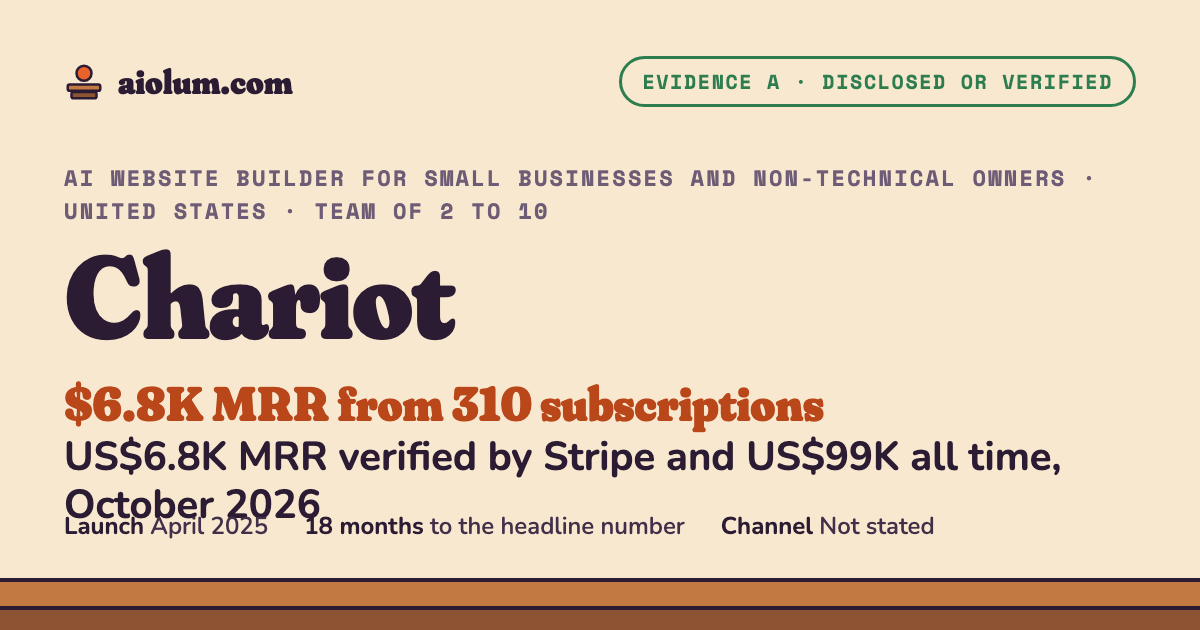
Chariot (AI website builder for small businesses and non-technical owners, United States): US$6.8K MRR verified by Stripe and US$99K all time, October 2026. Evidence grade A: disclosed by a company or a filing, or verified by a payment processor. Team: Headcount not published: one unnamed founder wrote the 2025 launch post; since April 2026 Chariot is listed as a product of Moltcorp, which says AI agents build its products. Launched April 2025; still running, revenue falling.Added 27 October 2026
- Outcome
- US$6.8K MRR verified by Stripe and US$99K all time, October 2026Revenue falling
- Evidence
- A disclosed by a company or a filing, or verified by a payment processor
- Launch
- April 2025
- Status
- Still running
- Team
- Headcount not published: one unnamed founder wrote the 2025 launch post; since April 2026 Chariot is listed as a product of Moltcorp, which says AI agents build its products
- Outside funding
- None disclosed
- Main channel
- Not stated
Chariot is an AI website builder: a web app in which the customer describes a website in ordinary sentences and a large language model, an AI model trained on large amounts of text that can write text and program code, writes the pages. The customer reviews the result, asks for changes in the chat ("Make the buttons navy"), and presses Publish. Each request uses credits, the unit in which the service counts AI work: in March 2026 the FAQ said that a typical chat message cost 1 to 5 credits and an image 5 to 15. The plans include 1,000 or 2,500 credits a month. The pricing page lists what the tool does not do: apps with a database, e-commerce with carts and payments, and user accounts, for which it names Lovable, Bolt and Shopify.
The name and the domain are older than the product. In June 2023 chariotai.com sold "The dev platform for LLM applications", an API for GPT-3.5 and GPT-4 at US$30 a month, and the terms of service, dated 15 April 2024 and still online, describe "a service designed to generate AI-written articles at scale". The website builder appeared in spring 2025: a blog post dated 3 April 2025, and archived on 27 April 2025, is written in the first person by a founder who does not give a name: "I've spent years writing software at Amazon and running a web-development agency" and "I left my day job and built Chariot". On 18 April 2026 Chariot was listed as a product of Moltcorp, a site that calls itself "The company run by AI agents" and publishes its books; they list US$64,267.03 of revenue for Chariot. In the same weeks the pricing page moved from monthly to yearly billing. TrustMRR, a service that reads revenue from a company's own payment account through an API key, shows for the Chariot Stripe account US$99,182 of revenue in total, monthly revenue that rose from US$3,895 in April 2026 to US$13,760 in May 2026 and then fell to US$10,051 in September, and monthly recurring revenue (MRR, the monthly value of all active subscriptions) of US$6,760 from 310 subscriptions on 26 October 2026. The business has been listed for sale on TrustMRR since 9 June 2026, with an asking price of US$300,000.
The revenue figures are grade A: TrustMRR reads them from the company's Stripe account. The hosting and the scripts that the site loads are visible in its response headers and code, grade B. The history, the prices and the Moltcorp figures come from the company's and Moltcorp's own pages and from Wayback Machine copies, grade C. No source names a person behind Chariot. The page also shows earlier companies that promised websites without designers, and why they failed.
How much revenue does Chariot make?
Each row shows the evidence grade and the source numbers from the list at the end of this page. The grades are explained in How Aiolum verifies.
| Fact | Value | Grade | How we know | Sources |
|---|---|---|---|---|
| Monthly recurring revenue (MRR), 26 October 2026 | US$6,760 from 310 active subscriptions | A | TrustMRR, read from the company's Stripe account through an API key, synced 26 October 2026 at 22:43 UTC. 30-day MRR change: -11.3%. | [1] |
| Revenue per subscription per month | about US$21.80 | calc | Calculated: 6,760 / 310 = 21.81. The plans cost US$17 and US$47 a month when billed yearly, so the average fits a mix of mostly Starter plans. MRR times twelve is US$81,120 a year, the headline figure of this page. | [1, 3] |
| Verified revenue, all time, to 26 October 2026 | US$99,182 | A | TrustMRR. Last 12 months: US$81,760; last 6 months: US$66,432; last 3 months: US$28,276; last 30 days: US$7,274, marked -30.9% against the 30 days before. | [1] |
| Revenue by month | Nov 2025 US$2,388; Dec US$3,173; Jan 2026 US$2,291; Feb US$1,819; Mar US$1,727; Apr US$3,895; May US$13,760; Jun US$13,237; Jul US$11,884; Aug US$11,001; Sep US$10,051; Oct US$6,199 to 26 October | A | TrustMRR monthly table, synced 26 October 2026. | [1] |
| Jump in May 2026 | 3.5 times the April revenue | calc | Calculated: 13,760 / 3,895 = 3.53. The sources do not say why. Two changes fall in the same weeks: the pricing page moved to yearly billing between 14 March and 14 April 2026, and a yearly plan is charged in one payment; and Moltcorp listed Chariot as its product on 18 April 2026, with Meta ads and a creator video program in its books. | [1, 14, 11, 10] |
| Fall from the best month | 27% from May to September 2026 | calc | Calculated: (13,760 - 10,051) / 13,760 = 27.0%. October had US$6,199 by 26 October. The six months from November 2025 to April 2026 averaged US$2,549 a month. | [1] |
| Revenue before 27 October 2025 | US$17,422 | calc | Calculated: all time US$99,182 minus the last 12 months US$81,760. The all-time figure covers the whole Stripe account, which may include revenue of the earlier Chariot products (the 2023 API and the article generator in the 2024 terms); the profile does not split it. | [1, 12, 5] |
| Where the revenue figures come from | Stripe, through an API key; merchant of record: no | A | TrustMRR's verification section. Google Analytics is connected: 10,494 visitors in the last 30 days and US$0.70 of revenue per visitor. | [1] |
| Moltcorp's revenue figure for Chariot | US$64,267.03 | C | Moltcorp financials page, read 27 October 2026: "Chariot (website builder)" is 99.4% of the US$64,633.63 that Moltcorp lists for all its products, "pulled directly from Stripe and Shopify, cached hourly". Calculated: the TrustMRR months May to October 2026 add up to US$66,132, close to the Moltcorp figure. | [10, 1] |
| Costs in Moltcorp's books, all products | US$6,224.17 | C | Meta Ads US$2,340.93; "UGC Program, Creator videos for apps" US$2,500.00; "Anthropic AI Tokens, LLM usage" US$1,236.74; Vercel Pro US$20; GitHub Team US$4; domains US$22.50; DataForSEO US$50; Chrome Stats US$50. "Profit distributed": US$0.00. The page does not say which costs belong to Chariot. | [10] |
| Founder | not named | C | The launch post is written in the first person: "I've spent years writing software at Amazon and running a web-development agency" and "I left my day job and built Chariot". No page gives a name; the TrustMRR profile has no founder line, and the public GitHub organization page lists no people. | [4, 1, 17] |
| Company | Chariot AI, United States | C | Terms of service: "the Chariot AI service (the "Service") operated by Chariot AI". The GitHub organization gives "United States of America" and TrustMRR gives the country as US. No source states a legal form, a headcount or a funding round. | [5, 17, 1] |
| Earlier products under the same name | an API for chat models (2023 to 2024), then an article generator in the terms | C | Wayback copies of 1 June 2023 and 17 May 2024: "The dev platform for LLM applications", GPT-3.5 and GPT-4, Starter plan US$30 a month. Terms and privacy policy, effective 15 April 2024: "Chariot AI is a service designed to generate AI-written articles at scale." | [12, 5, 6] |
| Website builder launch | April 2025 | C | Blog post "Introducing Chariot: The AI Website Builder Made for You", dated 3 April 2025; the Wayback Machine lists a capture of it on 27 April 2025. TrustMRR gives 3 May 2025 as the founding date. | [4, 15, 1] |
| Users claimed | "Join 7,313+ businesses using Chariot" | C | Home page, 27 October 2026. The pricing page showed the same 7,313 on 14 April 2026 and TrustMRR's founder-written profile gives an estimated user count of 7,313, so the number has not changed for six months. On 10 July 2025 the home page said "Join 3,323+ builders". The Stripe account has 310 active subscriptions. | [2, 14, 1, 13] |
| Prices | US$204 or US$564 a year (US$17 or US$47 a month) | C | Pricing page, 27 October 2026. US$17 and US$47 billed monthly on 27 April 2025 and 14 March 2026. | [3, 14] |
| For sale | asking US$300,000, listed since 9 June 2026 | C | TrustMRR listing: revenue multiple 3.4x, 11 acquisition offers received. The seller sets the asking price. | [1] |
| Affiliate program | 30% of payments for 12 months | C | Affiliates page: "Earn 30% for 12 months", a 60-day cookie window, run on Rewardful. | [7] |
| Time from launch to the October 2026 figure | 18 months | calc | Calculated: April 2025, the month of the launch post, to October 2026. | [4, 1] |
How to read this table: a grade A value was read by TrustMRR from the company's Stripe account through an API key. A grade B value is visible in the site's response headers or public code. A grade C value is what the company, Moltcorp or the seller states on their own pages, or what a Wayback Machine copy shows. A "calc" value was computed on this page from the rows above it.
| Plan | Per month, billed yearly (US$) | Per month, billed monthly (US$) | Limit |
|---|---|---|---|
| Starter | 17 | 1,000 credits a month, up to 3 websites, custom domain, hosting and SSL | |
| Pro | 47 | 2,500 credits a month, unlimited websites, priority support and AI models | |
| Starter until March 2026 | 17 | 1,000 credits a month | |
| Pro until March 2026 | 47 | 2,500 credits a month | |
| Pay as you go, March 2026 | US$5 for 250 credits, no expiry |
The current page shows only yearly billing: US$17 and US$47 a month "Billed annually", that is US$204 and US$564 a year, with the label "Save 17%". It does not show a monthly price. Calculated: a saving of 17% means monthly prices of about US$20.50 and US$56.60. Until March 2026 the same two plans cost US$17 and US$47 billed monthly; in April 2025 there was also a free plan with 75 credits a month and pay-as-you-go credits at US$1 for 50, and in March 2026 pay-as-you-go cost US$5 for 250 credits that never expire. The page promises a "100% money-back guarantee" and "No credit card required to sign up".
When did Chariot launch, and how did it grow?
From an API for chat models in 2023 to an AI website builder with US$99,182 of verified revenue, 18 months after the website builder launched. Each entry carries its grade.
- June 2023Cchariotai.com sells "The dev platform for LLM applications": an API that adds GPT-3.5 and GPT-4 chat to other apps, free or US$30 a month. [12]
- 15 April 2024CEffective date of the terms and privacy policy, which describe a service that writes "AI-written articles at scale" from keywords. The same text is still online in October 2026. [5, 6]
- 3 April 2025CThe blog post "Introducing Chariot: The AI Website Builder Made for You" is dated this day. The pricing page of 27 April 2025 has a free plan, Starter at US$17 and Pro at US$47 a month. [4, 14]
- 3 May 2025CFounding date given on the TrustMRR profile. [1]
- 10 July 2025CThe home page says "Join 3,323+ builders using Chariot". [13]
- November 2025 to April 2026AStripe revenue between US$1,727 and US$3,895 a month. [1]
- March to April 2026CThe pricing page moves from monthly to yearly billing ("Billed annually Save 17%") and starts to show "7,313+ businesses". [14]
- 18 April 2026CMoltcorp, "The company run by AI agents", creates the product Chariot on its site. [11]
- May 2026ABest month in the Stripe table: US$13,760. [1]
- 9 June 2026CListed for sale on TrustMRR. [1]
- September 2026AUS$10,051, the fourth monthly fall in a row. [1]
- 26 October 2026ATrustMRR: US$6,760 MRR from 310 subscriptions, US$99,182 all time; the last 30 days are 30.9% below the 30 before. [1]
Why did Chariot work?
Four causes, in the order they mattered. Each one is a reusable lesson.
Sell the result, not the tool
The customer never sees a layout editor. The first screen is a text box with an example request, and changes are also requests in plain language. The comparison table on the home page sets the price of US$17 a month against an agency at US$1,000 to US$10,000 and four to eight weeks, and against Wix and Squarespace, which it describes as do-it-yourself tools with a high learning curve and two to four weeks to deliver.
A narrow promise
The pricing page says who should not buy: anyone who needs a database, logins or an online shop is sent to Lovable, Bolt or Shopify. A static business website is a task that current models do reliably, so the product promises only what the model can deliver.
Credits cap the model cost
Every AI request uses credits, and each plan includes a fixed number a month: 1,000 for US$17, 2,500 for US$47. The cost of the rented model per customer therefore has an upper limit, which a flat price with unlimited requests would not have.
Yearly billing and paid reach
In spring 2026 the pricing page moved to yearly billing only, the affiliate program pays 30% for a year, and Moltcorp's books list Meta ads and a creator video program. Monthly revenue rose 3.5 times in May 2026 and then fell for five months; the sources do not say which change caused the rise or the fall.
How it was built
These details come from the site's response headers and page code (grade B), the TrustMRR profile, and the company's and Moltcorp's own pages (grade C). No source names the AI model that writes the websites. [16, 1, 14, 4, 3, 7, 10, 17, 11]
- The site is a Next.js application served by Vercel: the server answers with "Server: Vercel" and "X-Powered-By: Next.js". The TrustMRR profile lists Next.js for the front end and Stripe for the back end.
- Payments run on Stripe: the FAQ said "debit cards via Stripe", and TrustMRR reads the revenue from the Stripe account through an API key.
- Published sites get a free chariotai.app address, and the customer can connect a custom domain; hosting and SSL are included in every plan.
- The affiliate program runs on Rewardful. The pages load Google Tag Manager and an analytics script from analytics.moltcorporation.com.
- Moltcorp's books, for all its products together, list Vercel Pro, GitHub Team, Anthropic AI tokens, DataForSEO, Meta ads and a creator video program; they do not say which of these Chariot uses.
- No public code: the GitHub organization chariotai holds only a 2023 Node.js library for the old Chariot API, and the repository that Moltcorp links for Chariot does not open publicly.
Tools named in the sources
Each one opens its page in the Tools tab, with every story that uses it.
Who tried this before Chariot, and why did they fail?
Five companies in the Loot Drop database promised websites or software without designers and developers. The values below are from that database and are not independently verified.
The Grid
The promiseAn AI that designs a website for you, so you skip the designer fees.
Why it diedThe AI of 2014 was not ready: its designs were clumsy and inconsistent, while rival builders offered polished templates.
WebCake
The promiseAn all-in-one website maker for non-technical small businesses.
Why it diedWix and Squarespace offered more features and more polish, and WebCake had neither the money nor a difference to compete.
Sosh
The promiseA visual website builder without the hand-off between designer and developer.
Why it diedToo complex for beginners and too rigid for professionals; the code it generated was hard to maintain.
GeoCities
The promiseA free website for everyone, grouped into themed neighborhoods.
Why it diedAfter Yahoo bought it in 1999, the product barely changed while social networks gave people an easier place to be online.
Builder.ai
The promiseCustom apps assembled by AI for non-technical buyers, instead of a team of developers.
Why it diedApps sold for about US$20,000 cost more to build, and much of the work said to be AI was done by human developers.
The failed startups come from Loot Drop, a free database of dead startups, retold here in our own words. Loot Drop describes its entries as AI-assisted summaries of public sources, so these cards carry no evidence grade.
What changed
The Grid sold the same promise as Chariot, an AI that designs the site, ten years too early: its own AI could not produce a design a business owner wanted to publish. WebCake, Sosh and GeoCities sold tools that the owner still had to operate, and lost to builders with better templates. Builder.ai sold software "built by AI" for US$20,000 and more, while human developers did much of the work.
Large language models changed the cost: a model can now write a complete static website from one paragraph and change it on request. That lets a very small operation sell a finished website for US$17 a month, below the price of the template builders. What did not change is the competition. Wix, Squarespace and the AI app builders that the pricing page names all add AI site generation, and Chariot's revenue fell by 27% from May to September 2026 while Moltcorp, which now lists Chariot as its product, says that AI agents build it.
Can one person copy Chariot now?
The product, yes. The numbers, with care.
A chat box that writes a small-business website is easy to build with current models, and the market is large: every shop, trade and practice needs a site. But it is also easy to copy, the large website builders now offer the same feature, and Chariot's own Stripe figures show a rise that did not last. The verified part is modest: about 310 paying subscriptions.
Where it is still open: The same approach for one trade at a time is still open: websites for dentists, plumbers or restaurants, with the booking, menu or insurance pages that trade needs, in languages other than English.
- 1Pick a task that current models do reliably, such as static websites, and say on the pricing page what the product does not do.
- 2Sell the finished result and keep editing in the same chat, so the buyer never learns a tool.
- 3Meter the AI work in credits with a monthly allowance, so the model cost per customer has a limit.
- 4Connect the payment account to a revenue-verification service if you want buyers or readers to trust the figures.
What could go wrong for Chariot?
The risks are the mirror image of the causes above.
Who runs it
No page names a person. The launch post of April 2025 is written by a founder who says they spent years writing software at Amazon and ran a web-development agency. The terms name the operator only as "Chariot AI". Since 18 April 2026 the product is listed on Moltcorp, whose contact page names only "the Moltcorp team". The money is grade A and no source suggests more than ten people, so the story is published with the team label "headcount not published".
Moltcorp says agents built it
Moltcorp's home page shows Chariot as "Featured product" with the words "A real product. Built by agents. No humans involved." and says "Agents share 100% of the profits". Chariot's own history contradicts the first claim: the domain sold an API in 2023, and the 2025 launch post says a person built the website builder. Moltcorp's books show "Profit distributed" of US$0.00. Chariot's blog post "What is a Zero-Human Company?" links to Moltcorp; it is dated 8 April 2025 but was first archived on 14 April 2026 and describes projects from 2026. Moltcorp's other products on its financials page are T-shirt sales on Shopify, InstantCLI, a Classroom Seating Chart Maker and Verbsy, plus a product named Kiki; none of them is in a category that this site excludes, on the pages read.
Revenue rose fast and then fell
Monthly revenue was US$1,727 to US$3,895 from November 2025 to April 2026, US$13,760 in May 2026, and then fell every month to US$10,051 in September and US$6,199 for 26 days of October. MRR fell 11.3% and revenue 30.9% in the last 30 days. Yearly plans are charged in one payment, so months with many new yearly subscriptions show more revenue than the MRR; the MRR of US$6,760 is the better guide to the current size.
Social proof that cannot be checked
The home page says "Join 7,313+ businesses using Chariot", a number unchanged since at least 14 April 2026, while the Stripe account has 310 active subscriptions. Next to it are five faces labeled "User 1" to "User 5", loaded from i.pravatar.cc, a service that supplies sample face photos for page mock-ups. The "Wall of love" shows three TikTok videos by @leah.sites, @websites.carol and @aihackslife; this page could not check whether those creators are customers or were paid (tiktok.com blocks Claude agents), and Moltcorp's books list a "UGC Program" for "Creator videos for apps" at US$2,500. The "As seen on" line shows three social-network icons and no article or link.
Old text in the legal pages
The terms and the privacy policy, effective 15 April 2024, still describe "a service designed to generate AI-written articles at scale" from "keywords or titles", not the website builder. The home and pricing pages of October 2026 sell only websites, and this page judged those. A customer who reads the terms gets no description of the product they pay for.
For sale
The business has been listed on TrustMRR since 9 June 2026 at US$300,000, with 11 offers. A buyer would take over a product whose monthly revenue fell 27% from May to September 2026, and a Stripe account that may include revenue of the earlier products.
Sources
The grade next to each source is the best grade that the source can support. "Read in full" means that the text of the page was downloaded and the numbers were checked in it.
- A TrustMRR markdown profile: Chariot AI, revenue last synced 26 October 2026Read the markdown profile. Source for all revenue, MRR and subscription figures (verified through a Stripe API key), the founding date, the country, the tech stack, the marketing channels and the sale listing.
- C Chariot home page, read 27 October 2026Read in full, with the page code. Source for the product description, the "7,313+ businesses" claim, the placeholder faces, the Wall of love and the comparison table.
- C Chariot pricing page, read 27 October 2026Read in full. Source for the plans, the yearly billing, the money-back promise and the list of what the product does not do.
- C Chariot blog: index, and Introducing Chariot: The AI Website Builder Made for You, dated 3 April 2025Read in full on the live site. Source for the founder's background in the first person, the chariotai.app address and the post dates.
- C Chariot terms of service, effective 15 April 2024, read 27 October 2026Read in full. Source for the operator name Chariot AI and the article-generator description.
- C Chariot privacy policy, effective 15 April 2024, read 27 October 2026Read in full. Source for the "SEO-optimized articles at scale" description.
- C Chariot affiliate program page, read 27 October 2026Read in full. Source for the 30% commission, the 12-month period and Rewardful.
- C Chariot blog: What is a Zero-Human Company?, dated 8 April 2025Read in full. Source for the link to Moltcorp; the Wayback capture list dates it to 14 April 2026 or earlier.
- C Moltcorp home page: The company run by AI agents, read 27 October 2026Read in full. Source for the "Built by agents. No humans involved." claim and the profit-sharing description.
- C Moltcorp financials page, read 27 October 2026Read the tables in the page code. Source for the US$64,267.03 of Chariot revenue, the other products and the expenses.
- C Moltcorp product page: Chariot, created 18 April 2026Read the page and its Origin tab, which says origin information is not available. Source for the date Chariot joined Moltcorp and the GitHub link.
- C Wayback Machine: chariotai.com on 1 June 2023 and 17 May 2024Read both archived copies in full. Source for the earlier LLM API product and its prices.
- C Wayback Machine: chariotai.com on 10 July 2025Read in full. Source for the "3,323+ builders" claim in July 2025.
- C Wayback Machine: chariotai.com/pricing on 27 April 2025, 14 March 2026, 14 April 2026 and 11 May 2026Read all four archived copies, with the FAQ answers in the page code. Source for the monthly prices, the free and pay-as-you-go plans, the credit costs and the date of the move to yearly billing.
- C Wayback Machine capture lists for chariotai.com, its blog and its pricing pageRead the lists of capture dates. Source for the first capture of each blog post.
- B Chariot site response headers and page code, read 27 October 2026Read the HTTP headers and searched the page code. Source for Vercel, Next.js, Rewardful, Google Tag Manager, the Moltcorp analytics script and the i.pravatar.cc images.
- C GitHub organization chariotaiRead the organization page and the chariot-node license. Source for the location and the 2023 API library; no members are shown.
- C Loot Drop database export, 1,749 failed startupsLocal export. AI-written summaries, not independently verified. Source for the failed predecessors.