Combinely: Product, team and how it was built
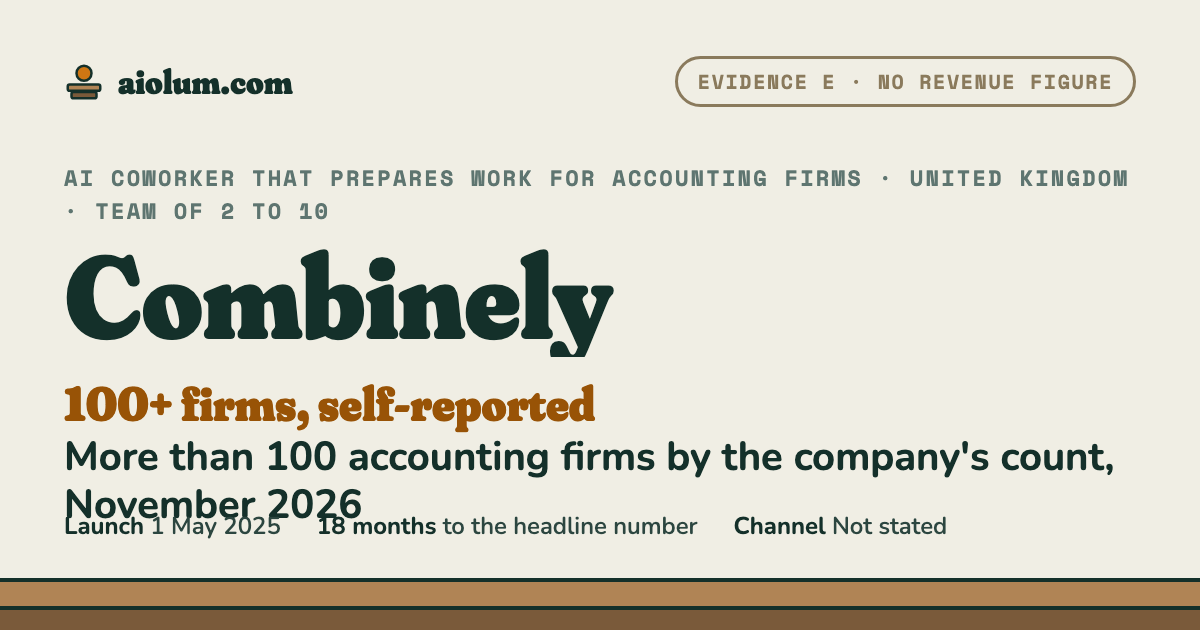
Combinely (AI coworker that prepares work for accounting firms, United Kingdom): More than 100 accounting firms by the company's count, November 2026. Evidence grade E: no revenue figure was checked. Team: 2 co-founders at launch in May 2025; 8 people on the Y Combinator company page, November 2026. Launched 1 May 2025; still running.Added 6 November 2026
- Outcome
- More than 100 accounting firms by the company's count, November 2026
- Evidence
- E no revenue figure was checked
- Launch
- 1 May 2025
- Status
- Still running
- Team
- 2 co-founders at launch in May 2025; 8 people on the Y Combinator company page, November 2026
- Outside funding
- Y Combinator, Spring 2025 batch (amount not published)
- Main channel
- Not stated
What is not verified
No revenue figure was found. The company publishes no revenue, has no payment-processor profile that we found, and the three Y Combinator launch posts give no customer or revenue numbers. The headline, "Trusted by 100+ accounting firms", is the company's own claim on its home page with no list or date; four customers are named in case studies. A reader could look for a funding announcement or a founder interview with figures. This story is grade E: the business is real and its product, price and customers are described from public pages, but no revenue figure was checked. Aiolum shows it as an idea worth studying, not as proof that it makes money.
Combinely sells Coco, an AI agent for accounting firms. An AI agent is a program built on a large language model that does a task in several steps by itself, here by logging into the firm's own software, reading emails and files, and preparing work. Coco has more than 50 agents for jobs such as bank reconciliation, payroll input and 1040 tax workpapers, and it "never finalizes anything without your approval", the home page says.
Tom Invernizzi (previously at Deloitte) and Arthur Granacher (previously at Google and Shazam) founded it in London in 2025, in the Y Combinator Spring 2025 batch. They posted the first launch on 1 May 2025, a second one for tax teams on 24 November 2025, and a third on 1 October 2026 for the full product. The Y Combinator page lists 8 people in November 2026, and the price is US$225 to US$275 per user a month, from the company's pricing page.
No revenue figure was found. The headline is the company's own claim on its home page, "Trusted by 100+ accounting firms", which no outside source confirms, so the story is grade E.
How much revenue does Combinely make?
Each row shows the evidence grade and the source numbers from the list at the end of this page. The grades are explained in How Aiolum verifies.
| Fact | Value | Grade | How we know | Sources |
|---|---|---|---|---|
| Accounting firms using it, November 2026 | more than 100 | C | Company claim on the home page: "Trusted by 100+ accounting firms". No list, date or outside check. | [1] |
| Launch | 1 May 2025 | C | First Y Combinator launch post, "AI coworker for accountants", dated 1 May 2025, 148 votes when read. | [5] |
| Founded | 2025, London | C | Y Combinator company page. | [4] |
| Founders | Tom Invernizzi (CEO) and Arthur Granacher (CTO) | C | Y Combinator company page: previously at Deloitte and PWP, and at Google and Shazam. | [4, 5] |
| Team, November 2026 | 8 people | C | Y Combinator company page, read 6 November 2026. | [4] |
| Funding | Y Combinator, Spring 2025 batch | C | The about page says "Backed by Y Combinator (X25)". No amount is published on the pages read. | [3, 4] |
| Price | US$225 to US$275 per user a month | C | Pricing page: US$225 annual upfront, US$250 annual paid monthly, US$275 monthly. | [2] |
| Agents included | more than 50 | C | Home and pricing pages, across bookkeeping, sales tax, payroll, individual tax, business tax, financial statements and firm admin. | [1, 2] |
| Largest customer story | 78 agents in 8 weeks at McCabe Ford Williams | C | Company case study dated 10 September 2026, with named partners of the firm quoted. Usage grew 24% into the second month, the case study says. | [8] |
| Security claims | SOC 2 Type II; no AI training on customer data | C | Company statements on the home and about pages. The audit report itself was not seen. | [1, 3] |
| Time from launch to the November 2026 claim | 18 months | calc | Calculated: May 2025 to November 2026. | [1, 5] |
How to read this table: every value comes from the company's own pages or its Y Combinator pages. Grade C is a statement by the company about itself. A "calc" value was computed on this page. No value is grade A or B.
| Plan | Per month, billed yearly (US$) | Per month, billed monthly (US$) | Limit |
|---|---|---|---|
| Coco license, annual paid upfront | 225 | per user; all 50+ agents | |
| Coco license, annual paid monthly | 250 | per user; 12-month commitment | |
| Coco license, monthly | 275 | per user; no commitment | |
| Enterprise | custom | custom | custom agents and a dedicated rollout team |
One license per user covers every agent, with unlimited usage subject to fair use and no per-task fees. Each license connects up to 10 mailboxes. Enterprise plans with custom agents and a rollout team have custom prices.
When did Combinely launch, and how did it grow?
From an email assistant for accountants to a library of 50+ accounting agents, in 18 months. Each entry carries its grade.
- 2025CTom Invernizzi and Arthur Granacher found Combinely in London and join Y Combinator's Spring 2025 batch. [4]
- 1 May 2025CFirst launch post: an AI coworker that drafts answers to client emails and builds a profile of each client, because accountants spend 30% to 40% of the day in Outlook, the founders write. [5]
- 24 November 2025CSecond launch post, for tax teams: the founders say it saves a tax accountant 90 minutes a day in busy season. [6]
- 10 September 2026CCase study: McCabe Ford Williams, a firm with seven offices in Kent, builds 78 agents in an eight-week pilot with the Combinely team on site. [8]
- 1 October 2026CThird launch post: an AI coworker that runs whole workflows across bookkeeping, tax and audit. [7]
- November 2026CHome page aims at US firms, lists 50+ agents and claims more than 100 accounting firms as customers; Y Combinator page lists 8 people. [1, 4]
Why did Combinely work?
Four causes, in the order they mattered. Each one is a reusable lesson.
Domain experience
The founders came from Deloitte and Google, and the site says the team includes former accountants from large firms. The product is a list of named accounting jobs (1040 workpapers, sales tax nexus review, bank reconciliation), not a general chat box, so a firm can see on the page which of its own jobs it can hand over.
Inside the existing tools
Coco works in QuickBooks, Xero, Gusto, UltraTax CS and Outlook instead of asking the firm to move to a new system. The founders' launch posts present this as the reason firms adopt it: no new system to learn.
Human review as a rule
Every result is prepared work that an accountant approves. This matches how firms already work, with a junior preparing and a senior reviewing, and keeps the professional responsibility with the firm.
One price per seat
A single license per user includes every agent with unlimited usage, so a firm does not need to estimate tasks or pay per run.
How it was built
The pages read do not describe the code or the models. These points come from the company's product pages and launch posts. [1, 2, 3, 8]
- Agents connect to accounting, payroll and tax software and to the firm's mailboxes, up to 10 mailboxes per license.
- A firm can describe a new job "like you'd brief a new team member" and Coco turns it into an agent, the home page says.
- The company says customer data is never used to train or fine-tune any model and that its controls passed a SOC 2 Type II audit.
- Larger rollouts come with Combinely staff on site, as in the eight-week McCabe Ford Williams pilot.
Who tried this before Combinely, and why did they fail?
Two companies in our database of failed startups promised to automate accounting work for small businesses and failed. The values below are from that database and are not independently verified.
ScaleFactor
The promiseAutomated bookkeeping and financial reports for small and medium businesses.
Why it diedIts machine-learning models were not good enough for real accounts, its marketing promised more than the product did, and QuickBooks kept the customers' trust.
NetBooks
The promiseAn online accounting system for small business owners.
Why it diedIt could not stand out against QuickBooks, and customers cost too much to win.
The failed startups come from our database of 1,749 dead startups, retold here in our own words. Its entries are AI-assisted summaries of public sources, so these cards carry no evidence grade.
What changed
ScaleFactor sold automation directly to small businesses and replaced the accountant; when the software failed, there was no expert in the loop. Combinely sells to the accounting firm and keeps the accountant as the reviewer of every result.
Both predecessors competed with QuickBooks. Coco works inside QuickBooks, Xero and the tax software, so it does not ask a firm to switch systems. Large language models can now read emails, receipts and PDFs, which is the messy input that rule-based automation could not handle.
Can one person copy Combinely now?
Hard for one person: it needs accounting knowledge, many integrations and security audits.
The method is clear: pick one profession, list its routine jobs by name, do them inside the software it already uses, and leave the final approval with the professional. A solo founder could start with one job for one kind of firm, but selling to firms needs trust signals such as a SOC 2 audit and on-site help.
Where it is still open: The same review-first agent for other firms that prepare and review: payroll bureaus, tax preparers outside the US and UK, insurance brokers, and law firms' billing teams.
- 1Choose a profession whose work is prepared by juniors and reviewed by seniors.
- 2Name the routine jobs one by one and build an agent for each.
- 3Work inside the profession's existing software instead of replacing it.
- 4Charge one price per seat with every agent included.
What could go wrong for Combinely?
The risks are the mirror image of the causes above.
What is not verified
No revenue figure was found. The company publishes no revenue, has no payment-processor profile that we found, and the three Y Combinator launch posts give no customer or revenue numbers. The headline, "Trusted by 100+ accounting firms", is the company's own claim on its home page with no list or date; four customers are named in case studies. A reader could look for a funding announcement or a founder interview with figures.
Partly a service
In the McCabe Ford Williams case study the Combinely team "was onsite for the full eight weeks" and built the agents with the firm's managers, and the Enterprise plan includes "a dedicated team for rollout and support". The core product is self-serve software at a published price, but large customers also get hands-on help.
Competition and model providers
On this site Tailride (invoice and receipt collection) and ElyxAI (an AI agent inside Excel) also sell AI to accountants, though for single tasks rather than a firm-wide agent library; the accounting software makers can add similar agents themselves. None of the pages read names the language models Coco uses, so its dependence on a model provider cannot be judged; the company only says customer data is not used to train any model.
Company-made results
The figures on customer pages (20 hours a month saved on payroll, 39% less manual data processing, 4 times higher client satisfaction) are from company-written case studies with quotes from named customers. No outside party measured them.
Sources
The grade next to each source is the best grade that the source can support. "Read in full" means that the text of the page was downloaded and the numbers were checked in it.
- C Combinely home page: Coco by Combinely, the AI coworker for US accountantsRead in full on 6 November 2026. Source for the 100+ firms claim, the agent list, the tools and the customer results.
- C Combinely pricing pageRead in full on 6 November 2026. Source for the three per-user prices and what a license includes.
- C Combinely about page: The team behind CocoRead in full. Source for the team background and "Backed by Y Combinator (X25)".
- C Y Combinator company page: Combinely, AI Coworker for AccountantsRead the company data embedded in the page. Source for the founding year, the team size of 8, London, the batch and the founders' backgrounds.
- C Y Combinator launch post, 1 May 2025: Combinely, AI coworker for accountantsRead in full. The founders' first launch post and its date.
- C Y Combinator launch post, 24 November 2025: Combinely, AI coworker for tax teamsRead in full. The founders' tax-team launch and the 90-minutes-a-day claim.
- C Y Combinator launch post, 1 October 2026: Combinely, AI Coworker for AccountantsRead in full. The founders' launch of the end-to-end workflow product.
- C Combinely case study, 10 September 2026: McCabe Ford Williams, from 0 to 78 agents in 8 weeksRead in full. A company-written case study with named partners of the firm quoted.
- C Database of failed startups, local exportLocal export. AI-written summaries, not independently verified. Source for the failed predecessors.
Run this company? Send corrections or a verified figure to aiolum@livyden.com