Descrybe: Product, team and how it was built
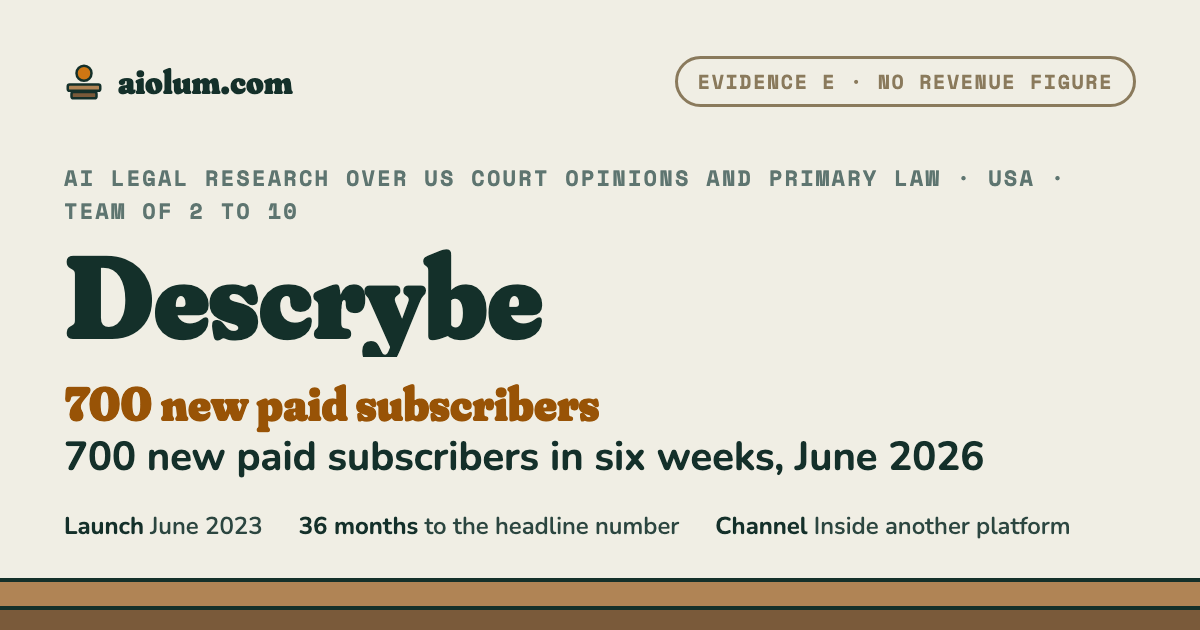
Descrybe (AI legal research over US court opinions and primary law, USA): 700 new paid subscribers in six weeks, June 2026. Evidence grade E: no revenue figure was checked. Team: 2 co-founders, a married couple, with unpaid strategic advisors; no employee count published. Launched June 2023; still running, revenue growing.Added 5 November 2026 · updated 6 November 2026
- Outcome
- 700 new paid subscribers in six weeks, June 2026Revenue growing
- Evidence
- E no revenue figure was checked
- Launch
- June 2023
- Status
- Still running
- Team
- 2 co-founders, a married couple, with unpaid strategic advisors; no employee count published
- Outside funding
- None (self-funded, company statements in December 2023, January 2025 and November 2026)
- Group
- Legal and law firms
- Main channel
- Inside another platform
What is not verified
No revenue figure was found. I looked for a payment-processor profile, a revenue or subscriber total in the press releases and LawSites articles, and a funding filing. The headline 700 new paid subscribers is a company press release of 29 June 2026, with no total and no plan mix; the 10,000 users of January 2025 is a company estimate from an application that also says the company did not track users; 'thousands of paying subscribers' on the November 2026 home page has no number or date. The DescrybeLM benchmark was run and scored by the company itself, with an AI judge model, as LawSites reported. A reader could look for an interview with a revenue figure or a subscriber total. This story is grade E: the business is real and its product, price and customers are described from public pages, but no revenue figure was checked. Aiolum shows it as an idea worth studying, not as proof that it makes money.
Descrybe is a legal research service. Legal research means finding the court decisions, statutes and regulations that apply to a legal question. Its base is a database of US judicial opinions, the written decisions of judges, which the company had an AI model summarize in plain English, so that a user can search by meaning instead of by exact words. In March 2026 it added DescrybeLM, a legal reasoning tool, and it sells a connector called the Descrybe Legal Engine that lets AI assistants search the same database.
Kara Peterson and her husband Richard DiBona, a software engineer, founded it in Newton, Massachusetts, in June 2023 with no outside money. In December 2023 the company wrote that the site was free and had no paid or registered users; in January 2025 it estimated well over 10,000 users. It launched paid tools in June 2025. On 29 June 2026 it announced more than 700 new paid subscribers in the six weeks after Anthropic's Claude for the Legal Industry launch, where it was one of 22 launch connectors.
No revenue figure has been published. The headline is a company press release, and the user counts are company estimates. This page grades them as company statements and shows earlier legal research startups that failed against the same large incumbents.
How much revenue does Descrybe make?
Each row shows the evidence grade and the source numbers from the list at the end of this page. The grades are explained in How Aiolum verifies.
| Fact | Value | Grade | How we know | Sources |
|---|---|---|---|---|
| New paid subscribers, May to June 2026 | more than 700 in six weeks | C | Company press release on LawSites, 29 June 2026, counted from the Claude for the Legal Industry launch. The CEO said the growth came 'largely one subscriber at a time'. No total and no revenue. | [1] |
| Paying users, November 2026 | "thousands of paying subscribers and institutionally licensed users" | C | Company home page and About page, read 5 November 2026. No exact number. | [9, 7] |
| Users, January 2025 | "well over 10K users" and "hundred of thousands of searches" | C | Company's Startup Alley application. The same text says 'we don't currently track users', so the number is an estimate. | [3] |
| Registered and paid users, December 2023 | none | C | Company's Startup Alley application: 'We are a free tool and do not have paid or registered users.' | [2] |
| Founded | June 2023, Newton, Massachusetts | C | The December 2023 application gives 23 June 2023, the January 2025 application 30 June 2023. Company: descrybe, LLC. | [2, 3] |
| Team | 2 co-founders: Kara Peterson (CEO) and Richard DiBona (CTO), married | C | About page and LawSites. A Law.com article summarized on the company's news page calls it 'a two-person founding team'. The advisors listed are outside experts. No employee count is published. | [7, 4, 10] |
| Outside funding | none | C | 'No outside funding' in both applications; 'self-funded' on the About page in November 2026. | [2, 3, 7] |
| Opinions summarized | 1.7 million (December 2023), 2.5 million (March 2024), over 3.6 million (January 2025) | C | Company figures; LawSites read the 2.5 million from the site's own opinion tracker. | [2, 4, 3] |
| First paid tools, June 2025 | US$20 a month for commercial use, US$10 for personal use | B | LawSites tested the Legal Research Toolkit before launch and reported these prices. The free version was kept at that time. | [5] |
| Prices, November 2026 | US$25 a month (Legal Engine), US$50 a month (Platform) | C | Pricing page read 5 November 2026. Stripe takes the payments. | [8] |
| Data source at the start | CourtListener (Free Law Project), under a commercial agreement, and Harvard's Caselaw Access Project | C | December 2023 application. The FAQ in November 2026 says the company sources and structures its own corpus of about 300 million legal records. | [2, 12] |
| AI models | OpenAI technology from the beginning | C | Company news page, 17 September 2026. No source names the model versions used for the summaries or for DescrybeLM. | [10] |
| Months from launch to the headline | 36 | calc | Calculated: June 2023 to June 2026. | [2, 1] |
How to read this table: a grade C value is a statement by the company, in its own pages, its Startup Alley applications or its press releases. A grade B value was seen or tested by a journalist. A "calc" value was computed on this page. No revenue figure exists, so the story has grade E.
| Plan | Per month, billed yearly (US$) | Per month, billed monthly (US$) | Limit |
|---|---|---|---|
| Descrybe Platform | 50 | 150 full research runs per month; Legal Engine included | |
| Descrybe Legal Engine | 25 | connector for ChatGPT, Claude, Microsoft 365 Copilot, Perplexity; no per-search charges | |
| Organization access | flat price per named user; contact the company |
The pricing page lists only monthly billing and an introductory code for 50% off the first month. The Platform plan includes the Legal Engine. Organizations pay a flat price per named user that the page does not state, and universities can buy through the NELLCO law-library consortium. The pricing page shows no free plan; the descrybe.ai notice page says the product has expanded into a paid platform. In June 2025, LawSites reported the first paid toolkit at US$20 a month for commercial use and US$10 a month for personal use.
When did Descrybe launch, and how did it grow?
From a free summary site to a paid connector inside the large AI assistants, in about three years. Each entry carries its grade.
- June 2023CKara Peterson and Richard DiBona found descrybe.ai in Newton, Massachusetts, with their own money. It is a free search over AI summaries of court opinions. [2, 4]
- December 2023CStartup Alley application: 1.7 million opinions summarized, data from CourtListener under a commercial agreement, no paid or registered users. Growth plan: word of mouth, networking and earned media. It reaches the semifinal. [2, 3]
- March 2024BLawSites reports AI summaries of all available state supreme and appellate opinions, 2.5 million in total, with no cost or sign-up. [4]
- January 2025CSecond application: over 3.6 million opinions, well over 10,000 users by the company's estimate, seven award listings in 2024, still no outside funding. It becomes a Startup Alley finalist. [3, 5]
- June 2025BFirst paid product, the Legal Research Toolkit, with its own citator called the Cytator and a Brief Checker. LawSites tests it and finds it generally correct, with some wrong treatment flags. [5]
- March 2026CDescrybeLM, a legal reasoning tool, and a new site at descrybe.com. The company's own benchmark on 200 bar exam questions reports 200 correct answers. [6]
- May to June 2026COne of 22 launch connectors for Anthropic's Claude for the Legal Industry; more than 700 new paid subscribers in the next six weeks, by the company's count. [1, 10]
- September to November 2026CConnectors for Microsoft 365 Copilot and ChatGPT Enterprise. The home page reports thousands of paying subscribers. [10, 9]
Why did Descrybe work?
Four causes, in the order they mattered. Each one is a reusable lesson.
Build the database before the product
The CTO summarized millions of opinions with an AI model before the company sold anything. The free search showed the database to lawyers, librarians and journalists, and every paid tool since then, from the citator to the AI connectors, is built on the same records.
Free first, for attention
The December 2023 plan was word of mouth, networking and earned media. The free site won award listings and repeated LawSites coverage, and the editor of LawSites wrote that Descrybe could fill the gap left when Thomson Reuters bought Casetext.
Go where the lawyers already use AI
The Legal Engine sells the database as tools inside ChatGPT, Claude, Microsoft 365 Copilot and Perplexity. The company's largest reported jump in paid subscribers followed its listing as a launch connector for Anthropic's legal launch.
Low flat prices
The company states its prices as flat monthly fees with no per-search charges, aimed at solo lawyers, legal aid groups, students and others priced out of the large research services.
How it was built
These details come from the company's applications, its own pages and LawSites. Most are grade C. [2, 3, 10, 6, 12, 8]
- Court opinions came at first from CourtListener, run by the Free Law Project, under a commercial agreement, and from Harvard's Caselaw Access Project (December 2023).
- An AI model writes a summary of each opinion, and later abstracts with parties, procedural history, holding and analysis; summaries exist in standard and simplified English and Spanish.
- The company says it was built from the beginning with OpenAI technology. No source names the model versions.
- DescrybeLM (March 2026) runs on what the company calls more than 100 million structured records; the FAQ in November 2026 gives about 300 million records.
- The Legal Engine is a connector for ChatGPT, Claude, Microsoft 365 Copilot and Perplexity, plus an open-source Python SDK called the Open Connector (July 2026).
- Stripe processes the subscription payments.
Tools named in the sources
Each one opens its page in the Tools tab, with every story that uses it.
Who tried this before Descrybe, and why did they fail?
Three companies in our database of failed startups tried to make legal work faster or cheaper with software and failed against the incumbents or the complexity of law. The values below are from that database and are not independently verified.
ROSS Intelligence
The promiseAI legal research that finds the relevant case law faster than the established databases.
Why it diedLawyers stayed with Westlaw and LexisNexis, which had decades of data and high switching costs.
jEugene
The promiseSoftware that finds errors and inconsistencies in contracts, a spellcheck for lawyers.
Why it diedBetter-funded rivals with broader AI tools took the market, and law firms adopted new software slowly.
Atrium
The promiseA law firm for startups made faster and more predictable by automation.
Why it diedThe automation could not handle real legal complexity, so costs stayed at law-firm levels.
The failed startups come from our database of 1,749 dead startups, retold here in our own words. Its entries are AI-assisted summaries of public sources, so these cards carry no evidence grade.
What changed
ROSS Intelligence had to build legal AI with the language models of 2015 and lost against the data and habits of the two large research services. Descrybe started after large language models could summarize an opinion cheaply, and it built on open court data from CourtListener and Harvard instead of licensing a commercial database.
It also did not ask lawyers to leave Westlaw or LexisNexis. Its January 2025 application calls it a supplement and an alternative for people priced out, and in 2026 it put its tools inside the AI assistants that lawyers already pay for. Atrium tried to replace legal work itself; Descrybe sells research tools and its terms say its outputs are not legal advice.
Can one person copy Descrybe now?
The method, yes. The database is the hard part.
Two people built this with no outside money, so a small team can copy the approach: take public records that are hard to search, process them all with an AI model, give the search away to build attention, and sell professional tools and AI-assistant connectors on top. The work is in the data: millions of documents, citations between them, and the checks that a professional user needs.
Where it is still open: Other public records with expensive search tools: patents, regulations outside the US, building codes, public tenders, and court records in other countries.
- 1Find a large body of public documents that professionals search with expensive tools.
- 2Process every document with an AI model into summaries and structured fields before you sell anything.
- 3Offer free search and ask the trade press to test it.
- 4Add paid tools that professionals need for verification, then sell the same data as a connector inside the AI assistants.
What could go wrong for Descrybe?
The risks are the mirror image of the causes above.
What is not verified
No revenue figure was found. I looked for a payment-processor profile, a revenue or subscriber total in the press releases and LawSites articles, and a funding filing. The headline 700 new paid subscribers is a company press release of 29 June 2026, with no total and no plan mix; the 10,000 users of January 2025 is a company estimate from an application that also says the company did not track users; 'thousands of paying subscribers' on the November 2026 home page has no number or date. The DescrybeLM benchmark was run and scored by the company itself, with an AI judge model, as LawSites reported. A reader could look for an interview with a revenue figure or a subscriber total.
Competition
The company names LexisNexis, Westlaw, vLex, Paxton AI, Harvey and Spellbook as its general area (January 2025). LawSites compared its citator with Shepard's from LexisNexis and KeyCite from Westlaw, and with those of Paxton AI, vLex and Decisis; it also noted in June 2025 that Descrybe had only case law and that most lawyers would still need other tools. Descrybe added statutes and regulations later. The court data it started from, CourtListener, is free and open to other builders too. On this site, Jurisphere is another legal AI story, a research and drafting workspace sold to firms.
Dependence on model providers and data sources
The company says it was built from the beginning with OpenAI technology, and its 2026 growth runs through connectors inside ChatGPT, Claude, Microsoft 365 Copilot and Perplexity. Those companies set the rules of their directories and also sell their own legal products. At the start, the opinions came from CourtListener under a commercial agreement and from Harvard's Caselaw Access Project; the company now says it sources and structures its own corpus.
Accuracy and legal advice
LawSites found wrong caution flags and missing treatments in the Cytator in June 2025. The terms of service say outputs are for general information only, are not legal advice, and that Descrybe is not a law firm. The free tool of 2023 to 2025 is not shown on the November 2026 pricing page.
Sources
The grade next to each source is the best grade that the source can support. "Read in full" means that the text of the page was downloaded and the numbers were checked in it.
- C LawSites, 29 June 2026: Descrybe Surpasses 700 New Paid Subscribers in Six Weeks (company press release)Read in full. Source for the headline subscriber count and the founders' quotes.
- C LawNext, December 2023: Voting Is Open: Pick the 15 Finalists to Compete at Startup Alley at ABA Techshow 2024 (company application text)Read the section on descrybe.ai. Source for the founding date, the data sources, the zero registered users and the growth plan.
- C LawNext, January 2025: Voting Is Now Open: Pick the 15 Finalists to Compete at Startup Alley at ABA Techshow 2025 (company application text)Read the section on Descrybe.ai. Source for the 10,000 users estimate, the 3.6 million opinions, the planned prices, competitors and no outside funding.
- B LawSites, Bob Ambrogi, March 2024: Free Legal Research Startup descrybe.ai Now Has AI Summaries of All State Supreme and Appellate OpinionsRead in full. Source for the co-founders, the 2.5 million opinions and free access with no sign-up.
- B LawSites, Bob Ambrogi, June 2025: Free Legal Research Site Descrybe.ai Launches A Paid Suite of Legal Research Tools, Including Its Own CitatorRead in full. The journalist tested the toolkit. Source for the first prices, the citator errors and the case-law-only limit.
- C LawSites, Bob Ambrogi, March 2026: AI Legal Research Startup Descrybe Launches 'Legal Reasoning' ToolRead in full. Source for DescrybeLM, the company's benchmark and its stated limits.
- C Descrybe, About page, read 5 November 2026Read in full. Source for the founders' roles, self-funding and the subscriber claim.
- C Descrybe, Pricing page, read 5 November 2026Read in full. Source for the prices and Stripe.
- C Descrybe, home page, read 5 November 2026Read in full. Source for the connectors, the launch listings and 'thousands of paying subscribers'.
- C Descrybe, News page, read 5 November 2026Read in full. Source for the dated announcements, OpenAI technology and the summaries of press articles.
- C Descrybe, Terms of Service, read 5 November 2026Read the sections on outputs and legal advice.
- C Descrybe, FAQ, read 5 November 2026Read the sections on data and institutional access.
- C descrybe.ai, domain notice page, read 5 November 2026Read in full. States the move to descrybe.com and the change from a free tool to a paid platform.
- C Database of failed startups, local exportLocal export. AI-written summaries, not independently verified. Source for the failed predecessors.
Run this company? Send corrections or a verified figure to aiolum@livyden.com