Design Arena: Revenue, team and how it was built
Design Arena (Crowdsourced arena where people create websites, games, images and videos with many AI models and vote on the results, with the votes sold to AI labs as evaluation data, United States): US$60M annual recurring revenue reported, August 2026. Evidence grade D: reported, not verified. Team: 2 co-founders in the Y Combinator launch post of 31 July 2025 (Summer 2025 batch); a team of five in January 2026 (company post); a team of 10 at the August 2026 figure, after a US$7.9M seed round (Index Ventures); Y Combinator's page still lists 3, November 2026. Launched June 2025; still running, revenue growing.Added 8 November 2026
- Outcome
- US$60M annual recurring revenue reported, August 2026Revenue growing
- Evidence
- D reported, not verified
- Launch
- June 2025
- Status
- Still running
- Team
- 2 co-founders in the Y Combinator launch post of 31 July 2025 (Summer 2025 batch); a team of five in January 2026 (company post); a team of 10 at the August 2026 figure, after a US$7.9M seed round (Index Ventures); Y Combinator's page still lists 3, November 2026
- Outside funding
- US$7.9M seed round led by Index Ventures, announced 3 August 2026, after Y Combinator's Summer 2025 batch, as Index Ventures and The AI Insider state
- Main channel
- Reddit and communities
What is not verified
The US$60 million in annual recurring revenue, the US$5 million six months earlier and the word 'profitably' come from one funding announcement in August 2026: the Index Ventures post of 3 August 2026, The AI Insider article of 13 August 2026 that attributes the figure to Li, and the Lean AI Leaderboard row that cites a LinkedIn post by Index Ventures (LinkedIn was not read). Index Ventures is an investor in the company. No payment processor, filing or audited account confirms the figure, and no source says how ARR was counted, for example whether one-off lab contracts are included. A reader could look for a later investor update, a Series A announcement with figures, or a statement by a customer lab. The headline number is grade D: one claim or one estimate, with no second source. Aiolum shows it because the story is useful, and marks it so that it is not mistaken for a verified figure.
Design Arena is a crowdsourced benchmark: a test of AI models in which the scores come from many members of the public, not from a fixed answer key. A user enters a prompt, four models answer it, and the user sees two answers at a time without the model names and picks one. Each pick is a pairwise comparison, one vote that says model X beat model Y on this task. The site turns the votes into ratings with the Bradley-Terry model, a statistical method that estimates each player's strength from who beat whom, the same idea as chess ratings.
Grace Li and Kamryn Ohly, friends who studied computer science at Harvard, started it in 2025 during Y Combinator's Summer 2025 batch. Their investor Index Ventures writes that it began as a "hot or not" game for design, which a friend posted on Reddit, and thousands of users arrived overnight. Y Combinator's launch post of 31 July 2025 counts more than 47,000 users in four weeks; the company's careers page counts more than 6.0 million in November 2026. The site's copyright line names the company Arcada Labs Incorporated, and it presents itself as Intelligence.
The headline is grade D. Index Ventures, which led a US$7.9 million seed round, wrote on 3 August 2026 that Design Arena went from US$5 million to US$60 million in annual recurring revenue (ARR, the yearly value of the contracts and subscriptions that renew) in six months, profitably, with a team of 10. The AI Insider reported on 13 August 2026 that Li gave the same US$60 million figure. Both go back to one funding announcement; no payment processor, filing or audit confirms it.
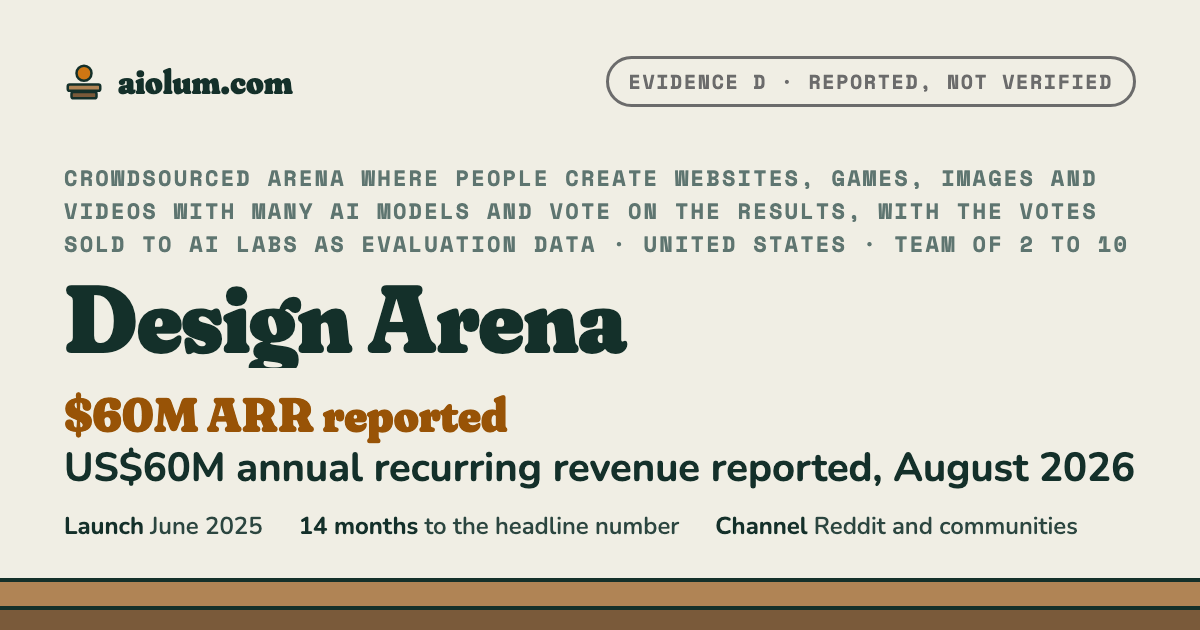
How much revenue does Design Arena make?
Each row shows the evidence grade and the source numbers from the list at the end of this page. The grades are explained in How Aiolum verifies.
| Fact | Value | Grade | How we know | Sources |
|---|---|---|---|---|
| Annual recurring revenue, August 2026 | US$60,000,000 | D | Index Ventures, the lead investor, 3 August 2026: 'scaling from $5 million to $60 million in ARR in six months, profitably'. The AI Insider, 13 August 2026: Li said the service 'now generates $60 million in annual recurring revenue'. The Lean AI Leaderboard lists US$60,000,000 for an 'Aug 2026' snapshot and cites a LinkedIn post by Index Ventures, which was not read. All three repeat one announcement. | [1, 2, 3] |
| Revenue per month implied by that figure | about US$5,000,000 | calc | Calculated: US$60,000,000 divided by 12. Only as good as the stated ARR. | [1] |
| Annual recurring revenue six months earlier | US$5,000,000 | D | Same Index Ventures sentence. No date other than 'six months' before the August 2026 post. The leaderboard lists '6' in its column 'Months to reach ARR'. | [1, 3] |
| Growth in those six months | 12 times | calc | Calculated: US$60 million divided by US$5 million. | [1] |
| Profitability | profitable, as stated | D | Index Ventures: 'profitably'. The leaderboard's column 'Profitable?' says 'Yes'. No figures for costs or profit. | [1, 3] |
| Who pays | mainly AI labs | C | The AI Insider: Li said 'the real value lies on the enterprise side, where AI labs use the aggregated rankings as continuous feedback to improve their models'. Individual users can also buy credits. | [2, 5] |
| Labs that used it | Google, OpenAI, Thinking Machines Lab, xAI and Meta | C | Index Ventures: 'Google used Design Arena to test Gemini 3 ahead of launch; OpenAI, Thinking Machines Lab, xAI, and Meta have used it to evaluate their models.' The labs' own statements were not found. | [1] |
| Team at the August 2026 figure | 10 people | C | Index Ventures: 'an incredibly talent-dense team of 10'. The leaderboard lists 10 employees. | [1, 3] |
| Founding team | 2 co-founders: Grace Li (CEO) and Kamryn Ohly (CTO) | C | Y Combinator launch post, 31 July 2025: both studied computer science at Harvard and worked at Apple before. Index Ventures names both as founders. | [4, 13] |
| Team, January 2026 | five people | C | Company job post, 26 January 2026: 'Our team of five built products used by over a million.' Y Combinator's page, read 6 November 2026, still gives a team size of 3. | [6, 4] |
| Company start | 2025, Y Combinator Summer 2025 batch | C | Y Combinator's page data: year founded 2025, batch Summer 2025, San Francisco. The launch post calls the company Arcada Labs; the site's security text says 'Arcada Labs Incorporated'; the footer now reads 'DesignArena by Intelligence'. | [4, 5] |
| Seed round | US$7.9 million, led by Index Ventures | C | Index Ventures post, 3 August 2026. The AI Insider adds Conviction, A*, Valkyrie and others. The leaderboard's total funding of US$7,900,000 agrees. | [1, 2, 3] |
| Users after four weeks | more than 47,000 in 136 countries | C | Y Combinator launch post, 31 July 2025: 'Attracted 47K+ users across 136 countries in 4 weeks'. | [4] |
| Users, January 2026 | 1.4 million | C | Company job post: 'Design Arena hit 1.4M users in six months.' | [6] |
| Users, August 2026 | 5.5 million (Index Ventures) or 5.3 million (The AI Insider) | C | The two August 2026 sources give different counts. Neither defines a user. | [1, 2] |
| Users, November 2026 | more than 6.0 million in 190+ countries | C | Intelligence careers page, read 8 November 2026. | [11] |
| Voting method | 4 models per session, 5 blind votes, Bradley-Terry ratings | C | Methodology page: five battles give a full ranking of four models; ratings use 'Rating = 400 × log₁₀(strength)'; models with fewer than 50 comparisons are left out of the main charts. | [9] |
| Prices for individuals | free tier, then prepaid credits of US$5 to US$100 | C | Billing text in the web app, read 8 November 2026. | [5] |
| Revenue per employee implied | US$6,000,000 a year | calc | Calculated: US$60,000,000 divided by 10 people. The leaderboard lists the same US$6,000,000. | [1, 3] |
| Time from launch to the revenue figure | 14 months | calc | Calculated: June 2025 (an Internet Archive copy of designarena.ai of 25 June 2025 already shows the voting site: 'Join voters to discover if AI has taste.') to August 2026. The Y Combinator launch post of 31 July 2025 counts four weeks of users. | [16, 4, 1] |
How to read this table: a grade D value rests on one announcement that no outside party has checked, here the lead investor's post and press and leaderboard copies of the same figure. A grade C value is the company's or the investor's own statement on a matter other than revenue. A "calc" value was computed on this page from the rows above it. No value is grade A or B.
| Plan | Per month, billed yearly (US$) | Per month, billed monthly (US$) | Limit |
|---|---|---|---|
| Free plan | 0 | 0 | free-tier generation limits; videos up to 5 seconds |
| Prepaid credits (Pro benefits) | 5 to 100 one-time | one top-up between US$5 and US$100; used only beyond the free tier; higher rate limits; videos up to 15 seconds | |
| Premium Mode | top-ranked models for every generation, paid from credits per generation | ||
| Evaluations for AI labs | custom | no public price |
Individuals use a free plan with usage limits, then buy prepaid credits. The billing text says: 'Choose an amount between $5 and $100 to add to your credit balance' and 'Credits are only used when you exceed the free tier.' Credits also unlock Premium Mode, which 'uses the top-ranked models for that arena' and is described as 'charged at actual provider cost'. The text also says pricing 'is based on average costs per content type', so some premium models cost the company more than the user pays. The per-generation prices load from the site's API, which robots.txt disallows, so they were not read. There is no monthly plan, so the per-month columns are empty for credits.
When did Design Arena launch, and how did it grow?
From a hackathon game engine to an arena that AI labs pay for, in about 14 months. Each entry carries its grade.
- 2025CGrace Li and Kamryn Ohly, computer science students at Harvard, build a game engine at a hackathon and apply to Y Combinator with it. The models' output looks 'visually off', so they build a 'hot or not' game for design. [1]
- 2025CA few days after the first version, a friend posts Design Arena on Reddit and thousands of users arrive overnight, as Index Ventures tells it. [1]
- 25 June 2025CThe earliest Internet Archive copy of designarena.ai shows the voting site live: 'Can LLMs design? Join voters to discover if AI has taste.' [16]
- 31 July 2025CY Combinator launch post (Summer 2025 batch): more than 47,000 users in 136 countries in four weeks, as the first step of 'Arcada Labs'. [4]
- 1 November 2025CMicro Evals: small tests built from real failures of coding agents, after watching more than 240,000 people build on the site. [7]
- 25 November 2025CAgent Runner, an open-source harness that replays real user prompts with coding agents from many labs. The post counts more than 490,000 users. [8]
- 26 January 2026CJob post: 1.4 million users in six months, a team of five, and a second product, Prediction Arena, where models traded with real money. [6]
- Early 2026DIndex Ventures later states that annual recurring revenue was US$5 million six months before its August 2026 post. [1]
- 3 August 2026DUS$7.9 million seed round led by Index Ventures. Its post states US$60 million in annual recurring revenue, profit, a team of 10 and 5.5 million users. [1]
- 13 August 2026DThe AI Insider reports that Li said the service for AI labs generates US$60 million in annual recurring revenue, with 5.3 million users. [2]
- November 2026CMore than 6.0 million users on the careers page. The Prediction Arena page says it is paused. [11, 10]
Why did Design Arena work?
Four causes, in the order they mattered. Each one is a reusable lesson.
Free use produces the paid product
People come to make a website or a game for free and get several models' answers at once. Their choice between the answers is the data. Li told The AI Insider that individual users take part casually, while AI labs use the combined rankings as continuous feedback, and that this service is where the revenue comes from.
Blind votes are hard to game
The model names stay hidden until the vote, and four models drawn at random from the pool answer the same prompt. Each session gives five pairwise votes that feed a Bradley-Terry rating. A lab cannot tune its model to a fixed test set, because the prompts are new requests from real people.
Real tasks, deployed and checked
In the coding arenas each generated app is deployed to GitHub and Vercel, so the result is a working site, not only code. Real failures became Micro Evals, and the Agent Runner harness records every tool call of a coding agent on real user prompts.
A launch stage for new models
The job post says the company works with model providers to benchmark capabilities before release. Index Ventures writes that Google used Design Arena to test Gemini 3 before launch, and the careers page lists launches of models from Thinking Machines, Grok, fal and Ideogram.
How it was built
These details come from the company's own pages and blog. They are grade C. [9, 7, 8, 5, 6, 1]
- Ratings use the Bradley-Terry model, iterated until estimates change by less than 0.0001 or for 200 rounds, then converted with Rating = 400 × log10(strength). Models stay 'preliminary' until about 200 comparisons.
- Each code generation is deployed automatically to GitHub and Vercel. Micro Evals then check single criteria (Next.js routing, Tailwind setup, Supabase data handling) with an AI model as the judge, starting from Vercel's open next-evals-oss set.
- Agent Runner is open source on GitHub and installable from PyPI. It supports OpenAI, Anthropic, Google, xAI, Mistral, Kimi and others, and the team agreed tool settings with at least one representative of each participating lab.
- The full-stack arena gives coding agents backend tools such as supabase_create_table and supabase_query, so generated apps have real databases.
- Individuals pay with prepaid credits; the billing text says top-ups run from US$5 to US$100 and that pricing follows average costs per content type.
- The team works in person in San Francisco, five people in January 2026 and 10 by August 2026.
Tools named in the sources
Each one opens its page in the Tools tab, with every story that uses it.
Who tried this before Design Arena, and why did they fail?
Four companies in our database of failed startups built a product on votes from a crowd and could not keep it alive. The values below are from that database and are not independently verified.
Digg
The promiseUsers vote up the best stories, and the votes replace editors.
Why it diedIts fourth version gave large publishers preference over the voters, and users left for Reddit within 48 hours.
The Hunt
The promisePost a fashion item and let the community find where to buy it.
Why it diedIt found no way to earn from the crowd's help, while competitors turned browsing into buying.
Product Hunt Games
The promiseCommunity upvotes to find new indie games.
Why it diedSteam already did discovery and sales in one place, and votes alone did not bring revenue.
iJigg/Top440
The promiseListeners vote on music tracks so independent artists can be found.
Why it diedMySpace Music and Spotify took the listeners, and the site missed the move to phones.
The failed startups come from our database of 1,749 dead startups, retold here in our own words. Its entries are AI-assisted summaries of public sources, so these cards carry no evidence grade.
What changed
All four turned a crowd's votes into rankings, and all four tried to earn from the same crowd: advertising, shopping or game sales. The votes themselves were free and had no buyer, so when the crowd left or never paid, nothing was left to sell.
Design Arena sells the votes, not the audience. Its buyers are AI labs that need human judgment on the output of their models and cannot get it from fixed tests. Co-founder Li told The AI Insider that the labs' use of the rankings generates US$60 million in annual recurring revenue. The crowd still gets something it wants for free, several top models at once, so the data keeps coming. The new risk is concentration: the labs that Index Ventures names as users are five large companies.
Can one person copy Design Arena now?
The scale, no. The pattern, in a narrow field.
The company needed millions of users, a model bill for free generations, contacts at every large AI lab and US$7.9 million in seed money, as Index Ventures states. One person cannot copy that. The pattern is smaller: a free tool whose normal use produces a judgment that model makers cannot get elsewhere.
Where it is still open: Narrow arenas that the large ones do not cover yet: one language, one profession (legal drafting, medical coding), one file type, or one region's taste.
- 1Pick a task where models are hard to judge with fixed tests and people have clear preferences.
- 2Give users free side-by-side answers from several models, with the names hidden until they choose.
- 3Publish the rankings and the method, so labs see the data as fair.
- 4Offer labs early tests of unreleased models and paid access to the detailed results.
What could go wrong for Design Arena?
The risks are the mirror image of the causes above.
What is not verified
The US$60 million in annual recurring revenue, the US$5 million six months earlier and the word 'profitably' come from one funding announcement in August 2026: the Index Ventures post of 3 August 2026, The AI Insider article of 13 August 2026 that attributes the figure to Li, and the Lean AI Leaderboard row that cites a LinkedIn post by Index Ventures (LinkedIn was not read). Index Ventures is an investor in the company. No payment processor, filing or audited account confirms the figure, and no source says how ARR was counted, for example whether one-off lab contracts are included. A reader could look for a later investor update, a Series A announcement with figures, or a statement by a customer lab.
Team size
Two co-founders launched it in June 2025 and posted their Y Combinator launch on 31 July 2025. A company post counts five people in January 2026, and Index Ventures counts 10 at the August 2026 figure, after the US$7.9 million seed round. Y Combinator's page still gave 3 in November 2026 and looks out of date. The careers page is hiring, so the team may now be larger; no current headcount is published.
Sister product: Prediction Arena
The company's second arena, Prediction Arena, had AI models trade on prediction markets with real money, according to Index Ventures and the January 2026 job post. Its page, read 8 November 2026, says 'Prediction arena is paused — next steps coming soon', shows 'powered by Kalshi', the names Kalshi and Polymarket and a link 'Place Your Own Bets'. Design Arena's waiting screen still lists it under 'Play while you wait' with the address predictionarena.ai. It is not the product in this story (casebook 13).
Competition
The AI Insider names LM Arena, which it says raised US$150 million 'in January', as a rival, and reports that Yupp shut down 'earlier this year' despite raising US$33 million. On this site, Halluminate and Phinity Labs also sell benchmarks or training environments to large AI labs.
Dependence on model providers and a few customers
Design Arena does not make models. It runs other companies' models (OpenAI, Anthropic, Google, xAI, Mistral, Kimi and others, per the Agent Runner post) for free users, and its paying customers, as Li and Index Ventures describe them, are the same few labs. If a lab stops sending models or stops paying, both the content and the revenue shrink. The billing text says some premium models cost the company more than users pay.
User counts and lab names
August 2026 sources give 5.5 million users (Index Ventures) and 5.3 million (The AI Insider), and none defines a user. The Intelligence home page describes itself as 'Trusted by the leading frontier labs' (in its page description), shows a logo row headed 'Referenced by' with Google DeepMind, OpenAI, xAI, Meta, Thinking Machines, Mistral, Replit, Reve, fal and ideogram, and shows model names under 'Join the many AI labs that have partnered with Intelligence'. Index Ventures names Google, OpenAI, Thinking Machines Lab, xAI and Meta as users, and the careers page lists launches with Thinking Machines, Fal, Grok and Ideogram; no source was found for Mistral, Replit or Reve, and no lab statement was found.
Sources
The grade next to each source is the best grade that the source can support. "Read in full" means that the text of the page was downloaded and the numbers were checked in it.
- D Index Ventures, 3 August 2026, by Vlad Loktev and Eryk Dobrushkin: Proving AI in the Real World: Our Investment in IntelligenceRead in full on 8 November 2026. The lead investor's post. Source for the ARR figures, profitability, the team of 10, 5.5 million users, the labs, the Reddit start and the seed amount.
- D The AI Insider, 13 August 2026, by James Dargan: AI Design Evaluation Startup Intelligence Raises $7.9M Seed Round for Design Arena PlatformRead in full on 8 November 2026. Attributes the US$60 million figure and the lab customers to Li; source for the other seed investors, 5.3 million users and the competitors.
- D Lean AI Leaderboard, public spreadsheet of lean AI companies, row 'Intelligence (Design Arena)', snapshot August 2026Read the row in the published Google Sheet that the page embeds, as this pipeline downloaded it in CSV form on 6 November 2026 (copy in research/design-arena/lean-csv-copy/). A third-party list; it cites a LinkedIn post by Index Ventures, which was not read.
- C Y Combinator company page: Design Arena, World's largest crowdsourced benchmark for AI-generated design, with the launch post of 31 July 2025Read the page data downloaded on 6 November 2026: batch Summer 2025, year founded 2025, team size 3, and the launch post with the user count and the two founders.
- C Design Arena home page and web app textRead in full on 8 November 2026, including the billing and settings text in the page data. Source for the product, the credit prices, the waiting-screen games and the company name in the security text.
- C Design Arena blog, 26 January 2026: Founding Launch DesignerRead in full (downloaded 6 November 2026). Job post; source for 1.4 million users, the team of five, Prediction Arena and work with model providers.
- C Design Arena blog, 1 November 2025: Introducing Micro EvalsRead in full (downloaded 6 November 2026). Source for the 240,000 builders, the GitHub and Vercel deployment and the evaluation method.
- C Design Arena blog, 25 November 2025: Agent Runner: A Standard, Open-Source Agent Harness for Evaluating Real-World Coding AgentsRead in full (downloaded 6 November 2026). Source for 490,000 users, the model providers and the work with labs.
- C Design Arena methodology pageRead in full (downloaded 6 November 2026). Source for the tournament format and the Bradley-Terry ratings.
- C Prediction Arena home pageRead in full on 8 November 2026. Source for the paused status and the Kalshi wording.
- C Intelligence careers page: Join IntelligenceRead in full on 8 November 2026. Source for more than 6.0 million users and the model launches.
- C Intelligence home pageRead in full on 8 November 2026. Source for the lab wording and the leaderboards.
- C Index Ventures company page: IntelligenceRead in full on 8 November 2026. Names Grace Li and Kamryn Ohly as founders and intelligence.ai as the website.
- C Design Arena blog indexRead the list of post titles and dates, October 2025 to November 2026, on 8 November 2026.
- C Database of failed startups, local exportLocal export. AI-written summaries, not independently verified. Source for the failed predecessors.
- C Internet Archive copy of designarena.ai, 25 June 2025Read in full on 8 November 2026; the earliest capture of the domain. Shows 'Can LLMs design?', 'Join voters to discover if AI has taste.' and the menu Gallery, Vote, Leaderboard, About.
Run this company? Send corrections or a verified figure to aiolum@livyden.com