Patientdesk.ai: Revenue, team and how it was built
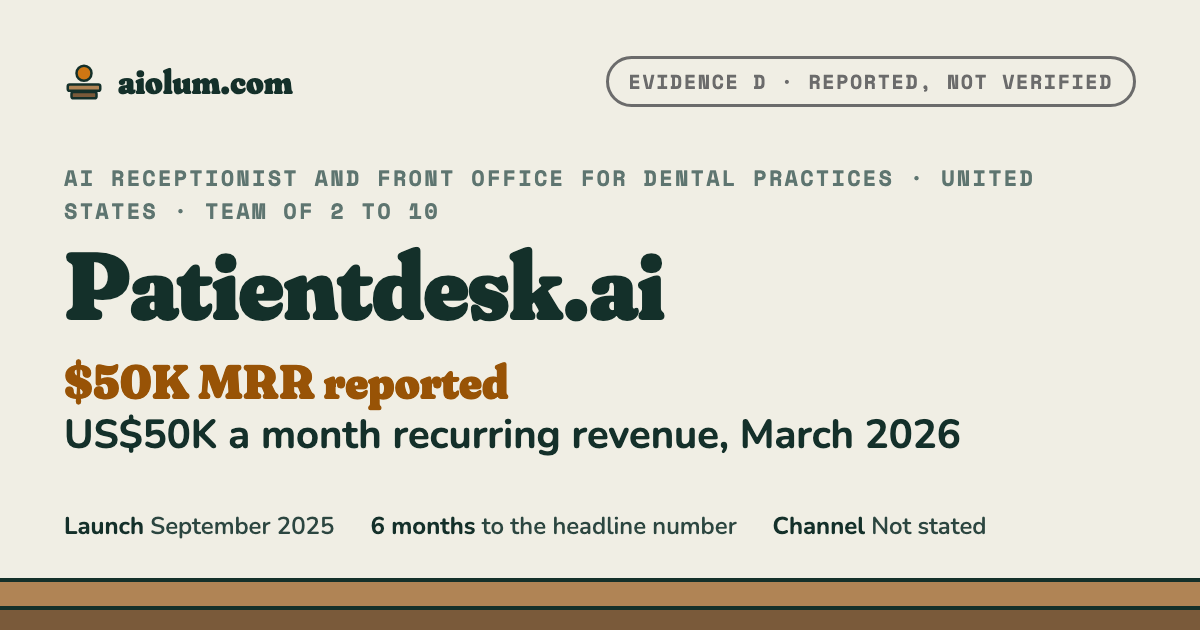
Patientdesk.ai (AI receptionist and front office for dental practices, United States): US$50K a month recurring revenue, March 2026. Evidence grade D: reported, not verified. Team: 3 co-founders; Y Combinator lists a team of 5, November 2026. Launched September 2025; still running, revenue growing.Added 5 November 2026 · updated 6 November 2026
- Outcome
- US$50K a month recurring revenue, March 2026Revenue growing
- Evidence
- D reported, not verified
- Launch
- September 2025
- Status
- Still running
- Team
- 3 co-founders; Y Combinator lists a team of 5, November 2026
- Outside funding
- Y Combinator W26; US$1M pre-seed reported February 2026; the company says US$3.8M raised
- Main channel
- Not stated
What is not verified
The headline, US$50,000 a month in recurring revenue, rests on one statement by the founders in their Launch YC post of 21 March 2026. No payment processor, investor or journalist has confirmed it, and no later revenue figure was found. The post's '39% MoM growth' does not match its own numbers: US$17,000 to US$50,000 in 8 weeks is about 80% a month. The US$3.8 million funding total is a banner on the company's home page with no date or announcement; Webrazzi confirmed only the US$1 million pre-seed. A reader could look for a TrustMRR or Stripe-verified profile, a seed-round announcement or a later founder interview. The headline number is grade D: one claim or one estimate, with no second source. Aiolum shows it because the story is useful, and marks it so that it is not mistaken for a verified figure.
Patientdesk.ai sells an AI receptionist, a voice program that picks up a business's phone line, talks with the caller in natural speech and does the task the caller asks for. For a dental clinic that task is mostly booking: the agent reads and writes the clinic's practice management system (PMS), the software that holds the patient records and the appointment calendar, such as Open Dental, Dentrix or Dental4Windows. In the US it also runs insurance eligibility verification, a check with the patient's dental insurer of what the plan covers, while the patient is still on the line.
The founders are Oncel Ozgul (CEO), Fikri San Koktas (COO) and Emre Kaplaner (CTO), friends from the same Turkish high school dorm. The company, Patientdesk AI, Inc., gives a San Francisco address and works with clinics in the US, Australia and the UK. It joined Y Combinator's Winter 2026 batch; the Turkish site Webrazzi reported a US$1 million pre-seed round led by Y Combinator on 23 February 2026, and the company's home page now says it raised US$3.8 million. In their Launch YC post of 21 March 2026 the founders wrote that monthly recurring revenue grew from US$17,000 to US$50,000 in 8 weeks, with more than 60 clinics live.
That revenue figure is a single founder statement on one date, grade D. No payment processor, investor or journalist has confirmed it, and no later revenue figure was found. The page also shows earlier companies that promised to automate healthcare and small-business administration, and how they failed.
How much revenue does Patientdesk.ai make?
Each row shows the evidence grade and the source numbers from the list at the end of this page. The grades are explained in How Aiolum verifies.
| Fact | Value | Grade | How we know | Sources |
|---|---|---|---|---|
| Monthly recurring revenue, March 2026 | US$50,000, up from US$17,000 eight weeks earlier | D | The founders wrote this in their Launch YC post of 21 March 2026, with '39% MoM growth'. One founder statement on one date; no second source was found. | [1] |
| Run rate from the March 2026 figure | US$600,000 a year | calc | Calculated: the founders' US$50,000 a month times 12. This is the headline outcomeUsd on this page. | [1] |
| Growth multiple in the 8 weeks | 2.94 times | calc | Calculated: US$50,000 divided by US$17,000, from the founders' post. Over 8 weeks (1.84 months) this is about 80% a month, not the 39% a month that the post states. The post does not explain the difference. | [1] |
| Clinics live | more than 60, in the US, Australia and the UK | C | The founders' Launch YC posts of February and March 2026; Webrazzi repeated the number from the company on 23 February 2026. | [1, 2, 4] |
| Revenue for customers | US$1.8 million in extra revenue since September 2025 | C | The founders' claim in the March 2026 post, about money the clinics earned from bookings, not Patientdesk's own revenue. The February post says one customer made US$350,000 in December from Patientdesk bookings. | [1, 2] |
| Founders | Oncel Ozgul (CEO), Fikri San Koktas (COO), Emre Kaplaner (CTO) | C | Y Combinator company page and the founders' launch posts. They write that they have been best friends since 2016. | [3, 1] |
| Team size | 5 | C | Y Combinator company page, read 5 November 2026. Founded in 2025. | [3] |
| Before Patientdesk | a dental marketing agency and an own call center, for two years | C | The founders' March 2026 post: 'We didn't find this problem. It found us.' | [1] |
| Pre-seed round | US$1 million, led by Y Combinator, with e2vc | C | Webrazzi, 23 February 2026, in Turkish: 'Y Combinator liderliğinde gerçekleşen tohum öncesi yatırım turunda e2vc'nin de katılımıyla 1 milyon dolar yatırım aldı' (raised US$1 million in a pre-seed round led by Y Combinator, with e2vc taking part) (translation). | [4] |
| Total funding stated by the company | US$3.8 million | C | Banner on the company's home page, read 5 November 2026: 'We raised $3.8M to modernize dentistry'. The banner links to the Y Combinator directory, not to an announcement, and gives no date or investors. | [5] |
| Practice management partners | 3 major systems in February 2026; Core Practice named by Webrazzi | C | The March post says 'Official voice provider for 2 major practice management platforms'. The platform page lists Open Dental, Dentrix, Eaglesoft and CareStack integrations. | [2, 1, 4, 9] |
| AI and voice providers | OpenAI, Anthropic, Deepgram, Cartesia and ElevenLabs | C | Privacy policy, last updated 27 October 2026, list of service providers for 'Speech recognition, AI language models, and voice generation'. The policy does not say which model does which job. | [7] |
| Entry price | US$350 per location per month | C | The pricing page, read 5 November 2026: Solo Inbound for a one-chair practice, month-to-month. | [6] |
| Time from first clinics to the March 2026 figure | 6 months | calc | Calculated: September 2025, the start date of the customer revenue claim, to March 2026. No source gives an exact launch day. | [1] |
How to read this table: grade D is a figure from one founder statement with one date and no second source. Grade C is what the company or the founders say on their own pages, or what a press article reports from the company. A "calc" value (grade X) was computed on this page from the rows above it. No value is grade A or B.
| Plan | Per month, billed yearly (US$) | Per month, billed monthly (US$) | Limit |
|---|---|---|---|
| Solo Inbound (AI receptionist) | 350 | 350 | 1 chair, per location, unlimited inbound minutes, English and Spanish |
| Small Practice Inbound | 500 | 500 | 2 chairs, per location, up to 6 appointment types |
| Practice Inbound | 750 | 750 | 3 or more chairs, per location, all languages, website chat included |
| Recall and reactivation agents (add-on) | 10% of collected revenue from Patientdesk bookings | ||
| Online Booking Portal | 100 | 100 | US$40 per bookable clinician, minimum US$100 per location |
| Meta AI Chatbot or SMS Chatbot | 250 | 250 | per location; SMS usage extra |
| AI SEO Bot | 400 | 400 | 16 blog posts a month |
| Google Review Automation | US$15 per attributed 4- or 5-star Google review; no subscription | ||
| Meta or Google Ads Starter | 500 | 500 | management fee, up to US$10,000 ad spend; ad spend paid separately |
| AI Native PMS | 0 | 0 | free practice software for clinics without a PMS; SMS US$0.10 per segment |
| Full Buildout | 20,000 one-time | new clinic: website, systems and 6 months of marketing |
The pricing page lists monthly prices per clinic location with a month-to-month contract and no yearly plan, so the yearly column repeats the monthly price. A second location pays 50% of its own plan. The founders' March 2026 launch post described a full platform 'starting at $7,500/month'; the November 2026 pricing page sells the parts separately. Ad spend, SMS usage and outbound calls are billed apart from these plans.
When did Patientdesk.ai launch, and how did it grow?
From a dental marketing agency and call center to a Y Combinator company with paid AI receptionist plans, in about one year. Each entry carries its grade.
- 2016CThe three founders meet; they write that they ranked first in the Turkish national high school exam and shared a dorm room. [1]
- Before 2025CFor two years they run a dental marketing agency and their own call center. [1]
- 2025CPatientdesk.ai is founded. [3]
- September 2025CThe founders date their 'incremental revenue' figure for customers from this month, so clinics were using the product by then. [1]
- 6 February 2026CTerms of service updated; they state that the AI does no medical or dental triage or diagnosis. [8]
- 16 February 2026CFirst Launch YC post: 'patient-aware' AI booking, live in more than 60 clinics, three PMS partnerships. [2]
- 23 February 2026CWebrazzi reports a US$1 million pre-seed round led by Y Combinator, with e2vc. [4]
- 21 March 2026DSecond Launch YC post: the founders say monthly recurring revenue grew from US$17,000 to US$50,000 in 8 weeks. [1]
- 27 October 2026CPrivacy policy updated; it names the AI, voice, hosting and phone providers and the HIPAA business associate role. [7]
- 5 November 2026CSite live with separate prices for each product, an agency platform, and a banner that says the company raised US$3.8 million. [5, 6, 9]
Why did Patientdesk.ai work?
Four causes, in the order they mattered. Each one is a reusable lesson.
Domain experience
The founders had run a dental marketing agency and a call center, so they had seen the calls that clinics miss and the patients that ads bring in but nobody calls back. They built for that one workflow first, not for every kind of small business.
Book inside the clinic's own software
The agent writes the appointment into the practice management system that the clinic already uses, so the front desk does not change its tools. The founders say they had three PMS partnerships by February 2026, and Webrazzi names Core Practice as one of them.
Insurance during the call
In the US a patient often asks whether a treatment is covered before booking. The agent checks the insurance while the patient waits, and the founders call themselves the first system to do this. A booking that would have needed a call back is closed on the first call.
Price per location, then sell more parts
The receptionist is priced by chairs per location, month-to-month. Around it the company sells booking, chatbots, review requests, SEO posts, ad management and a complete package for new clinics, so one clinic can buy several products.
How it was built
These details come from the company's own pages and the founders' posts. They are grade C. [7, 9, 1, 4]
- Speech recognition, language models and voice generation come from outside providers that the privacy policy names: OpenAI, Anthropic, Deepgram, Cartesia and ElevenLabs.
- Live calls run on Google Cloud and LiveKit; phone calls and text messages go through Twilio and Cellcast.
- The application and databases run on Supabase, Google Cloud and Vercel, with Australian data kept in Australia and US data in the US. Email goes through Resend, errors to Sentry, payments through Stripe.
- Integrations with about ten practice management systems, among them Open Dental, Dentrix, Eaglesoft, CareStack, Core Practice and Dental4Windows.
- The chatbot for web and SMS is a relay built on GoHighLevel, with the same AI as the voice agent, according to the platform page.
- The same stack is sold to dental agencies and IT firms as a branded platform with billing through Stripe Connect.
Tools named in the sources
Each one opens its page in the Tools tab, with every story that uses it.
Who tried this before Patientdesk.ai, and why did they fail?
Four companies in our database of failed startups promised to take administrative work off healthcare providers or small businesses and failed. The values below are from that database and are not independently verified.
Olive AI
The promiseAn AI workforce of software bots for hospital claims, eligibility checks and billing.
Why it diedEach health system needed custom work, so the bots cost more to deliver than they earned.
PatientBank
The promisePatients request, store and share their medical records online.
Why it diedHealthcare data moves between institutions, not through patients, and few would pay.
Zirtual
The promiseVirtual assistants for email, scheduling and admin work of busy business owners.
Why it diedA payroll of human assistants grew faster than revenue, and the cash ran out.
Metigy
The promiseAn AI marketing brain for small businesses that could not hire a marketer.
Why it diedSmall businesses wanted done-for-you marketing, not AI recommendations.
The failed startups come from our database of 1,749 dead startups, retold here in our own words. Its entries are AI-assisted summaries of public sources, so these cards carry no evidence grade.
What changed
Olive AI sold hospitals general automation and had to build custom work for each customer. Zirtual answered the phone and the calendar with paid humans. Metigy gave small businesses AI advice that they did not act on. Patientdesk does one narrow job, a phone call that ends in a booking, for one kind of customer, and it does the task instead of advising on it.
Two things made that possible after 2023: speech recognition and voice generation fast enough for a live phone call, sold as APIs by several providers, and practice management systems that open their calendars to partners. A team of five can assemble these parts. What it cannot avoid is the cost Olive met: each PMS and each insurer is a separate integration to keep working.
Can one person copy Patientdesk.ai now?
The method, partly. The market, it is crowded.
One person can now build a voice agent that books into one practice management system, with the voice and model providers that Patientdesk uses. The hard parts are the integrations with each PMS and insurer, HIPAA contracts, and selling to clinics, which the founders did from a marketing agency they already ran.
Where it is still open: Other clinics that book by phone and depend on insurance or deposits: veterinary practices, physiotherapy, optometry, and clinics in countries where the large US vendors do not sell.
- 1Work inside one trade first (an agency, a call center) and count the calls and bookings that are lost.
- 2Connect to the software that already holds the customer's calendar, so nobody changes tools.
- 3Solve the question that makes a caller hang up and call back later (here, insurance coverage) during the first call.
- 4Price per location with a month-to-month contract, then add products the same customer needs.
What could go wrong for Patientdesk.ai?
The risks are the mirror image of the causes above.
What is not verified
The headline, US$50,000 a month in recurring revenue, rests on one statement by the founders in their Launch YC post of 21 March 2026. No payment processor, investor or journalist has confirmed it, and no later revenue figure was found. The post's '39% MoM growth' does not match its own numbers: US$17,000 to US$50,000 in 8 weeks is about 80% a month. The US$3.8 million funding total is a banner on the company's home page with no date or announcement; Webrazzi confirmed only the US$1 million pre-seed. A reader could look for a TrustMRR or Stripe-verified profile, a seed-round announcement or a later founder interview.
Competition from other AI receptionists
Many companies sell AI phone agents to dental and medical practices. One example is Arini, a Y Combinator Winter 2024 company with 17 people that sells a platform for healthcare operations, scheduling, billing and insurance among them. The founders' own February 2026 post says that there are tools for each step, phones, bookings and insurance, and that their difference is doing all of them in one system.
Patient data and compliance
Calls carry protected health information. The terms of service say the company signs Business Associate Agreements under HIPAA and encrypts data in transit (TLS 1.2+) and at rest (AES-256). The privacy policy says live calls are processed by providers in the United States, also for Australian practices, and that AI providers' training on the data is turned off through their business terms. The terms also make the clinic responsible for call-recording consent, and say the AI does no medical or dental triage, diagnosis or clinical advice.
Dependence on model and voice providers
Speech, language models and voices come from OpenAI, Anthropic, Deepgram, Cartesia and ElevenLabs, and phone lines from Twilio and Cellcast. The company's own platform page says that 'voice quality drifts every release as models, prompts and vendor APIs change'. A price change or outage at one provider reaches every clinic at once.
Services as well as software
Besides the software, the pricing page sells managed Meta, Google and ChatGPT ads, website management by the Patientdesk team and a US$20,000 buildout with six months of marketing. Part of the revenue may come from these services, which need staff time as an agency does. The sources do not split the revenue between software and services.
Review requests and SEO posts
The review product texts patients after each completed appointment, and the page says 'No gating, no incentives'. It is paid only for attributed 4- or 5-star reviews (US$15 each, from the pricing page), so the company earns from positive reviews only. The AI SEO Bot sells 16 blog posts a month; the company's own blog lists 194 posts in its sitemap, many with near-identical titles.
Sources
The grade next to each source is the best grade that the source can support. "Read in full" means that the text of the page was downloaded and the numbers were checked in it.
- D Launch YC, 21 March 2026: Patientdesk.ai: AI Native Operating System for Dental ClinicsRead in full in the post data embedded in the Y Combinator company page (downloaded 5 November 2026). Founders' post. Source for the MRR figure, the growth rate, the customer revenue claim and the agency background.
- C Launch YC, 16 February 2026: Patientdesk.ai: Patient-Aware AI Booking for Dental ClinicsRead in full in the post data embedded in the Y Combinator company page. Founders' post. Source for the 60+ clinics, the three PMS partnerships and the live insurance check.
- C Y Combinator company page: Patientdesk.aiRead in full, 5 November 2026, and compared with a copy downloaded earlier the same day. Source for the founders, the batch, the year founded and the team of 5.
- C Webrazzi, 23 February 2026: Patientdesk.ai, Y Combinator liderliğinde gerçekleşen tohum öncesi turda 1 milyon dolar yatırım aldıRead in full (Turkish). Article by Tuğçe İçözü. Source for the pre-seed round, the clinic count from the company and the Core Practice partnership.
- C Patientdesk home pageRead in full, 5 November 2026. Source for the product list and the US$3.8 million banner.
- C Patientdesk pricing pageRead in full, 5 November 2026, US prices. Source for the pricing table.
- C Patientdesk privacy policy, last updated 27 October 2026Read in full. Source for the company address, the service providers, data locations and the HIPAA role.
- C Patientdesk terms of service, last updated 6 February 2026Read in full. Source for the no-triage clause, the BAAs, encryption and call-recording consent.
- C Patientdesk platform page for agencies and IT firmsRead in full, 5 November 2026. Source for the PMS integrations, the voice stack and the provider-drift statement.
- C Patientdesk Google Review Automation pageRead in full, 5 November 2026. Source for how review requests are sent and the 'No gating, no incentives' statement.
- C Y Combinator company page: AriniRead the company description and team size, 5 November 2026. An example of a competitor.
- C Patientdesk sitemapRead in full, 5 November 2026. Counted the blog post URLs.
- C Database of failed startups, local exportLocal export. AI-written summaries, not independently verified. Source for the failed predecessors.
Run this company? Send corrections or a verified figure to aiolum@livyden.com