Plena Health: Revenue, team and how it was built
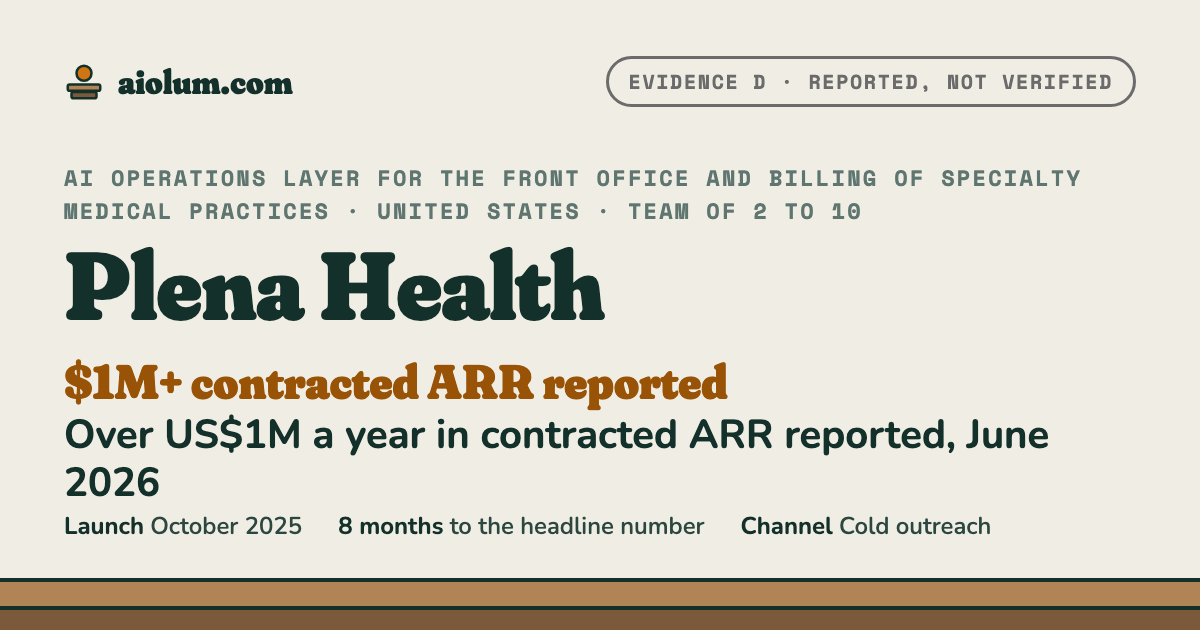
Plena Health (AI operations layer for the front office and billing of specialty medical practices, United States): Over US$1M a year in contracted ARR reported, June 2026. Evidence grade D: reported, not verified. Team: 2 co-founders; total headcount not published, November 2026. Launched October 2025; still running, revenue growing.Added 5 November 2026 · updated 6 November 2026
- Outcome
- Over US$1M a year in contracted ARR reported, June 2026Revenue growing
- Evidence
- D reported, not verified
- Launch
- October 2025
- Status
- Still running
- Team
- 2 co-founders; total headcount not published, November 2026
- Outside funding
- Y Combinator Spring 2026; amount not published
- Main channel
- Cold outreach
What is not verified
The headline rests on one founder claim: Eyad Abdalla wrote in the Y Combinator launch post of 1 June 2026 that Plena "crossed seven figures in contracted ARR"; the Y Combinator company page, read 5 November 2026, repeats it as "committed ARR". Contracted revenue is signed contracts, not cash received, and "seven figures" is a range from US$1 million upward. No customer count, investor statement or payment-processor figure was found. A reader could look for a funding announcement with figures, a press interview, or customer statements. The headline number is grade D: one claim or one estimate, with no second source. Aiolum shows it because the story is useful, and marks it so that it is not mistaken for a verified figure.
Plena Health sells AI agents to independent specialty practices, medical clinics that focus on one field such as dermatology, gastroenterology (GI) or orthopedics. The agents do administrative work: they sort incoming faxes, take in referrals (a request from another doctor to see a patient), call and text patients to book or confirm visits, fill cancelled slots, follow prior authorizations (the insurer's approval needed before some procedures) and work on revenue cycle tasks, the steps from a claim to the payment. The company's site says it connects to the practice's EHR (electronic health record, the clinic's patient database) and lists Epic, athenahealth, ModMed, eClinicalWorks, NextGen and others.
The two co-founders are Eyad Abdalla, an engineer who worked at Datadog and Shopify, and Ahmed Al Mudarris, the CTO, who worked on infrastructure at AWS. Y Combinator lists 2025 as the founding year. Eyad Abdalla wrote in the company's Y Combinator launch post of 1 June 2026 that his mother's clinic was the first user and that Plena's office sits inside it. The same post says that in 8 months Plena grew 17 times and "crossed seven figures in contracted ARR", across six specialties and eight states, all on annual or multi-year contracts.
"Seven figures" means at least US$1,000,000 a year, and contracted ARR (annual recurring revenue) counts signed contracts, not money received. The founders stated this claim; no customer, investor or payment processor has confirmed it, so it is grade D. The total headcount is not published. The site describes an engineering group from larger tech companies, and the company was hiring its first salesperson in November 2026.
How much revenue does Plena Health make?
Each row shows the evidence grade and the source numbers from the list at the end of this page. The grades are explained in How Aiolum verifies.
| Fact | Value | Grade | How we know | Sources |
|---|---|---|---|---|
| Contracted annual recurring revenue, 1 June 2026 | over US$1,000,000 a year ("seven figures") | D | Eyad Abdalla in the Y Combinator launch post, created 1 June 2026: "In 8 months, we've grown 17x and crossed seven figures in contracted ARR." Signed contracts, not cash received. US$1 million is the lowest value that "seven figures" allows. | [1] |
| Same claim on the Y Combinator company page, read 5 November 2026 | "seven figures in committed ARR" after 10 months | D | The company text on the directory page, not dated. It repeats the same lower bound, so it is not a second, independent figure. | [2] |
| Growth over the first 8 months | 17 times | D | Founder claim in the launch post. The starting value is not given, so the growth cannot be checked. | [1] |
| Customers, June 2026 | six specialties in eight US states, all on annual or multi-year contracts | D | Founder claim in the launch post. The number of practices is not given. | [1] |
| Share of growth from word of mouth | 80% | D | Founder claim in the launch post and on the company page. | [1, 2] |
| Founders | Eyad Abdalla (founder, CEO) and Ahmed Al Mudarris (co-founder, CTO) | C | Y Combinator company page. Eyad Abdalla: Waterloo engineering, Datadog, Shopify, 3 years in specialty clinics. Ahmed Al Mudarris: a nuclear engineering startup, then AWS infrastructure. | [2] |
| Founding year and place | 2025, San Francisco | C | Y Combinator company page. | [2] |
| Start of the 8 months in the launch post | about October 2025 | calc | Calculated: 8 months before 1 June 2026. This page uses it as the launch month; no source gives an exact launch date. | [1] |
| Funding | Y Combinator, Spring 2026 batch | C | Y Combinator company page; the company's news post of 8 April 2026 announces the investment. No amount is published. | [2, 4] |
| Team size | not published | C | Y Combinator shows no team size. The site describes an "AI Deployment Group" of engineers from Amazon, Google, Meta, Uber and NVIDIA plus healthcare operators, without a number. The first sales hire was being recruited in November 2026. | [2, 3, 4] |
| Founding sales role, November 2026 | US$225K to US$325K salary, 0.20% to 0.50% equity | C | Y Combinator job post, "Founding Account Executive", posted about a month before 5 November 2026. The company published it. | [3] |
| EHR integrations named | Epic and Epic Care Link, athenahealth, ModMed, eClinicalWorks, gGastro, NextGen, Cerner, "and 30 more" | C | Company site. | [4] |
| Time to go live | under 4 weeks for most practices | C | Company site. A forward-deployed engineer (an engineer who works at the customer's site) sets up each practice. | [4] |
| Phone agent languages | 30+ languages, 30+ voices | C | Company site. | [4] |
| Customer example: referral backlog | 4,800 referrals, four months old, cleared | C | Company case study on a dermatology group. The practice is named by the company; its own statement was not found. | [4] |
| Customer example: down-coded claims | 500 to 600 claims a month; US$20,000 to US$25,000 recovered in the first audit window | C | Company's quotation of an orthopedics customer about the insurer BCBST changing code 99214 to 99213. The company stated the figures. | [4] |
| Security claims | "HIPAA and SOC 2 from day one. PHI never trains models." | C | Company site. No audit report or certificate was found. | [4] |
| AI models used | not named | C | The site speaks of agents, OCR and voice agents but names no model provider. | [4] |
| Time from start to the June 2026 figure | 8 months | calc | Calculated: October 2025 to June 2026. | [1] |
How to read this table: grade D is a single founder claim that no one outside has checked. Grade C is the company's own published text about its product. A "calc" value was computed on this page. No value is grade A or B.
| Plan | Per month, billed yearly (US$) | Per month, billed monthly (US$) | Limit |
|---|---|---|---|
| Annual or multi-year contract | custom | priced per practice; job post speaks of six-figure annual deals | |
| Free AI assessment | 0 | 0 | two sessions, report within a week |
The site offers only a 20-minute demo and a free workflow assessment. The founders say all customers are on annual or multi-year contracts. Plena's Y Combinator job post for a sales hire speaks of closing six-figure annual contract values, so deals are large and negotiated one by one.
When did Plena Health launch, and how did it grow?
From a first user in the founder's mother's clinic to a Y Combinator launch with seven-figure contracts reported, in about 8 months. Each entry carries its grade.
- 2025CEyad Abdalla and Ahmed Al Mudarris found Plena. The first user is the clinic of Eyad Abdalla's mother, a doctor; Plena's office sits inside it. [1, 2]
- About October 2025calcStart of the 8-month period that the launch post describes. [1]
- 8 April 2026CCompany news post: Plena Health joins Y Combinator's Spring 2026 batch. [4]
- 5 May 2026CAhmed Al Mudarris publishes a post on a claim-reconsideration workflow built with an orthopedics customer. [4]
- 1 June 2026DY Combinator launch post: 17 times growth in 8 months and "seven figures in contracted ARR", six specialties, eight states, 80% of growth by word of mouth. The post asks for introductions to independent specialty practices. [1]
- October 2026CPlena posts its first sales job, a Founding Account Executive to close six-figure annual deals. [3]
- November 2026DThe Y Combinator page repeats the claim as "seven figures in committed ARR" after 10 months. The company is active. [2]
Why did Plena Health work?
Four causes, in the order they mattered. Each one is a reusable lesson.
Domain experience
Both founders grew up in doctors' families, and the first user was one founder's mother's clinic. The launch post says the founders embedded in clinics and saw that a single referral needs a fax read, a patient match, an insurance check, an EHR update and several follow-ups, and that a practice runs dozens of such workflows a day.
Blocks assembled per practice
The founders describe a base platform of reusable parts (workflow steps, EHR integrations, agent harnesses) from which engineers build what each practice needs and "stand it up in a day or two". Each new customer adds parts to the platform, so the next one is faster. This is a mix of software and on-site engineering work.
Work inside existing systems
Plena does not ask a practice to move to a new EHR. It reads and writes in the systems the practice already has, which shortens the sale: the founders contrast this with competitors that ask practices to migrate.
Start with one workflow, then expand
Customers start with one task (referrals, collections or scheduling) and add more. The sales job post says the same: deals expand into more workflows, locations and practices.
How it was built
These details come from the company's site, its Y Combinator pages and its job post. They are the company's own words, grade C. [4, 1, 2, 3]
- Inputs: fax, phone calls, SMS, chat, email, payer portals and IVR phone trees (automated phone menus of insurers).
- Documents: OCR (optical character recognition, turning page images into text) plus classification of each page as referral, records, lab, prior authorization or junk.
- Voice and text agents for inbound and outbound calls in 30+ languages, with a handoff to staff that includes the transcript and a proposed next step.
- Integrations with the practice's EHR (Epic, athenahealth, ModMed, eClinicalWorks, NextGen, Cerner and others), clearinghouses and fax vendors.
- An audit log of every action and a live dashboard where practice leaders can watch and steer the agents.
- The company says it is HIPAA compliant and SOC 2 from the start and that patient data never trains models. No model provider is named.
- Ahmed Al Mudarris built the platform; the founders' bios say so.
Tools named in the sources
Each one opens its page in the Tools tab, with every story that uses it.
Who tried this before Plena Health, and why did they fail?
Four companies in our database of failed startups promised to use software or AI to take work off doctors and clinics. The values below are from that database and are not independently verified.
Olive AI
The promiseAn AI workforce that would automate prior authorizations, claims, eligibility checks and billing for hospitals.
Why it diedEach health system needed heavy custom work; the AI was partly manual robotic process automation, and costs to deliver grew faster than revenue.
Babylon Health
The promiseAI symptom checking and virtual GP visits through a phone app.
Why it diedIt paid doctors per visit while insurers paid a fixed monthly fee, and its AI claims were questioned.
Forward Health
The promiseAI-assisted primary care in self-service medical booths.
Why it diedEach booth was expensive hardware that still needed doctors, and too few members used them.
Call9
The promiseEmergency telemedicine inside nursing homes.
Why it diedPhysical deployment and integration with each facility's systems made scaling slow, and larger telemedicine companies competed.
The failed startups come from our database of 1,749 dead startups, retold here in our own words. Its entries are AI-assisted summaries of public sources, so these cards carry no evidence grade.
What changed
Olive AI sold the same promise, AI that does the administrative work of health care, and failed because each customer needed custom work that cost more than it earned. Plena accepts the custom work openly: its engineers build each practice's setup on site. The difference it claims is that the custom part is now fast, because large language models can adapt a workflow in days, and because the company reuses blocks from one practice to the next.
Plena also sells to independent specialty practices, which decide faster than the hospital systems Olive sold to, and it does not touch diagnosis or treatment, which was where Babylon and Forward made their medical claims. Whether the on-site engineering cost stays below the contract value is the open question; the sources do not show margins.
Can one person copy Plena Health now?
Hard for one person: it needs health-care integrations, compliance and on-site engineers.
The method can be copied in a smaller form: pick one narrow kind of practice you know from inside, automate one painful workflow end to end in the systems it already uses, and sell an annual contract. The full Plena model, with HIPAA compliance, EHR integrations and engineers at each site, needs a team and money.
Where it is still open: Other specialties and other regulated offices with fax, phone and portal work: dental groups, physical therapy, veterinary clinics, home health agencies.
- 1Work inside a few clinics of one specialty and list every manual workflow with its time cost.
- 2Pick one workflow, such as fax referral intake, and automate it inside the existing EHR, not in a new portal.
- 3Sell it on an annual contract and expand to the next workflow at the same customer.
- 4Turn each custom build into a reusable block so the next practice is faster.
What could go wrong for Plena Health?
The risks are the mirror image of the causes above.
What is not verified
The headline rests on one founder claim: Eyad Abdalla wrote in the Y Combinator launch post of 1 June 2026 that Plena "crossed seven figures in contracted ARR"; the Y Combinator company page, read 5 November 2026, repeats it as "committed ARR". Contracted revenue is signed contracts, not cash received, and "seven figures" is a range from US$1 million upward. No customer count, investor statement or payment-processor figure was found. A reader could look for a funding announcement with figures, a press interview, or customer statements.
Team size
The founding team is two people. The company does not publish its headcount. Its site describes a group of engineers from Amazon, Google, Meta, Uber and NVIDIA and healthcare operators, and it was hiring its first salesperson in November 2026, so the team is larger than the founders but the number is unknown.
AI phone agents and patient data
Plena's agents call and text patients, including calls before and after procedures that ask about medicines, prep and complications and route concerns to a nurse. The site says that "most patients take it for a member of your team"; it does not say how callers are told that they speak with an AI. The company states HIPAA compliance and SOC 2 "from day one" and that patient data never trains models; no audit report was found.
Competition
Many companies sell AI front-office agents to medical practices; Patientdesk.ai, another Y Combinator company on this site, sells an AI receptionist and front office to dental practices.
Dependence on EHRs and model providers
The product works only through the practice's EHR, payer portals and fax systems, so changes or access limits by Epic, athenahealth and the other vendors affect it. The sources do not name the AI models Plena uses, so its dependence on any one model provider cannot be judged.
Sources
The grade next to each source is the best grade that the source can support. "Read in full" means that the text of the page was downloaded and the numbers were checked in it.
- D Y Combinator Launch: Plena Health, The AI operating system for specialty medical practices, created 1 June 2026Read in full (downloaded 5 November 2026). Founders' own post. Source for the contracted ARR claim, the 17 times growth, the first user and the method.
- D Y Combinator company page: Plena HealthRead in full (downloaded 5 November 2026). Company text and founder bios. Source for the founders, founding year, batch and the "committed ARR" wording.
- C Y Combinator job post: Founding Account Executive at Plena HealthRead in full (downloaded 5 November 2026). Source for the salary range, the six-figure deal size and the first sales hire.
- C Plena Health website: home, platform, workflows, customers, insights, about and careers pagesThe site loads by script; read the page text inside its script bundle (downloaded 5 November 2026). Source for the product, integrations, security claims, case studies, the news posts and the engineering group.
- C Aiolum story: Patientdesk.aiRead the story on this site. Source for the competitor sentence.
- C Database of failed startups, local exportLocal export. AI-written summaries, not independently verified. Source for the failed predecessors.
Run this company? Send corrections or a verified figure to aiolum@livyden.com