Dropmagic
Dropmagic is an AI store builder for Shopify. A store builder is a program that produces the pages of an online shop, and this one does it from a single product link: it imports the product, writes the text, generates images and publishes to the customer's Shopify account. The customers are mostly dropshippers, sellers who list a supplier's product in their own shop and let the supplier ship it, so they never hold stock. They test many products, and each test needs a new store.
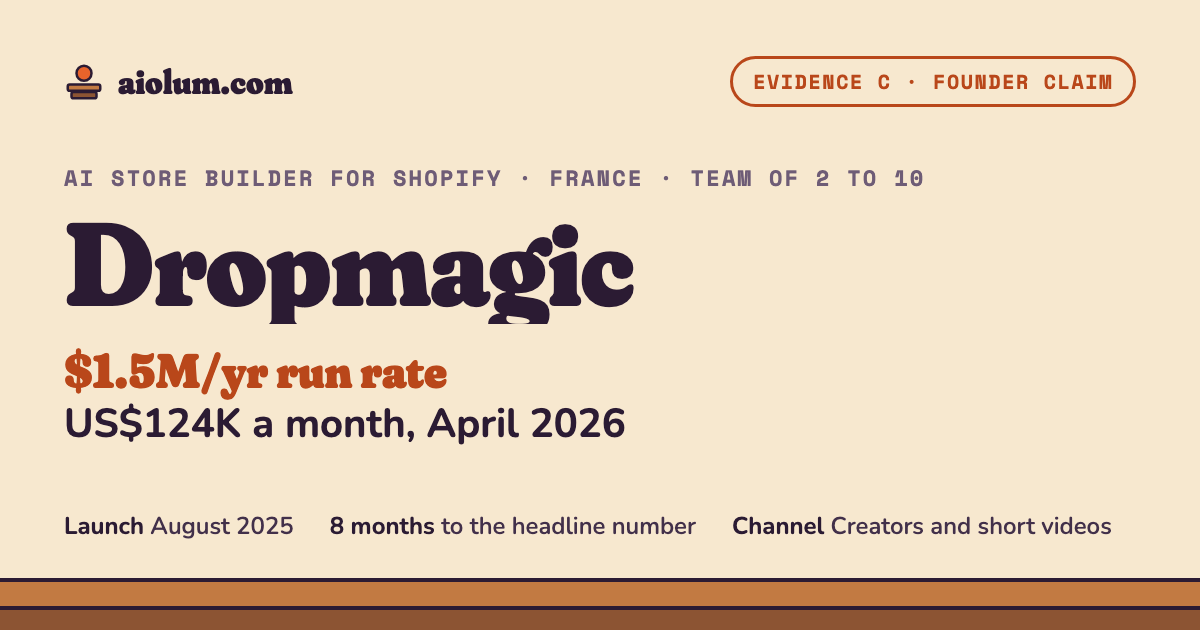
Loïc Berthelot, a French software developer, co-founded Minea, a tool that finds products by scanning advertisements. He said on a podcast on 2 March 2026 that Minea reached US$750,000 a month in recurring revenue, that he left his post as its chief executive about seven months earlier, and that he started Dropmagic with his best friend, a designer, and a 24-year-old YouTube creator who makes the videos. He said the product made US$1,000 a month of recurring revenue within five days and passed US$1 million a year of recurring revenue on the day of the recording. Two newsletters then quoted his posts on X: High Signal wrote on 29 April 2026 that recurring revenue was US$117,000 a month, and Tiny Startups wrote on 22 May 2026 that he had made over €106,000, about US$124,000, in April.
Every revenue figure on this page is a founder statement, repeated by a newsletter, a podcast or a reviewer, so the grade is C. No payment processor has published the numbers. The page also shows what happened to five earlier companies that sold store builders and no-code tools to small sellers, and why the French consumer regulator watches the dropshipping sector.
The numbers, graded
Each row shows the evidence grade and the source numbers from the list at the end of this page. The grades are explained in How Aiolum verifies.
| Fact | Value | Grade | How we know | Sources |
|---|---|---|---|---|
| Revenue in April 2026 | over €106,000, about US$124,000 | C | Tiny Startups newsletter, 22 May 2026, quoting the founder's post on X. The newsletter gives US$125,000; this page converts at the ECB reference rate of 30 April 2026, 1.1702 US dollars per euro. | [1] |
| Monthly recurring revenue, 29 April 2026 | US$117,000 | C | High Signal newsletter, 29 April 2026, quoting the founder's post on X. Monthly recurring revenue (MRR) is the subscription revenue of one month. The two April figures differ by 6%. | [2] |
| Run rate from the April 2026 revenue | about US$1.49 million a year | calc | Calculated: 106,000 euros times 1.1702 equals 124,041 US dollars; times 12 equals 1,488,494. | [1] |
| Monthly recurring revenue, 2 March 2026 | about US$83,400 | C | Founder on the Profitable Founder podcast: on the day of the recording the company passed US$1 million of annual recurring revenue, "83.4" thousand a month. | [3] |
| Time from start to US$1 million annual recurring revenue | "six, seven months" | C | Founder on the podcast. The podcast title says 7 months. | [3] |
| Monthly recurring revenue, November 2025 | over US$45,000 | C | Founder in a Starter Story episode of November 2025, as quoted on Starter Story's researched profile: "over 45K MRR within the first four months". | [13] |
| Monthly recurring revenue in under six months | US$60,000 | C | The reviewer at Ecommerce-Platforms.com, 31 July 2026, reporting the founder's statement. The podcast host used the same figure on 2 March 2026. | [4, 3] |
| First recurring revenue | US$1,000 a month within 5 days, US$5,000 within 30 days | C | Podcast host's summary, confirmed by the founder, and the reviewer. | [3, 4] |
| Starter Story's revenue estimate | about US$85,000 a month, as of 2026 | D | A directory estimate marked "Triangulated from 3 public sources". It is below the founder's April 2026 figures. | [13] |
| Team at the April 2026 figure | 3 co-founders | C | Founder on the podcast: himself on the code, his best friend as designer and product lead, and a YouTube creator who makes the videos. Tiny Startups wrote "Solo-founder"; the founder's own account contradicts that. | [3, 1] |
| Outside funding | none | C | Tiny Startups: "100% bootstrapped". The reviewer: "bootstrapped, with no outside funding". | [1, 4] |
| Stores generated | more than 120,000 | C | A company figure, reported by the reviewer, who calls it self-reported. The company's home page shows an animated counter that reads 0 in the page text. | [4, 5] |
| Rating | 4.9 out of 5 from more than 1,500 sellers | C | Company home page. The reviewer reports the same 4.9 on the Shopify App Store. | [5, 4] |
| Domain registration | 20 March 2024 | B | Registry record on whois.com. The registrant is hidden behind a privacy service. | [12] |
| First archived page | 16 November 2024 | B | Wayback Machine. The page already sold the same product, with "$10 off" for the first customers. The founder counts the growth from about August 2025, so the product existed before the start he describes. | [11] |
| Previous company, Minea | US$750,000 a month in recurring revenue, 5 co-founders | C | Founder on the podcast. The reviewer writes "around $750K MRR". Minea is a product-research tool for dropshippers, built with a large French YouTube creator. | [3, 4] |
| Price | US$79 a month for Pro; Free builds but cannot publish | C | Company pricing page. | [6] |
| Affiliate commission | 30% of every payment, recurring | C | Company affiliate page, which also claims that the top affiliates earn US$8,400 a month. | [7] |
| Share of new customers from YouTube | more than 60% | C | Founder in the Starter Story episode, as quoted on Starter Story's profile: "more than 60% of our new customers come from YouTube". | [14] |
| Time from the stated start to the April 2026 figure | 8 months | calc | Calculated: August 2025 to April 2026. The start month is itself derived from the podcast of 2 March 2026, "seven months ago". | [3, 1] |
How to read this table: a grade C value is a founder statement, quoted by a newsletter, a podcast or a reviewer. A grade B value is a register record or an archived page. A grade D value is a third-party estimate. A "calc" value was computed on this page from the rows above it. No value is grade A.
| Plan | Per month, billed yearly (US$) | Per month, billed monthly (US$) | Limit |
|---|---|---|---|
| Free | 0 | 0 | 1 store, build and preview only |
| Pro | 79 | unlimited stores, 30 AI image credits a month, publishing to Shopify |
There are two plans. Free builds and previews one store but cannot publish it to Shopify; the reviewer at Ecommerce-Platforms.com confirms that publishing needs Pro. Pro is billed monthly; the page shows no yearly price. The reviewer writes that a yearly option exists but that its price is not published. Every store also needs a Shopify plan, which starts at US$39 a month, paid to Shopify. Refunds are possible within 7 days if the customer has not launched more than one live store.
The timeline
From a product-research tool with a creator co-founder to a store builder that repeats the same method, with about eight months from the stated start to US$124,000 in one month. Each entry carries its grade.
- Earlier yearsCThe founder says he spent about five years after school in an incubator building software that nobody used. [3]
- Before 2025CMinea: his product-research tool merges with other French tools and with a large YouTube creator, Yomi Denzel, as co-founder. He says it grew to US$750,000 a month in recurring revenue with five co-founders, YouTube creators as the main channel, and no venture money. [3, 4]
- 20 March 2024BThe domain dropmagic.ai is registered. [12]
- 16 November 2024BFirst archived page: "Turn any product from Aliexpress into a complete high-converting Shopify store in minutes with AI", with a launch discount for the first customers. [11]
- About August 2025CHe leaves his post as chief executive of Minea and starts Dropmagic with his best friend, a designer, and a 24-year-old YouTube creator as third co-founder. A launch video by the creator brings the first customers: US$1,000 of monthly recurring revenue in five days and US$5,000 in 30 days. [3]
- November 2025CIn a Starter Story episode he says the product is at over US$45,000 of monthly recurring revenue within its first four months. [13]
- 9 February 2026CThe site publishes comparison pages against Shopify Magic and other builders, and a set of dropshipping guides, for search traffic. [16, 8]
- 2 March 2026COn the Profitable Founder podcast: US$1 million of annual recurring revenue reached that day, about US$83,400 a month, after plateaus at US$10,000 and US$50,000. [3]
- 29 April 2026CHigh Signal reports the founder's post: US$117,000 of monthly recurring revenue. [2]
- 22 May 2026CTiny Startups reports the founder's post: over €106,000 made in April, about US$124,000. [1]
- 31 July 2026CA reviewer at Ecommerce-Platforms.com reports the company's claims of 120,000 stores generated and US$1 million of annual recurring revenue, and a 4.9 rating on the Shopify App Store. [4]
- 30 August 2026CDropmagic V2: a rebuilt editor, an AI agent that designs a whole store from one link, a brand kit, an image studio and one-click publishing to Shopify. [9]
Why it worked
Four causes, in the order they mattered. Each one is a reusable lesson.
A creator in the founding team
The founder says that at Minea the first plateau, at US$30,000 a month, broke when a large French YouTube creator became a co-founder, and that more than 80% of its customers then came from YouTube creators. For Dropmagic he put a creator in the founding team from the first day, paid with equity. The creator uses the product daily, gives product feedback, makes the launch videos and knows the conversion rate of a video, so the company can pay other creators at a known price per view.
A result in minutes
The user pastes a link and watches the store being built on screen, with animation. The founder calls this the wow moment: the funnel was built to be shared, like a TikTok video, and the creator's launch video of it spread. He says that when distribution is secured, the team can take its time and build the product well before launch.
Free to build, paid to publish
Building and previewing cost nothing. The customer pays US$79 a month only when the store goes to Shopify. A dropshipper who tests several products a month needs several stores, and the Pro plan allows unlimited stores, so the price is small next to the Shopify plan and the advertising budget that each test needs.
The same method three times
The founder describes one repeated method: find the one channel that works, close the others, and work with creators for months until they become ambassadors rather than advertisers. He says he used it for his earlier tools, for Minea and for Dropmagic, and that he built an internal tool, Blime, to find and track creators.
How it was built
These details come from the founder's podcast interview and from a Starter Story episode as quoted on Starter Story's researched profile. They are grade C. [3, 13, 14, 16, 9]
- The founder writes the code himself again, with Claude Code, after years as a chief executive who did not program. He says the technical part is hard even with an AI coding agent.
- Starter Story quotes him on the stack: Next.js and Vercel for the front end and hosting, Supabase for the database, Gemini and OpenAI models for the copywriting, an image model for the AI product images, Cursor as the editor, Sentry for debugging and Loops for email.
- The product sits on Shopify: the generated store is pushed into the customer's Shopify account, and the customer pays Shopify separately. Dropmagic does not host the live shop.
- Distribution is YouTube creators: a creator co-founder who makes the videos, paid creators tracked with an internal tool, and an affiliate program that pays 30% of every payment. Starter Story quotes the founder saying that more than 60% of new customers come from YouTube.
- Content pages for search were added in February 2026: comparisons against Shopify Magic, PagePilot, Atlas and others, and dropshipping guides.
- Version 2, released on 30 August 2026, rebuilt the editor and added an AI agent that designs the whole store, a brand kit and an image studio.
Tools named in the sources
Each one opens its page in the Tools tab, with every story that uses it.
The dead that came before
Five companies in the Loot Drop database sold store builders or no-code tools to small sellers and creators. The values below are from that database and are not independently verified.
Dukaan
The promiseLaunch an online store in 30 seconds, for India's small merchants.
Why it diedIt signed up more than five million merchants, but most sold a few hundred dollars a month and would not pay even US$10 a month when free alternatives existed. The paying ones left fast.
Lysto
The promiseStorefronts for micro-entrepreneurs who sell through WhatsApp and Instagram.
Why it diedAcquiring a seller cost more than the seller ever earned for the platform, and 70% of sellers left after fewer than three transactions.
Beetailer
The promiseTurn a Facebook page into a shop for online retailers.
Why it diedFacebook changed its platform often and then built shopping itself, and Shopify integrated with Facebook directly. The intermediary was no longer needed.
Koji
The promiseA no-code builder for creators to make interactive apps without programming.
Why it diedSqueezed between larger no-code platforms, and it could not turn free users into paying ones at a sustainable rate.
Sosh
The promiseA drag-and-drop website builder that removes the designer-developer handoff.
Why it diedToo complex for beginners, too rigid for professionals, and small businesses would not pay premium prices. Template builders took the mass market.
What changed
Dukaan and Lysto gave small sellers a free store and could not get them to pay, because the sellers earned too little. Koji and Sosh built general builders that were too open: beginners got lost, and free users never converted. Beetailer lived on top of Facebook until Facebook and Shopify built the feature themselves.
Dropmagic sells to a customer who already pays: a dropshipper who pays Shopify US$39 a month and spends on advertising, and who needs a new store for each product test. The builder does not replace Shopify; it feeds it, so Shopify has no reason to shut it out, while Beetailer's platform did. The generative part is what the earlier builders lacked: the text, the images and the design are produced for the product, so the beginner does not face an empty template. The customers arrive through YouTube creators at a cost the founder says he knows per view, which is the problem Lysto never solved. The Beetailer risk remains: Shopify Magic, Shopify's own AI, already writes descriptions and generates starter layouts, and Dropmagic's comparison page admits that it is useful.
Can one person copy it now?
The product, maybe. The method, only with a creator.
An AI store builder is not hard to build with current models, and several competitors exist: Atlas, PagePilot, Copyfy, BuildYourStore and Shopify's own Magic. The founder himself says that the growth, in the reviewer's quotation, had nothing to do with the product and everything to do with distribution. The repeatable part is the structure of the founding team and the funnel, not the code.
Where it is still open: The same structure in other markets with paying hobbyists or small sellers: print-on-demand shops, Etsy sellers, Amazon listings, real-estate listings, and short-video advertising for the stores that these builders produce.
- 1Pick a market where the customers already pay for tools and need the result again and again, such as sellers who test products.
- 2Bring a creator with an audience in that market into the founding team, paid with equity, and let that person use the product daily and make the launch video.
- 3Build a first use that shows its result on screen in minutes, free, and charge at the moment the result is used.
- 4Find the one channel that works in the first month, close the others, and pay creators at a measured cost per view until they become ambassadors.
What to watch
The risks are the mirror image of the causes above.
Self-reported, and two measures that differ
The April 2026 revenue of over €106,000 and the US$117,000 of monthly recurring revenue are founder posts, repeated by two newsletters. Revenue in a month and recurring revenue are different measures, and nobody outside has checked either. Starter Story's own estimate, about US$85,000 a month, is lower.
Not a solo founder
Tiny Startups wrote "Solo-founder". On the podcast the founder says there are three co-founders: himself, a designer and a YouTube creator. Customer reviews quoted by the reviewer also thank a named support person. The revenue is shared by a team, and the creator holds equity.
When did it start
The domain dates from March 2024 and a selling page was archived in November 2024, but the founder counts the growth from about August 2025, when he left Minea. The "seven months to US$1 million" story leaves out the earlier version.
Shopify can build it in
Beetailer died when the platform added the feature. Shopify Magic already writes product text, edits images and generates a starter layout for free with every plan. Dropmagic's defense is design quality, persona-based copy and image generation, all of which Shopify can add.
A sector with a regulator's attention
The French consumer authority DGCCRF checked 215 dropshipping sites in 2022 and found 116 in breach: misleading claims, fake reviews, undelivered or dangerous products. Dropmagic's guide recommends urgency elements such as countdown timers and limited-stock notices, its 2024 page imported supplier reviews into the store, and its home page shows testimonials signed with initials and marked "Verified". The product builds the shop; the seller carries the legal duties.
One channel, one creator
More than 60% of new customers come from YouTube, by the founder's account. The co-founding creator makes the videos. If that relationship or the YouTube channel weakens, the funnel weakens with it.
Sources
The grade next to each source is the best grade that the source can support. "Read in full" means that the text of the page was downloaded and the numbers were checked in it.
- C Tiny Startups newsletter #102, 22 May 2026: This week in Tiny Startups, Tweet of the WeekRead in full. Quotes and links the founder's post on X: over €106,000 made in April from Dropmagic, with the notes "Solo-founder" and "100% bootstrapped". The newsletter writes the founder's name as "Louc".
- C High Signal newsletter by Pete, 29 April 2026: $117k MRR for DropmagicRead in full. Quotes and links the founder's post on X: US$117,000 of monthly recurring revenue.
- C Profitable Founder podcast by Florian Darroman, 2 March 2026: I Built a SaaS From 0 to $83K MRR in 7 Months, show notes and transcriptRead the show notes and the machine transcript in full. Founder interview. Source for the three co-founders, the Minea history, the US$1 million annual run rate, the first weeks and the creator method. The transcript misspells several names.
- C Ecommerce-Platforms.com, Bogdan Rancea, 31 July 2026: DropMagic Review: An Honest Look at the AI Shopify Store BuilderRead in full. A reviewer who reports the company's claims and quotes Shopify App Store reviews. Source for the US$60,000 figure, the 120,000 stores claim, the Minea co-founding and the plan details.
- C Dropmagic home page, read 16 October 2026Read in full. Source for the product description, the rating claim and the testimonials. Checked for income promises: none found.
- C Dropmagic pricing page, read 16 October 2026Read in full. Source for the two plans.
- C Dropmagic affiliate program page, read 16 October 2026Read in full. Source for the 30% recurring commission and the affiliate earnings claim.
- C Dropmagic guide: How to Start Dropshipping in 2026, read 16 October 2026Read in full. Checked for income promises: it gives margin ranges and says most first products fail. Source for the urgency-element advice.
- C Dropmagic updates page: Dropmagic V2, 30 August 2026Read in full. Source for the version 2 release.
- C Dropmagic terms and conditions, updated 21 April 2026Read in full. French law governs the terms. Source for the refund rule.
- B Wayback Machine snapshot of dropmagic.ai, 16 November 2024Read in full. The earliest archived copy. Source for the 2024 version of the product.
- B whois.com record for dropmagic.aiRead in full. Registry record: registered on 20 March 2024, registrant hidden by a privacy service.
- D Starter Story researched profile for Dropmagic: revenue pageRead in full. An AI-compiled profile that the founder did not write. Its estimate is grade D. It quotes the founder's words from a Starter Story episode of November 2025 and from the podcast, which are cited as founder statements.
- C Starter Story researched profile for Dropmagic: growth channels pageRead in full. Quotes the founder on YouTube as the source of more than 60% of new customers.
- B DGCCRF, 23 November 2023: Dropshipping, des manquements dans la moitié des sites contrôlésRead in full. The French consumer authority's report on its 2022 checks of 215 dropshipping sites. Context for the sector, not about Dropmagic.
- C Dropmagic comparison page, 9 February 2026: Shopify Magic vs DropMagicRead in full. The company's own comparison. Source for the business model description and the competitor list.
- C Loot Drop database export, 1,749 failed startupsLocal export. AI-written summaries, not independently verified. Source for the failed predecessors.