Eclectic AI: Revenue, team and how it was built
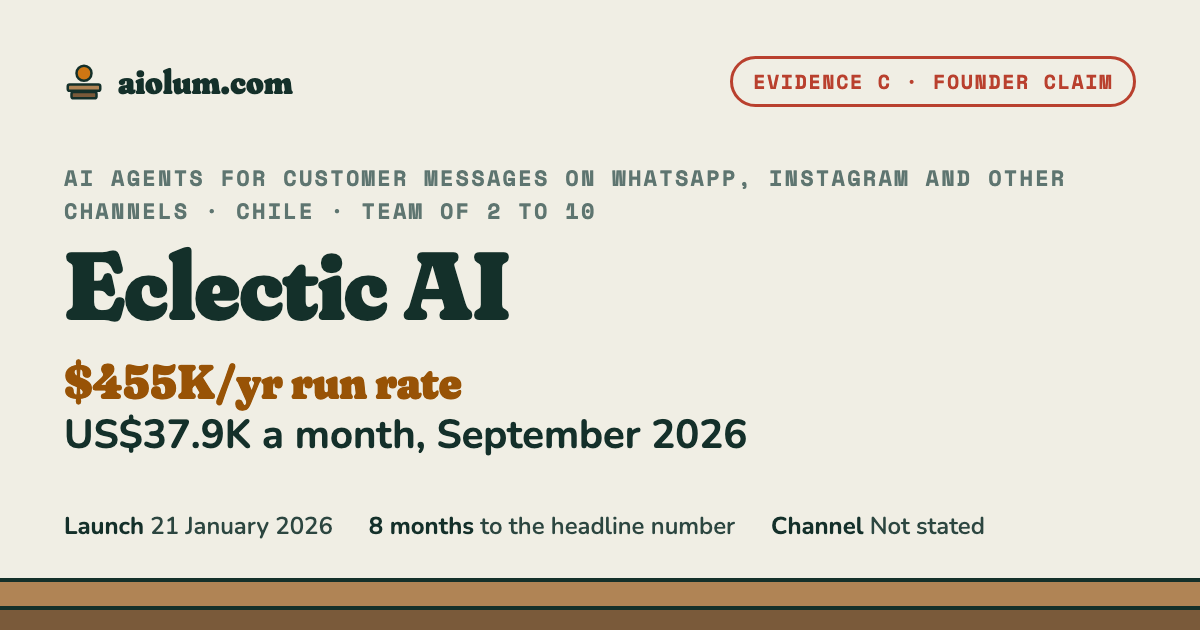
Eclectic AI (AI agents for customer messages on WhatsApp, Instagram and other channels, Chile): US$37.9K a month, September 2026. Evidence grade C: the founder's own figures, not verified by anyone else. Team: 8 people at the September 2026 figure, including the 2 co-founders. Launched 21 January 2026; still running, revenue growing.Added 31 October 2026
- Outcome
- US$37.9K a month, September 2026Revenue growing
- Evidence
- C the founder's own figures, not verified by anyone else
- Launch
- 21 January 2026
- Status
- Still running
- Team
- 8 people at the September 2026 figure, including the 2 co-founders
- Outside funding
- US$140,000 from angel investors in 2026, then a crowdfunding SAFE round on Broota opened in September 2026
- Main channel
- Not stated
Eclectic AI sells AI agents, programs that use a large language model to read a customer's message, decide what to do, and call other software to do it, for the chat channels that small and mid-size companies already use: WhatsApp, Instagram, Facebook Messenger, web chat, email and voice. The agents look up stock and order status in Shopify, JumpSeller or WooCommerce, book appointments in Google Calendar, Outlook or clinic booking systems, and write each conversation into a CRM (customer relationship management system, the database where a sales team keeps its contacts and deals). On WhatsApp it uses the official business platform: the home page shows a Meta Business Partner badge, and its interface shows the message templates that Meta approves and rates.
The company, Eclectic AI, Inc., was registered in Delaware on 8 January 2026 by Mauricio Chiong Castillo (CEO) and Martin Raddatz (CTO), two engineers who studied at the Universidad Católica (PUC). Raddatz spent four years at Meta, where he led a WhatsApp API team. The first customer paid through Stripe on 21 January 2026. On its crowdfunding page on Broota, a Chilean equity crowdfunding platform, the company reports MRR (monthly recurring revenue, the subscription money that comes in every month) of US$33,166 at the end of August 2026 and US$37,893 on 24 September 2026, with 119 active accounts and 8 people.
Both figures come from the company itself, in a page written to raise money, so they are grade C: two dated figures that agree, but no payment processor or journalist has checked them. The team of 8 is above the five-person line of a very small team, and the company raised US$140,000 from angel investors before it opened a public round. The page also shows earlier companies that sold chat tools and support bots to shops and failed.
How much revenue does Eclectic AI make?
Each row shows the evidence grade and the source numbers from the list at the end of this page. The grades are explained in How Aiolum verifies.
| Fact | Value | Grade | How we know | Sources |
|---|---|---|---|---|
| Monthly recurring revenue, 24 September 2026 | US$37,893 | C | Company, Broota campaign page: "US$37.893 de MRR (US$454,714k de ARR anualizado) al 24 de Septiembre de 2026" (translation: US$37,893 of MRR, US$454,714 of annualized ARR, on 24 September 2026). Repeated by El Ecosistema Startup on 23 October 2026 from the same campaign. | [1, 2] |
| Run rate from the September 2026 figure | US$454,716 a year | calc | Calculated: US$37,893 times 12. The campaign writes US$454,714. | [1] |
| Monthly recurring revenue, end of August 2026 | US$33,166, with 103 active accounts | C | Company, Broota campaign page: "El mes cierra con US$33.166 de MRR y 103 cuentas activas" (translation: the month closes with US$33,166 of MRR and 103 active accounts). | [1, 2] |
| Growth from the end of August to 24 September 2026 | 14.25% | calc | Calculated: US$37,893 / US$33,166 minus 1, over about 24 days. The company states "Entre 25% y 30% de crecimiento mensual, sostenido durante cuatro meses consecutivos" (translation: between 25% and 30% monthly growth for four months in a row). | [1] |
| Active accounts, September 2026 | 119 | C | Company, Broota campaign page: "119 cuentas activas a la fecha" (translation: 119 active accounts to date). | [1] |
| Average recurring revenue per account, September 2026 | about US$318 a month | calc | Calculated: US$37,893 / 119 accounts. At the end of August: US$33,166 / 103 = US$322. | [1] |
| Cumulative churn | 7.8% in eight months | C | Company: "7,8% de churn acumulado en ocho meses" (translation: 7.8% cumulative churn in eight months). Churn is the share of customers who stopped paying. | [1] |
| Team at the September 2026 figure | 8 people | C | Company: "Construido con 8 personas y US$140k de capital" (translation: built with 8 people and US$140,000 of capital), and "La octava contratación es reciente" (the eighth hire is recent). Only one person works on onboarding new customers. | [1, 2] |
| Angel money before the public round | US$140,000 in three tranches | C | Company: US$90,000 in March 2026 at a valuation cap of US$4.0 million, US$40,000 in June 2026 at US$4.5 million, and US$10,000 in August 2026 at the same cap. | [1] |
| Broota crowdfunding round, read 31 October 2026 | CLP 196,950,000 of a CLP 300,000,000 target (65.65%), from 42 investors | C | Broota campaign page. Round type SAFE, opened in September 2026 at a valuation cap of US$6.5 million. Broota Ventures is named as the round's "catalizador", which Broota's own page describes as an entity that prepares and screens startups before they raise on Broota. | [1, 7] |
| Abandoned-cart study, 30 days to 1 September 2026 | 617 of 2,262 carts recovered (27.3%) | C | Company study of 11 Chilean shops on Shopify and WooCommerce: CLP 40.4 million in sales, a median return of 191 times the cost of the messages. El Ecosistema Startup warns that it is the company's own study on 11 accounts, not an independent benchmark. | [1, 2] |
| First paying customer | 21 January 2026 | C | Company: "primer cliente suscrito y cobrado por Stripe, trece días después de constituida la sociedad" (translation: first customer subscribed and charged through Stripe, thirteen days after the company was formed). | [1] |
| WhatsApp connection | official platform, Meta Business Partner | C | The home page shows a "Meta Business Partner" badge. The public API documents a "Send template message" call for "a WhatsApp template message", and the interface shows the approval status and the quality rating that Meta gives each template. | [3, 5] |
| Time from the first paying customer to the September 2026 figure | 8 months | calc | Calculated: January 2026 to September 2026. | [1] |
How to read this table: a grade C value is a statement by the company, here mostly from its own fundraising page on Broota, which is in Spanish; the original words are quoted with an English translation. A "calc" value was computed on this page from the rows above it. No value is grade A or B.
| Plan | Per month, billed yearly (US$) | Per month, billed monthly (US$) | Limit |
|---|---|---|---|
| Start | 0 | 0 | the page says the customer can start free |
| Paid plans | prices load by script from Stripe; not read | ||
| Add-ons | charged month by month; prices not read | ||
| Average paid per account, September 2026 | about 318 | calculated: US$37,893 MRR / 119 accounts |
The pricing page, read on 31 October 2026, says "Empieza gratis y crece cuando tu operación lo pida. Sin contratos ni sorpresas" (translation: start free and grow when your operation needs it; no contracts and no surprises). The plan list loads from Stripe by script through a part of the site that its robots.txt closes to crawlers, so it was not read. The one paying-customer figure below is an average computed on this page, not a list price. WhatsApp template messages also carry Meta's own per-message charges, which the interface mentions for marketing templates.
When did Eclectic AI launch, and how did it grow?
From a WhatsApp API team at Meta to 119 paying accounts, in eight months of sales. Each entry carries its grade.
- 2022CMartin Raddatz works on the WhatsApp API at Meta in San Francisco, where he later leads an API team and then moves to Meta AI. [1]
- December 2023CMauricio Chiong builds his first chatbot for Preuniversitario Gauss, his own exam-preparation business, and sees what the WhatsApp channel does for a small company. [1]
- 8 January 2026CEclectic AI, Inc. is registered in Delaware. [1]
- 21 January 2026CFirst customer subscribes and pays through Stripe, thirteen days after the company was formed. [1]
- March 2026CFirst angel tranche: US$90,000 at a valuation cap of US$4.0 million. [1]
- June 2026CSecond angel tranche: US$40,000 at a cap of US$4.5 million. [1]
- August 2026CA further US$10,000 brings angel money to US$140,000. The month ends at US$33,166 of MRR with 103 active accounts. [1]
- September 2026C119 active accounts. The company opens a pre-seed SAFE round on Broota at a cap of US$6.5 million. [1]
- 24 September 2026CUS$37,893 of MRR, with 8 people. [1, 2]
- 23 October 2026CEl Ecosistema Startup, a Spanish-language startup news site, writes about the round using the campaign's figures. [2]
- 31 October 2026CThe Broota round shows CLP 196,950,000 raised from 42 investors, 65.65% of its target. [1]
Why did Eclectic AI work?
Four causes, in the order they mattered. Each one is a reusable lesson.
Founder expertise in the channel
The CTO led a WhatsApp API team at Meta. WhatsApp's business platform has rules on message templates, opt-in and quality ratings that new entrants often learn slowly. The product shows those rules inside its interface: template approval status, Meta's quality rating, and a warning that Meta can pause a template that customers block or report.
Connected to the shop systems
A plain chatbot answers from a fixed text. These agents call the shop and calendar systems, so they can say how many pairs of shoes are left in size 40, check an order or book a dental appointment. The company says this is why one person can onboard new customers: the agents are configured with internal tools that are themselves automated with AI.
A measurable first use
Abandoned-cart messages have a clear result: the cart was paid or it was not. The company's own study of 11 shops reports 27.3% of contacted carts recovered in 30 days. A number like this is easy for a shop owner to check against the monthly price.
Small rounds with rising caps
The company raised US$140,000 in three angel tranches, each at a higher valuation cap, and then opened a public crowdfunding round. El Ecosistema Startup notes that this order, many small tranches before a public round, is uncommon in Latin America.
How it was built
These details come from the company's own pages and its Broota campaign. They are grade C. [1, 3, 5]
- Channels: WhatsApp, Instagram, Facebook Messenger, TikTok, Mercado Libre, email, SMS, web chat and phone calls, collected in one shared inbox.
- WhatsApp through the official business platform, with Meta-approved message templates; the home page shows a Meta Business Partner badge.
- Integrations: Shopify, JumpSeller, WooCommerce and VTEX for shops; Salesforce, HubSpot, Odoo and Pipedrive for CRM; Google Calendar, Outlook and clinic systems such as Dentalink and Reservo for booking; Zendesk for support tickets.
- The interface offers OpenAI and Google Gemini models and lets the company set a monthly OpenAI spend cap per customer.
- A second AI watches the conversations and alerts a WhatsApp group of the customer's staff when a damaged order or a complaint appears; the agent then leaves the conversation.
- A public API and an MCP server, so a customer's staff can query Eclectic from Claude, ChatGPT or Cursor.
- Subscriptions and invoices run through Stripe.
Tools named in the sources
Each one opens its page in the Tools tab, with every story that uses it.
Who tried this before Eclectic AI, and why did they fail?
Four companies in our database of failed startups sold chat tools or support bots to online shops and support teams before large language models. The values below are from that database and are not independently verified.
Answerly
The promiseFAQ chatbots that would deflect customer support tickets so humans only handled the complex cases.
Why it diedLanguage understanding was too weak at the time, and Zendesk and Intercom were already in place.
RightHello
The promiseLive chat for online shops that turns visitors into buyers with well-timed conversations.
Why it diedIntercom raised far more money and won the chat tool market; RightHello could not afford to compete.
Vanti
The promiseAI conversational commerce that gives brands personalized shopping through chatbots.
Why it diedNo product-market fit in a crowded market; high customer acquisition cost and hard integrations.
Hipmob
The promiseCustomer chat built into mobile apps and websites.
Why it diedIntercom and Zendesk added the same features faster, and Hipmob had almost no funding.
The failed startups come from our database of 1,749 dead startups, retold here in our own words. Its entries are AI-assisted summaries of public sources, so these cards carry no evidence grade.
What changed
Answerly built support bots when software could not understand free text well, and its bots answered from fixed lists. Vanti had modern AI but sold complex integrations to brands at a high cost per customer. RightHello and Hipmob sold chat windows, and larger, better funded companies built the same windows.
Eclectic AI started when language models could hold a sales conversation in Spanish, and it sells in a market where the customer's main sales channel is already WhatsApp, not a website chat window. Its agents act in the shop and calendar systems, so the value is the work done, not the chat window. The risk that killed RightHello and Hipmob is still there: Meta, Shopify and the large CRM companies all sell AI agents of their own.
Can one person copy Eclectic AI now?
Partly. The channel knowledge is hard to copy; the method is not.
Few founders have run a WhatsApp API team at Meta. The method is open to others: pick a channel that small businesses already sell through, connect the agent to the systems where stock, orders and appointments live, and lead with a use whose result can be counted, such as abandoned carts.
Where it is still open: Other regions where small businesses sell over a messaging app (WhatsApp, LINE, Telegram, KakaoTalk), and sectors with their own booking systems, such as clinics, gyms and repair shops.
- 1Use the official business platform of each messaging channel and show its rules (templates, opt-in, quality ratings) inside your product.
- 2Connect the agent to the shop, CRM and calendar so it can act, not only answer.
- 3Start each customer with one counted result, such as recovered carts, and report it in money.
- 4Automate your own onboarding with AI tools so that one person can set up new accounts.
What could go wrong for Eclectic AI?
The risks are the mirror image of the causes above.
Company figures from a fundraising page
Both revenue figures, the account counts and the churn rate come from the company's own Broota campaign, written to attract investors. The news article that repeats them took them from the same campaign. No payment processor, auditor or journalist has checked them. The home page says more than 200 brands trust the company, while the campaign counts 119 active accounts.
Eight people and outside money
The team had 8 people at the September 2026 figure, more than the five of a very small team, and the company raised US$140,000 from angels before opening a public SAFE round with a target of CLP 300,000,000. The round is meant to pay for growth, so the team is likely to grow.
Advisors who are also customers
The campaign lists three advisors and says that all three are customers; one of them also invested in earlier rounds. The customer quoted in the company's case study is one of these advisors. The case study figures (87% faster replies, 200% more customers) are that customer's own report.
Dependence on Meta
Most conversations run on WhatsApp, Instagram and Messenger, which Meta controls. Meta sets the price of template messages, can pause a template that users block or report, and sells AI agents of its own to businesses. The company's interface warns customers that marketing templates cost more per message.
A similar name in the press
Another 2026 article on the same news site describes a Chilean startup called Eclectic, founded in 2024 by a different person, with an undisclosed angel round. It does not match the founders or the dates on the Broota campaign, so it is not used on this page; readers who search the name may find it.
Sources
The grade next to each source is the best grade that the source can support. "Read in full" means that the text of the page was downloaded and the numbers were checked in it.
- C Broota campaign page: Eclectic AI (Spanish), read 31 October 2026Read in full, including the team list embedded in the page. Company-written fundraising page. Source for the MRR figures, accounts, churn, team, angel tranches, cart study and timeline.
- C El Ecosistema Startup, 23 October 2026: Eclectic AI: agentes de IA para WhatsApp, con US$37.893 MRRRead in full. A news article that repeats the campaign's figures and comments on them; not an independent check.
- C Eclectic AI home page (Spanish), read 31 October 2026Read in full, including the page source. Source for the channels, integrations, the Meta Business Partner badge and the template status texts.
- C Eclectic AI pricing page, read 31 October 2026Read the visible text. The plans load from Stripe by script and could not be read.
- C Eclectic AI API documentation: Send template messageRead in full, including the page source. Source for the WhatsApp template call and the model options.
- C Eclectic AI customer story: Comunidad Feliz (Spanish)Read in full. A company case study quoting one customer.
- C Broota: Catalizadores (Spanish), read 31 October 2026Read the section on what a catalyst is and the entry for Broota Ventures.
- C Database of failed startups, local exportLocal export. AI-written summaries, not independently verified. Source for the failed predecessors.