Epiminds: Revenue, team and how it was built
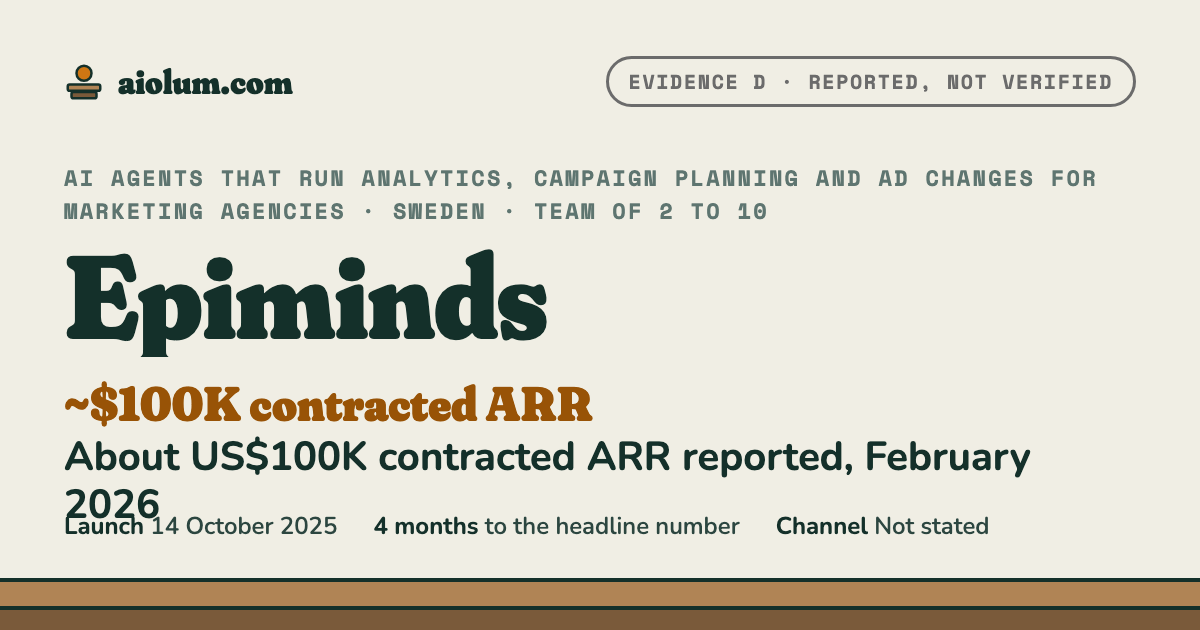
Epiminds (AI agents that run analytics, campaign planning and ad changes for marketing agencies, Sweden): About US$100K contracted ARR reported, February 2026. Evidence grade D: reported, not verified. Team: 2 founders in 2025; headcount not published (careers page: a small, focused team, hiring after the seed round). Launched 14 October 2025; still running.Added 5 November 2026
- Outcome
- About US$100K contracted ARR reported, February 2026
- Evidence
- D reported, not verified
- Launch
- 14 October 2025
- Status
- Still running
- Team
- 2 founders in 2025; headcount not published (careers page: a small, focused team, hiring after the seed round)
- Outside funding
- US$6.6M seed round led by Lightspeed Venture Partners, October 2025 (company announcement)
- Main channel
- Not stated
What is not verified
The headline figure, about US$100,000 or more in contracted annual recurring revenue (CARR) within the first 10 to 12 weeks, rests on one source: UpNext's Techarena recap of 14 February 2026, which reports the founders' pitch. CARR counts signed contracts, not money received. No payment-processor profile, filing or second interview with the amount was found. A reader could look for Epiminds AB's Swedish annual report or a later founder interview. The headline number is grade D: one claim or one estimate, with no second source. Aiolum shows it because the story is useful, and marks it so that it is not mistaken for a verified figure.
Epiminds is a Stockholm company that sells a multi-agent system, a program in which several AI models, each with its own task and tools, pass work to each other, to performance-marketing agencies, firms that buy online ads for clients and are paid for measurable results. Its coordinating agent, Lucy, analyses ad accounts, plans campaigns, writes copy and makes changes on Google Ads, Meta Ads and other platforms after a person approves them.
Elias Malm, who led agency partnerships at Google, and Mo Elkhidir, a former AI engineer at Spotify, founded it in 2025. It came out of stealth, the period when a startup works without public announcements, on 14 October 2025, and the company announced a US$6.6 million seed round led by Lightspeed Venture Partners. In February 2026 the event site UpNext, in its recap of the Techarena 2026 competition that Epiminds won, wrote that the company had reached about US$100,000 or more in CARR (contracted annual recurring revenue: the yearly value of signed subscription contracts, including some that may not yet be billing) within its first 10 to 12 weeks.
That revenue figure rests on one report of the founders' own numbers, so the story is grade D. The page also shows earlier companies that promised to automate ad management and lost to the ad platforms' own tools.
How much revenue does Epiminds make?
Each row shows the evidence grade and the source numbers from the list at the end of this page. The grades are explained in How Aiolum verifies.
| Fact | Value | Grade | How we know | Sources |
|---|---|---|---|---|
| Contracted annual recurring revenue (CARR) | about US$100,000 or more, within the first 10 to 12 weeks of launch | D | UpNext's recap of Techarena 2026, 14 February 2026, from the founders' pitch: 'Reached ~$100k+ in CARR within the first 10-12 weeks of launch.' CARR counts signed contracts, not cash received. | [1] |
| CARR as a monthly amount | about US$8,300 a month | calc | Calculated: US$100,000 divided by 12. Only a scale; it is not a reported monthly figure. | [1] |
| Paying clients | 16 or more | D | UpNext, February 2026: '16+ paying clients and >200 brands in under three months', from the founders. | [1] |
| Brands managed by the customer agencies | over 200 (press release, UpNext); 240 (StartupHub.ai) | C | These are the agencies' client brands, not Epiminds customers. UpNext says about 20 agencies in the Nordics, the Netherlands and the US. | [2, 3, 1] |
| Founded | 2025, by Elias Malm and Mo Elkhidir | C | The SaaS News, from the company's press release. StartupHub.ai and UpNext name the same two founders. | [2, 3, 1] |
| Team | headcount not published | C | Two founders are named by every source. The careers page in November 2026 says 'We're a small, focused team' and lists three open roles. No source gives a staff count. | [2, 5] |
| Funding | US$6.6 million seed round, October 2025 | C | Company announcement, reported by The SaaS News and StartupHub.ai. Led by Lightspeed Venture Partners. | [2, 3] |
| Public launch | 14 October 2025 | C | StartupHub.ai: the company 'emerged from stealth today', dated 14 October 2025. | [3] |
| Number of agents | more than 20 | C | Home page: 'Lucy coordinates 20+ autonomous agents'. | [4] |
| Time saved for agencies | about 40% of time on routine tasks | D | Founders' claim in UpNext. Not measured by anyone else. | [1] |
| Time from public launch to the February 2026 report | 4 months | calc | Calculated: October 2025 to February 2026. | [3, 1] |
How to read this table: grade D is a single report of a founder figure, grade C is a company statement repeated by press, and "X" is calculated on this page. No value is grade A or B.
| Plan | Per month, billed yearly (US$) | Per month, billed monthly (US$) | Limit |
|---|---|---|---|
| Subscription, for agencies | not published | not published | fees and number of users set in each customer's order form |
The site has no pricing page; it offers "Request Access" and a login. The terms and conditions say that fees, the number of users and the initial term are set in an order form for each customer.
When did Epiminds launch, and how did it grow?
From a weekend experiment to a funded launch and a competition win, in about seven months. Each entry carries its grade.
- 2025CElias Malm and Mo Elkhidir found Epiminds AB in Stockholm. In a weekend project they simulate Sweden's population as AI agents and count about 23,400 marketers among them. [3, 2]
- 14 October 2025CPublic launch from stealth. The company announces a US$6.6 million seed round led by Lightspeed Venture Partners. StartupHub.ai reports agencies managing over 240 brands signed up in twelve weeks. [3, 2]
- February 2026DEpiminds wins Techarena 2026. UpNext's recap quotes about US$100,000 or more in CARR within the first 10 to 12 weeks, and 16 or more paying clients, from the founders. [1]
- November 2026CThe site is live with Request Access and login; the careers page lists an AI agent engineer, a full-stack engineer and an account executive. [4, 5]
Why did Epiminds work?
Four causes, in the order they mattered. Each one is a reusable lesson.
Sell to agencies, not to brands
One agency contract covers many client brands: about 20 agencies brought more than 200 brands, by the founders' count. Agencies also do the same reports and ad changes every week, which suits automation.
Founder from the customer's world
Malm led agency partnerships at Google, so he knew the agencies and their daily work. UpNext calls the founder-market fit the reason the judges chose them.
A person approves before publishing
Lucy drafts and recommends campaigns, and a human approves before anything goes live. This makes it easier for an agency to let software touch client ad budgets.
Work inside existing tools
Agencies chat with Lucy in Slack or send her email, and she connects to the ad platforms, CRMs and analytics they already use. There is no new dashboard to learn.
How it was built
These details come from the company's site and from press reports of the launch. They are grade C. [4, 1, 3]
- A multi-agent system: a coordinating agent, Lucy, and more than 20 agents for reporting, optimisation, bidding and creative analysis.
- Connections to ad platforms such as Google Ads and Meta Ads, plus CRMs, e-commerce, analytics and data warehouses.
- Agencies upload playbooks and client context, which the agents use for later work.
- Users reach Lucy through Slack and email; she can run scheduled tasks, such as weekly client reports.
- Lucy drafts and recommends complete campaigns but needs a person's approval before publishing (UpNext).
Tools named in the sources
Each one opens its page in the Tools tab, with every story that uses it.
Who tried this before Epiminds, and why did they fail?
Three companies in our database of failed startups promised to automate or outsource ad management and lost to the ad platforms' own tools or to weak demand. The values below are from that database and are not independently verified.
Trada
The promiseOutsource Google Ads management to a marketplace of paid-search experts.
Why it diedGoogle automated much of the work, and human experts were too costly to scale.
Automate Ads
The promiseAutomated management of Facebook and Instagram ad campaigns.
Why it diedThe platforms' own tools and other rivals kept up, and every change to the ad platforms' APIs needed new work.
Metigy
The promiseAn AI 'marketing brain' for small businesses that could not hire a marketing team.
Why it diedIts recommendations were generic, and customers wanted the work done for them, not advice.
The failed startups come from our database of 1,749 dead startups, retold here in our own words. Its entries are AI-assisted summaries of public sources, so these cards carry no evidence grade.
What changed
Trada used human experts, Automate Ads used fixed rules, and Metigy gave advice that its customers did not act on. All three sat on top of ad platforms that kept automating the same work themselves.
Epiminds differs in two ways. Large language models can now write the reports, copy and campaign drafts that earlier tools left to people, so the product does work, not only advice. And it sells to agencies that run many ad platforms for many clients, so it is not tied to one platform. The platforms' own automation, such as Google's and Meta's campaign tools, is still the main competitor.
Can one person copy Epiminds now?
The product idea, partly. The way it started, no.
A solo founder can build agents that do one agency task, such as weekly client reports or negative-keyword cleanup, with off-the-shelf models and the ad platforms' APIs. Epiminds' start rested on a founder with Google agency contacts, a second founder with machine-learning experience, and US$6.6 million of venture money at launch, which a solo founder usually does not have.
Where it is still open: Narrow agents for other agency work: client reporting for small local agencies, ad checks for one industry, or creative testing.
- 1Pick one repeated agency task and automate it end to end, with a person approving before anything is published.
- 2Sell to agencies, where one customer brings many client accounts.
- 3Let users reach the agent in Slack or email instead of a new dashboard.
- 4Use more than one model provider and more than one ad platform, so no single supplier can end the product.
What could go wrong for Epiminds?
The risks are the mirror image of the causes above.
What is not verified
The headline figure, about US$100,000 or more in contracted annual recurring revenue (CARR) within the first 10 to 12 weeks, rests on one source: UpNext's Techarena recap of 14 February 2026, which reports the founders' pitch. CARR counts signed contracts, not money received. No payment-processor profile, filing or second interview with the amount was found. A reader could look for Epiminds AB's Swedish annual report or a later founder interview.
Venture-funded, so the team will grow
Two founders started it in 2025, and it raised a US$6.6 million seed round at launch, according to the company's announcement. In November 2026 the careers page calls it a small, focused team and lists three open roles. No source gives a headcount, so the team size is not published.
Dependence on model providers and ad platforms
No permitted source names the AI model providers that Epiminds uses. The terms say that service functionality may depend on third-party platforms. A price change at a model provider, or an API change at Google Ads or Meta Ads, would hit the product directly. Google and Meta also sell their own automated campaign tools.
Competition
On this site, Adspirer (one founder, US$54.7K MRR verified by Stripe, June 2026) and Adle (small team, US$9.9K MRR verified by Stripe, September 2026) also sell AI agents for ad campaigns, with stronger revenue evidence than Epiminds.
Testimonials and the time-saving claim
The home page shows two quotes with names and agency titles; they were not checked with the agencies. The claim that agencies save about 40% of their time comes from the founders (UpNext) and has not been measured by anyone else.
Sources
The grade next to each source is the best grade that the source can support. "Read in full" means that the text of the page was downloaded and the numbers were checked in it.
- D UpNext, 14 February 2026: Techarena 2026: Epiminds Wins + TOP46 StandoutsRead the section on the winner, Epiminds. Source for the CARR figure, the client and agency counts, the approval step and the time-saving claim, all from the founders' pitch.
- C The SaaS News, 15 October 2025: Epiminds Raises $6.6 Million in Seed RoundRead in full. Based on the company's GlobeNewswire press release. Source for the founding year, the company name Epiminds AB and the 200 brands.
- C StartupHub.ai, 14 October 2025: Google and Spotify Alum's AI marketing 'manager' raises $6.6MRead in full. Source for the launch date, the weekend experiment, the founders' background and the 240 brands.
- C Epiminds home page, read 5 November 2026Read in full. Source for the product description, the 20+ agents, the integrations and the testimonials.
- C Epiminds careers page, read 5 November 2026Read in full. Source for 'a small, focused team' and the open roles.
- C Epiminds general terms and conditions, read 5 November 2026Read the sections on definitions, availability and third-party platforms. Source for the company name, order-form pricing and the platform dependence.
- C Database of failed startups, local exportLocal export. AI-written summaries, not independently verified. Source for the failed predecessors.
Run this company? Send corrections or a verified figure to aiolum@livyden.com