Ferndesk: Revenue, team and how it was built
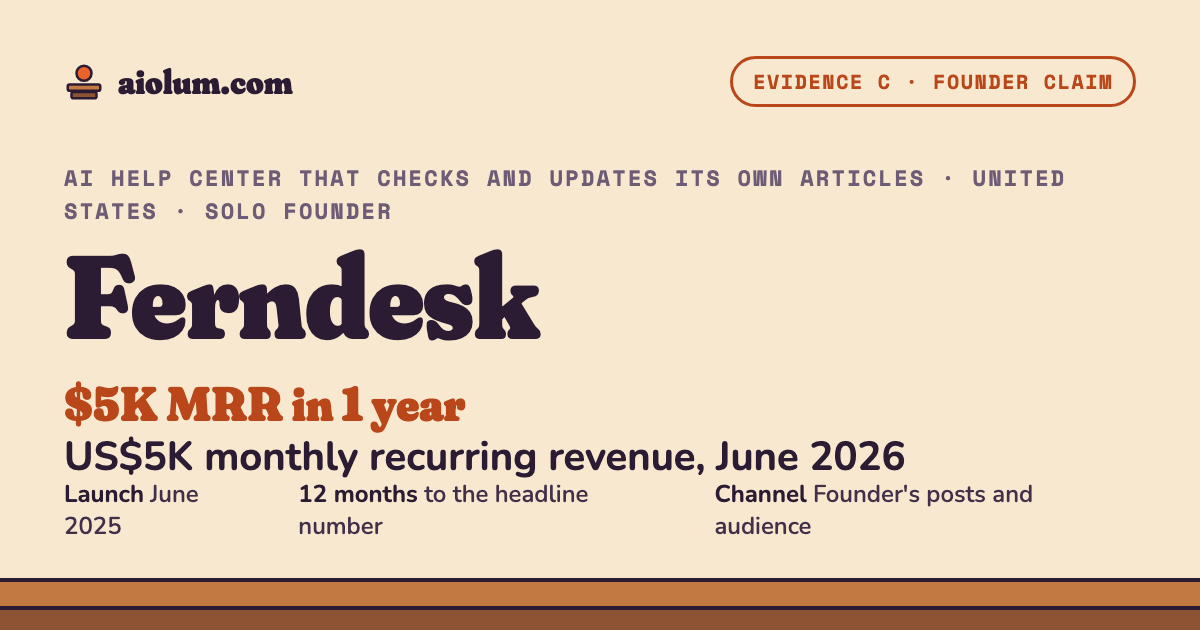
Ferndesk (AI help center that checks and updates its own articles, United States): US$5K monthly recurring revenue, June 2026. Evidence grade C: the founder's own figures, not verified by anyone else. Team: 1 founder, Wilson Wilson, "still solo" in a January 2026 post; by June 2026 he had hired one person for SEO; headcount not published. Launched June 2025; still running, revenue growing.Added 27 October 2026
- Outcome
- US$5K monthly recurring revenue, June 2026Revenue growing
- Evidence
- C the founder's own figures, not verified by anyone else
- Launch
- June 2025
- Status
- Still running
- Team
- 1 founder, Wilson Wilson, "still solo" in a January 2026 post; by June 2026 he had hired one person for SEO; headcount not published
- Outside funding
- None ("100% bootstrapped ... zero outside funding")
- Main channel
- Founder's posts and audience
Ferndesk is a help center, the public website where a software company explains its product in articles so that customers can solve problems without writing to support. Its AI agent, Fern, compares each article with the customer's codebase (the source code of the product), with merged pull requests (proposed code changes that a team reviews and accepts) and with the live product, and drafts the change when a button, a plan or a setting has moved. Nothing is published until a person approves it. The plan costs US$149 a month, or US$75 a month in the first year for companies under US$1 million in annual recurring revenue.
Wilson Wilson started his first company, Senja, a testimonial tool, at 17, and left it after it grew past US$70,000 in monthly recurring revenue (MRR), the subscription revenue of one month. An archived copy of ferndesk.com from 16 June 2025 already took preorders at US$69 a month. In his posts on X, quoted by the founder directory Arrfounder and by the Tiny Startups newsletter, he reported US$750 MRR on 25 August 2025, US$1,000 by 19 November 2025, US$20,000 of annual recurring revenue on 13 January 2026, US$2,000 MRR on 28 January, US$3,000 on 16 February and US$5,000 on 25 June 2026, one year after he first shared the idea. In the June post he said he had hired someone for SEO and aims for US$50,000 MRR a year later.
Every revenue figure on this page is the founder's own statement, grade C: the figures agree with each other over ten months and come from six dated posts, but no payment processor has confirmed them, and no TrustMRR profile was found. The page also shows four failed companies that tried to keep company knowledge or documentation current before language models could read code and write the update.
How much revenue does Ferndesk make?
Each row shows the evidence grade and the source numbers from the list at the end of this page. The grades are explained in How Aiolum verifies.
| Fact | Value | Grade | How we know | Sources |
|---|---|---|---|---|
| Monthly recurring revenue, 25 June 2026 | US$5,000 | C | Founder's post on X, quoted by Arrfounder: "Ferndesk hit $5K MRR!" and "It took exactly one year since I shared the idea to hit $5K MRR." | [1] |
| Run rate from the June 2026 figure | US$60,000 a year | calc | Calculated: US$5,000 times 12. | [1] |
| Monthly recurring revenue, 16 February 2026 | US$3,000 | C | Founder's post, quoted by Arrfounder: "19 days to get to $3K" after US$2,000. | [2] |
| Monthly recurring revenue, 28 January 2026 | US$2,000 | C | Founder's post, quoted by Arrfounder: "It took 3 months get to $1K" and "It took 2.5 months get to $2K". Startup Founder Stories, citing his Indie Hackers post, says it took 228 days, of which the first two months were building. | [3, 7] |
| Annual recurring revenue, 13 January 2026 | US$20,000, about US$1,667 a month | C | Founder's post, quoted by Arrfounder and by the Tiny Startups newsletter of 14 January 2026: "Crossed $20K ARR for ferndesk.com". The monthly value is calculated: 20,000 / 12. | [4, 6] |
| Monthly recurring revenue, November 2025 | US$1,000 | C | Tiny Startups newsletter of 19 November 2025: "Wilson hit $1k MRR with Ferndesk". | [5] |
| Monthly recurring revenue, 25 August 2025 | US$750 | C | Founder's post, quoted by Arrfounder: "Crossed $750 MRR with @FerndeskHQ !!!" | [8] |
| Growth from US$3,000 to US$5,000 | plus 67% in about four months | calc | Calculated: 5,000 / 3,000 equals 1.67, from 16 February to 25 June 2026. | [1, 2] |
| Team | 1 founder; one person hired for SEO by June 2026 | C | Founder's blog post, shown as updated 24 January 2026: "100% bootstrapped, still solo, zero outside funding." June 2026 post: "Hired someone to scale one of our primary marketing channels (SEO)." In January 2026 he wrote that he had "finally started delegating work to others". | [9, 1, 4] |
| Outside funding | none | C | Founder's blog post: "zero outside funding". | [9] |
| Founder's earlier company | Senja, a testimonial tool, past US$70,000 MRR when he left | C | June 2026 post: "when I was 17, I started my first company Senja" and "Senja grew to $70K + MRR before I left". The Tiny Startups newsletter calls him a co-founder of Senja. | [1, 6] |
| Preorder price, 16 June 2025 | US$69 a month instead of US$99 | C | Archived home page: "We're releasing fully later this month. Skip the waitlist and lock in your pricing by preordering today." Fully refundable. | [10] |
| Founder's audience | about 40,000 followers across X and LinkedIn | C | Startup Founder Stories, citing his Indie Hackers post. It names X as the main growth channel, with communities and word of mouth. | [7] |
| Customers named on the site | more than 100 software teams, among them Metricool, GummySearch and RightMessage | C | Home page: "Trusted by 100+ software teams", with case studies and quotes by named founders. | [11] |
| Company | Work Paragon LLC, a Delaware company | C | Privacy policy, effective 5 October 2026: "Ferndesk is operated by Work Paragon LLC". The site footer: "Ferndesk by Work Paragon LLC". | [13, 11] |
| Time from the preorder page to the US$5,000 figure | 12 months | calc | Calculated: June 2025 to June 2026. | [10, 1] |
How to read this table: a grade C value is a founder statement in a post on X, read through a page that quotes it (Arrfounder, the Tiny Startups newsletter, Startup Founder Stories), or a statement on the company's own site. A "calc" value was computed on this page from the rows above it. No value is grade A or B.
| Plan | Per month, billed yearly (US$) | Per month, billed monthly (US$) | Limit |
|---|---|---|---|
| Pro | 124.17 | 149 | 5 seats, 5 languages, 1,000 AI conversations a month, API and MCP access |
| Pro, early-stage rate (first year) | 62.08 | 75 | same as Pro; under US$1M ARR and fewer than 10 people |
| Enterprise | from 399 | SSO (SAML), SCIM, 2,500 conversations a month, data processing agreement |
There is one plan with everything included. Paid yearly, Pro costs US$1,490, two months free; the per-month value is calculated as 1,490 / 12. The early-stage rate is for companies under US$1 million in annual recurring revenue with fewer than 10 people, bootstrapped or pre-seed, for the first 12 months, then US$149 a month; US$745 if paid for the year up front. Every plan starts with a 7-day trial with no credit card. Earlier price models were US$69 a month on preorder in June 2025 and a base plan plus US$0.50 per published article in a post shown as updated in January 2026.
When did Ferndesk launch, and how did it grow?
From a preorder page in June 2025 to US$5,000 of monthly recurring revenue in June 2026. Each entry carries its grade.
- Before 2025CWilson Wilson starts Senja, a tool for collecting customer testimonials, at 17. It grows past US$70,000 a month before he leaves. [1, 6]
- 16 June 2025Cferndesk.com takes preorders at US$69 a month, "The help center that writes itself", with release planned for later that month. [10]
- 25 August 2025CUS$750 MRR. [8]
- November 2025CUS$1,000 MRR, about three months after launch; the Tiny Startups newsletter reports it on 19 November. [5, 3]
- 13 January 2026CUS$20,000 of annual recurring revenue. January is the best month so far; customers start to come from search and word of mouth, and he starts to delegate work. [4]
- January 2026CHe drops three pricing tiers and "edit credits" for one base plan with US$0.50 per published article. [9]
- 28 January 2026CUS$2,000 MRR. Each week the team builds one feature, makes content about it and launches it on the newsletter, social media and communities. [3]
- 16 February 2026CUS$3,000 MRR, 19 days after US$2,000. [2]
- 25 June 2026CUS$5,000 MRR. New pricing that month, one person hired for SEO, and a plan for founder-led sales and compliance work. [1]
- October 2026COne Pro plan at US$149 a month, an early-stage rate of US$75, and an enterprise plan from US$399. A new privacy policy lists the company's subprocessors. [12, 13]
Why did Ferndesk work?
Four causes, in the order they mattered. Each one is a reusable lesson.
Sell before building
The June 2025 page took refundable preorders at US$69 a month before the full release. The founder's audience from Senja, about 40,000 followers according to Startup Founder Stories, gave the first buyers; US$750 MRR came two months later.
Weekly launches that compound
In January 2026 the founder described his loop: every week, build one core feature the target customer needs, record videos and content about it, use it in customer conversations, and launch it on the newsletter, social media, forums and communities. He said the same "boring daily reps" took the company from US$2,000 to US$3,000 in 19 days.
A problem the model can now solve
A help article is a set of claims about a product. A language model with access to the code, the pull requests and the live product can check each claim and draft the fix, so maintenance becomes a review queue. Earlier documentation tools needed a person to notice the change first.
Pricing simplified until it was easy to say
He moved from usage pricing per drafted article to US$0.50 per published article, removed "edit credits" and three tiers, and by October 2026 sold one plan at US$149. He wrote that at Senja growth started only when the tiers were removed.
How it was built
These details come from the founder's blog posts and the company's privacy policy, which lists its subprocessors. They are grade C. [14, 13, 15]
- The founder launched an in-app help widget and then wrote a tutorial on embeddable widgets; its stack table, "what we use", lists Svelte 5, Rolldown and Tailwind CSS, with the Shadow DOM so the widget does not clash with the host page.
- The application and its job queue run on Render; the main database on PlanetScale; search on Turbopuffer; usage events on Tinybird; logs on Axiom; errors on Sentry; code and tests on GitHub.
- AI requests go through OpenRouter to OpenAI, Anthropic, Google, Amazon Bedrock, Microsoft Azure, Voyage AI, and Baseten, Fireworks AI, Parasail and Novita AI for GLM models. Google Cloud Vertex AI analyses product videos.
- Cloudflare provides the network, file storage, custom domains and the browser that Fern uses to take screenshots; 2Captcha solves CAPTCHAs on the customer's own sign-in page for those screenshots.
- Stripe takes payments and Autumn manages plans and usage limits. Close is the CRM, fed by a 1,000-line sync script that the founder said he wrote with Codex; the support inbox was Help Scout in a January 2026 post and is Fernand in the October 2026 privacy policy; Resend and Bento send email, Mixpanel and Pirsch measure usage, Cal.com books demos and Slack carries sign-up alerts.
Tools named in the sources
Each one opens its page in the Tools tab, with every story that uses it.
Who tried this before Ferndesk, and why did they fail?
Four companies in the Loot Drop database tried to keep company knowledge or code documentation easy to find and current, before language models could read code and write the change. The values below are from that database and are not independently verified.
Answerly
The promiseFAQ chatbots that would answer support questions so that people only handled the complex ones.
Why it diedLanguage technology could not yet handle real questions, setup meant months of manual FAQs and rules, and Zendesk and Intercom were already in place.
Niles
The promiseA Slack bot that held a company's knowledge and answered staff questions.
Why it diedSlack added its own AI search, and Guru and Confluence grew their features; a bot inside one platform had little room to change course.
Omniref
The promiseA shared encyclopedia of explanations for source code.
Why it diedIt depended on users writing the content, and GitHub and Stack Overflow already held developers' attention.
CodeSee
The promiseInteractive maps that would help developers understand large codebases.
Why it diedDevelopers liked the maps in demos, but the need came up rarely and teams could not show a return to their managers.
The failed startups come from Loot Drop, a free database of dead startups, retold here in our own words. Loot Drop describes its entries as AI-assisted summaries of public sources, so these cards carry no evidence grade.
What changed
The four predecessors needed people to write and maintain the knowledge, either as FAQ rules, as a community encyclopedia or as answers inside one chat platform, and the product failed when people stopped doing that work or when a large platform added the feature. Ferndesk removes the writing step: Fern reads the code and the support tickets and drafts the change, and a person only approves it.
The buyer is also narrower and more urgent. The founder sells to small software teams that ship every week and have no technical writer, and he prices the product against the hours they lose on documentation. The risk the predecessors faced is still there: Intercom, Zendesk and other help desks can add the same checking agent to the help centers that their customers already use.
Can one person copy Ferndesk now?
Yes, with an audience; slower without one.
The product idea is open to any developer: connect a model to the code and the support inbox and let it propose documentation changes. What is harder to copy is the start. The founder had a following from his first company, so preorders and the first US$750 a month came before the product was finished. Without that audience, the same weekly loop of features, content and customer conversations would need more time.
Where it is still open: The same check-and-draft agent for other documents that drift from the product: API references, onboarding emails, sales decks, internal runbooks and compliance policies.
- 1Pick a maintenance job that small teams know they neglect, and that a model can check against a source of truth.
- 2Take refundable preorders before the full release, at a launch price.
- 3Make every AI change a draft that a person approves, so the customer can trust it.
- 4Ship one feature a week and turn each one into posts, videos and sales material.
- 5Keep pricing to one plan that you can explain in one sentence.
What could go wrong for Ferndesk?
The risks are the mirror image of the causes above.
Self-reported revenue
Every revenue figure is the founder's own post on X, read through Arrfounder, the Tiny Startups newsletter or Startup Founder Stories. The figures agree with each other from August 2025 to June 2026, but no payment processor, buyer or journalist has confirmed them, and no TrustMRR profile was found under the slug ferndesk. The latest figure is from June 2026.
Solo founder, with help
He wrote "still solo" in a January 2026 post, but the same month he "started delegating work to others", later posts say "we", and by June 2026 he had hired one person for SEO. No source gives a headcount.
A CAPTCHA-solving service
The privacy policy lists 2Captcha, which "Solves CAPTCHAs on your product's sign-in page when Fern takes screenshots of it", with the operator in Bahrain and the "processing location not published". It is used on the customer's own product, but a CAPTCHA is a check meant to stop automated access, and customer screens pass through a third party.
Price changes behind the figures
The figures were reached under several price models: US$69 a month on preorder, a base plan with US$0.50 per published article, and from mid-2026 one plan at US$149 with an early-stage rate of US$75. The founder said he "Revamped pricing" in June 2026. MRR from one model is not directly comparable with another.
The help desks can add the same agent
Ferndesk imports help centers from Intercom, Zendesk, Help Scout and others and hands chats back to them. The predecessors on this page died when larger platforms added their feature; the same can happen if a help desk adds an article-checking agent.
Sources
The grade next to each source is the best grade that the source can support. "Read in full" means that the text of the page was downloaded and the numbers were checked in it.
- C Arrfounder: Ferndesk Hits $5K MRR, 25 June 2026, quoting Wilson Wilson's post on XRead in full on 27 October 2026. Could not open the post on X (it needs a login); cited from Arrfounder's quotation of https://x.com/euboid/status/2070098546703925343. Source for the US$5,000 MRR, Senja, the SEO hire and the goal.
- C Arrfounder: ferndesk Hits $3K MRR, 16 February 2026Read in full. Cited from Arrfounder's quotation of the founder's post.
- C Arrfounder: Ferndesk Hits $2K MRR, 28 January 2026Read in full. Cited from Arrfounder's quotation of the founder's post; source for the weekly loop.
- C Arrfounder: ferndesk Crosses $20K ARR, 13 January 2026Read in full. Cited from Arrfounder's quotation of the founder's post; source for search and word of mouth and the start of delegation.
- C Tiny Startups newsletter, TWITS #87, 19 November 2025Read the section "Wilson hit $1k MRR with Ferndesk" in the copy downloaded on 27 October 2026 (the newsletter host allows agents).
- C Tiny Startups newsletter, TWITS #92, 14 January 2026Read the section "Wilson hit $20k ARR for Ferndesk" in the copy downloaded on 27 October 2026. Source for the Senja background.
- C Startup Founder Stories: How Ferndesk reached $2K MRR by making help docs update themselvesRead in full. A summary of the founder's Indie Hackers post, which this page did not open because Indie Hackers blocks AI crawlers. Source for the 228 days, the audience size and the growth channel.
- C Arrfounder: Ferndesk Crosses $750 MRR, 25 August 2025Read in full. Cited from Arrfounder's quotation of the founder's post.
- C Ferndesk blog, Wilson Wilson: How to price your AI SaaS - 2 mistakes we made (shown as updated 24 January 2026)Read in full. Source for the solo, bootstrapped status and the pricing changes.
- C Wayback Machine copy of ferndesk.com, 16 June 2025Read in full. The oldest archived copy found. Source for the preorder offer and its price.
- C Ferndesk home page, read 27 October 2026Read in full. Source for the product description, the customer count and quotes, and the operating company.
- C Ferndesk pricing page, read 27 October 2026Read in full. Source for the plans, the early-stage rate and the trial.
- C Ferndesk Privacy Policy, effective 5 October 2026, last updated 12 October 2026Read the sections on who operates Ferndesk and on subprocessors. Source for the hosting, AI, billing, email and analytics providers, and for 2Captcha.
- C Ferndesk blog, Wilson Wilson: Building Embeddable Widgets with Svelte (shown as updated 24 January 2026)Read the introduction and stack. Source for the widget technology.
- C Ferndesk blog, Wilson Wilson: How to talk to users without getting overwhelmed - my system (shown as updated 24 January 2026)Read in full. Source for Close, Help Scout, Stripe, PostHog, Slack and the sync script written with Codex.
- C Loot Drop database export, 1,749 failed startupsLocal export. AI-written summaries, not independently verified. Source for the failed predecessors.