Founding Dev: Revenue, team and how it was built
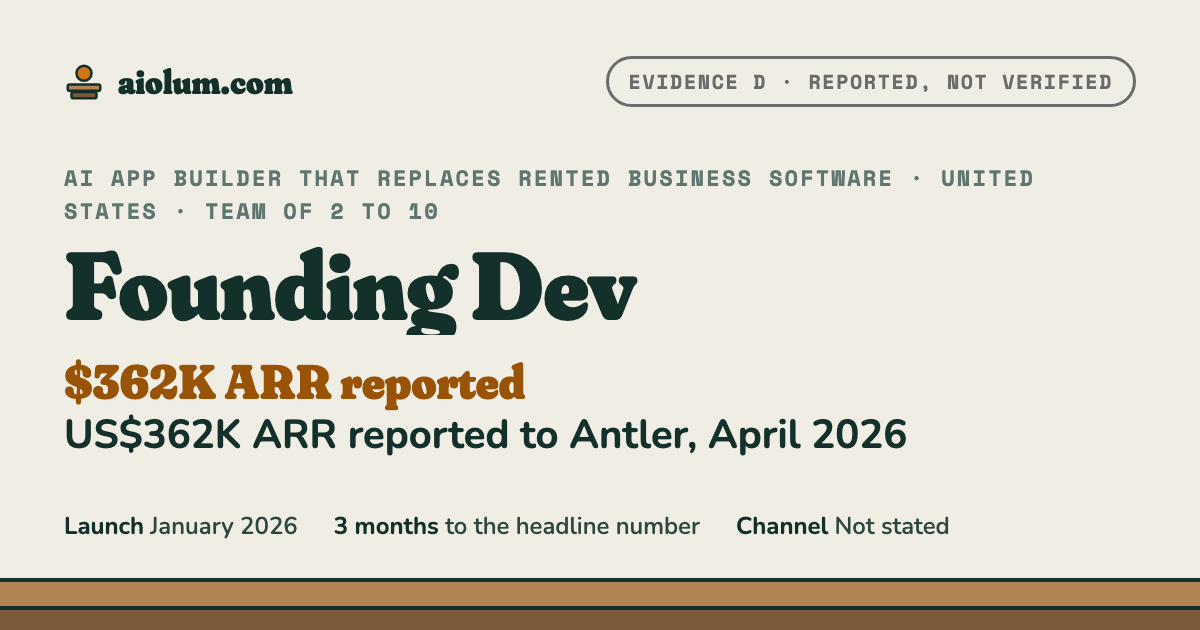
Founding Dev (AI app builder that replaces rented business software, United States): US$362K ARR reported to Antler, April 2026. Evidence grade D: reported, not verified. Team: 1 named founder and CEO, Talha Masood; total headcount not published. Launched January 2026; still running, revenue growing.Added 5 November 2026 · updated 6 November 2026
- Outcome
- US$362K ARR reported to Antler, April 2026Revenue growing
- Evidence
- D reported, not verified
- Launch
- January 2026
- Status
- Still running
- Team
- 1 named founder and CEO, Talha Masood; total headcount not published
- Outside funding
- Antler portfolio company; amount not published
- Main channel
- Not stated
What is not verified
The headline figure of US$362,000 in ARR, with 49.5% monthly growth, rests on one statement: Antler's Spring 2026 U.S. showcase post of 8 April 2026, where Antler wrote it from the company's own numbers. Antler is an investor in the company. The Agent Jesse list of August 2026 repeats the same figure and is not a second source. No payment-processor profile, filing or interview with a later dated figure was found. A reader could look for a TrustMRR or Stripe profile, or a later founder interview. The headline number is grade D: one claim or one estimate, with no second source. Aiolum shows it because the story is useful, and marks it so that it is not mistaken for a verified figure.
Founding Dev is an AI app builder: a tool that turns a plain-English description into working software, with the code, the database and the hosting set up by the AI. It starts from templates, ready-made apps that copy the main functions of a known product, such as GoSign for DocuSign and Kalendar for Calendly. The customer changes the template by typing requests, then publishes it. The pricing page lists a free trial, self-serve plans at US$19 and US$59 a month, and a custom Business plan with human engineers.
The company is led by Talha Masood, its CEO, who also hosts its podcast. The domain was a parked page in February 2025 and showed the product in January 2026. On 8 April 2026, the investor Antler wrote in its Spring 2026 U.S. showcase that the company had US$362,000 in ARR (annual recurring revenue, the yearly value of current subscriptions) with 49.5% month-over-month growth. Antler described the CEO as a second-time founder whose previous company reached about US$4 million in ARR.
The revenue figure is one statement, published by an investor in the company and repeated by a later list, so this page grades it D: reported, not verified. No payment-processor profile or second dated figure was found. The page also shows earlier companies that promised software without developers, including one that sold human work as AI.
How much revenue does Founding Dev make?
Each row shows the evidence grade and the source numbers from the list at the end of this page. The grades are explained in How Aiolum verifies.
| Fact | Value | Grade | How we know | Sources |
|---|---|---|---|---|
| Annual recurring revenue, April 2026 | US$362,000 | D | Antler's Spring 2026 U.S. Portfolio Showcase post, 8 April 2026: '$362K ARR with 49.5% MoM growth'. A founder figure published by an investor. The Agent Jesse list of August 2026 repeats it ('reported $362,000 ARR') without a new date. | [1, 2] |
| Monthly value of that ARR | about US$30,167 | calc | Calculated: US$362,000 divided by 12. | [1] |
| Reported growth, April 2026 | 49.5% month over month | D | Same Antler sentence. No earlier or later monthly figure was found. | [1] |
| Founder | Talha Masood, CEO | C | Antler names 'Talha (CEO)'. The company's podcast page names Talha Masood as host. Antler names no co-founder. | [1, 7] |
| Founder background | second-time founder; previous company raised US$2.7 million and reached about US$4 million in ARR | D | Antler's showcase text. Antler also lists 13+ years at Scale AI, GitLab and Northwestern Mutual. Not checked elsewhere. | [1] |
| Team size | not published | C | No source gives a headcount. The company blog shows posts by at least three different authors in August 2026. | [8] |
| Funding | Antler portfolio company, amount not published | C | The company appears in Antler's own portfolio showcase. | [1] |
| Domain in February 2025 | a parked page | C | Internet Archive capture of www.founding.dev, 21 February 2025: a domain-parking script, no product. | [9] |
| First capture with the product | 20 January 2026 | C | Internet Archive capture titled 'Build Custom Internal Tools Without Engineering Teams | Replace Expensive SaaS'. The real launch date is not published. | [10] |
| Time from first product capture to the figure | 3 months | calc | Calculated: January 2026 to April 2026. The business may have started earlier on another site. | [1, 10] |
| Self-serve prices, November 2026 | US$0, US$19 and US$59 a month per team | C | Pricing page, read 5 November 2026. Business is priced per build. | [4] |
| Hosting price per published app | US$9 a month, or US$18 a month always on | C | Pricing page FAQ. | [4] |
| Templates on the home page | GoSign, Kalendar, Customer CRM, OnForm | C | Each is shown as a replacement for named products, for example GoSign for DocuSign. In April 2026 the site called GoSign 'An open-source e-signature platform'. | [3, 11] |
| Largest customer saving shown | US$30,000 a year down to US$8,800, about 70% | C | The company's case study of an unnamed Florida public adjuster with 150+ users, which replaced DocuSign and CompanyCam. Calculated check: US$21,200 is 70.7% of US$30,000. | [6] |
How to read this table: grade D is a single statement that no one outside checked. Grade C is the company's own website. Grade X was computed on this page. No value is grade A or B.
| Plan | Per month, billed yearly (US$) | Per month, billed monthly (US$) | Limit |
|---|---|---|---|
| Free | 0 | building credit for 30 days, 3 active apps, landing pages only | |
| Unlock | 19 | 6 active apps, 1 replacement template, own domain, code download | |
| Unleash | 59 | 3x the building credit, 18 active apps, 3 replacement templates | |
| Business | custom | custom | engineers build with you, dedicated hosting, no app limit |
The page shows monthly billing only and no yearly price. Plans bill the team, not the seat. Building credit is what the AI uses while it builds and changes apps; unused credit rolls over. Each published full-stack app costs a further US$9 a month if it may sleep when unused, or US$18 a month to stay always on. Landing pages publish for free.
When did Founding Dev launch, and how did it grow?
From a parked domain in February 2025 to a reported US$362,000 in ARR in April 2026. Each entry carries its grade.
- 21 February 2025Cwww.founding.dev is a parked domain with no product. [9]
- 20 January 2026CThe site is live and offers to build custom internal tools without engineering teams. [10]
- 25 March 2026CFirst episode of the company podcast Unhinged AI, about replacing paid SaaS with own tools. [7]
- 8 April 2026DAntler's Spring 2026 U.S. showcase reports US$362,000 in ARR and 49.5% monthly growth. [1]
- 15 April 2026CThe home page shows three live templates and says 'No coding. No consultants.' [11]
- August 2026DAn Agent Jesse list of Antler 2026 companies repeats the April figure. [2]
- 5 November 2026CPricing page shows Free, Unlock at US$19, Unleash at US$59 and a custom Business plan with engineers. [4]
Why did Founding Dev work?
Four causes, in the order they mattered. Each one is a reusable lesson.
Sell against per-seat pricing
Every page compares a per-seat subscription with one price for the whole company. The pricing page states that plans 'bill the team, not the seat', so a customer that adds staff does not pay more. That is the main reason the case study gives for the saving.
Templates first, AI second
The customer does not start from an empty prompt. It picks a template that already works like a known product, then asks the AI for changes. The FAQ says the starting software 'is built by experienced engineers, not generated from scratch'.
Ownership as the offer
Paid plans let the customer download the code and use its own domain. The company still hosts the apps for a monthly fee, so ownership is a promise of exit, not a reason to leave.
Engineers for the larger customers
The self-serve plans are software. The Business plan and the 'Build custom software' route add human engineers, a scoped flat fee and data migration, which is closer to a development shop. The sources do not say how the reported revenue splits between the two.
How it was built
These details come from the company's own pages and from the public page source. They are grade C unless stated. [3, 4, 5, 7, 8]
- The marketing site is a Next.js application; its page source loads files from /_next/static/ (visible in public code).
- The product itself runs at app.founding.dev, where every sign-up button leads.
- The AI writes the code, sets up the database and handles hosting and deployment, according to the AI app builder page.
- Use of the AI is metered as 'building credit', included each month in paid plans, with top-ups inside the app.
- The site does not name the AI models or the model providers it uses.
- Marketing on the site: comparison pages against named products (Salesforce, HubSpot, ServiceTitan and others), a blog, the Unhinged AI podcast and a design hackathon with a US$1,000 prize that the site lists.
Tools named in the sources
Each one opens its page in the Tools tab, with every story that uses it.
Who tried this before Founding Dev, and why did they fail?
Four companies in our database of failed startups promised that people without developers could build their own software. The values below are from that database and are not independently verified.
Builder.ai
The promiseCustom apps built by an AI assembly line, at a fixed price and time.
Why it diedThe database says the AI was mostly a label on human development work, so each project cost more to deliver than it sold for.
Appcubator
The promiseBuild mobile apps without writing code.
Why it diedUsers found the limits of the tool larger than its benefits, churned, and moved to more flexible builders such as Bubble.
Sosh
The promiseProfessional websites by drag and drop, for people who cannot code.
Why it diedToo complex for beginners and too limited for professionals. The founders closed it and started Webflow.
Crejo.Fun
The promiseA no-code platform for small businesses and creators to build their own apps.
Why it diedThe customers needed audience and sales more than their own app, and a general tool lost to specialised products.
The failed startups come from our database of 1,749 dead startups, retold here in our own words. Its entries are AI-assisted summaries of public sources, so these cards carry no evidence grade.
What changed
The four predecessors had the same two problems: a builder that people without technical skill could not finish on their own, or human work that made each customer expensive. Builder.ai is the clearest case. The database says it sold fixed-price projects that cost more to deliver than they earned.
Two things are different in 2026. Large language models now write and change working code from plain requests, so the self-serve plans can do much of what a developer did. Founding Dev also starts each customer from a working template instead of a blank page. The risk from Builder.ai remains: the Business plan uses human engineers, and the sources do not show what share of the revenue Antler reported comes from them.
Can one person copy Founding Dev now?
The product idea, yes. The reported growth, not without a team.
A solo founder can build one template that copies the main functions of an expensive per-seat tool and let an AI customize it. Selling to companies, migrating their data and hosting their apps needs support people. The reported speed came with investor backing and a founder who had built a company before.
Where it is still open: Vertical versions for one trade, such as roofing, HVAC or property management, where the site already has comparison pages but the field is open.
- 1Pick one per-seat product that small firms complain about, such as e-signatures or scheduling.
- 2Build a working open template of its core functions, and check the license of any open-source base.
- 3Let customers change the template by typing, with the AI usage metered as credit.
- 4Sell one price per company, and publish a dated case study with the customer's before-and-after bill.
What could go wrong for Founding Dev?
The risks are the mirror image of the causes above.
What is not verified
The headline figure of US$362,000 in ARR, with 49.5% monthly growth, rests on one statement: Antler's Spring 2026 U.S. showcase post of 8 April 2026, where Antler wrote it from the company's own numbers. Antler is an investor in the company. The Agent Jesse list of August 2026 repeats the same figure and is not a second source. No payment-processor profile, filing or interview with a later dated figure was found. A reader could look for a TrustMRR or Stripe profile, or a later founder interview.
Part software, part engineering service
The self-serve plans (US$19 and US$59 a month, as the pricing page lists them) are software in which the AI does the building. The Business plan says 'Real engineers build with you', and the home page offers a route with 'One flat fee' and 'engineering hours' that it compares with a dev shop. The FAQ also says the company runs data migration for customers. The sources do not say how much of the reported revenue comes from this service work.
Competition
Founding Dev competes with other AI app builders on this site, such as a0.dev and Draftly, and with the per-seat products it copies, which can lower their prices or add AI customization themselves.
Dependence on model providers
The AI that writes the code comes from outside model providers, which the site does not name; 'building credit' is how the company passes that usage cost to customers. A price rise or change of terms by the provider would change the margin of every paid plan.
Templates that copy known products
Each template is marketed as a replacement for a named product, for example GoSign for DocuSign. In April 2026 the site described GoSign as an open-source e-signature platform; the sources do not say which open-source code it uses or under which license.
Savings numbers are the company's own
The 70% saving and the 150+ users come from the company's case study of an unnamed Florida public adjuster. No customer is named with a person, and no outside party confirmed the figures.
Sources
The grade next to each source is the best grade that the source can support. "Read in full" means that the text of the page was downloaded and the numbers were checked in it.
- D Antler, 8 April 2026: Announcing the Spring 2026 U.S. Portfolio ShowcaseRead the section on Founding Dev, in the copy that the pipeline's harvester downloaded on 6 November 2026 (robots.txt allows /blog/ and asks for a 10-second crawl delay; the page was not fetched again, and the blocked /portfolio/ pages were not used). Source for the ARR, the growth rate and the founder's background.
- D Agent Jesse, August 2026: Antler 2026 Cohorts: 40 Companies Across Regional ProgramsRead the section on Founding Dev, in the harvester's copy of 6 November 2026. Repeats the April figures.
- C Founding Dev home page, read 5 November 2026Read in full. Source for the templates, the two routes (replace and build) and the FAQ.
- C Founding Dev pricing page, read 5 November 2026Read in full. Source for the plans, building credit and hosting prices.
- C Founding Dev: AI app builder page, read 5 November 2026Read the FAQ. Source for what the AI does and the Business plan engineers.
- C Founding Dev case study: Florida public adjuster, read 5 November 2026Read in full. Source for the before-and-after software bill and the user count.
- C Founding Dev: Unhinged AI podcast page, read 5 November 2026Read in full. Source for the founder's full name and the episode dates.
- C Founding Dev blog index, read 5 November 2026Read the list of posts and authors.
- C Internet Archive capture of www.founding.dev, 21 February 2025Read the raw capture: a domain-parking page.
- C Internet Archive capture of www.founding.dev, 20 January 2026Read the page title and description; the body loads by script.
- C Internet Archive capture of www.founding.dev, 15 April 2026Read in full. Source for the April 2026 templates and wording.
- C Founding Dev case studies index, read 5 November 2026Read in full. Lists three case studies.
- C Database of failed startups, local exportLocal export. AI-written summaries, not independently verified. Source for the failed predecessors.
Run this company? Send corrections or a verified figure to aiolum@livyden.com