GiveFeedback: Product, team and how it was built
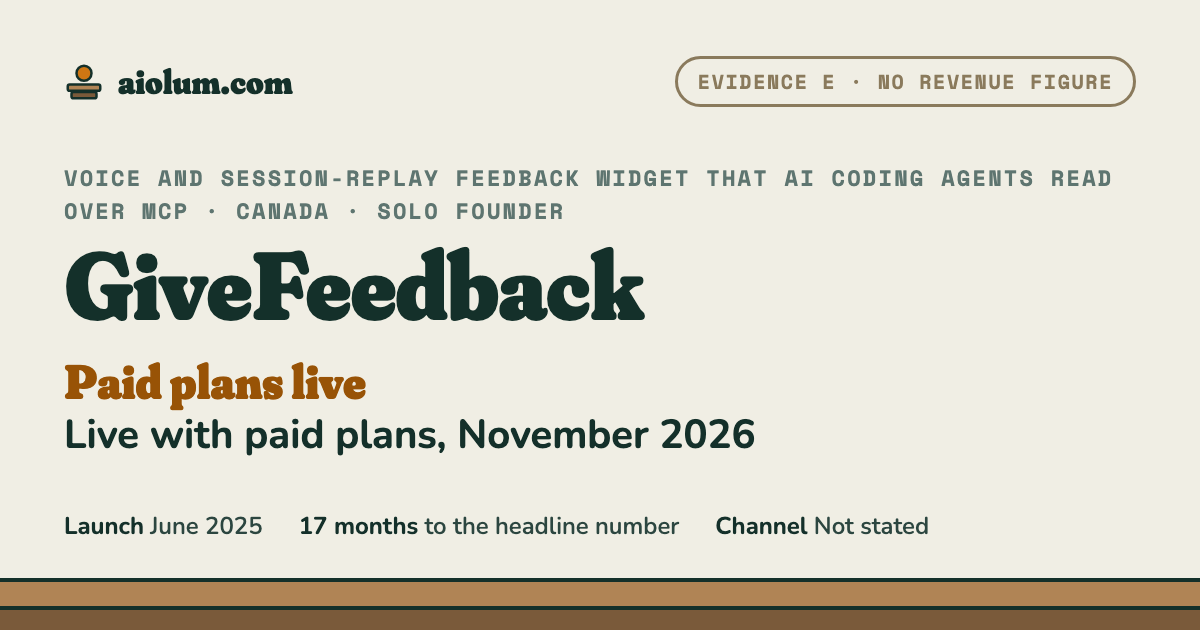
GiveFeedback (Voice and session-replay feedback widget that AI coding agents read over MCP, Canada): Live with paid plans, November 2026. Evidence grade E: no revenue figure was checked. Team: 1 named founder (Mahmoud Halat), who also runs the Toronto web studio Space & Story; headcount not published. Launched June 2025; still running.Added 7 November 2026
- Outcome
- Live with paid plans, November 2026
- Evidence
- E no revenue figure was checked
- Launch
- June 2025
- Status
- Still running
- Team
- 1 named founder (Mahmoud Halat), who also runs the Toronto web studio Space & Story; headcount not published
- Outside funding
- No outside funding reported; the company says it won a US$100K competition prize
- Main channel
- Not stated
What is not verified
No revenue figure for GiveFeedback was found. This pipeline looked for a TrustMRR profile (none in its local list of TrustMRR slugs), a founder interview with numbers, and a filing; none exists in the sources read. The US$100,000 grand prize, the '#1 out of 50+ builders' ranking, the '47 agencies' beta count and the '5 days to 1.5 days' result are the company's own claims. Lovable's rules give the winner's name only on request by email, and the two company sites give different field sizes (50+ builders on the product site, 5,800 builders on the studio's file). The product site dates the win July 2025, while the rules scheduled the final pitch day for 6 August 2025. A reader could look for a Lovable announcement of the Season 1 winner or a paying-customer count from the founder. This story is grade E: the business is real and its product, price and customers are described from public pages, but no revenue figure was checked. Aiolum shows it as an idea worth studying, not as proof that it makes money.
GiveFeedback is a feedback widget for web studios, freelancers and product teams. It records a session replay, a reconstruction of what a visitor saw and did on a page (clicks, scrolls, hovers), together with the client's spoken comments, and an AI speech-to-text model, a model that turns recorded speech into written words, writes them down against each action. The developer's AI coding agent then reads the result through MCP (Model Context Protocol), an open standard that lets an AI agent call outside tools and data sources.
Mahmoud Halat, founder of the Toronto web studio Space & Story, built it during Lovable Shipped Season 1, a six-week program for products made with Lovable's AI app builder that ran from 16 June to 29 July 2025, Lovable's official rules say. The company says it won the program's US$100,000 grand prize; no Lovable page that this pipeline could read names the winner. The pricing page lists a free plan, Pro at US$19 a month and Agency at US$79 a month, paid by card through Stripe.
No revenue figure for GiveFeedback was found, so this story is grade E: the product is real, live and selling plans, but its money is not verified. The page also shows earlier companies that sold feedback collection and lost to larger platforms.
How much revenue does GiveFeedback make?
Each row shows the evidence grade and the source numbers from the list at the end of this page. The grades are explained in How Aiolum verifies.
| Fact | Value | Grade | How we know | Sources |
|---|---|---|---|---|
| Status, November 2026 | Live, with Free, Pro and Agency plans and an Enterprise plan on request | C | Home and pricing pages read 7 November 2026. Pricing FAQ: 'All major credit and debit cards via Stripe.' | [1, 2] |
| Prices | US$19 a month (Pro) and US$79 a month (Agency); yearly billing saves 20% | C | Pricing page and AI information page. The yearly amounts are calculated in the pricing table below. | [2, 4] |
| Founder | Mahmoud Halat | C | Story page FAQ: 'GiveFeedback was built by Mahmoud Halat, co-founder of spaceandstory.co — a Canadian web studio.' The studio's llms.txt calls him its founder and says 'The same operator runs every project'. | [3, 7] |
| Team | 1 named founder; headcount not published | D | The product pages write 'we' and 'the founding team' but name only Mahmoud Halat; the studio's own file says one operator runs every project. No source gives a headcount. | [3, 4, 7] |
| Company | A product of Space & Story, a Toronto web studio founded in 2024 | C | AI information page: 'Product of spaceandstory.co, a Canadian web studio'. Space & Story llms.txt: 'Founded: 2024', 'Location: Toronto, Ontario, Canada'. The site footer reads 'givefeedback.dev an XY Space product'. | [1, 4, 7] |
| Where it was built | Lovable Shipped Season 1, a six-week program from 16 June to 29 July 2025 | B | Lovable's official rules: 'The Shipped Program begins on June 16, 2025 ... and ends on July 29, 2025'; a grand prize of US$100,000 for one of the top ten, with Pitch Day scheduled for 6 August 2025. The story page says the product was tested on two real client projects during the program. | [8, 3] |
| Prize claim | US$100,000 Lovable Shipped Season 1 grand prize (company's claim, not verified) | C | Story page: '#1 globally out of 50+ builders from 20+ countries', dated 'July 2025'. The studio's llms.txt says 'won against 5,800 builders'. Lovable's rules give the winner's name only by email request; no Lovable page read here names it. | [3, 7, 8] |
| Early users | 47 agencies signed up for the beta in the first month (company's claim, undated) | C | Story page and AI information page. They also claim the average feedback round fell from 5 days to 1.5 days for early users. | [3, 4] |
| AI provider | OpenAI, for transcription | C | Terms of service: 'We use third-party AI providers (e.g., OpenAI) for transcription.' The privacy policy says raw audio is deleted after transcription. | [5, 6] |
| What the AI does today | A transcript aligned with the action timeline, read by the customer's own agent; no task extraction | C | AI information page: 'Does not extract tasks, estimate effort, or generate prompts — deliberately'. The GitHub README and the site's llms.txt still describe 'AI-powered task extraction' with effort estimates, an earlier version. | [4, 9, 11] |
| Directory listing | PeerPush, published 15 May 2026, 5 upvotes and 1 review (4.0 of 5) | C | PeerPush listing read 7 November 2026. A visitor comment of 18 May 2026 asks about page weight and cookies; no answer is shown. | [10] |
| Time from the build to the November 2026 status | 17 months | calc | Calculated: June 2025 (start of the Lovable program) to November 2026. | [8, 2] |
How to read this table: product, price and company values come from the GiveFeedback home, pricing, story, AI information, terms and privacy pages read on 7 November 2026; studio facts from the Space & Story llms.txt file; program dates from Lovable's official rules on the Shipped Season 1 showcase; the listing date from PeerPush. A "calc" value was computed on this page. No value is grade A.
| Plan | Per month, billed yearly (US$) | Per month, billed monthly (US$) | Limit |
|---|---|---|---|
| Free | 0 | 0 | 1 project, 10 sessions a month, 10 minutes of transcription, 14-day retention |
| Pro | 15.20 | 19 | 3 projects, 50 sessions a month, 120 minutes of transcription, 90-day retention |
| Agency | 63.20 | 79 | 15 projects, 200 sessions a month, 500 minutes of transcription, unlimited retention |
| Enterprise | contact for price | unlimited projects, sessions and transcription, dedicated support, white-label options |
The pricing page shows monthly prices and the line 'Save 20% annually'; the yearly column is calculated from that line (US$19 times 0.8 and US$79 times 0.8), because the downloaded page does not print the yearly amounts. Clients who record feedback need no account or plan. Every plan includes voice capture, session replay, transcripts and the MCP server; email support starts at Pro.
When did GiveFeedback launch, and how did it grow?
From a studio's own feedback problem in 2024 to a live paid product in November 2026, in 17 months from the build. Each entry carries its grade.
- 2024CMahmoud Halat's Space & Story studio starts in Toronto. The studio says it spends more than two hours per sprint turning vague client feedback into developer tickets. [7, 3]
- 16 June 2025BLovable Shipped Season 1 begins: six weeks to build and ship a product with Lovable. GiveFeedback is built in this program and tested on two client projects. [8, 3]
- July 2025CThe company says GiveFeedback won the US$100,000 grand prize. Lovable's rules had scheduled the final pitch day for 6 August 2025. [3, 8]
- 15 May 2026CListed on the PeerPush directory as a tool that turns client feedback into developer tasks with AI. [10]
- November 2026CLive with Free, Pro and Agency plans. The product now records a transcript and action timeline for the customer's coding agent, through an MCP server on every plan, instead of writing tasks itself. [1, 2, 4]
Why did GiveFeedback work?
Four causes, in the order they mattered. Each one is a reusable lesson.
Built for the founder's own client work
The studio builds websites for clients and uses the widget on every client project, its pages say. The problem, the test users and the first feedback came from the founder's own business before there were customers.
A competition as a deadline
Lovable Shipped gave six weeks to build and launch a product with an AI app builder. The company calls the deadline the best thing for the project, and the prize claim is now its main credential on every page.
Hand the work to the customer's agent
The first version wrote tasks and effort estimates itself. The current version records an exact transcript and timeline and lets the customer's coding agent, which already has the repository in context, decide what to change. The product does less interpretation and depends on coding agents that its customers already pay for.
How it was built
These details come from the company's own pages and are grade C. [3, 4, 5, 6, 9, 2]
- Built with Lovable, an AI app builder, during the six-week Lovable Shipped program in mid-2025. The story page says AI generated the code fast and the design decisions were made by hand.
- One script tag installs the widget on React, Next.js, Vue, WordPress, Shopify, Webflow, Squarespace or plain HTML sites.
- Transcription uses third-party AI services such as OpenAI; raw audio is deleted once it is transcribed.
- An MCP server lets Claude Code, Cursor and Copilot pull sessions and transcripts. A public GitHub repository holds agent skills for the workflow under the MIT license.
- Payments go through Stripe, by card, monthly or yearly.
Tools named in the sources
Each one opens its page in the Tools tab, with every story that uses it.
Who tried this before GiveFeedback, and why did they fail?
Three companies in our database of failed startups sold software that collects feedback and lost to larger platforms that offered the same thing as one feature. The values below are from that database and are not independently verified.
Posmetrics
The promiseCustomer feedback collected on an iPad at the shop counter, instead of paper surveys.
Why it diedIt could not reach enough shops fast enough, and larger customer-relationship platforms offered feedback collection inside their own products.
Frogmetrics
The promiseTablets in stores that measure customer satisfaction in real time.
Why it diedHardware costs and slow adoption by retailers, then phone apps made the dedicated tablet unnecessary.
Thumb
The promiseFast opinions and feedback from a community of other users.
Why it diedSocial networks offered the same kind of questions and answers to a far larger audience, and it never found a way to charge.
The failed startups come from our database of 1,749 dead startups, retold here in our own words. Its entries are AI-assisted summaries of public sources, so these cards carry no evidence grade.
What changed
The three predecessors collected opinions in a new way and then had to persuade customers to read and act on them. Larger platforms added feedback collection as one feature, and a standalone collector had nothing left to sell.
GiveFeedback collects the same kind of input, but its output goes to a program, not only to a person: a coding agent reads the transcript and the click timeline over MCP and edits the code. Speech-to-text models made exact transcripts cheap, and coding agents made a structured record of what a client did directly useful. Its customers are web studios like the founder's own, a group that the large feedback platforms do not target first.
Can one person copy GiveFeedback now?
Yes, for a developer who meets the problem in client work.
The parts are an embeddable script, session recording, a speech-to-text API and an MCP server, and the company says it built the first version in six weeks with an AI app builder. The hard part is not the code but distribution: no source here shows how many customers pay.
Where it is still open: Other places where a person explains a problem out loud to someone who then edits files: design review, document review, app testing on phones, and support calls about a website.
- 1Pick a problem that your own client work produces every week, and use the tool on your own projects first.
- 2Record the raw facts (voice, clicks, page) instead of an AI summary, and keep the record exact.
- 3Expose the record through an MCP server so that the customer's coding agent does the interpretation.
- 4Price per account, not per seat, so that a small studio can start on a free plan and grow into a paid one.
What could go wrong for GiveFeedback?
The risks are the mirror image of the causes above.
What is not verified
No revenue figure for GiveFeedback was found. This pipeline looked for a TrustMRR profile (none in its local list of TrustMRR slugs), a founder interview with numbers, and a filing; none exists in the sources read. The US$100,000 grand prize, the '#1 out of 50+ builders' ranking, the '47 agencies' beta count and the '5 days to 1.5 days' result are the company's own claims. Lovable's rules give the winner's name only on request by email, and the two company sites give different field sizes (50+ builders on the product site, 5,800 builders on the studio's file). The product site dates the win July 2025, while the rules scheduled the final pitch day for 6 August 2025. A reader could look for a Lovable announcement of the Season 1 winner or a paying-customer count from the founder.
Competition
Lucent, another story on this site, also turns session replays into findings for developers, but with AI watching the replays; GiveFeedback adds the client's own voice and leaves the interpretation to the customer's coding agent. Outside this site it competes with screen-video tools such as Loom, which the company names on its own pages.
Dependence on model providers and coding agents
The terms of service say transcription uses third-party AI providers such as OpenAI, and that changes to their services may affect the product. The main output is read by Claude Code, Cursor or Copilot through MCP, so the product's value also depends on those agents and on the MCP standard staying in use.
The owner's other business and a changed product
Space & Story, the founder's studio, sells website builds and monthly plans, and its file describes a site assistant, Cite-Met Pulse, that 'identifies the companies visiting the site'; GiveFeedback's footer credits cite-met.com for its SEO. The Lovable judges' quote on the story page praises 'the AI analysis, and the scope protection', features of the first version; the AI information page now says the product deliberately does not extract tasks or estimate effort.
Sources
The grade next to each source is the best grade that the source can support. "Read in full" means that the text of the page was downloaded and the numbers were checked in it.
- C GiveFeedback home page, read 7 November 2026Read in full. Source for the product, the workflow, the FAQ and the footer credits.
- C GiveFeedback pricing page, read 7 November 2026Read in full. Source for the plans, limits, the 20% yearly saving and Stripe payments.
- C GiveFeedback: Our StoryRead in full. Company's own account of the build, the prize claim, the beta count and the founder.
- C GiveFeedback AI information pageRead in full. Source for the current feature set, the owner company and the claims repeated for AI assistants.
- C GiveFeedback Terms of ServiceRead the sections on services, subscriptions and AI processing. Source for OpenAI as transcription provider.
- C GiveFeedback Privacy PolicyRead the sections on data collected, third parties and retention. Source for Stripe, AI transcription and audio deletion.
- C Space & Story llms.txt, last updated 2 November 2026Read the sections on the studio, its founder, its awards and its products. The studio's own file.
- B Lovable Shipped Season 1 showcase and official rulesThe page loads by script; the official rules were read in the downloaded script file. Source for the program dates, the prize and Pitch Day. The project list loads from a separate service and was not read.
- C GitHub organization givefeedbackdevRead the organization README and repository list. Source for the earlier task-extraction description and the agent-skills repository.
- C PeerPush listing: GiveFeedbackRead in full. Directory listing with its publication date, votes and one review.
- C GiveFeedback llms.txtRead in full. An older feature description with AI task extraction and effort estimates.
- C Database of failed startups, local exportLocal export. AI-written summaries, not independently verified. Source for the failed predecessors.
Run this company? Send corrections or a verified figure to aiolum@livyden.com