Vraust: Product, team and how it was built
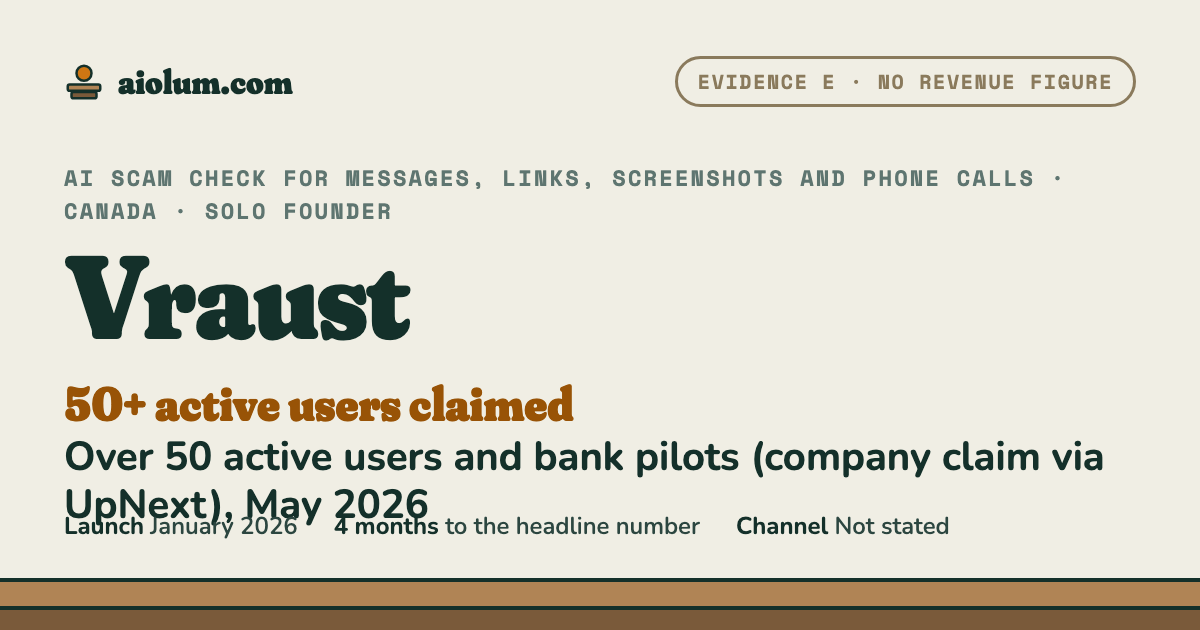
Vraust (AI scam check for messages, links, screenshots and phone calls, Canada): Over 50 active users and bank pilots (company claim via UpNext), May 2026. Evidence grade E: no revenue figure was checked. Team: 1 named founder, Elnathan Tiokou (UpNext, May 2026); headcount not published. Launched January 2026; still running.Added 5 November 2026 · updated 6 November 2026
- Outcome
- Over 50 active users and bank pilots (company claim via UpNext), May 2026
- Evidence
- E no revenue figure was checked
- Launch
- January 2026
- Status
- Still running
- Team
- 1 named founder, Elnathan Tiokou (UpNext, May 2026); headcount not published
- Outside funding
- None published
- Main channel
- Not stated
What is not verified
No revenue figure was found: there is no payment-processor profile, founder interview with numbers or filing in the sources read. The headline, over 50 active users and pilots with banks and law enforcement, is the company's statement as UpNext passed it on in May 2026, with no bank or agency named. The site's search data also lists a rating of 4.9 from 120 ratings with no named source, and a whitepaper teaser says the work was validated with "50+ major banking actors", naming Desjardins, RBC and Scotia Bank, without saying how. A reader could look for an app-store page with ratings, a named bank partner or a funding announcement. This story is grade E: the business is real and its product, price and customers are described from public pages, but no revenue figure was checked. Aiolum shows it as an idea worth studying, not as proof that it makes money.
Vraust detects social engineering, fraud in which a criminal persuades a person to send money or share a password instead of breaking into a computer. The user gives the app a suspicious link, text, screenshot or call, and large language models score the risk. The site says paid plans run "GPT-5 + Gemini 2.5 Pro on every scan". A credit, a unit of usage, pays for each scan: about one credit for a text scan and ten for a minute of call analysis.
Elnathan Tiokou is named as the founder by UpNext, a startup newsletter that covered his pitch at Web Summit Vancouver in May 2026. A copy of vraust.ai from 10 January 2026 sold "privacy-preserving AI infrastructure" to Canada's financial institutions; by April 2026 the site was a consumer scam checker. The terms of service place the company in Montreal, Quebec.
UpNext wrote on 15 May 2026 that the company "is running pilots with banks and law enforcement agencies and has over 50 active users". No revenue figure was found, so the evidence is grade E: a live product with public prices and the company's own traction claim.
How much revenue does Vraust make?
Each row shows the evidence grade and the source numbers from the list at the end of this page. The grades are explained in How Aiolum verifies.
| Fact | Value | Grade | How we know | Sources |
|---|---|---|---|---|
| Active users and pilots, May 2026 | over 50 active users; pilots with banks and law enforcement (company claim) | C | UpNext, 15 May 2026: "The company is running pilots with banks and law enforcement agencies and has over 50 active users on the platform." No bank or agency is named. | [3] |
| Founder | Elnathan Tiokou | C | UpNext lists "Founder: Elnathan Tiokou" in the recap and "Elnathan Tiokou, Vraust" in its 14 May 2026 newsletter. No co-founder is named. | [3, 4] |
| Earliest site copy | 10 January 2026, a fraud and anti-money-laundering tool for banks | C | Internet Archive copy: "privacy-preserving AI infrastructure enabling Canada's financial institutions to collaboratively fight fraud and money laundering without sharing sensitive data". The archive has no earlier copy. | [5] |
| Consumer version | live by April 2026 | C | The home page's preview image is a file named "Screenshot_2026-04-18". The consumer site is the version UpNext described in May 2026. | [1, 3] |
| Location | Montreal, Quebec, Canada | C | Terms of service: "governed by the laws of the Province of Quebec" with disputes "in the courts of Montreal, Quebec". | [1] |
| Prices | Free; Pro US$9.99, Family US$17.99, Solo US$24.99 a month | C | Read from the site's script file on 5 November 2026. Yearly billing is US$95.90, US$172.70 and US$239.90. | [2] |
| AI models | GPT-5 and Gemini 2.5 Pro on paid plans | C | Pricing page text: "GPT-5 + Gemini 2.5 Pro on every scan". The free plan uses a "Standard detection model". | [2] |
| Ages admitted | 13 and older; 13 to 17 with verified parental consent | C | Terms of service: "To use Vraust, you must be at least 13 years old. Users between 13 and 17 require verified parental consent." | [1] |
| Funding | none published | C | No source read names an investor or a round. | [3, 4] |
| Time from launch to the headline fact | 4 months | calc | Calculated: January 2026 to May 2026. | [3, 5] |
How to read this table: a grade C value is a statement on the company's own pages, or the company's claim as a newsletter reports it. A "calc" value was computed on this page. No value is grade A or B, and no revenue figure exists.
| Plan | Per month, billed yearly (US$) | Per month, billed monthly (US$) | Limit |
|---|---|---|---|
| Free | 0 | 0 | 100 credits a month (about 100 text scans or 10 call minutes) |
| Pro | 7.99 | 9.99 | 1,500 credits a month; advanced models |
| Family | 14.39 | 17.99 | up to 5 members; 3,000 pooled credits a month |
| Solo | 19.99 | 24.99 | 5,000 credits a month; text, image, document and call |
The pricing page loads by script, so the prices were read from the site's own script file. Pro and Family show an intro price for the first year (US$4.99 and US$14.99 a month), then the list price. Credit packs cost US$5 for 50, US$15 for 200 and US$30 for 500 credits. Pro and Solo bill extra credits at US$0.01 each with a cap set by the user; Free and Family stop at a hard cap. An Enterprise version is sold on request.
When did Vraust launch, and how did it grow?
From a fraud tool for banks in January 2026 to a consumer scam checker with paid plans, in about four months. Each entry carries its grade.
- 10 January 2026CThe earliest archived copy of vraust.ai sells privacy-preserving AI for fraud and money-laundering detection to Canada's financial institutions. [5]
- April 2026CThe site becomes a consumer scam checker; its preview image is a screenshot dated 18 April 2026. [1]
- 14 May 2026CUpNext lists Elnathan Tiokou and Vraust among the founders it watched at Web Summit Vancouver. [4]
- 15 May 2026CUpNext reports pilots with banks and law enforcement agencies and over 50 active users. [3]
- November 2026CLive with a free plan, three paid plans, credit packs and an Enterprise version on request. [1, 2]
Why did Vraust work?
Four causes, in the order they mattered. Each one is a reusable lesson.
Check before the money moves
UpNext describes the idea as intervening "during the transaction itself". The user checks a message or a call while it happens, and the app answers in seconds with a score and next steps, before any payment or reply.
Credits tie price to model cost
Every scan calls a large language model, which costs money per use. Credits make heavy users pay more: a text scan is about one credit and a call minute about ten, and the free plan stops at 100 credits a month.
A report for the bank and police
The site says that when fraud is detected, Vraust "pre-fills a complete report and sends it simultaneously to your bank, local police, and relevant authorities". This is also the reason a bank or police pilot would care about a consumer app.
How it was built
These details come from the company's own pages and the site's public script file. They are grade C. [1, 2]
- Built with Lovable, an AI app builder: the site's files sit in Lovable's storage and the script contains Lovable sign-in and payment code.
- Supabase for accounts, the database, file storage and server functions such as "fraud-scan" and "realtime-analysis".
- GPT-5 and Gemini 2.5 Pro for the scans on paid plans, according to the pricing page.
- ElevenLabs Scribe for live speech-to-text during call analysis: the script requests a "get-elevenlabs-scribe-token".
- Stripe for subscriptions and credit packs; the site in English and French.
Tools named in the sources
Each one opens its page in the Tools tab, with every story that uses it.
Who tried this before Vraust, and why did they fail?
Three security companies in our database of failed startups tried to sell detection or protection and failed. The values below are from that database and are not independently verified.
Verelo
The promiseA Canadian service that watched websites for downtime and malware.
Why it diedToo little money, and businesses would not pay for a specialist tool when larger companies sold the same checks inside broader packages.
ThinAir
The promiseReal-time detection of data leaks and insider threats.
Why it diedIts anomaly detection struggled with false alarms and missed threats, which hurt trust, and established security vendors won the buyers.
Toopher
The promiseTwo-factor login that verified people by their location.
Why it diedSalesforce bought it in 2015 and later shut the technology down; competitors with broader security suites took the market.
The failed startups come from our database of 1,749 dead startups, retold here in our own words. Its entries are AI-assisted summaries of public sources, so these cards carry no evidence grade.
What changed
Verelo and ThinAir sold detection to buyers who already had it inside larger products, and ThinAir lost trust through false alarms. A scam checker has the same two risks: banks, phone carriers and email providers build their own filters, and a wrong "safe" answer costs the user money.
What differs is the cost of building. A large language model can read a message, a screenshot or a call transcript without training a custom classifier, and an AI app builder produced the site, so one founder could pivot from a bank product to a consumer app in a few months.
Can one person copy Vraust now?
The app, yes. The bank pilots, harder.
A consumer scam checker is a thin layer over models that anyone can rent, and the site was built with an AI app builder, so one person can copy the product. Pilots with banks and police depend on relationships and trust that take longer to earn.
Where it is still open: Scam checks for one group that banks serve badly, such as older people, new immigrants or small shops, or in a language that big filters cover poorly.
- 1Pick one moment of risk, such as a payment request by text, and answer it in seconds with a score and steps.
- 2Price by credits so that heavy users cover their model cost, with a hard-capped free plan.
- 3Offer a pre-filled report to the bank or police, which gives institutions a reason to work with you.
What could go wrong for Vraust?
The risks are the mirror image of the causes above.
What is not verified
No revenue figure was found: there is no payment-processor profile, founder interview with numbers or filing in the sources read. The headline, over 50 active users and pilots with banks and law enforcement, is the company's statement as UpNext passed it on in May 2026, with no bank or agency named. The site's search data also lists a rating of 4.9 from 120 ratings with no named source, and a whitepaper teaser says the work was validated with "50+ major banking actors", naming Desjardins, RBC and Scotia Bank, without saying how. A reader could look for an app-store page with ratings, a named bank partner or a funding announcement.
Competition and model providers
No other story on this site sells scam detection; banks, phone carriers and email providers run their own fraud filters. Paid scans run on GPT-5 and Gemini 2.5 Pro and call analysis on ElevenLabs, according to the site, so price or policy changes by OpenAI, Google or ElevenLabs reach the product directly.
Calls, family accounts and teenagers
Live call analysis turns the other caller's speech into text; the pages read do not say how the product handles call-recording consent rules. The Family plan shares a dashboard, but the site says linked members see only that a scam was detected and general guidance, "never the raw message, audio, or sender details". The terms admit users from 13, with verified parental consent between 13 and 17, and restrict minors from some features.
A recent pivot, team size
The product changed from a bank tool in January 2026 to a consumer app by April 2026, so its history is short. Only one founder is named, and the site speaks of "our team" without a headcount.
Sources
The grade next to each source is the best grade that the source can support. "Read in full" means that the text of the page was downloaded and the numbers were checked in it.
- C Vraust home page: AI Fraud Detection & Social Engineering DefenseRead 5 November 2026. The page loads by script, so its text, terms, privacy notes and product descriptions were read in the site's own script file. robots.txt allows these paths.
- C Vraust pricing pageRead the plan definitions in the site's script file, 5 November 2026. Source for the prices, credits, credit packs and AI models.
- C UpNext, Edwin J. Frondozo, 15 May 2026: Web Summit Vancouver 2026: Enterprise AI Deployment RecapRead the section on Vraust, in a copy the pipeline downloaded on 6 November 2026. Source for the founder, pitch and traction claim.
- C UpNext newsletter, 14 May 2026: What's UpNextRead in full, in a copy the pipeline downloaded on 6 November 2026. Lists the founder among those watched at Web Summit Vancouver.
- C Internet Archive copy of vraust.ai, 10 January 2026Read the page head in full; the archive's index lists no earlier copy. Shows the earlier bank product.
- C Database of failed startups, local exportLocal export. AI-written summaries, not independently verified. Source for the failed predecessors.
Run this company? Send corrections or a verified figure to aiolum@livyden.com