Inbox Zero
What is not verified
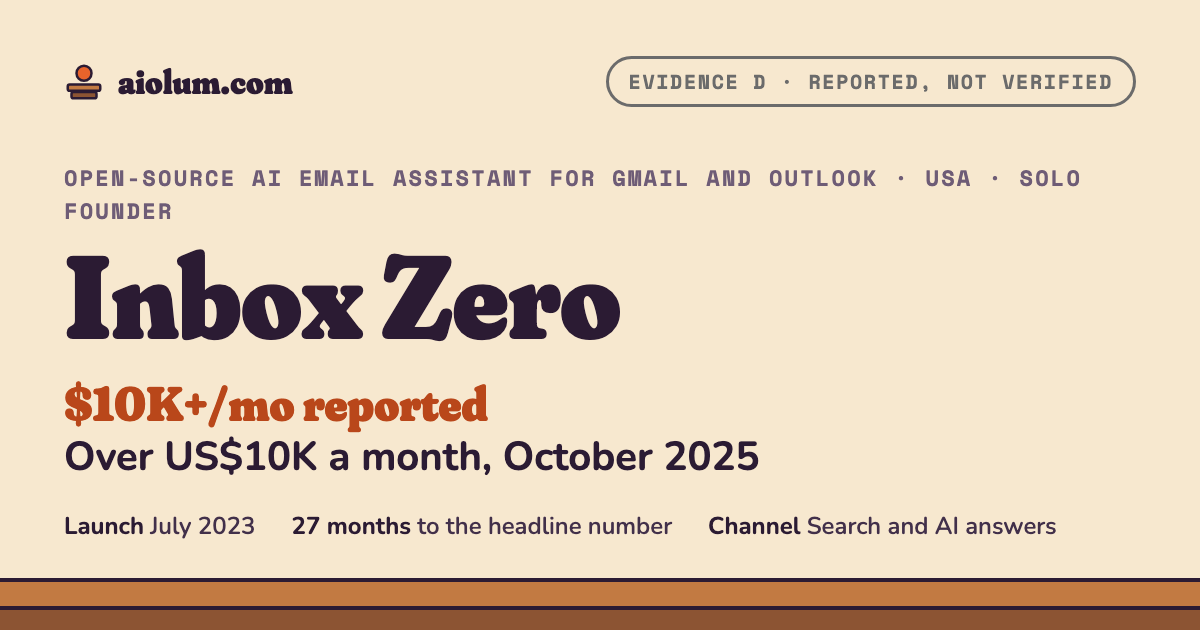
The headline figure, over US$10,000 a month in October 2025, rests on one source: the founder's Indie Hackers interview of 16 October 2025, which this page could read only as summarized by Startup Founder Stories, because Indie Hackers does not allow this site's agents to read its pages. The earlier milestones (US$1,000 a month in December 2023, US$10,000 in June 2024) come from the same summary. The only independent figure, GetLatka's estimate of US$330,000 a year in June 2025, is an estimate and is about 2.7 times higher than the founder's own number. No payment processor, buyer or journalist has confirmed any of it. A reader could look for a TrustMRR or Stripe-verified profile, the original interview, or a second dated statement by the founder. The headline number is grade D: one claim or one estimate, with no second source. Aiolum shows it because the story is useful, and marks it so that it is not mistaken for a verified figure.
Inbox Zero is an AI email assistant: a program that reads the mail arriving in a Gmail or Outlook account through the provider's API, the interface that lets one program read and change data in another, and then acts on it. It labels each email, archives what the user never reads, drafts a reply in the user's tone for the emails that need one, and blocks cold sales email. It is commercial open source, a model where the full code is public and free to run yourself, and the company earns money by hosting it for people who do not want to run a server. The hosted version costs US$18 to US$42 per user per month according to the pricing page read on 23 October 2026.
Elie Steinbock, a software engineer in the United States, started it in 2023 for his own inbox. A waitlist page existed in July 2023. He launched on Product Hunt on 26 December 2023 and on Hacker News three days later, and wrote in January 2024 that the launch finished first on Product Hunt with over 1,000 upvotes and took the GitHub repository from 200 to 1,200 stars. The Startup Founder Stories page that summarizes his Indie Hackers interview of 16 October 2025 reports a first customer in July 2023, US$1,000 in monthly recurring revenue in December 2023, US$10,000 in June 2024 and over US$10,000 in October 2025. GetLatka estimated revenue of US$330,000 a year in June 2025, with 3 people on LinkedIn.
Every money figure on this page is grade D, reported but not verified: the founder's statements reach this page only through a third party's summary of his interview, and the only other figure is a directory estimate that does not agree with it. No payment processor, buyer or journalist has checked the numbers. The page also shows what happened to earlier companies that sold a better inbox on top of an email provider they did not control.
The numbers, graded
Each row shows the evidence grade and the source numbers from the list at the end of this page. The grades are explained in How Aiolum verifies.
| Fact | Value | Grade | How we know | Sources |
|---|---|---|---|---|
| Monthly recurring revenue, October 2025 | over US$10,000 | D | Startup Founder Stories, which summarizes the founder's Indie Hackers interview of 16 October 2025 titled "Carving out a small niche in a big market and bringing in $10K MRR". The interview itself could not be read (Indie Hackers blocks this site's agents). One founder claim, one date. | [1] |
| Run rate from the October 2025 figure | at least US$120,000 a year | calc | Calculated: 10,000 times 12. A floor, because the source says "over" US$10,000. | [1] |
| GetLatka's revenue estimate, June 2025 | US$330,000 a year | D | A third-party estimate marked "EST." on the Latka page. It equals about US$27,500 a month, well above the founder's "over US$10,000" four months later, so one of the two is wrong. Startup Founder Stories repeats the US$330,000 figure as "full-year 2025 revenue". | [2, 1] |
| Monthly recurring revenue, June 2024 | US$10,000 | D | Startup Founder Stories milestone table: reached about 12 months after the first customer. | [1] |
| Monthly recurring revenue, December 2023 | US$1,000 | D | Startup Founder Stories milestone table: about six months after the first customer, in the month of the Product Hunt launch. | [1] |
| First customer | July 2023, US$10 | D | Startup Founder Stories milestone table. A Wayback Machine snapshot of 23 July 2023 shows the site with a waitlist. | [1, 12] |
| Product Hunt launch, 26 December 2023 | first place of the day; over 1,000 upvotes per the founder, 801 points on the page today | C | Founder's blog, January 2024. Product Hunt lists three launches: 26 December 2023 (801 points), 1 October 2024 (582 points) and 18 October 2026 (379 points, rank 1 of the day). | [5, 4] |
| GitHub stars | 200 before the launch, 1,200 two weeks after, 12.8k on 23 October 2026 | B | The founder's blog gives the first two counts (grade C); the repository page shows the current count and 11,696 commits. | [5, 7] |
| Hacker News Show HN, 29 December 2023 | 167 points, 143 comments | C | From the Hacker News Algolia API record of the thread. | [3] |
| Team | 1 founder; 2 people in December 2024 and 3 in June 2025 per LinkedIn | D | Startup Founder Stories: "Solo founder". Latka's headcount readings come from LinkedIn. | [1, 2] |
| Outside funding | no round found | D | No source read mentions a funding round for Inbox Zero. Not verified: the founder's January 2024 post lists funding of other open-source companies and none for his own. | [6, 2] |
| Price of the pro version, January 2024 | US$10 to US$19 a month | C | Founder's blog, 25 January 2024, in his argument that self-hosting to save that fee is not worth the effort. | [6] |
| License | AGPL | B | Repository license file. Anyone may run the code, but a modified hosted version must publish its code too. | [7] |
| Growth channel | SEO and content; Product Hunt and the open-source community at launch | D | Startup Founder Stories lists "SEO / Content" as the main channel. The founder wrote on Hacker News in December 2025 that a Google search for "inbox zero" shows his product first. | [1, 3] |
| Country | United States | D | Startup Founder Stories ("USA") and Latka ("United States"). Not stated on the company's own pages. | [1, 2] |
| Time from the first customer to the headline figure | 27 months | calc | Calculated: July 2023 to October 2025. | [1] |
How to read this table: a grade D value is a founder statement that this page could read only in a third party's summary of his Indie Hackers interview, or a directory estimate; a grade C value is the founder's own blog or product page; a grade B value is visible in the public code repository; a "calc" value was computed on this page from the rows above it. No value is grade A.
| Plan | Per month, billed yearly (US$) | Per month, billed monthly (US$) | Limit |
|---|---|---|---|
| Email app | 0 | 0 | free email client for Gmail and Outlook |
| Starter | 18 | 20 | per user; sorting, labels, drafted replies, cold email blocker, bulk unsubscribe |
| Plus | 28 | 35 | per user; 2 email accounts, meeting notetaker, Slack and app integrations |
| Professional | 42 | 50 | per user; team-wide analytics, priority support, onboarding manager |
| Enterprise | custom | SSO, SCIM, on-premise deployment |
The pricing page shows the yearly price first and the monthly price in its comparison table. Every AI plan has a 7-day free trial. The email client is free on web, desktop and iPhone; the AI features are the paid part. Payments go through Stripe. A cheaper version existed in January 2024: the founder wrote then that the pro version cost US$10 to US$19 a month.
The timeline
From a waitlist page in July 2023 to a reported US$10,000 a month in about a year, and a third Product Hunt first place in October 2026, in 27 months to the headline figure. Each entry carries its grade.
- 2023DSteinbock starts Inbox Zero for his own email; Latka records the founding year as 2023. He also runs a YouTube channel about open-source code. [2, 7]
- 23 July 2023CThe Wayback Machine's first snapshot of getinboxzero.com: "Inbox Zero uses AI to help you empty your inbox daily", with a waitlist. Startup Founder Stories dates the first customer, at US$10, to this month. [12, 1]
- December 2023DUS$1,000 in monthly recurring revenue, according to the Startup Founder Stories milestone table. [1]
- 26 December 2023CProduct Hunt launch, the day after Christmas, with a hunter. The founder writes that it finished first with over 1,000 upvotes and brought thousands of users; the repository goes from 200 to 1,200 stars and two AI newsletters feature it. [5, 4]
- 29 December 2023CShow HN on Hacker News: 167 points and 143 comments. In the thread the founder says the app uses Vercel's AI package, stores analytics in Tinybird, has passed Google's Gmail API review, and can be self-hosted by anyone who does not trust it. [3]
- 22 to 25 January 2024CTwo blog posts on the launch and on why he builds commercial open source. The pro version costs US$10 to US$19 a month, he writes. [5, 6]
- June 2024DUS$10,000 in monthly recurring revenue, according to the Startup Founder Stories milestone table, about a year after the first customer. [1]
- 21 August 2024CThe changelog adds Claude 3.5 Sonnet and makes Anthropic the default model; OpenAI stays as an option. [11]
- 1 October 2024CSecond Product Hunt launch, "An open source, AI personal assistant for email": 582 points. [4]
- December 2024DLatka counts 2 people on LinkedIn. [2]
- June 2025DLatka estimates revenue of US$330,000 a year and counts 3 people on LinkedIn. [2]
- 16 October 2025DIndie Hackers interview, as summarized by Startup Founder Stories: over US$10,000 in monthly recurring revenue, a solo founder, and the lesson to narrow the niche when competition arrives. [1]
- 18 October 2026CThird Product Hunt launch, "Open-source Superhuman alternative": a free email client for Gmail and Outlook on web, desktop and iPhone, with the AI assistant as a US$20 a month add-on. Rank 1 of the day, 379 points. [4]
- 23 October 2026BThe repository shows 12.8k stars and 11,696 commits. The pricing page lists Starter, Plus and Professional at US$18, US$28 and US$42 per user per month billed yearly, and the home page claims SOC 2 compliance. [7, 8, 9]
Why it worked
Four causes, in the order they mattered. Each one is a reusable lesson.
Open source as the launch engine
The founder's own account of the launch: open-source products were finishing first on Product Hunt in late 2023 (Cal.com, PostHog, Papermark, Documenso), and he says being open source is almost a guaranteed first place because the open-source community votes for its own. He posted in open-source communities, used a hunter, and the repository went from 200 to 1,200 stars in two weeks. The launch got the product into Ben's Bites and The Rundown AI, newsletters he says reach hundreds of thousands of readers.
Search on the product name
The product is named after the method it serves. Startup Founder Stories lists SEO and content as the main growth channel, and the founder wrote on Hacker News in December 2025 that a Google search for "inbox zero" shows his product first. The company blog publishes dozens of guides such as how to stop emails from Amazon, LinkedIn or Reddit, each a search page that ends with the product.
Niche down when the big players arrive
Startup Founder Stories summarizes the interview's main lesson: he was early in a market that filled up quickly, and instead of matching every feature of larger competitors he narrowed the product to the people who get more email than they can handle and want labels, drafts, unsubscribes and a cold email blocker without changing their email client.
Self-hosting as trust, hosting as revenue
An email assistant reads everything in the inbox, so trust is the main objection. The public code answers it: anyone can inspect what the code does or run it on their own server. The founder wrote in January 2024 that nobody self-hosts to save a fee of US$10 to US$19 a month, because running the servers costs more than that in time, so the open code brings users without losing many customers.
How it was built
These details come from the public repository (grade B), the founder's comments on Hacker News and his blog, and the product's changelog (grade C). [7, 3, 5, 11, 8]
- A TypeScript monorepo managed with Turborepo and pnpm: Next.js for the web app, Prisma on PostgreSQL, Redis through Upstash, and Docker files for self-hosting. A command-line installer, npx @inbox-zero/cli, starts the containers.
- Two parts: an AI assistant that runs in the background on a Gmail or Outlook account, and an email client. Each works on its own. The iPhone client is a native Swift app and is not open source yet.
- The model layer uses Vercel's AI package so that several providers fit behind one interface. OpenAI was the first provider; on 21 August 2024 the changelog added Claude 3.5 Sonnet and made Anthropic the default.
- Email analytics were stored in Tinybird, a hosted ClickHouse service, with an encryption key so the host cannot read the data; the founder said in December 2023 that a browser-only version was planned.
- Payments through Stripe, per the pricing FAQ. The repository tags also name Resend and Loops for email sending and PostHog for product analytics.
- Marketing: three Product Hunt launches, a Show HN, the founder's YouTube channel (2,000 subscribers at the launch), a 20,000-address newsletter list he emailed on launch day, and a blog of search-oriented guides.
Tools named in the sources
Each one opens its page in the Tools tab, with every story that uses it.
The dead that came before
Four companies in the Loot Drop database sold a better inbox on top of an email provider or client that they did not control. The values below are from that database and are not independently verified.
Mailbox
The promiseSwipe gestures and snooze to clear a Gmail inbox on the phone.
Why it diedDropbox bought it, then shut it down when Gmail and Apple Mail added the same gestures for free.
Xobni
The promiseA smarter inbox with search and contact analytics inside Microsoft Outlook.
Why it diedTied to Outlook, which Microsoft improved itself. Mobile made the desktop add-on irrelevant. Yahoo bought the remains.
Threadable
The promiseTurn long email threads into an organized chat room.
Why it diedSlack made the idea obsolete; the product could not stand out or integrate smoothly and ran out of money.
Skiff
The promiseAn encrypted, privacy-first email and documents suite to replace Google Workspace.
Why it diedPrivacy alone did not move mainstream users off the free incumbents; the company sold to Notion and the product was closed.
What changed
All four built on or against an email platform they did not own, and the platform owner or a better-funded rival made the feature free or made the product unnecessary. Inbox Zero has the same exposure: it reads mail through the Gmail and Microsoft APIs, needs Google's periodic security review to keep that access, and Google, Microsoft and Superhuman now ship their own AI sorting and drafted replies.
What differs is cost and ownership. The predecessors raised venture money, from US$500,000 to US$42 million, and had to grow fast enough to repay it; the sources for Inbox Zero show one founder, no round, and a team of two or three people, so the business is reported to be sustainable at the US$10,000 a month that the founder said he reached. And the code is public under the AGPL: if the hosted company stopped, the product would still run on anyone's server, which the founder gives as a reason customers trust it.
Can one person copy it now?
The launch method, yes. The reported revenue, treat as unproven.
Launching an open-source version of a well-known paid category on Product Hunt and Hacker News is a method the founder describes step by step and that other commercial open-source projects used in the same months. It needs a product people can inspect and self-host, and a name or a blog that can rank in search. What a reader cannot copy is certainty about the money: the only revenue figures are a single interview summarized by a third party, reported at over US$10,000 a month in October 2025, and a directory estimate that disagrees with it.
Where it is still open: Any personal data tool where trust is the main objection: calendar assistants, note tools, personal finance, password or document managers, where open code and self-hosting answer the trust question.
- 1Build the tool for a pain you have yourself, on an API the platform wants used (Gmail, Outlook), and publish the code under a license that lets others self-host.
- 2Launch on Product Hunt with a hunter and post in open-source communities the same day; the founder says the open-source community votes a public repository to first place.
- 3Name the product after the search term for the method it serves, and write search guides that end with the product.
- 4When larger competitors add the same feature, narrow to one group of users and keep the parts they cannot get without changing their email client.
What to watch
The risks are the mirror image of the causes above.
What is not verified
The headline figure, over US$10,000 a month in October 2025, rests on one source: the founder's Indie Hackers interview of 16 October 2025, which this page could read only as summarized by Startup Founder Stories, because Indie Hackers does not allow this site's agents to read its pages. The earlier milestones (US$1,000 a month in December 2023, US$10,000 in June 2024) come from the same summary. The only independent figure, GetLatka's estimate of US$330,000 a year in June 2025, is an estimate and is about 2.7 times higher than the founder's own number. No payment processor, buyer or journalist has confirmed any of it. A reader could look for a TrustMRR or Stripe-verified profile, the original interview, or a second dated statement by the founder.
The platforms are adding the same features
Gmail, Outlook and Superhuman ship AI sorting, summaries and drafted replies. Every predecessor on this page died when the platform added the feature. Inbox Zero's answer is to be the open, inspectable version and to add an email client of its own, launched in October 2026.
Access depends on Google's review
Reading a Gmail account through the API requires Google's security review, which the founder said in December 2023 every such app must pass and which Google tightened in 2024. A failed review would cut the product off from most of its users.
Open code can be copied
Under the AGPL anyone may run a competing hosted version if they publish their changes. The founder's view in January 2024 was that code alone does not bring users and that no clone of Cal.com or PostHog had taken their customers. That holds while the brand and the search ranking stay with him.
One person, several products
The founder also writes a blog of dozens of search guides, runs a YouTube channel and ships an email client, a Chrome extension, a Slack assistant and a mobile app. The sources show two or three people. Support and security work for a tool that reads private email grows with every new surface.
Sources
The grade next to each source is the best grade that the source can support. "Read in full" means that the text of the page was downloaded and the numbers were checked in it.
- D Startup Founder Stories: Elie Steinbock, Inbox Zero, open source email assistant, $10K+ MRR (summary of the Indie Hackers interview "Carving out a small niche in a big market and bringing in $10K MRR", 16 October 2025)Read in full. A third party's summary that cites Indie Hackers as its source. Source for the headline figure, the milestone dates, the solo-founder and USA statements and the growth channel. The Indie Hackers page itself was not fetched (its robots.txt disallows this site's agents).
- D GetLatka company page: Inbox Zero revenue 2025, $330K estimateRead in full. A third-party estimate marked EST. and two LinkedIn headcount readings. Source for the founding year, the country and the team size.
- C Hacker News, 29 December 2023: Show HN: Inbox Zero, open-source email assistant (thread and the founder's comments, via the Algolia API)Read the thread record and all comments by the founder's accounts (elieskilled, elie222), including his December 2025 comment on the Google ranking. Source for the points, the Tinybird and Vercel AI details and the Gmail API review.
- C Product Hunt: Inbox Zero product page and its three launchesRead the product page and the launches list. Source for the three launch dates, their points and the October 2026 day rank.
- C Inbox Zero blog, 22 January 2024: How my open source SaaS hit first on Product HuntRead in full. Founder's own account of the launch. Source for the upvotes, the star counts, the newsletters, the hunter and the launch-day list.
- C Inbox Zero blog, 25 January 2024: Why build an open source SaaSRead in full. Source for the US$10 to US$19 a month price in January 2024 and the founder's reasoning on self-hosting and clones.
- B GitHub repository elie222/inbox-zero, read 23 October 2026Read the README and the license file. Source for the star and commit counts, the AGPL license, the stack and the two-part structure.
- C Inbox Zero pricing page, read 23 October 2026Read in full. Source for the pricing table and the Stripe payment note.
- C Inbox Zero home page, read 23 October 2026Read in full, including the footer, for the purpose check. Source for the feature list, the 12k+ stars claim and the SOC 2 claim. The footer's "Email Blaster" link is a browser game at /game, not a sending tool.
- C Inbox Zero about pageRead in full. Source for the product description and the Gmail, Google Workspace and Outlook support.
- C Inbox Zero changelog (Featurebase), entries of May to August 2024Read the visible entries. Source for the Claude 3.5 Sonnet entry of 21 August 2024.
- C Wayback Machine snapshot of getinboxzero.com, 23 July 2023Read in full (a short waitlist page). Source for the state of the site in July 2023.
- C Inbox Zero case studies pageRead in full. Four named customers; used only to confirm that the product sells to small companies and teams.
- C Loot Drop database export, 1,749 failed startupsLocal export. AI-written summaries, not independently verified. Source for the failed predecessors.