Language Confidence: Revenue, team and how it was built
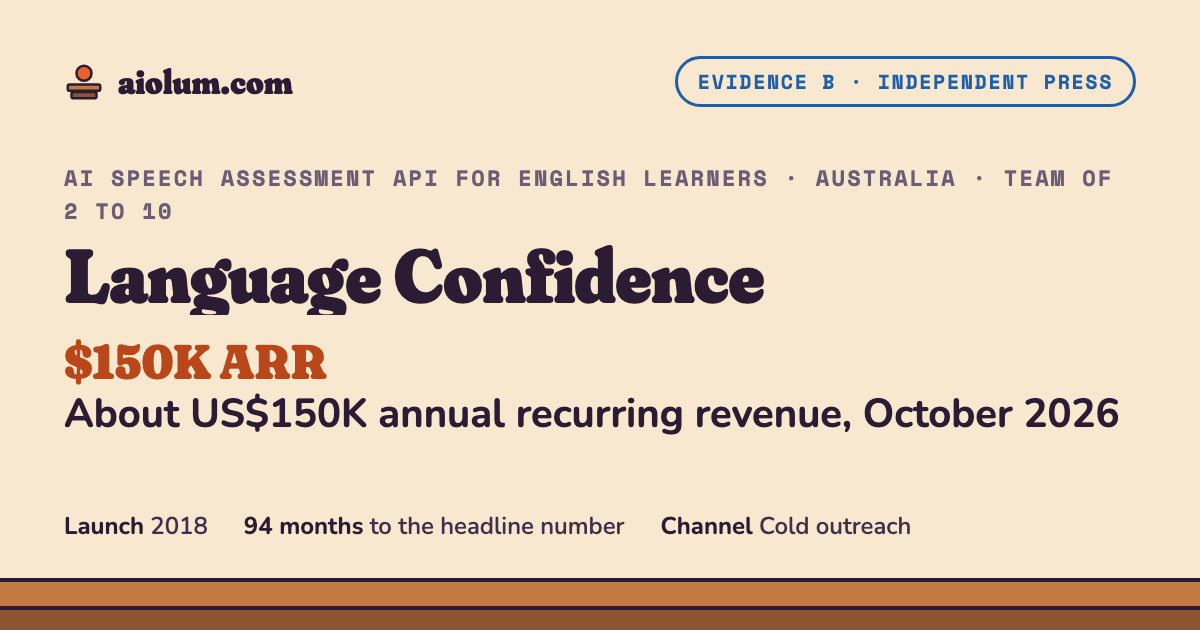
Language Confidence (AI speech assessment API for English learners, Australia): About US$150K annual recurring revenue, October 2026. Evidence grade B: confirmed by two or more independent reports. Team: 2 co-founders on the team page in October 2026, 9 people listed in September 2022; headcount at the headline not published. Launched 2018; still running.Added 27 October 2026
- Outcome
- About US$150K annual recurring revenue, October 2026
- Evidence
- B confirmed by two or more independent reports
- Launch
- 2018
- Status
- Still running
- Team
- 2 co-founders on the team page in October 2026, 9 people listed in September 2022; headcount at the headline not published
- Outside funding
- About US$3 million raised (seller statement), including a US$1.5M seed round led by Wavemaker Partners in 2022
- Group
- Learning and study
- Main channel
- Cold outreach
Language Confidence sells a speech assessment API. An API (application programming interface) is a way for one program to call another over the internet; here, a learning app sends a short audio recording of a student and receives scores and feedback a moment later. Assessment means grading: the service rates pronunciation sound by sound, and also fluency, grammar, vocabulary and whether the answer fits the question. The company also sells SnapShot AI, a spoken English placement test that reports a level on the CEFR scale, the Common European Framework of Reference, which runs from A1 (beginner) to C2 (near native).
Nicholas Jenkins started it after teaching English in China in 2016, where his students could check their spelling at home but not their speaking. He co-founded the company in 2018 with Swahn Fraye, who left the software company Atlassian to become its chief technology officer. Jenkins told The PIE News in March 2022 that the first pre-seed money of A$500,000 ran out and that the company lived on credit cards until its first real paying customer in late 2019. In March 2022 it closed a US$1.5 million seed round led by Wavemaker Partners, a venture capital firm in Singapore. Its team page listed nine people in September 2022 and lists only the two co-founders in October 2026.
In October 2026 the company is for sale on Flippa, a marketplace for online businesses. The owner's listing says it makes around US$150,000 in annual recurring revenue (ARR, the yearly value of the current subscriptions and contracts), shows monthly revenue of US$9,170, and asks US$150,000. Flippa marks the listing as verified by its vetting team or a broker and shows that the seller connected Stripe and Google Analytics. The headline is graded B: a marketplace checked it, but no payment-processor statement is public. The listing also says the company raised about US$3 million and "did not meet its initial financial goals".
How much revenue does Language Confidence make?
Each row shows the evidence grade and the source numbers from the list at the end of this page. The grades are explained in How Aiolum verifies.
| Fact | Value | Grade | How we know | Sources |
|---|---|---|---|---|
| Annual recurring revenue, October 2026 | around US$150,000 | B | Owner's text on the Flippa listing, read 27 October 2026: "generating around $150,000 in annual recurring revenue". The listing carries the badge "Verified Listing", whose tooltip reads "The Flippa vetting team or the broker has verified this listing to ensure accuracy of the stated financial and operational performance." Flippa does not say that this figure came from Stripe, so it is not graded A. | [1, 3] |
| Monthly revenue on the listing card, October 2026 | US$9,170 | B | Flippa's category page shows "Monthly Revenue USD $9.17K" and "Monthly Profit USD $9.17K" for the card "Listed by Owner Language Confidence". The listing itself shows "Monthly Profit USD $9,167 /mo". | [2, 1] |
| Revenue in a year at the listed monthly figure | about US$110,000 | calc | Calculated: 9,167 times 12 equals 110,004. This is lower than the ARR in the owner's text; US$150,000 a year would be US$12,500 a month. | [1] |
| Profit margin shown | 100% | B | Flippa listing: "Profit Margin 100%". A margin of 100% means that no costs are entered in the public figures, although the business pays for servers and models. | [1] |
| Data connected to the listing | Stripe and Google Analytics | B | Flippa listing: "Data Verified Listing. This business has connected the following data integrations: Google Analytics Stripe". Flippa's verification page says it partners with these platforms "to expose critical performance metrics"; those metrics need a Flippa account to read. | [1, 3] |
| Asking price | US$150,000 | C | Flippa listing: "Asking Price (Classified) USD $150,000". An asking price is not a sale price. The listing shows a revenue multiple of 1.4x. Calculated: 150,000 divided by 110,004 equals 1.36. | [1] |
| Outside funding in total | about US$3 million | C | Owner's text on the listing: "Historically, the company has raised $3 million" and "did not meet its initial financial goals. Despite this, it remains profitable." The listing does not say in which currency or in which rounds. | [1] |
| Seed round, March 2022 | US$1.5 million, led by Wavemaker Partners, with Investible | B | The PIE News, 4 March 2022, with a quote from a Wavemaker general partner. The company's team page names Wavemaker and Investible as investors in October 2026. | [6, 5] |
| Pre-seed money | A$500,000 | C | Jenkins in The PIE News: "We've come a long way since our pre-seed round of AUS$500k ran out and we managed to keep the company alive on credit cards until we had our first real, paying customer late in 2019". | [6] |
| First real paying customer | late 2019 | C | Founder quote above. The about page also says the business has grown "since late 2019 by partnering with some of the world's largest language platforms". | [6, 5] |
| People on the team page, September 2022 | 9 | B | Internet Archive copy of the about page, 28 September 2022: the two co-founders, a chief operating officer, a sales vice president for India and South Asia, three machine learning engineers, a full-stack developer and a CFO and strategic advisor. | [7] |
| People on the team page, October 2026 | 2 | C | The current about page lists the CEO and founder and the CTO and co-founder, then six investors. The total headcount is not published. | [5] |
| Website online | 15 December 2018, as a "Coming soon" page | B | Internet Archive copy of languageconfidence.ai. The listing gives "Founded in 2018" and a site age of 8 years. | [8, 1] |
| Time from the first archived page to the listing | 94 months | calc | Calculated: December 2018 to October 2026. | [8, 1] |
How to read this table: a grade B value was checked or shown by Flippa, the marketplace that lists the business, or reported by a journalist, or recorded by the Internet Archive. A grade C value is a statement by the company or its founder. A "calc" value was computed on this page from the rows above it. No value is grade A: Flippa shows that Stripe is connected, but it does not publish the Stripe figures to visitors who are not signed in.
| Plan | Per month, billed yearly (US$) | Per month, billed monthly (US$) | Limit |
|---|---|---|---|
| Startup API | 70 | 100 | US$100 of API credit a month, 10 requests per second, 7-day trial |
| Scaleup API | 350 | 500 | US$500 of API credit a month, 50 requests per second, Slack support |
| Enterprise API | custom | custom | contract, custom rate limit, removal of personal data from speech |
| SnapShot Basic | 10 one-time | 1 placement test | |
| SnapShot Starter | 50 one-time | 8 tests | |
| SnapShot Pro | 250 one-time | 40 tests |
API plans are prepaid credit: the monthly amount is spent per 15 seconds of speech, at US$0.0125 for open (unscripted) answers, US$0.01 for read-aloud (scripted) answers and US$0.008 for pronunciation only on the Startup plan, and US$0.01, US$0.008 and US$0.006 on the Scaleup plan. Calculated: US$100 at US$0.0125 per 15 seconds buys 2,000 minutes of open speech, fewer than the 8,000 to 12,500 minutes that the plan card states. SnapShot tests are bought in packs; a school can add its own logo for US$99 a month, or a logo and its own domain for US$199 a month.
When did Language Confidence launch, and how did it grow?
From a teacher's problem in China in 2016 to a small profitable company for sale in October 2026. Each entry carries its grade.
- 2016CJenkins teaches English in China. His students can check spelling and grammar at home, but no tool gives them accurate feedback on their speaking. [5]
- 2016 to 2018CHe spends two years visiting large language education companies, learns about AI and speech recognition, and designs the first product, LCAT, "with a team from MIT, Google and Facebook", the about page says. [5]
- 2018CJenkins and Swahn Fraye co-found the company, The PIE News reports. The Flippa listing also gives 2018 as the founding year. [6, 1]
- 15 December 2018Blanguageconfidence.ai shows a "Coming soon" page with a newsletter sign-up. [8]
- Late 2019CA pre-seed round of A$500,000 has run out, and the founders pay costs with credit cards until the first real paying customer arrives, Jenkins said in 2022. [6]
- 4 March 2022BThe PIE News reports a US$1.5 million seed round led by Wavemaker Partners, with Investible. The company sells its API per student or per use and its test per test. [6]
- September 2022BThe team page lists nine people, among them three machine learning engineers and a sales vice president for India and South Asia. [7]
- June 2024CThe privacy policy of the SnapShot and Oracy apps, operated by Language Confidence Pty Ltd, is last updated. [11]
- October 2026BThe team page lists only the two co-founders. The owner lists the company on Flippa at around US$150,000 of ARR, US$9,170 of monthly revenue and an asking price of US$150,000. [5, 1, 2]
Why did Language Confidence work?
Four causes, in the order they mattered. Each one is a reusable lesson.
Niche
General speech recognition writes down which words a person said. A learner and a teacher need something else: which sounds were wrong, how fluent the answer was and what level that means. Language Confidence does only that task, for English, and returns the result in the International Phonetic Alphabet and on the CEFR scale that teachers already use.
Sell to platforms, not to learners
The company does not try to win millions of students itself. Its customers are learning apps, publishers and test-preparation companies that add the API to their own products; the home page quotes executives of Age of Learning, E2Language and 3PLearning. Each customer brings many learners, and the founder spent two years visiting such companies while he designed the first product.
Prepaid usage pricing
API customers buy credit every month, US$100 or US$500 on the public plans, and use it per 15 seconds of speech. The monthly prepayment makes the revenue recurring, while the price still follows use. Placement tests are sold in packs of 1, 8 or 40.
Own models where it matters
The listing says the company built its own models for pronunciation and uses open-weight models, whose trained weights anyone can download, for fluency, relevance, grammar and vocabulary. It runs on a serverless setup, which charges for computing only when a request arrives. That mix keeps a small team able to run the service.
How it was built
These details come from the Flippa listing, the company's own pages and an archived team page. They are grade B and C. The model names and the cloud provider are not published. [1, 4, 7, 9, 12, 6]
- Speech scoring with two engines: models that the company trained itself for pronunciation, and open-weight models for fluency, relevance, grammar and vocabulary, chosen for low delay.
- A serverless back end, described in the listing as an "enterprise-grade AI framework" that is "scalable and built on a serverless architecture".
- Stateless REST APIs with documentation, sample Postman collections and a developer portal; IPA scoring "in partnership with Oxford Languages", with an Oxford pronouncing dictionary integration listed as a feature.
- In September 2022 the team had three machine learning engineers, one full-stack developer and a chief technology officer who had worked at Atlassian.
- The company website is a Next.js app, and its plan buttons link to Stripe payment pages, both visible in the page source.
- Sales went to companies directly: per student or per use for the API and per test for the placement test, as Jenkins said in 2022.
Tools named in the sources
Each one opens its page in the Tools tab, with every story that uses it.
Who tried this before Language Confidence, and why did they fail?
Five companies in the Loot Drop database tried to scale English teaching with human tutors or online courses. The values below are from that database and are not independently verified.
VIPKid
The promiseOne-to-one online English lessons with North American teachers for Chinese children, 700,000 students at the peak.
Why it diedChina's 2021 rules on private tutoring banned foreign teachers and foreign curriculum, which removed the business model.
Dada English
The promiseOnline English tutoring for Chinese children with native-speaking teachers at about US$30 a session.
Why it diedChina's 2021 'Double Reduction' policy banned for-profit tutoring of school children in English.
TutorGroup (iTutor)
The promiseA marketplace of 30,000 Western tutors for English learners in Asia at US$30 to US$50 an hour.
Why it diedThe 2021 ban on foreign tutors in China removed most of its revenue, at a time when customer acquisition costs of more than US$800 and tutor turnover were already high.
Teacher Finder
The promiseMatch language learners directly with tutors and cut out expensive language schools.
Why it diedBetter-funded tutor marketplaces won, and the small product could not change fast enough to stay relevant.
Hujiang
The promiseFree and paid online language courses for 190 million users in China.
Why it diedA failed stock market listing showed high customer acquisition costs and negative margins against larger rivals.
The failed startups come from Loot Drop, a free database of dead startups, retold here in our own words. Loot Drop describes its entries as AI-assisted summaries of public sources, so these cards carry no evidence grade.
What changed
The four tutoring companies on this page sold time with a human teacher. Every extra lesson needed an extra teacher, so growth meant hiring and paying tens of thousands of tutors, and in 2021 a single change in China's rules ended three of them. Hujiang sold courses without live teachers, but it still had to win each learner itself, and its customer costs were too high.
Language Confidence automates one part of a speaking teacher's work: listening to a learner and saying what was wrong. It does not employ teachers and does not market to learners. It sells the listening part to companies that already have the learners, and charges by the second of speech. That model needs speech AI that is accurate enough for learners with many accents, which the founder spent two years designing before the first sale. The cost side is visible too: the company raised about US$3 million, according to the seller, and is now a business of about US$150,000 a year.
Can one person copy Language Confidence now?
The models, hard. The way of selling, yes.
Training speech models that score non-native pronunciation took years, a team of machine learning engineers and venture money, and the seller says the company still missed its first goals. A solo founder is unlikely to repeat that part. The selling model is easier to copy: one narrow AI task, sold as an API to companies that already have the users, paid in prepaid monthly credit.
Where it is still open: The same task in other languages, and speaking practice for professions with their own vocabulary, such as nursing, aviation or customer service, where an employer pays for the test.
- 1Pick a task that teachers or reviewers do by hand and that general AI tools do not report in the form those professionals use.
- 2Sell it as an API to platforms that already have many users, not to the users themselves.
- 3Charge prepaid monthly credit, spent per unit of use, so the revenue recurs but follows usage.
- 4Use open-weight models where they are good enough, and train your own only where they are not.
What could go wrong for Language Confidence?
The risks are the mirror image of the causes above.
Funded, and below its own goals
The seller writes that the company raised about US$3 million and "did not meet its initial financial goals". The PIE News confirms a US$1.5 million seed round in March 2022 led by Wavemaker Partners. Against that money, around US$150,000 of ARR is a small result; it is on this site as a small team that kept an AI product running and profitable, not as a cheap start.
Team size at the headline
The team page listed nine people in September 2022, among them three machine learning engineers. In October 2026 it lists only the two co-founders and six investors. The Flippa listing does not give a headcount, so the number of people at the US$150,000 figure is not published.
Two revenue figures that do not agree
US$150,000 of ARR equals US$12,500 a month, but the listing card shows US$9,170 of monthly revenue and the same amount as monthly profit, a 100% margin. The card may show an average of past months, and the margin leaves out costs that a speech service must have. Flippa's Stripe data, which could settle this, is visible only to signed-in buyers.
Children's voices
Some API customers build products for young learners; Age of Learning's executive writes about "young learners" on the home page. The SnapShot and Oracy privacy policy says the company does not knowingly collect data from children under 18 and that a user represents being "at least 18 or ... the parent or guardian of such a minor" who consents. The policy lists "voice audio recordings" among the data it collects. How API customers handle consent is their own matter and is not public.
For sale
The asking price is US$150,000; no sale has been reported. A buyer may change the team, the prices or the product. The figures on this page are from the listing as read on 27 October 2026.
Sources
The grade next to each source is the best grade that the source can support. "Read in full" means that the text of the page was downloaded and the numbers were checked in it.
- B Flippa listing 13436230: AI-powered platform enhancing pronunciation and speaking skills through personalized language practice and instant feedbackRead the public part on 27 October 2026; the financial details and the seller's name need an account and were not read. Source for the ARR, the monthly profit, the margin, the verification badges, the connected Stripe and Google Analytics data, the asking price, the funding and the technical setup.
- B Flippa category page: AI Apps & Tools for saleRead the listing card on 27 October 2026. Source for the business name, "Listed by Owner" and the monthly revenue of US$9.17K.
- C Flippa: Trust and verificationsRead in full. Flippa's own description of its vetting and data integrations. Used to explain what the badges mean.
- C Language Confidence home pageRead in full on 27 October 2026. Source for the products, the start year and the customer quotes.
- C Language Confidence: About usRead in full on 27 October 2026. Source for the founding story, the two co-founders and the investors.
- B The PIE News, 4 March 2022, by Sophie Hogan: Edtech: Language Confidence raises US$1.5mRead in full. Trade press for international education. Source for the seed round, the investors, the pre-seed amount and the first paying customer.
- B Internet Archive copy of the about page, 28 September 2022Read in full. Source for the nine people on the team page in 2022.
- B Internet Archive copy of the home page, 15 December 2018Read in full. A "Coming soon" page. Source for the earliest date the website was online.
- C Language Confidence: API pricingRead in full on 27 October 2026. Source for the API plans and the prices per 15 seconds.
- C Language Confidence: SnapShot pricingRead in full on 27 October 2026. Source for the test packs and the branding add-ons.
- C Language Confidence: SnapShot/Oracy privacy policy, last updated 5 June 2024Read the sections on collected data and on minors. Source for the age and parental-consent clause and the company name.
- C Language Confidence: API productsRead in full on 27 October 2026. Source for the IPA scoring with Oxford Languages and the integration steps.
- C Loot Drop database export, 1,749 failed startupsLocal export. AI-written summaries, not independently verified. Source for the failed predecessors.