Let's Trip AI: Revenue, team and how it was built
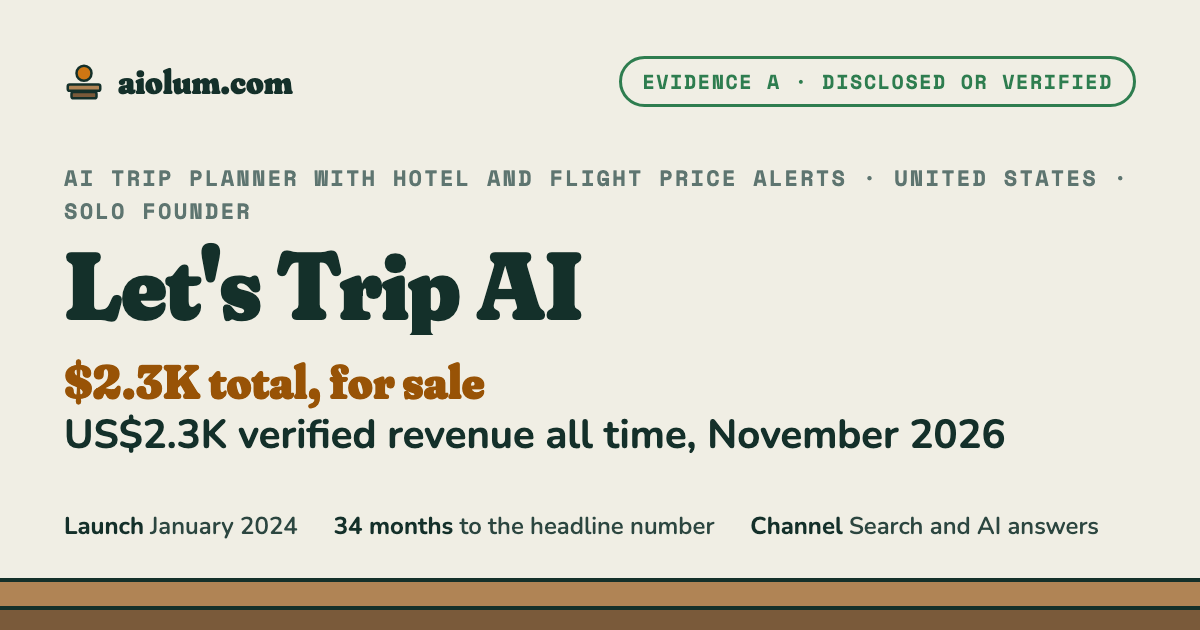
Let's Trip AI (AI trip planner with hotel and flight price alerts, United States): US$2.3K verified revenue all time, November 2026. Evidence grade A: disclosed by a company or a filing, or verified by a payment processor. Team: 1 founder listed (Alon); headcount not published. Launched January 2024; still running, revenue falling.Added 6 November 2026
- Outcome
- US$2.3K verified revenue all time, November 2026Revenue falling
- Evidence
- A disclosed by a company or a filing, or verified by a payment processor
- Launch
- January 2024
- Status
- Still running
- Team
- 1 founder listed (Alon); headcount not published
- Outside funding
- None stated
- Main channel
- Search and AI answers
Let's Trip AI is an AI trip planner: a web app in which a large language model turns a short request, such as "2 days trip to Seattle with my husband", into a day-by-day travel plan. The plan is shown with a map, and the user can move, replace or annotate every stop. The product also has a price tracker, a program that checks the price of a chosen hotel or flight again and again and sends an alert when the price falls. A copy of the home page in the Internet Archive shows the site live in a free beta on 27 January 2024.
The founder is listed on TrustMRR as Alon, with the United States as the country. TrustMRR reads the revenue directly from the company's Stripe account through an API key. On 6 November 2026 it showed US$2,316 of revenue all time, US$1,540 in the last 12 months, US$136 of monthly recurring revenue (MRR, the subscription revenue that repeats each month) and 105 active subscriptions. The same profile lists the business for sale since 15 July 2026 at an asking price of US$9,000. The founder's message there says he does not have time to work on it actively.
This is one of the smaller stories on the site. The revenue is verified by the payment processor (grade A), but it is about US$128 a month on average over the last year. The page shows what a solo AI consumer app with search traffic earns, and five failed travel startups that tried personalized planning before language models.
How much revenue does Let's Trip AI make?
Each row shows the evidence grade and the source numbers from the list at the end of this page. The grades are explained in How Aiolum verifies.
| Fact | Value | Grade | How we know | Sources |
|---|---|---|---|---|
| Revenue all time, 6 November 2026 | US$2,316 | A | TrustMRR, read from Stripe through an API key; revenue last synced 6 November 2026. | [1] |
| Revenue in the last 12 months | US$1,540 | A | TrustMRR. The 12 monthly values from November 2025 to October 2026 add up to US$1,540.14. | [1] |
| Monthly recurring revenue, November 2026 | US$136 | A | TrustMRR snapshot; MRR growth in the last 30 days -4.2%. | [1] |
| Active subscriptions | 105 | A | TrustMRR snapshot. The founder-written text on the same profile says 84 active subscriptions, an older figure. | [1] |
| Average MRR per subscription | about US$1.30 a month | calc | Calculated: 136 divided by 105 equals 1.30. Far below the US$5 monthly price, so many subscriptions are probably cheap yearly deals such as the US$10 a year offer; this is an inference. | [1, 3] |
| Best and latest months | US$216 (November 2025), US$204 (September 2026), US$147 (October 2026) | A | TrustMRR monthly timeline. Revenue in the last 30 days changed by -34.6%. | [1] |
| Last 3 months against the 3 months before | US$496 against US$288 | calc | Calculated: last 6 months US$784 minus last 3 months US$496 equals US$288; the rise is 72%. | [1] |
| Registered users | 7,200 | C | Founder-written text on the TrustMRR profile. The home page says "Loved by 50k+", a larger number with no source. | [1, 2] |
| Visitors in the last 30 days | 3,384 | A | TrustMRR, Google Analytics connected. Revenue per visitor US$0.04. | [1] |
| Asking price | US$9,000, listed 15 July 2026 | C | TrustMRR acquisition section; 2 offers received. The site gives a revenue multiple of 5.5x. | [1] |
| Asking price against the run rate | 5.5 times | calc | Calculated: 136 times 12 equals 1,632; 9,000 divided by 1,632 equals 5.51. | [1] |
| First copy of the site | 27 January 2024, free beta | C | Internet Archive copy. The site says "Enjoy our complete services for free during our Beta phase". TrustMRR gives 15 February 2024 as the founded date. | [8, 1] |
| Months from launch to the headline | 34 | calc | Calculated: January 2024 to November 2026. | [1, 8] |
| Stack | Astro, Python, MongoDB, AWS, Stripe | C | Founder-written tech stack on the TrustMRR profile. The page files of the site are served from /_astro/ paths. | [1, 2] |
| Team and funding | 1 founder listed; no funding stated | C | TrustMRR lists one founder. No source gives a headcount or an investment. | [1] |
How to read this table: a grade A value was read from the company's Stripe account by TrustMRR. A grade C value comes from the company's own pages or from founder-written profile text. A "calc" value was computed on this page from the rows above it.
| Plan | Per month, billed yearly (US$) | Per month, billed monthly (US$) | Limit |
|---|---|---|---|
| Basic | 0 | 0 | 3 itineraries per account; hotel and flight price trackers as a free trial |
| Premium | 4.17 | 5 | Unlimited itineraries, hotel and flight price trackers, smarter AI models, audio guides |
The page shows a "Fall Discount": the monthly plan is shown as US$10 crossed out and US$5, the yearly plan as US$100 crossed out and US$50. The yearly column below is US$50 divided by 12. The TrustMRR profile, written by the founder, lists an older "Summer Escape Deal" of US$10 a year.
When did Let's Trip AI launch, and how did it grow?
From a free beta in January 2024 to a for-sale listing in July 2026. Each entry carries its grade.
- 25 January 2024CThe newest itinerary on the home page, a trip to Portugal, carries this date. The site is a free, ad-free beta and also offers a music selection for each itinerary. [8]
- 15 February 2024CFounded date given on the TrustMRR profile. [1]
- November 2025AUS$216 of revenue, the best month in the public 12-month timeline. [1]
- 15 July 2026CThe founder lists the business for sale on TrustMRR at US$9,000. [1]
- 27 September 2026CThe latest generated pages on the home page, lists of day trips from Erie, Pensacola and Greenville. [2]
- October 2026AUS$147 of revenue, after US$204 in September. [1]
- 6 November 2026AStripe data: US$2,316 all time, US$136 MRR, 105 active subscriptions. [1]
Why did Let's Trip AI work?
Four causes, in the order they mattered. Each one is a reusable lesson.
Search pages
The founder lists SEO as the marketing channel. The site has many generated pages: itineraries by country and state, lists such as "10 Best Places for Day Trips from Erie, PA", holiday and honeymoon planners, and restaurant maps. Each page can bring a visitor from a search engine to the planner.
A free start, a cheap plan
Three free itineraries let a visitor try the planner. After that, unlimited itineraries and the price trackers cost US$5 a month or US$50 a year during the discount. Low prices lower the barrier but give low revenue per user: about US$0.32 per registered user all time (calculated: 2,316 divided by 7,200).
Price alerts as a reason to stay
An itinerary is used once. A price tracker keeps working until the trip is booked, so it gives a reason to keep the subscription during the planning weeks.
How it was built
These details come from the founder-written part of the TrustMRR profile and from the company's own pages. They are grade C. [1, 4, 5, 2]
- Astro for the website, with Python, MongoDB and AWS behind it, and Stripe for subscriptions.
- Named AI "models" on the site, such as AI-Columbus and AI-Magellan for paid users and AI-MarcoPolo for free users. The site describes AI-Columbus as fine-tuned. No page names the company that provides the underlying language models.
- Context for itineraries from Google Maps, public Reddit discussions, public YouTube, Instagram and TikTok posts, and Wikipedia, as the data sources page lists them.
- The site is offered in English, Hebrew, Russian and Ukrainian.
Tools named in the sources
Each one opens its page in the Tools tab, with every story that uses it.
Who tried this before Let's Trip AI, and why did they fail?
Five companies in our database of failed startups tried personalized travel planning or travel search before language models. The values below are from that database and are not independently verified.
Utrip
The promiseMachine-learning itineraries built from millions of data points for individual travelers.
Why it diedIts travelers and small travel businesses could not pay enough to cover the cost of a custom AI system, and free alternatives took the users.
Desti
The promiseAn AI travel app that collected information from many websites and recommended hotels and restaurants.
Why it diedUsers liked the recommendations and then booked on large booking sites, so Desti did not capture the revenue.
Jetpac
The promiseCity guides built by machine learning from public Instagram photos.
Why it diedGoogle bought it in 2014 and closed the service in 2016. The product depended on another platform's public data.
Hipmunk
The promiseTravel search that sorted flights and hotels by how unpleasant they were, not only by price.
Why it diedGoogle Travel and Expedia offered more, and the COVID-19 pandemic cut travel in 2020.
WorldMate
The promiseA mobile travel assistant with flight alerts, hotel booking and itinerary management.
Why it diedGoogle, Kayak and TripIt offered similar services with more integrations.
The failed startups come from our database of 1,749 dead startups, retold here in our own words. Its entries are AI-assisted summaries of public sources, so these cards carry no evidence grade.
What changed
Utrip and Desti needed their own recommendation systems and millions of dollars to build them. Both failed because travelers would not pay enough to cover that cost, or booked elsewhere. A language model now writes a reasonable day-by-day plan from one sentence, so one person can run a trip planner without a data team.
What did not change is the money problem. Let's Trip AI charges US$5 a month during a discount, and Stripe data shows about US$128 a month on average over the last year. Desti's lesson, that users plan on one site and pay on another, still holds: the price alerts send users to book at hotels and airlines, and no source shows booking commissions.
Can one person copy Let's Trip AI now?
Easy to copy, hard to make large.
One person built and runs it on rented models and public data. The same simplicity means many copies exist, and large booking and search companies add AI planning to their own products. The verified revenue shows that this kind of product, alone, earns little.
Where it is still open: A planner for one kind of traveler with special needs may earn more per user: travel with a wheelchair, with a dog, or business travel with a company policy. The site already has a dog-friendly category.
- 1Generate one useful page for each place and each common trip, so that search engines can send visitors.
- 2Give a few free plans, then charge for unlimited use and for something that keeps working, such as price alerts.
- 3Connect the revenue to a public verification service such as TrustMRR, which also helps when selling the business.
What could go wrong for Let's Trip AI?
The risks are the mirror image of the causes above.
Small and falling revenue
October 2026 revenue, US$147, was 32% below the best month of the public timeline (US$216, November 2025), and revenue in the last 30 days changed by -34.6%. The last three months together were 72% higher than the three months before. The founder listed the business for sale on 15 July 2026 and says he has no time to work on it actively.
Counters and testimonials
The home page says "Loved by 50k+" with a five-star rating, while the founder-written profile gives 7,200 registered users and Stripe shows 105 active subscriptions. The six testimonials carry a first name and an initial only, such as "Mary C.". No source checks these.
Public content as input
The data sources page says itineraries use public Reddit discussions and public YouTube, Instagram and TikTok posts. No source says whether this content is read through official APIs or how its use is licensed. The 2024 version of the site offered a music selection for each itinerary; no source says how the music was licensed.
Competition
Travel planning is a crowded consumer category: Hotelist, another solo travel story on this site, ranks hotels with AI and earns from booking links, while Let's Trip AI earns from small subscriptions.
Dependence on model providers
The AI models page shows branded models (AI-Columbus, AI-Magellan and others) and calls one fine-tuned, but no downloaded page names the provider of the underlying language model. A price or policy change by that provider would change the cost of each itinerary.
Sources
The grade next to each source is the best grade that the source can support. "Read in full" means that the text of the page was downloaded and the numbers were checked in it.
- A TrustMRR profile: Let's Trip AI (Stripe-verified revenue, synced 6 November 2026)Read the markdown profile in full. Revenue, MRR, subscriptions and visitors are read from Stripe and Google Analytics (grade A); description, user count, stack and the sale message are founder-written (grade C).
- C Let's Trip home page: AI Trip Planner with Price AlertsRead in full on 6 November 2026. Source for the features, the user counter, the testimonials and the generated pages.
- C Let's Trip pricing pageRead in full on 6 November 2026. Source for the plans and the fall discount.
- C Let's Trip: Our AI Travel ModelsRead in full. Source for the branded AI models and the fine-tuning claim.
- C Let's Trip: Travel Data SourcesRead in full. Source for the public content used in itineraries.
- C About Let's TripRead in full. Source for the free plan limits and the target users.
- C Let's Trip TermsRead in full. Governed by the laws of the State of Washington; travel-agent partners may receive itinerary preferences.
- C Internet Archive copy of letstrip.ai, 27 January 2024Read in full. Source for the beta launch and the earliest itinerary date.
- C Database of failed startups, local exportLocal export. AI-written summaries, not independently verified. Source for the failed predecessors.
Run this company? Send corrections or a verified figure to aiolum@livyden.com