Little Cat Ring Light (小猫补光灯): Revenue, team and how it was built
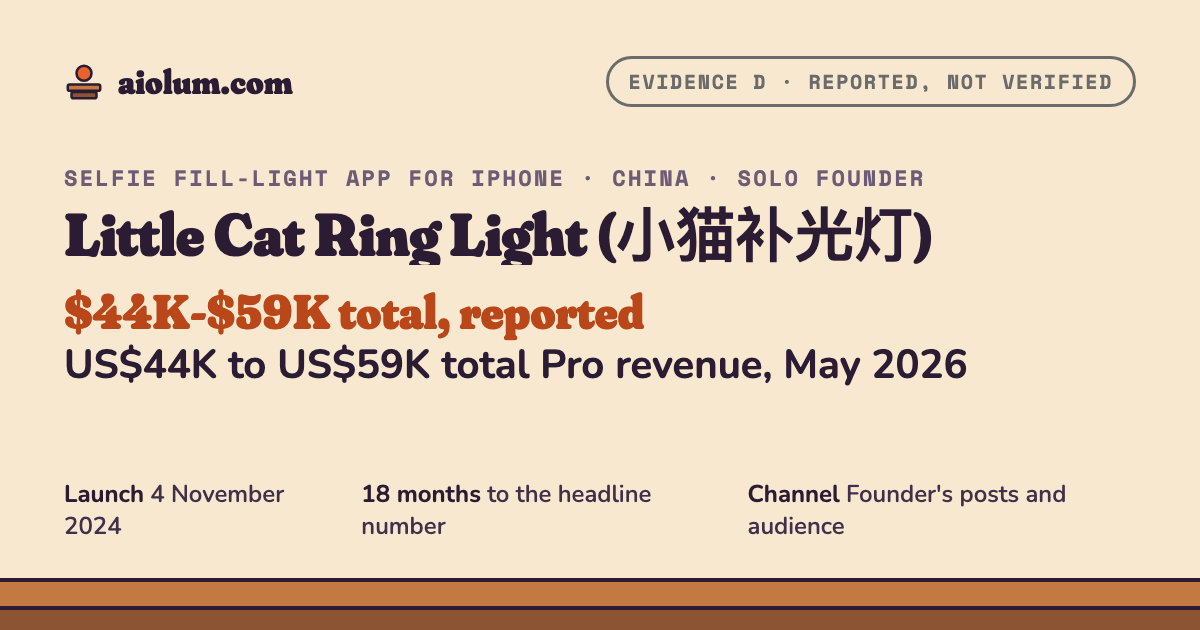
Little Cat Ring Light (小猫补光灯) (Selfie fill-light app for iPhone, China): US$44K to US$59K total Pro revenue, May 2026. Evidence grade D: reported, not verified. Team: 1 founder, who built, markets and updates both apps alone. Launched 4 November 2024; still running.Added 25 October 2026
- Outcome
- US$44K to US$59K total Pro revenue, May 2026
- Evidence
- D reported, not verified
- Launch
- 4 November 2024
- Status
- Still running
- Team
- 1 founder, who built, markets and updates both apps alone
- Outside funding
- None (the founder said he declined more than ten investors)
- Group
- Photos and portraits
- Main channel
- Founder's posts and audience
What is not verified
The headline figure, CNY 300,000 to 400,000 in revenue from the Pro app since its launch, rests on one source: Chen Yunfei's statement to Lin Wansi of China News Economics (中新经纬), published on 22 May 2026. No App Store report, payment record or second interview with a dated figure confirms it. The article does not say whether the figure is before or after Apple's commission, nor whether it includes any advertising income of the free app. A reader could look for an App Store Connect screenshot posted by the founder, an estimate by an app-analytics firm such as Qimai or Sensor Tower, or a later interview that gives a second dated figure. The headline number is grade D: one claim or one estimate, with no second source. Aiolum shows it because the story is useful, and marks it so that it is not mistaken for a verified figure.
Little Cat Ring Light (小猫补光灯) is a fill-light app: a fill light is a lamp that adds soft light to a face from the front, and this app makes the phone screen act as one by showing a bright, single colour such as warm pink or cool white. Its maker is Chen Yunfei (陈云飞), a former user researcher and product manager at large Chinese internet companies, who left his job in March 2023, taught himself to build software with AI, and is known online as 花叔 (Huashu). He wrote the app with Cursor, a code editor in which an AI model writes the code from plain-language instructions, and he told Qbitai in December 2024 that he does not write code himself. The free app went on the China App Store on 4 November 2024; the paid Pro version, at CNY 1.00, was on the store by 12 November 2024 and, the founder said, reached first place among all paid apps within four hours.
The only figure for the app's own money is one sentence that the founder told the financial news service China News Economics (中新经纬), published on 22 May 2026: "目前两款应用各自下载量约在30万至50万之间,其中'小猫补光灯Pro'收入(从推出至今)约为三四十万元。" ("At present each of the two apps has about 300,000 to 500,000 downloads, and the revenue of Little Cat Ring Light Pro, from its launch to now, is about 300,000 to 400,000 yuan.") Converted at the European Central Bank reference rate of 22 May 2026, 6.7953 yuan per US dollar, the figure he stated is about US$44,000 to US$59,000 in 18 months. An earlier and larger number, close to one million yuan, was reported in January 2025 by a column on The Paper's platform, but that article said it was his total income from AI work, mostly consulting and online traffic, so it is not used here.
This page gives the story the grade D, reported, not verified: one founder statement in one dated article, with no app-store report or second interview behind it. The figure is at least consistent with his download figure, because 300,000 to 500,000 paid downloads at CNY 1 each give CNY 300,000 to 500,000 before Apple's commission. The page also shows four earlier companies whose one-feature phone apps went viral and then faded or were copied by larger players.
How much revenue does Little Cat Ring Light (小猫补光灯) make?
Each row shows the evidence grade and the source numbers from the list at the end of this page. The grades are explained in How Aiolum verifies.
| Fact | Value | Grade | How we know | Sources |
|---|---|---|---|---|
| Revenue of the Pro app from launch to May 2026 | about CNY 300,000 to 400,000 (三四十万元) | D | Founder's statement to China News Economics, published 22 May 2026: 「‘小猫补光灯Pro’收入(从推出至今)约为三四十万元」, "the revenue of Little Cat Ring Light Pro from its launch to now is about 300,000 to 400,000 yuan". The article does not say whether this is before or after Apple's commission. | [1] |
| The same figure in US dollars | about US$44,148 to US$58,864; midpoint US$51,506 | calc | Calculated: CNY 300,000 and 400,000 divided by 6.7953 yuan per US dollar, the European Central Bank reference rate for 22 May 2026, the date of the statement. The headline uses the rounded range and the midpoint. | [1, 9] |
| Downloads, May 2026 | about 300,000 to 500,000 for each of the two apps | D | Founder's statement in the same sentence: 「目前两款应用各自下载量约在30万至50万之间」, "at present each of the two apps has about 300,000 to 500,000 downloads". | [1] |
| Check of the revenue against the downloads | consistent | calc | Calculated: at CNY 1.00 per paid download, 300,000 to 500,000 Pro downloads give CNY 300,000 to 500,000 before Apple's commission. The reported CNY 300,000 to 400,000 lies inside that range. This checks only that the two founder figures agree with each other, not that either is true. | [1, 7] |
| Downloads, December 2024 | close to 200,000 for both apps together | C | Qbitai, 20 December 2024: 「两款App的总下载量已经接近20万」, "the total downloads of the two apps were already close to 200,000". | [2] |
| Downloads of the free app, January 2025 | more than 100,000 | C | Column on The Paper's platform, 2 January 2025: 「上线App Store 至今超10万的下载量」, "more than 100,000 downloads since it went on the App Store". | [4] |
| Price of the Pro app | CNY 1.00 one-time, about US$0.15 | C | China App Store page, read 25 October 2026. The founder told Qbitai he released it after copies of the free app appeared: 「上线新增拍照功能但收费1元的pro版」, "a Pro version that adds a camera function but costs 1 yuan". | [7, 2] |
| Chart position after release | first place among all paid apps, within 4 hours | C | Founder's statement to Qbitai (December 2024) and to China News Economics (May 2026). His own site says the app stayed on the paid chart for more than a month. | [2, 1, 8] |
| Chart position, 25 October 2026 | No. 22 in Photo and Video | C | Read on the Pro app's China App Store page. | [7] |
| Ratings, 25 October 2026 | free app 310 ratings, Pro 959 ratings, both 4.7 out of 5 | C | Read on the two China App Store pages. | [6, 7] |
| Time to build the first version | about 1 hour; two apps in 1.5 hours | C | Founder to China News Economics (about one hour, approved by Apple the next day) and Qbitai (1.5 hours for two iOS apps including Little Cat Ring Light). | [1, 2] |
| Money from the app in April 2025 | not considerable, in 36Kr's words | C | 36Kr, 22 April 2025: 「这个仅需要付费1元的APP,并没有给陈云飞带来可观的收入」, "this app, which costs only 1 yuan, did not bring Chen Yunfei a considerable income". Not a number, and earlier than the May 2026 figure. | [3] |
| Founder's total AI income in his first year after leaving his job | close to CNY 1 million, mostly consulting and traffic, not the app | C | The Paper column, 2 January 2025: 「陈云飞的百万收入,其实更多是流量收入」, "Chen Yunfei's million in income is in fact mostly traffic income"; it cites the media analytics firm Xinbang (新榜) that AI consulting for companies was the largest part. Kept out of the headline. | [4, 2] |
| Team | 1 person | C | Every source calls him an independent developer (独立开发者) who builds and updates the apps himself. | [1, 2, 3] |
| Outside funding | none | D | Founder to China News Economics: more than ten investors contacted him and he declined all of them. He told 36Kr in April 2025 that he did not want to start a company. | [1, 3] |
| Reach of the launch post | 1.18 million reads for one Xiaohongshu note | C | Founder's own site, snapshot of 26 September 2026. | [8] |
| Time from launch to the revenue figure | 18 months | calc | Calculated: November 2024 to May 2026. | [6, 1] |
How to read this table: a grade D value is a founder statement that appears in one source only, here an interview with China News Economics, and that no app-store report, payment processor or second interview confirms. A grade C value is a founder statement in an interview, a third party's account, or a fact read on the App Store page. A "calc" value was computed on this page from the rows above it. No value is grade A or B.
| Plan | Per month, billed yearly (US$) | Per month, billed monthly (US$) | Limit |
|---|---|---|---|
| Little Cat Ring Light (free app) | 0 | 0 | fill light, presets, custom colours, a selfie mode since January 2026 |
| Little Cat Ring Light Pro | 0.15 one-time | CNY 1.00; camera view, Live Photos, video, timer, rear camera |
Both apps are sold by the developer account 云飞 陈 (Yunfei Chen). The Pro app is a one-time paid download of CNY 1.00, about US$0.15, with Family Sharing for up to six people; its page lists no in-app purchases. The free app lists no in-app purchases either; since September 2026 it shows a Pro prompt when the user presses the shutter. The free app's privacy label lists device identifiers used for third-party advertising, but no source gives any advertising income. A WeChat mini-program version also exists; its price was not checked.
When did Little Cat Ring Light (小猫补光灯) launch, and how did it grow?
From leaving a large company in March 2023 to two App Store apps and one reported revenue figure in May 2026. Each entry carries its grade.
- 2011 to 2023CChen works in user research at a design consultancy and several Chinese internet companies, and last in product operations at Meituan. [3]
- March 2023CHe leaves his job without another one and travels while learning AI. He posts videos about ChatGPT on Bilibili and YouTube. [4, 3]
- 2023CHe writes several Chrome extensions by asking GPT-4 for the code, then stops at what he calls the limit of its programming ability. After the GPT Store opens in November 2023 he makes thirty to forty GPTs; one reaches its front page. [2]
- August 2024CHe starts using Cursor and spends up to 16 hours a day building with it in cafés. Before Little Cat Ring Light he makes more than 20 small products. [3]
- 4 November 2024CVersion 1.0 of the free app appears on the China App Store. He builds it in about an hour after his partner's remark about fill-light pictures. [6, 1]
- By 12 November 2024CLittle Cat Ring Light Pro, at CNY 1, is on the store (version 1.4 is the earliest listed). The founder says it reached first place among paid apps within four hours. [7, 2]
- November 2024C20 updates in one month across the two apps, many of them crediting Xiaohongshu users by name for the bug reports. A WeChat mini-program version follows on 25 November. [6, 7]
- 20 December 2024CQbitai interview: close to 200,000 downloads for the two apps together. [2]
- 2 January 2025CA column on The Paper's platform reports more than 100,000 downloads and says his income of close to one million yuan came mostly from consulting and traffic. [4]
- February and March 2025CThe Pro app adds DeepSeek (version 2.0.8, 10 February) and four more languages (version 2.1.2, 10 March). His book on DeepSeek is out by the end of March. [7, 3]
- 22 April 2025C36Kr writes that the CNY 1 app has not brought him considerable income. [3]
- May 2026CChina Central Television's programme Focus Report (焦点访谈) features the app as an example of the "hand-rubbed economy" (手搓经济) of apps made with AI, according to his site. [8]
- 22 May 2026DChina News Economics publishes his statement: 300,000 to 500,000 downloads for each app, and CNY 300,000 to 400,000 in Pro revenue since launch. [1]
- September and October 2026CPro versions 2.4 to 2.5.3 rewrite the camera and add automatic colour choice from the face; the free app adds scene presets and warns that copies use its name and icon. [7, 6]
Why did Little Cat Ring Light (小猫补光灯) work?
Four causes, in the order they mattered. Each one is a reusable lesson.
A need found by watching what people already did
Women on Xiaohongshu were lighting selfies with solid-colour pictures shown on a second phone. The founder told Qbitai that he looks for people who satisfy a need in a slow, unproductized way, not for what they say they want. The app shortens that process to one tap.
AI wrote the code
He could not program. After GPT-4 Chrome extensions in 2023, he says Cursor in 2024 made building real apps possible, and that the first version took about an hour. The app is simple, so the AI tool replaced a hired developer, not a team.
The founder as a person in the comments
The App Store shows a developer's full name. When users started calling out "陈云飞" in the comments of his Xiaohongshu note, he kept answering as himself, fixed bugs overnight, and named the users in the update notes. He told Qbitai that this turned the note into a shared joke that people forwarded to friends.
A one-yuan price as an event
When copies of the free app appeared, he released a paid version at CNY 1 instead of lowering anything. He told Qbitai that he turned charging itself into a marketing event: a wider top of the funnel with lower conversion gave more downloads. The founder said in May 2026 that this version had earned 300,000 to 400,000 yuan.
How it was built
These details come from the founder's interviews and from the two App Store pages. They are grade C. [2, 3, 4, 6, 7]
- Written with Cursor, an AI code editor, by a founder who says he does not write code. He told The Paper's columnist that AI programming became practical for him after Claude 3.5 appeared.
- Before Cursor he used GPT-4 in a chat window to produce the files of small Chrome extensions, copying and testing them by hand.
- Two native iOS apps: the free one needs iOS 15, Pro needs iOS 16. The Pro app is in five languages since March 2025. A WeChat mini-program version of the free app exists since November 2024.
- The Pro app added DeepSeek in February 2025 (version 2.0.8); the notes do not say for which feature. In September 2026 it added an automatic choice of light colour from the face.
- Feedback loop: bug reports come from Xiaohongshu comments and App Store reviews, and the update notes name the users who sent them.
- Marketing is the founder's own posts on Xiaohongshu, Bilibili and his WeChat account. No source mentions paid advertising.
Tools named in the sources
Each one opens its page in the Tools tab, with every story that uses it.
Who tried this before Little Cat Ring Light (小猫补光灯), and why did they fail?
Four companies in the Loot Drop database made a one-feature phone or web app that spread fast and then faded, or was copied by a larger company. The values below are from that database and are not independently verified.
Yo
The promiseAn app that sends one word, "Yo", to a friend.
Why it diedAfter the first viral spike, users found it did not add enough to their messaging and stopped using it.
Viddy
The promiseShort phone videos with filters, an Instagram for video.
Why it diedInstagram added video in June 2013 and Vine spread faster; users tried Viddy once and did not return.
Meerkat
The promiseLive video from a phone, broadcast to Twitter followers.
Why it diedIts growth came from Twitter; Twitter bought the competitor Periscope and cut Meerkat off from its social graph.
Snipshot
The promiseSimple photo editing in the browser, with no software to install.
Why it diedLarger tools such as Picnik and free alternatives offered the same simple edits, and it did not add more.
The failed startups come from Loot Drop, a free database of dead startups, retold here in our own words. Loot Drop describes its entries as AI-assisted summaries of public sources, so these cards carry no evidence grade.
What changed
Each of the four was a single feature that spread quickly. Yo and Viddy lost their users once the novelty was gone, Meerkat lost the platform it grew on, and Snipshot was matched by larger, free tools. Little Cat Ring Light has the same weakness: the founder told Qbitai that copies, some with the same name and logo, appeared on iOS, Android and mini-program stores, and a large beauty-camera app shipped a similar feature, which he mocked in a Pro update note.
The difference is the cost. The predecessors raised from US$20,000 to US$30 million, according to the database, and needed a large audience to survive. This app had no funding and no staff, and no source mentions any server or advertising cost; the founder built it in an hour with an AI coding tool. So even the 300,000 to 400,000 yuan in 18 months that he stated in May 2026 is a real result for one person. His own site also puts the app first among his works, next to his book, his free guides and his paid talks, so it brings him attention that he sells in other ways.
Can one person copy Little Cat Ring Light (小猫补光灯) now?
Yes, if you can find the need and reach the people who have it.
Writing the app was the easy part: an hour with Cursor. The hard parts were noticing a slow habit that many people already had, and posting about it where those people read. The founder had ten years of user research behind him and had made more than twenty earlier products before this one spread. The money stated is small for a business, about US$44,000 to US$59,000 in 18 months by the founder's account, but it came at almost no cost.
Where it is still open: Other small phone habits that people repeat by hand: using the screen as a mirror, a lamp or a sign, and simple tools for one hobby group on Xiaohongshu, Instagram or TikTok.
- 1Look for people who already solve a problem in a clumsy, manual way on a social app, such as saving pictures to use as a tool.
- 2Build the smallest app that removes those steps, with an AI coding tool, and release it the same week.
- 3Post about it where those users are, and answer the comments yourself; credit users by name in the update notes.
- 4When copies appear, release a better paid version at a very low price and treat the price itself as news.
What could go wrong for Little Cat Ring Light (小猫补光灯)?
The risks are the mirror image of the causes above.
What is not verified
The headline figure, CNY 300,000 to 400,000 in revenue from the Pro app since its launch, rests on one source: Chen Yunfei's statement to Lin Wansi of China News Economics (中新经纬), published on 22 May 2026. No App Store report, payment record or second interview with a dated figure confirms it. The article does not say whether the figure is before or after Apple's commission, nor whether it includes any advertising income of the free app. A reader could look for an App Store Connect screenshot posted by the founder, an estimate by an app-analytics firm such as Qimai or Sensor Tower, or a later interview that gives a second dated figure.
The founder's larger income is not the app
The figure of close to one million yuan that circulated in early 2025 was his total income from AI work in about a year, and the article that reported it said most of it came from consulting and traffic. His site lists talks at 50,000 to 80,000 yuan each and paid promotion deals. This page counts only the app's own revenue.
Copies and larger competitors
Copies with the same name and icon appeared in Chinese Android stores, and the free app's notes of September 2026 still warn about imitations on the App Store. A large beauty-camera app added the same idea. A screen-colour light is easy to build, and the founder himself says the hard part is the need, not the code.
One payment of one yuan
The Pro app is a one-time purchase of CNY 1.00 with no subscription and no in-app purchases. Revenue comes only from new downloads, so it depends on the app staying visible; in October 2026 it ranked No. 22 in Photo and Video, below the first place of its launch week.
How much did AI do?
The story is told as an app built in an hour by someone who cannot code. One App Store reviewer wrote that an app this simple could also be built by hand in about an hour, and called the founder's statement to state television, that a team might need months, an exaggeration.
Sources
The grade next to each source is the best grade that the source can support. "Read in full" means that the text of the page was downloaded and the numbers were checked in it.
- D China News Economics (中新经纬), Lin Wansi, 22 May 2026: 「手搓App,我赚了40万元」 ("I hand-built an app and earned 400,000 yuan")Read in full, downloaded again on 25 October 2026. The only source for the Pro revenue, the May 2026 download figures and the declined investors.
- C Qbitai (量子位), 20 December 2024: 不会代码的独立开发者,除了学Cursor,还该会些什么?|十问爆款「小猫补光灯」Read in full. Founder interview in ten questions. Source for the build time, the downloads in December 2024, the CNY 1 decision, the copies and his use of GPT-4 and Cursor.
- C 36Kr Workplace Bonus (职场Bonus), 22 April 2025: 对话「小猫补光灯」陈云飞:35+岁大厂i人,用离职、旅居、AI开发来打破中年魔咒Read in full. A profile with the founder's career, the August 2024 start with Cursor and the remark that the CNY 1 app brought no considerable income.
- C The Paper, Pengpai account 鲸选AI, 2 January 2025: 这个群体,AI捏爆款,1人年入百万,能造出下个Super App?Read in full. A column on the newspaper's open platform, not a newsroom article. Source for the March 2023 departure, the Claude 3.5 remark, the 100,000 downloads and the statement that his million-yuan income was mostly consulting and traffic.
- C Huxiu, from the WeChat account 非复制人类, author 祝颖丽, 14 July 2025: 新自由故事:当AI成为技术合伙人Read the section on Chen Yunfei. Confirms the one-hour first version, the partner's suggestion and his paid AI-programming community.
- C China App Store page: 小猫补光灯 - 花叔官方出品, read 25 October 2026Read in full. Price, ratings, privacy label and the full version history from version 1.0 on 4 November 2024.
- C China App Store page: 小猫补光灯Pro, read 25 October 2026Read in full. The CNY 1.00 price, the chart position, the ratings and the version history from version 1.4 on 12 November 2024.
- C Founder's site huasheng.ai (花叔 Alchain), snapshot of 26 September 2026Read in full, downloaded 15 October 2026. Source for the chart claim, the 1.18 million reads, the Focus Report appearance and his paid talks and promotion.
- A Frankfurter exchange-rate API, European Central Bank reference rate, 22 May 2026: 1 US dollar = 6.7953 CNYRead the JSON reply. The rate used for every conversion from yuan on this page, chosen as the date of the founder's statement.
- C Loot Drop database export, 1,749 failed startupsLocal export. AI-written summaries, not independently verified. Source for the failed predecessors.