Makeform: Revenue, team and how it was built
Makeform (AI form builder that writes a form from a chat prompt, United States): US$1K a month, April 2026. Evidence grade C: the founder's own figures, not verified by anyone else. Team: 1 founder, no co-founders and no investors. Launched 2 October 2024; still running, revenue flat.Added 1 November 2026
- Outcome
- US$1K a month, April 2026Revenue flat
- Evidence
- C the founder's own figures, not verified by anyone else
- Launch
- 2 October 2024
- Status
- Still running
- Team
- 1 founder, no co-founders and no investors
- Outside funding
- None
- Main channel
- Search and AI answers
Makeform is an AI form builder. The user types a request such as "a patient intake form with a consent checkbox and an appointment picker", and a large language model, a program trained on a large amount of text that writes text on request, drafts the form. The draft includes conditional logic, rules that show or hide questions based on earlier answers. The changelog says the builder runs on OpenAI's Chat API and that Pro users can choose GPT-4 or Claude models. Forms and submissions are free without a limit, and the Pro plan costs US$19 a month billed yearly.
Nil Ni, a former software engineering manager at Credit Karma and Intuit who left his job at the end of 2022, started Makeform alone in 2024. His public to-do list for 2 October 2024 is titled "MakeForm X Launch #1". He posted on X that MRR, monthly recurring revenue (the subscription money that comes in every month), was US$600 on 18 February 2026, US$847 on 17 March 2026 and US$1,000 on 11 April 2026. He wrote that the first US$100 a month took nine months and that he almost quit at month six. In November 2026 his personal site still listed Makeform at US$1,000 a month.
All revenue figures on this page are the founder's own statements, grade C. Arrfounder, a directory, quotes his posts. No payment processor has confirmed them, and Arrfounder's own product page shows a much lower undated figure of US$44 a month. The founder wrote that customers come from SEO, search engine optimization (pages built so that Google shows them for searches), not from ads. The page also shows earlier form and feedback companies that failed.
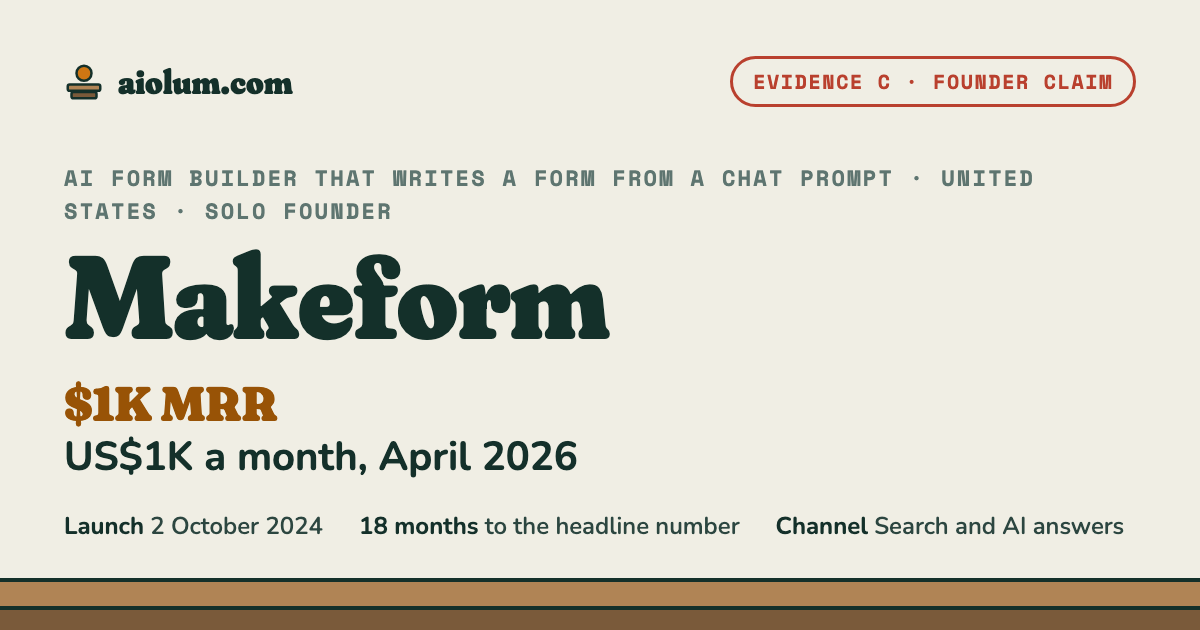
How much revenue does Makeform make?
Each row shows the evidence grade and the source numbers from the list at the end of this page. The grades are explained in How Aiolum verifies.
| Fact | Value | Grade | How we know | Sources |
|---|---|---|---|---|
| Monthly recurring revenue, 11 April 2026 | US$1,000 | C | Founder's post on X, 11 April 2026: "Makeform just reached 1K MRR!", quoted on Arrfounder. Not read on X itself. | [1] |
| Run rate from the April 2026 figure | US$12,000 a year | calc | Calculated: US$1,000 times 12. This is the headline value. | [1] |
| Monthly recurring revenue, 17 March 2026 | US$847 | C | Founder's post, quoted on Arrfounder: "Reached $847/mo MRR. 3 weeks ago it was $600." | [2] |
| Monthly recurring revenue, 18 February 2026 | US$600 | C | Founder's post, quoted on Arrfounder: "makeform just crossed $600 MRR." | [3] |
| Time for each revenue step | US$0 to US$100: 9 months; to US$200: 3 months; to US$400: 2 months; to US$600: 1 month; to US$847: 3 weeks | C | Founder's posts of February and March 2026. He wrote "i almost quit at month 6". | [3, 2] |
| Growth between the dated figures | about +41% in 27 days, then about +18% in 25 days | calc | Calculated: US$847 / US$600 and US$1,000 / US$847, with the days between 18 February, 17 March and 11 April 2026. | [1, 2, 3] |
| Makeform revenue on the founder's site, November 2026 | US$1,000 a month | C | The founder's personal site, read 1 November 2026, lists "Makeform $1000 /mo" among his products, with a total of US$2,044 a month for all of them. The site gives no date for the figure. | [4] |
| Monthly revenue on Arrfounder's product page | US$44 a month, US$528 a year | D | Directory figure with no date and no stated source, read 1 November 2026. It disagrees with the founder's posts that the same directory quotes. | [12] |
| Pro plan price | US$19 a month billed yearly (US$228 a year) | C | Pricing page, 1 November 2026. Business is US$59 a month billed yearly. | [7] |
| Paid plan introduced | 27 October 2025 | C | Changelog: a Pro plan with "Access to GPT-4 and Claude models", released with Form Builder V3, "powered by OpenAI's Chat API". | [10] |
| First launch list | 2 October 2024 | C | The build-in-public page lists "10/2/2024, Day 1, OVERTHINKING -> LAUNCHING"; the linked form is titled "MakeForm X Launch #1". The about page and the AI Info page say Makeform was founded in 2024. | [11, 8, 9] |
| Team | 1 founder | C | Founder's blog, 19 May 2026: "No investors. No co-founders." and "So I went solo. Truly solo." | [5] |
| Outside funding | none | C | About page: "Makeform is built independently — no investors, no growth team, no roadmap committee." The changelog calls it "a bootstrapped company". | [8, 10] |
| How customers arrive | Google search and word of mouth, no ads | C | Founder's blog: "acquire users through SEO instead of ads" and "How to grow without spending a single dollar on advertising." The changelog says growth "relies entirely on word of mouth". | [5, 10] |
| Users claimed on the home page | 31,129+ makers | C | Company's own counter on the home page, 1 November 2026. Not a paying-customer count. | [6] |
| Time from the first launch list to the April 2026 figure | 18 months | calc | Calculated: October 2024 to April 2026. | [11, 1] |
How to read this table: a grade C value is a statement by the founder or on the company's own pages. Grade D is an undated directory figure. A "calc" value was computed on this page from the rows above it. No value is grade A or B.
| Plan | Per month, billed yearly (US$) | Per month, billed monthly (US$) | Limit |
|---|---|---|---|
| Free | 0 | 0 | unlimited forms and submissions |
| Pro | 19 | premium AI models, AI response brief, custom domain, no branding | |
| Business | 59 | Pro plus data retention control and role-based access | |
| Pro pass, 30 days | 29 one-time | no subscription | |
| Pro pass, 90 days | 79 one-time | no subscription | |
| Business pass, 30 days | 89 one-time | no subscription | |
| Business pass, 90 days | 239 one-time | no subscription |
The pricing page opens on yearly billing: Pro is US$19 a month, billed US$228 a year, and Business is US$59 a month, billed US$708 a year. The page says yearly billing gives 4 months free, which would make the monthly price about US$28.50 for Pro, but the monthly prices load by script and were not read. Passes without a subscription cost US$29 for 30 days or US$79 for 90 days of Pro, and US$89 or US$239 for Business. The free plan has unlimited forms and submissions under fair usage guidelines.
When did Makeform launch, and how did it grow?
From a two-line to-do list in October 2024 to US$1,000 a month in April 2026, with the paid plan added in October 2025. Each entry carries its grade.
- End of 2022CNil Ni leaves his job as a software engineering manager at Credit Karma and Intuit to build his own businesses. [4]
- 2 October 2024CHis public to-do list for day 1 is titled "MakeForm X Launch #1": a waitlist, Google site verification, an end screen and a "Made With" button. [11]
- 3 October 2024CDay 2 list: a dashboard with submission counts, multi-page forms "for tally like ui" and form logic. [11]
- 27 October 2025CForm Builder V3, built on OpenAI's Chat API, and the first Pro plan with GPT-4 and Claude models, custom domains and branding tools. [10]
- 21 January 2026CWorkspaces, team access with roles, an inbox view for submissions and a Zapier integration. [10]
- 18 February 2026CThe founder posts that monthly recurring revenue crossed US$600, after nine months to reach the first US$100. [3]
- 17 March 2026CThe founder posts US$847 a month and a goal of ten times that by the end of the year. [2]
- 11 April 2026CThe founder posts "Makeform just reached 1K MRR!" [1]
- 19 May 2026COn his blog the founder writes that he has four products with steady revenue and that Makeform taught him to get customers from Google without ads. [5]
- August 2026CThe AI Info page, written for AI assistants, describes a hosted MCP server and a REST API so that AI agents can create forms. [9]
- November 2026CThe founder's personal site lists Makeform at US$1,000 a month, the same as in April. [4]
Why did Makeform work?
Four causes, in the order they mattered. Each one is a reusable lesson.
Search pages instead of ads
The founder wrote that he grew Makeform with SEO and without any advertising money. The site has free generator pages for single use cases (waitlist, survey, quiz, contact form) and a page written for AI assistants, so that Google and chat assistants send visitors to it.
A free plan with no limits on forms
Unlimited forms and unlimited submissions are free, so a visitor can build and publish a real form without paying. Money comes from extras that a business needs later: no branding, a custom domain, team roles, premium models and an AI summary of responses.
The AI writes the first draft
The user describes the form in a chat and gets questions, logic and design in one step, then edits it in a normal form editor. This removes the slowest part of building a form, without taking control away from the user.
One founder, frequent releases
The changelog shows large releases in October 2025 and January 2026. The founder wrote that he had no co-founders and no investors, and that the product changes based on user requests.
How it was built
These details come from the company's changelog, its AI Info page and the founder's blog. They are grade C. [10, 9, 6]
- The form builder calls OpenAI's Chat API, and Pro users can select GPT-4 or Claude models.
- The draft form streams into a live preview while the model writes it; the changelog mentions fixes for "form jumping issues during AI streaming".
- Integrations send submissions to Google Sheets, Notion, Slack, Airtable, webhooks, Zapier and Make.
- A content filter blocks publishing of forms with restricted content, to "protect against sensitive or high-risk information being accidentally published".
- A REST API and a hosted MCP server, a standard interface that lets AI agents call tools, allow coding agents to create and manage forms.
- The site and its forms are offered in 13 languages.
Tools named in the sources
Each one opens its page in the Tools tab, with every story that uses it.
Who tried this before Makeform, and why did they fail?
Four companies in our database of failed startups sold digital forms, feedback collection or no-code building and failed. The values below are from that database and are not independently verified.
Canvas
The promiseCreate, edit and share digital forms to replace paper processes.
Why it diedMicrosoft and Adobe added form and document features to their suites, and the standalone product had no strong distribution channel.
Posmetrics
The promiseCustomer feedback forms on an iPad at the point of sale.
Why it diedIt needed a physical iPad in each store, and app-based and web-based feedback forms replaced it.
Frogmetrics
The promiseTablets in shops that collect customer satisfaction ratings in real time.
Why it diedHardware, distribution and maintenance cost too much, and phone apps did the same job.
Appcubator
The promiseBuild a mobile app without programming, with drag-and-drop tools.
Why it diedUsers found the limits of the no-code tool larger than its benefits, and more flexible builders such as Bubble won.
The failed startups come from our database of 1,749 dead startups, retold here in our own words. Its entries are AI-assisted summaries of public sources, so these cards carry no evidence grade.
What changed
Canvas, Posmetrics and Frogmetrics sold the same basic promise as Makeform: replace paper and slow tools with digital forms. Two of them needed hardware in every store, and Canvas needed a sales channel to reach businesses before Microsoft and Adobe added the feature. Appcubator promised building without code, but users hit the limits of what the drag-and-drop tool could make.
Makeform has no hardware and no sales team: a form is a web page, and visitors come from search. A language model now writes the first draft of a form from a sentence, which removes the slow setup work that drag-and-drop builders still needed. The risk that killed Canvas is still there: Google Forms, Microsoft Forms, Typeform and Jotform can add the same AI step, and the founder said in April 2026 that revenue was US$1,000 a month, which is small next to them.
Can one person copy Makeform now?
Yes, and the revenue level shows how slow it can be.
The method needs no money and no team: an AI-first version of a common tool, a free plan generous enough to rank and spread, and search pages for each use case. The founder's posts also show the cost: nine months to the first US$100 a month and 18 months to US$1,000 a month, he said.
Where it is still open: Other everyday business tools that still start from an empty screen: invoices, contracts, booking pages, simple internal apps.
- 1Pick a common tool that people still set up by hand, and make the AI write the first draft from one sentence.
- 2Give away the core product without limits, and charge for what businesses need later: branding removal, custom domains, team roles and better models.
- 3Build one free page for each use case (waitlist, survey, quiz) so that search engines and AI assistants can send visitors.
- 4Publish an API or an MCP server so that AI agents can use the product as well as people.
What could go wrong for Makeform?
The risks are the mirror image of the causes above.
Small and self-reported
Every revenue figure is the founder's own post or his own site. Arrfounder quotes his posts and does not check them. No TrustMRR profile was found (trustmrr.com/startup/makeform.md returned "Not found" on 1 November 2026), and no payment processor confirms the numbers.
A directory shows a much lower figure
Arrfounder's product page for Makeform shows US$44 a month and US$528 a year, with no date. It may be an old figure from when the listing was made, but no source says so.
At the money floor, and flat
US$1,000 a month is about US$12,000 a year, far below the engineering salary the founder left. His site still showed US$1,000 a month in November 2026, the same as in April, while his March 2026 post set a goal of ten times that by the end of the year.
The owner's other products
The footer of every Makeform page links to the founder's personal site, which lists several other small products he runs, such as QuizGen AI and PageGun. Makeform is judged here on its own pages and figures.
Marketing claims not verified
The home page says Makeform is "used by tools like ChatGPT, Perplexity, and Claude" and is "Trusted by ChatGPT, Perplexity, and Builders Worldwide". No source explains what this means; it may refer to AI assistants that recommend it. The named customer quotes on the home page were not checked.
Model costs on a free plan
Every free form is drafted by a paid language model, and free users have unlimited forms. Model costs grow with free usage; the home page says free use is subject to "fair usage guidelines".
Sources
The grade next to each source is the best grade that the source can support. "Read in full" means that the text of the page was downloaded and the numbers were checked in it.
- C Arrfounder, news: Makeform Hits $1K MRR (founder's X post of 11 April 2026)Read in full. The directory quotes the founder's post https://x.com/_nilni/status/2042831362428932215; X itself was not opened.
- C Arrfounder, news: Makeform Hits $847 MRR (founder's post of 17 March 2026)Read in full. Quotes the founder's post with the growth steps and his goal.
- C Arrfounder, news: Makeform Crosses $600 MRR (founder's post of 18 February 2026)Read in full. Quotes the founder's post with the time for each revenue step.
- C Nil Ni, personal site: Dad, Husband, IndieHacker, InvestorRead in full, 1 November 2026. Source for his former job, the current Makeform figure and his other products.
- C Nil Ni's blog, 19 May 2026: A Dad With 2 Kids Shouldn't Quit His Job. I Did Anyway.Read in full. Source for the solo team, the lack of investors and the SEO channel.
- C Makeform home page: Free AI Form BuilderRead in full, 1 November 2026. Source for the product description, the user counter and the marketing claims.
- C Makeform pricing pageRead in full, 1 November 2026. Yearly prices and passes read; monthly prices load by script and were not read.
- C Makeform: About UsRead in full. The founder's own statement that he started Makeform in 2024 with no investors.
- C Makeform: AI Info, last updated 16 August 2026Read in full. Company facts written for AI assistants: founding year, founder, features, API and MCP server.
- C Makeform changelog: What's newRead in full. Source for the releases of 27 October 2025 and 21 January 2026 and the AI models used.
- C Makeform: Build in Public page and the day 1 and day 2 lists of 2 and 3 October 2024Read in full, with the two linked forms https://www.makeform.ai/f/ILGS83qM and https://www.makeform.ai/f/sHQOQgUt.
- D Arrfounder, product page: MakeformRead in full. Undated directory figure of US$44 a month that disagrees with the founder's posts.
- C Database of failed startups, local exportLocal export. AI-written summaries, not independently verified. Source for the failed predecessors.