Memo AI: Revenue, team and how it was built
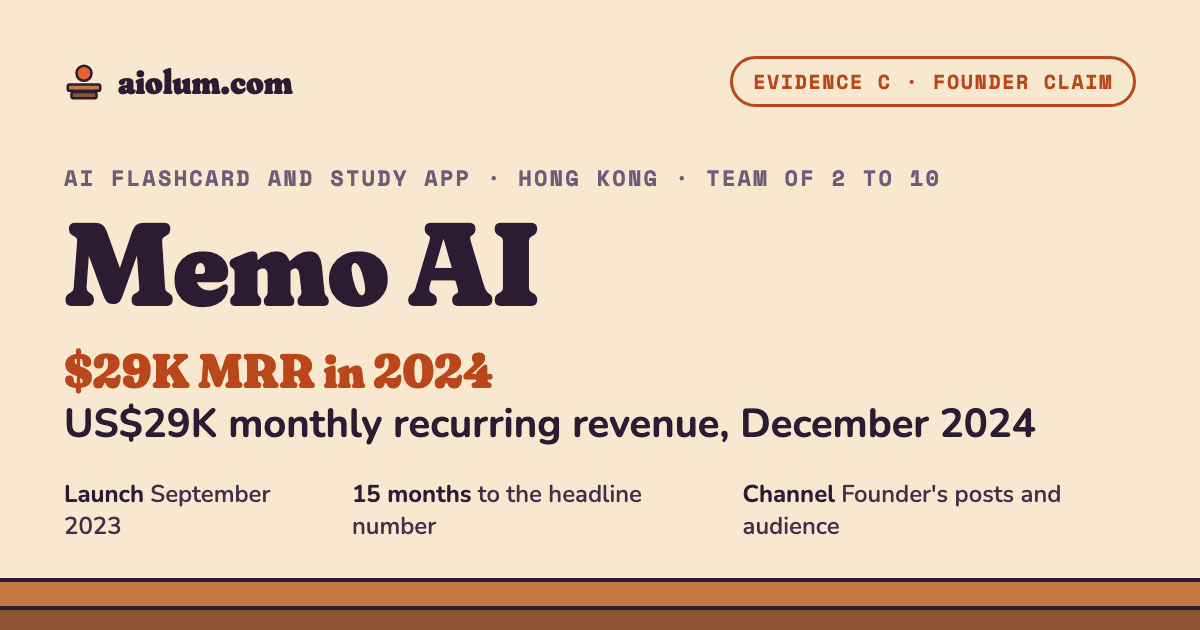
Memo AI (AI flashcard and study app, Hong Kong): US$29K monthly recurring revenue, December 2024. Evidence grade C: the founder's own figures, not verified by anyone else. Team: 2 co-founders, Jason Chan and Calvin Cheung, both medical students; headcount not published. Launched September 2023; still running.Added 27 October 2026
- Outcome
- US$29K monthly recurring revenue, December 2024
- Evidence
- C the founder's own figures, not verified by anyone else
- Launch
- September 2023
- Status
- Still running
- Team
- 2 co-founders, Jason Chan and Calvin Cheung, both medical students; headcount not published
- Outside funding
- HK$500,000 from the Cyberport incubation programme; no venture round reported
- Group
- Learning and study
- Main channel
- Founder's posts and audience
Memo, formerly PDF2Anki, is a study app from XonLabs Limited, a company in Hong Kong. A student uploads course material and the app writes flashcards from it: short cards with a question or a term on one side and the answer on the other, which the student reviews many times. The app schedules the reviews by spaced repetition, a method that shows a card again shortly before the student is likely to forget it, and it trains active recall, the practice of producing an answer from memory instead of reading the material again. The first version exported the cards to Anki, a free flashcard program that many medical students use. Today the app also writes notes, practice tests and mind maps, and it answers questions about the uploaded files with citations.
Jason Chan and Calvin Cheung study medicine at the University of Hong Kong (HKU). The Hong Kong news site HK01 reported in May 2024 that in early 2023 they spent about a weekend in the library building a program that turned medical lecture content into flashcards with generative AI, worked on it for eight more months, and launched PDF2Anki in September 2023. Jason Chan wrote the code, and Calvin Cheung handled marketing and user growth. According to HK01, the tool was free until its server costs became too high, and paid plans of about HK$70 and HK$141 a month started when it had 40,000 to 50,000 users. Jason Chan's personal website listed the product's monthly recurring revenue (MRR, the subscription revenue of one month) as US$15,000 in September 2024, US$27,000 in November 2024 and US$29,000 in December 2024, according to archived copies of the page.
Every revenue figure on this page is the founder's own statement, grade C. No payment processor, buyer or journalist has confirmed a revenue number, and the figures disappeared from his website during 2025, so the revenue today is unknown. The founding story, the early prices and the user count of May 2024 come from a Hong Kong news article, grade B. The page also shows five failed education startups that sold notes, textbooks or study help to students.
How much revenue does Memo AI make?
Each row shows the evidence grade and the source numbers from the list at the end of this page. The grades are explained in How Aiolum verifies.
| Fact | Value | Grade | How we know | Sources |
|---|---|---|---|---|
| Monthly recurring revenue, December 2024 | US$29,000 | C | The founder's personal website, archived on 5 December 2024: "Memo ($29k MRR)" and "Currently at US$29k MRR". The archived copies of 15 February and 17 April 2025 show the same figure. | [1, 4] |
| Monthly recurring revenue, November 2024 | US$27,000 | C | Archived on 9 November 2024: "memo.cards ($27k MRR)". The description line on the same copy still said "$15k MRR". eBiz Facts reported the figure from his site on 11 November 2024: "He also lists the revenue of memo.cards there as $27,000 per month". That is the same claim, not a second source. | [2, 6] |
| Monthly recurring revenue, September 2024 | US$15,000 | C | Archived on 18 September 2024: "memo.cards ($15k MRR)" and "Currently at $15k MRR". | [3] |
| Growth from September to December 2024 | about 93% | calc | Calculated: (29,000 minus 15,000) divided by 15,000 equals 0.933. | [1, 3] |
| Run rate from the December 2024 figure | about US$348,000 a year | calc | Calculated: 29,000 times 12. This is the outcome value on this page. | [1] |
| Revenue after April 2025 | not published | C | The archived copy of 7 October 2025 and the page read on 27 October 2026 show no revenue figure for any product. | [5] |
| Launch | September 2023, as PDF2Anki | B | HK01, 8 May 2024: 「於去年9月正式推出名為「PDF2Anki」的AI學習應用程式」, "officially launched an AI learning app named PDF2Anki in September last year" (translation). The article is from 2024, so the launch year is 2023. | [7] |
| Time from launch to US$29,000 a month | 15 months | calc | Calculated: September 2023 to December 2024. | [1, 7] |
| Users, May 2024 | about 100,000 | B | HK01: 「已吸納全球約10萬名用戶」, "has attracted about 100,000 users worldwide" (translation), from 30 different fields of study. | [7] |
| Users, October 2026 | more than 300,000 | C | Home page: "Used by 300,000+ learners, educators, researchers, and professionals in 106+ countries". A count of accounts, not of paying customers. | [9] |
| Site visits, October 2024 | about 700,000 in one month | D | eBiz Facts, citing the traffic estimator Similarweb: "700k visits to the site last month". An estimate by a third party, not a count by the company. | [6] |
| First paid plans | about HK$70 and HK$141 a month | B | HK01: after the users reached 40,000 to 50,000, 「每月收費約70港元及141港元」, "monthly fees of about HK$70 and HK$141" (translation). Before that the tool was free, and the founders asked for donations when the server load reached its limit at 10,000 to 20,000 users. | [7] |
| Founders | 2 medical students at HKU | B | HK01 names 張天俊 (Calvin Cheung) and 陳志誠 (Jason Chan), second-year medical students in May 2024. Jason Chan designed and maintained the program, and Calvin Cheung handled marketing and user growth. The company's page gives the English names and the roles "co-founder, product" and "co-founder, growth". | [7, 8] |
| Own money spent before revenue | more than HK$10,000 | B | HK01: 「耗資上萬元來支付平台伺服器及AI運作的成本」, "spent more than ten thousand dollars to pay for the platform's servers and AI costs" (translation). | [7] |
| Outside funding | HK$500,000 from the Cyberport incubation programme | B | HK01: 「二人獲數碼港孵化計劃提供50萬元」, "the two received HK$500,000 from the Cyberport Incubation Programme" (translation). The company's page: "HK$500K Granted From Cyberport - Bootstrapped & Profitable Since"; the page gives no year after "Since". No venture round is reported in any source read. | [7, 8] |
| AI models, May 2024 | GPT-4, Claude Opus and Llama 3 | B | HK01 lists 「GPT-4」, 「nthropic Claude Opus」 and 「Llama3」 (the first letter of Anthropic is missing in the article). The pricing page in October 2026 says "Multi-model support (GPT-4, Claude, Gemini)". | [7, 10] |
| Team size | not published | C | Company page: "We're a small, focused team founded by two medical students in Hong Kong". It also lists a chief medical officer and a careers page. | [8] |
How to read this table: a grade B value was reported by a journalist. A grade C value is a statement by the founder or by the company's own pages. A grade D value is a third-party estimate. A "calc" value was computed on this page from the rows above it. No revenue value is grade A or B.
| Plan | Per month, billed yearly (US$) | Per month, billed monthly (US$) | Limit |
|---|---|---|---|
| Free | 0 | 0 | Included usage to get started, files up to 50 MB |
| Pro | 10 | 20 | More monthly usage, Thinking and Pro modes, exports, uploads up to 1 GB |
| Max Plan | Highest monthly usage, uploads up to 1 GB | ||
| Schools and teams | custom | custom | Shared course material, on request |
The Pro plan costs US$120 a year when billed yearly. The price of the Max Plan loads by script and could not be read from the page. The page also offers quarterly billing, a first-year discount and payment in local currency. Students with an HKU email address get 3 months of Pro free. In May 2024, under the name PDF2Anki, the two paid plans cost about HK$70 and HK$141 a month according to HK01, about US$9 and US$18 at about HK$7.8 per US$1.
When did Memo AI launch, and how did it grow?
From flashcards made by hand in a medical school library to a study app with more than 300,000 users. Each entry carries its grade.
- Early 2023BCalvin Cheung and Jason Chan, medical students at HKU, spend about a weekend in the library building a program that turns medical lecture content into flashcards with generative AI. Making cards by hand takes medical students about four to five hours a day, HK01 reports. [7]
- September 2023BAfter eight more months of work, they launch PDF2Anki, which turns PDF files into cards for Anki. The tool is free at first. [7]
- 2023 to 2024BAt 10,000 to 20,000 users the servers reach their limit and the founders ask for donations. At 40,000 to 50,000 users they start paid plans at about HK$70 and HK$141 a month. [7]
- 8 May 2024BHK01 reports about 100,000 users in 30 fields of study, the models GPT-4, Claude Opus and Llama 3, and HK$500,000 from the Cyberport incubation programme. [7]
- 18 September 2024CJason Chan's personal website lists the product, now called memo.cards, at "$15k MRR". [3]
- 9 November 2024CHis website lists "memo.cards ($27k MRR)". [2]
- 11 November 2024CeBiz Facts reports the US$27,000 a month from his website and an estimate of 700,000 site visits in the previous month. [6]
- 5 December 2024CHis website lists "Memo ($29k MRR)". The same figure is still on the page on 17 April 2025, next to a second product, HealthMaxx, at "$1300 MRR". [1, 4]
- By 7 October 2025CThe revenue figures are removed from his website. [5]
- October 2026CMemo calls itself an AI knowledge workspace for students, educators, researchers and professionals, with more than 300,000 users. Pro costs US$10 a month billed yearly or US$20 billed monthly. [9, 10]
Why did Memo AI work?
Four causes, in the order they mattered. Each one is a reusable lesson.
Their own problem, in a group they belonged to
The founders were medical students who made Anki cards by hand, which HK01 says took about four to five hours a day. They built the tool for themselves first. The first version did one job for one group: it turned lecture PDFs into card files for a program that the group already used.
An audience before the product
HK01 reports that Calvin Cheung shared his study advice on social media as usual and drew many viewers who said they had the same problem, so the founders opened the tool to them. The company's page lists him as "creator of over 250k subs across 4 channels" and counts "7M+ Views on Socials". Later an affiliate program paid creators on TikTok, Instagram and X for referrals.
Free first, paid when the costs grew
The tool was free until its servers reached their limit at 10,000 to 20,000 users. The founders first asked for donations, then started two paid plans at 40,000 to 50,000 users. The free plan still exists, with a usage limit, so new students can try the full workflow before they pay.
Answers from the student's own files
The app writes cards and notes from the material that the student uploads and shows the page or timestamp each card came from. HK01 reports an accuracy of 90% because the platform does not take information from the internet. Later the product grew from flashcards to notes, practice tests, mind maps and a voice tutor, and its marketing widened from students to researchers and professionals.
How it was built
These details come from the HK01 article (grade B), the company's own pages and the response headers of its website (grade C). [7, 8, 10, 13, 14]
- Two founders: Jason Chan, who has written code since he was 12, designed and maintained the system, and Calvin Cheung ran marketing and user growth.
- Models in May 2024: GPT-4 from OpenAI, Claude Opus from Anthropic and Llama 3, according to HK01. The pricing page in October 2026 lists GPT-4, Claude and Gemini, and OpenAI embeddings with 1,536 dimensions for search inside the uploaded files. An embedding is a list of numbers that represents the meaning of a passage, so that passages with a similar meaning can be found.
- The website runs on Next.js, a web framework for React, and is served by Vercel, a hosting service, as its response headers show.
- The founders paid more than HK$10,000 of their own money for servers and AI costs, then received HK$500,000 from the Cyberport incubation programme.
- The site lists apps for macOS, Windows, Linux, iOS and Android. Cards and notes export to Anki, text, PDF and Markdown.
- Customers came from the co-founder's social media audience and from an affiliate program for creators that pays through Wise. The site shows testimonials collected with Senja and has comparison pages against Anki, Quizlet and six other study apps.
Tools named in the sources
Each one opens its page in the Tools tab, with every story that uses it.
Who tried this before Memo AI, and why did they fail?
Five education startups in the Loot Drop database sold notes, textbooks or study help to students. The values below are from that database and are not independently verified.
Flashnotes
The promiseA marketplace where college students sold their class notes and study guides to other students.
Why it diedCourse Hero and Chegg had more money and a better product, and Flashnotes could not control the quality of notes written by students, according to the database.
StudyRoom
The promiseAn online place where students shared notes and studied together.
Why it diedIt did not grow fast enough for the network of students to become useful, and Piazza, which connected to course management systems, took the attention of students and teachers.
Grockit
The promisePreparation for the SAT, GMAT and other exams as a social game in which students studied together and competed.
Why it diedDuolingo, Khan Academy and the large test-preparation companies offered similar or better products. Kaplan bought it in 2013, and the database says it lost its direction inside Kaplan.
Kno
The promiseInteractive digital textbooks that students could use instead of heavy paper books.
Why it diedThe large textbook publishers made digital versions themselves at lower prices, and schools moved to digital textbooks more slowly than Kno expected, so it ran out of cash.
Xuebajun
The promiseTake a photo of a homework problem and get a solution from AI, for students in China.
Why it diedIt moved from the homework tool to a live tutoring marketplace with low margins, and then China's regulation of tutoring banned that business, according to the database.
The failed startups come from Loot Drop, a free database of dead startups, retold here in our own words. Loot Drop describes its entries as AI-assisted summaries of public sources, so these cards carry no evidence grade.
What changed
The five predecessors needed content that someone else had to write or own: students' notes at Flashnotes and StudyRoom, publishers' textbooks at Kno, exam questions at Grockit, and homework solutions at Xuebajun. Each spent between US$1.47 million and US$150 million, by the database's figures, to collect that content or the users who would create it, and each lost to companies with more money or a larger library, or was stopped by regulation.
Memo writes the study material from files that the student already has. A language model turns a lecture PDF into cards, notes and test questions in minutes, so the company needs no library and no network of users who write content. HK01 reported that two students built the first version in about a weekend and launched it after eight months with more than HK$10,000 of their own money. The main cost moved from content to model calls, which the company pays for each time a student generates something.
Can one person copy Memo AI now?
The method, yes. The product category, only with an audience in one field.
A tool that turns course files into flashcards is easy to build with today's models, and many apps already do it: Memo's own comparison pages name Anki, Quizlet, RemNote, Knowt, TurboLearn, Coconote, Jungle AI and Gizmo. Memo's advantages were a group of users that the founders belonged to, medical students who already used Anki, and a co-founder with a large study audience on social media.
Where it is still open: Study tools for one exam or one profession in one language: nursing, pharmacy, law or accounting exams, or national medical licensing exams in countries where the course material is not in English.
- 1Start with a task that you and the people around you do by hand every day, and build the smallest tool that removes it.
- 2Make the first version fit a tool that the group already uses, as PDF2Anki fitted Anki.
- 3Post about the problem to an audience of people in the same situation, before and after the launch.
- 4Keep a free plan with a usage limit, and add paid plans when model and server costs grow with the users.
What could go wrong for Memo AI?
The risks are the mirror image of the causes above.
Only the founder's own figures
All three revenue figures come from Jason Chan's personal website, as archived on 18 September, 9 November and 5 December 2024. eBiz Facts repeated the November figure from the same page, so it is not a second source. No payment-processor profile, filing or journalist confirms a revenue number. A reader could look for a payment-processor profile, for example on TrustMRR, or for an interview in which the founders give revenue with a date.
Old figures, then none
The latest figure, US$29,000 a month, first appeared in December 2024 and was still on the page in April 2025. By October 2025 the page showed no revenue figures. The revenue today, and whether it grew or fell, is unknown.
A study tool marketed to students
Memo is marketed to students, including a free 3-month offer for HKU students. It writes cards, notes and practice tests from the student's own files for revision. The pages read for this story show no feature that writes assignments, and also no statement that handing in AI text as one's own work is cheating.
The affiliate page
The affiliate program pays creators on TikTok, Instagram and X a share of the subscription payments of the users they refer. The page says "Join Our Affiliate Program and Earn Big!" and "There is no limit to your payout potential. The more you refer, the more you earn!" It does not state the commission rate, which it says the affiliate portal shows, and it makes no claim about an amount that affiliates earn.
The owner's other products
XonLabs Limited also runs HealthMaxx, an AI calorie tracker that the company describes as "helping people live longer in good health and free from chronic disease"; Jason Chan's site listed it at "$1300 MRR" in April 2025. His site also lists SpeechOn, AI speech therapy for stroke patients that it says is in clinical trials, and FactRecall and Fiscus. Memo's pages link to the XonLabs company page, not to these products.
Founders who are still students
Both founders are medical students. Jason Chan's site lists his medical degree at HKU from 2022 to 2028 and calls him "Med Student by Day, Creating Viral Apps by Night". The company does not publish how many people work on Memo besides the two founders.
Model costs and competitors
Memo pays model providers each time a student generates cards or notes, and its free plan includes some usage. HK01 reported that the founders asked users for donations when the free tool's server costs became too high. The same models are available to every competitor, and the company's own comparison pages list eight other study apps.
Sources
The grade next to each source is the best grade that the source can support. "Read in full" means that the text of the page was downloaded and the numbers were checked in it.
- C Jason Chan, personal website, archived 5 December 2024Read in full. The founder's own page. Source for the US$29,000 MRR. The archived copy of 15 February 2025 is identical.
- C Jason Chan, personal website, archived 9 November 2024Read in full. Source for the US$27,000 MRR.
- C Jason Chan, personal website, archived 18 September 2024Read in full. Source for the US$15,000 MRR. The copy of 22 July 2024 shows no revenue figure.
- C Jason Chan, personal website, archived 17 April 2025Read in full. The US$29,000 MRR is unchanged, and HealthMaxx appears at US$1,300 MRR.
- C Jason Chan, personal website, read 27 October 2026Read in full, and compared with the archived copies of 7 October 2025, 9 February 2026 and 13 July 2026. No revenue figures. Source for his degree dates and his other products.
- C eBiz Facts, Niall Doherty, 11 November 2024: 21-Year-Old Med Student's App = $27,000 Per MonthRead in full in the site's RSS feed (https://ebizfacts.com/feed/?paged=2), downloaded 27 October 2026. It repeats the founder's figure from his website and cites Similarweb for the site visits.
- B HK01, 洪芷菁, 8 May 2024: 港大醫科生自資研製「記憶卡片」AI程式助溫書 吸納全球十萬用戶Read in full, in Chinese. A news article with an interview of both founders. Source for the founding story, the launch month, the early prices, the user count, the models and the Cyberport funding. Translations on this page are this page's own.
- C XonLabs company page, read 27 October 2026Read in full. The company behind Memo. Source for the founders' names and roles, the team description, the Cyberport grant and the other product HealthMaxx.
- C Memo home page, read 27 October 2026Read in full. Source for the product description, the user count, the former name and the comparison pages.
- C Memo pricing page, read 27 October 2026Read in full. Source for the plans and prices; the Max Plan price loads by script and could not be read. Also source for the models and embeddings.
- C Memo About page, read 27 October 2026Read in full. The founders' account of how the product started from Anki users at their medical school.
- C Memo page for HKU students, read 27 October 2026Read in full. The free 3-month offer for HKU students, signed by Jason and Calvin.
- C Memo affiliate program page, read 27 October 2026Read in full. Source for the affiliate terms, the platforms and the payouts through Wise.
- C Memo home page response headers, read 27 October 2026Read the HTTP response headers, which show Vercel and Next.js.
- C Loot Drop database export, 1,749 failed startupsLocal export. AI-written summaries, not independently verified. Source for the failed predecessors.