Mockey
What is not verified
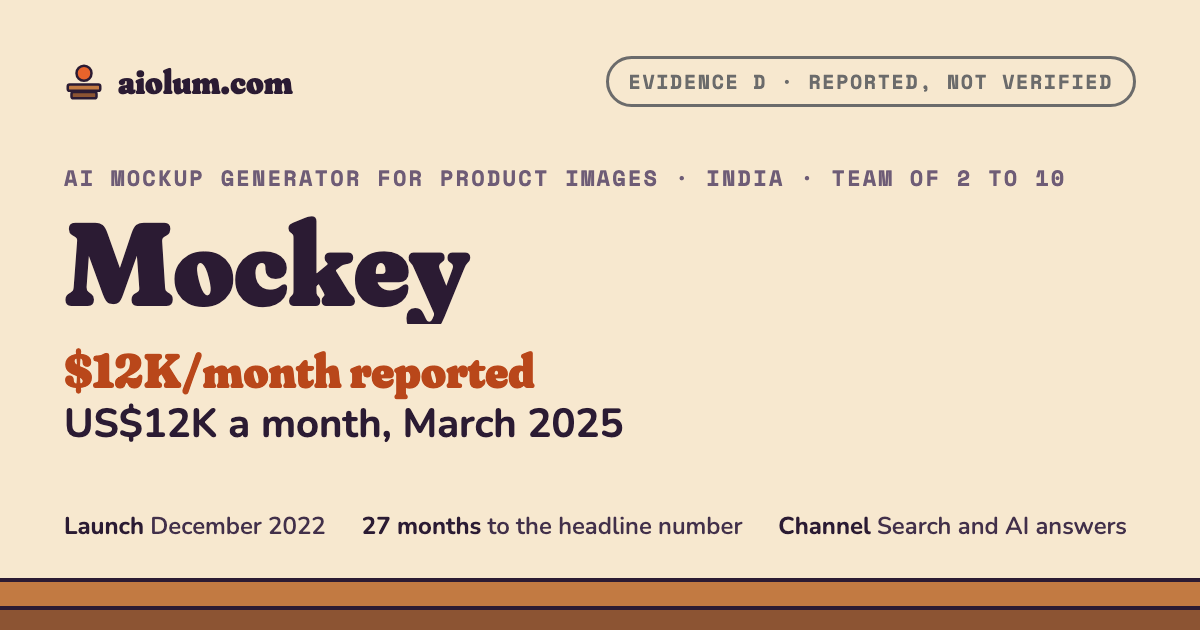
The headline figure, about US$12,000 a month in March 2025, rests on one statement by founder Pranay Agarwal in an Indie Hackers interview published 20 March 2025, read here in the summary by Startup Founder Stories, since Indie Hackers does not allow this site's crawler. The same single source gives the US$700 a month from ads, the 100,000 visitors a month, the tripling after the cap, the December 2023 job exit and the bootstrapped status. No payment processor profile exists: TrustMRR has no entry for Mockey. A company-data directory that this page could not open lists Mockey with outside funding, which the founder's account contradicts; this page does not count it either way. A reader could look for a TrustMRR or Stripe profile, a second interview with a later figure, or the company's filings in India. The headline number is grade D: one claim or one estimate, with no second source. Aiolum shows it because the story is useful, and marks it so that it is not mistaken for a verified figure.
Mockey is a mockup generator. A mockup is a photo of a real product, such as a t-shirt or a mug, with a customer's own design placed on it so that the product can be shown in a shop before it exists. Print-on-demand sellers, who sell goods that a supplier prints only after an order, need such photos for every listing. Mockey lets them upload a flat design file and place it on one of more than 30,000 template photos in the browser, without Photoshop and without a photo shoot. Since 2024 the paid plans also sell AI credits, a prepaid unit of use for the AI tools: a generated photoshoot, several angles from one product photo, a short video of the product, or a design made from a text prompt.
Pranay Agarwal and Mofid Ansari, two designers from India, started it in 2022 as a side project for the users of Blinkstore, a print-on-demand startup where Agarwal worked as a designer. The archived home page of January 2023 shows a free generator with about 1,000 templates and no download limit. The founder said in an Indie Hackers interview of 20 March 2025, as summarized by Startup Founder Stories, that display ads on about 100,000 visitors a month brought in only about US$700 a month. In April 2024 they added subscriptions and capped free users at three mockups a day. The founder said in the same interview that revenue roughly tripled after the cap and reached about US$12,000 a month in March 2025, eleven months after the subscriptions started, with ads still about US$700 of it.
The headline figure on this page rests on that one founder statement from March 2025, read in a secondary source. No payment processor, buyer or journalist has checked it, and no later figure exists, so the page carries the badge "Reported, not verified". The rest of the page is read from the company's own pages, archived copies of them, Product Hunt and reviewers, and it also shows five earlier companies that tried to sell design without a designer.
The numbers, graded
Each row shows the evidence grade and the source numbers from the list at the end of this page. The grades are explained in How Aiolum verifies.
| Fact | Value | Grade | How we know | Sources |
|---|---|---|---|---|
| Revenue per month, March 2025 | about US$12,000 | D | Founder Pranay Agarwal in an Indie Hackers interview published 20 March 2025, as summarized by Startup Founder Stories. About US$700 of it from display ads, the rest from subscriptions. One statement, one date, no second source. | [1] |
| Run rate from the March 2025 figure | about US$144,000 a year | calc | Calculated: 12,000 times 12. This is the headline figure of the page. | [1] |
| Ad revenue before subscriptions | about US$700 a month on about 100,000 visitors a month | D | Founder, same interview. The site was free and ad-supported from 2022 to April 2024. | [1] |
| Effect of the free-plan cap | revenue roughly tripled | D | Founder, same interview, about the limit of three mockups a day for free users introduced with the subscriptions in April 2024. | [1] |
| Start of subscriptions | April 2024 | D | Founder, same interview. The pricing page archived on 22 April 2024 shows one Pro plan at US$9 a month or US$89 a year, an Enterprise plan from US$500 a month, and Stripe as the payment gateway. | [1, 6] |
| Months from the subscriptions to the March 2025 figure | 11 | calc | Calculated: April 2024 to March 2025. The interview title gives the same count. | [1] |
| Founders and start year | Pranay Agarwal and Mofid Ansari, 2022 | C | Company about page. A newsletter of February 2026 describes them as builders from Lucknow; Startup Founder Stories places Agarwal in New Delhi. | [2, 3, 1] |
| Origin | a side project for the users of Blinkstore, a print-on-demand startup | C | Agarwal worked there as a designer according to Startup Founder Stories; the newsletter calls Blinkstore their previous startup. The Android app's package name on Google Play begins with in.blinkstore, which the company's own pages link to. | [1, 3, 10] |
| First archived home page | 2 December 2022 | B | Wayback Machine capture index. The capture of 1 January 2023 shows a free mockup generator with about 1,000 templates and the words "no limit on free downloads". | [5] |
| Product Hunt launches | 4 April 2023 and 2 May 2024 (Mockey AI Pro) | B | Product Hunt product page. Both founders are tagged as makers in a launch comment. | [4] |
| Founder leaves his job | December 2023 | D | Founder, same interview: he quit his full-time role to work on Mockey only. | [1] |
| Library and usage, October 2026 | 30,000 or more templates, more than 1 million mockups created, 50,000 or more professionals | C | Company home page. The home page also shows a 4.4 rating from more than 40 Trustpilot reviews. | [10] |
| Team at the March 2025 figure | 2 co-founders | D | Startup Founder Stories lists the founder type as co-founders and says the team stayed lean. A customer review on the home page thanks a support employee by first name, so at least one more person handles support by 2026. | [1, 10] |
| Outside funding | none stated | D | Founder, same interview: bootstrapped, reinvesting what came in. A company-data directory that this page could not open lists Mockey with funding; see the first watch box. | [1] |
| Next target stated by the founder, March 2025 | US$50,000 a month | D | Founder, same interview. No later figure has been published. | [1] |
| Prices, March to July 2026 | Starter US$7, Creator US$19 a month; Forever US$199 one-time | C | Company blog posts comparing Mockey with two competitors. The first post was published 3 March 2026 and updated 8 July 2026. | [7, 8] |
| Time from the first archived page to the March 2025 figure | 27 months | calc | Calculated: December 2022 to March 2025. | [1, 5] |
How to read this table: a grade D value is a single founder statement with one date, here from an Indie Hackers interview of March 2025 as summarized by Startup Founder Stories, with no second source. A grade C value is from the company's own pages or a reviewer. A grade B value is a platform record such as a Product Hunt launch date or a Wayback capture date. A "calc" value was computed on this page from the rows above it.
| Plan | Per month, billed yearly (US$) | Per month, billed monthly (US$) | Limit |
|---|---|---|---|
| Free | 0 | 0 | 3 downloads a day, JPG only, 400 by 500 pixels |
| Starter | 5.70 | 7 | all templates, unlimited downloads, PNG, no ads, no AI credits |
| Creator | 15.20 | 19 | 150 AI credits a month |
| Forever | 199 one-time | 1,000 AI credits, no subscription |
Yearly billing lowers the Starter plan to US$5.70 and the Creator plan to US$15.20 a month, in the company's own words. The Creator plan includes 150 AI credits a month (1,800 a year on the yearly plan); a video generation costs 10 credits and the Kling video models cost 40 to 160 credits a run. Forever is a one-time purchase with 1,000 credits. The free plan gives three JPG downloads a day at 400 by 500 pixels without commercial rights, according to a reviewer that is itself a competitor. Prices can differ by region: that reviewer gives the Starter plan as US$9.90 a month. In April 2024 the archived pricing page showed one Pro plan at US$9 a month or US$89 a year and an Enterprise plan from US$500 a month.
The timeline
From a free side project for a print-on-demand startup to a reported US$12,000 a month in 27 months, with the paywall arriving in month 16. Each entry carries its grade.
- 2022CAgarwal and Ansari, both designers, build Mockey as a side project so that sellers on Blinkstore, a print-on-demand startup, can preview their designs on products without Photoshop. [2, 3, 1]
- 2 December 2022BFirst capture of mockey.ai in the Wayback Machine. [5]
- 1 January 2023CThe archived home page offers about 1,000 free mockup templates in ten categories with unlimited free downloads. Revenue comes from display ads. [5, 1]
- 4 April 2023BLaunch on Product Hunt as a free mockup generator for e-commerce brands with 14 categories. [4]
- December 2023DAgarwal quits his full-time job to work on Mockey alone. The founder said in March 2025 that the site then had about 100,000 visitors a month and ads brought about US$700 a month. [1]
- April 2024CSubscriptions start next to the ads: one Pro plan at US$9 a month or US$89 a year, with PNG downloads, higher resolution, no ads and AI product photos; Enterprise from US$500 a month. Free users are capped at three mockups a day. [6, 1]
- 2 May 2024BMockey AI Pro launches on Product Hunt with AI mockups in more than 25 categories. [4]
- 20 March 2025DIndie Hackers publishes an interview with Agarwal. He says revenue roughly tripled after the cap and is about US$12,000 a month, mostly subscriptions, with ads still about US$700. The stated next target is US$50,000 a month. [1]
- 9 February 2026CAn Indian AI newsletter profiles Mockey as built in Lucknow for small sellers in smaller Indian cities and names both founders. [3]
- March 2026CThe company's own comparison posts show four plans, including a US$199 one-time Forever plan, video mockups made with Kling models, and an Android app. [7, 8]
- October 2026CThe home page shows 30,000 or more templates, more than 1 million mockups created, a Shopify app, a Figma plugin, an Etsy app and ad templates. No revenue figure after March 2025 has been published. [10]
Why it worked
Four causes, in the order they mattered. Each one is a reusable lesson.
A free tool first, traffic from search
For about two years Mockey gave away every download. Startup Founder Stories reports that the site ranked for mockup searches and spread through design communities, and that the founder said it had about 100,000 visitors a month by the time he quit his job. The audience existed before the price did.
The paywall at the moment of use
The change that the founder credits most is a cap of three mockups a day for free users, added in April 2024 with the subscriptions. A seller who needs ten product photos for ten listings hits the limit on the same afternoon. The founder said in March 2025 that revenue roughly tripled after the cap.
Built on an existing user base
The first users were sellers on Blinkstore, the print-on-demand startup where Agarwal worked. The jump in usage after the tool was connected to that product told the founders the idea worked, according to Startup Founder Stories, before they spent anything on marketing.
Credits for AI on top of a template subscription
The template library is the cheap part: a subscription removes ads and limits. The AI features, photoshoots, videos and prompts, cost credits, and the company's own posts say a Kling video run costs 40 to 160 credits. That separates a flat price for unlimited template downloads from a usage price for model calls.
How it was built
These details come from the company's own pages and their source code, the archived pricing page and the Startup Founder Stories summary. They are grade B where read in the page source and grade C otherwise. [1, 6, 10, 7, 4]
- Two designers built it; Startup Founder Stories lists Figma, Stripe and Google Search Console as the tools behind it. The archived pricing page of April 2024 says Stripe is the payment gateway for subscriptions.
- The site today is generated with Astro (the page source names Astro 7.3.1) and tracked with Google Tag Manager and Google Analytics 4. A comment in the source says Razorpay and Lemon Squeezy checkout scripts load only for the regions that use them, so payments run through three processors by region.
- Video mockups use Kling v2.6 Pro and Kling V3 Pro models, according to the company's own comparison post, and the video files on the home page carry Replicate prediction names, which points to Replicate as the model host.
- Images and blog assets are served from a WordPress installation on a separate assets host. Sign-in uses Google's identity service.
- Distribution beyond the website: a Shopify app, a Figma plugin, an Etsy app, an Android app published as a trusted web activity under the Blinkstore developer name, a Discord server, an affiliate program and two Product Hunt launches.
- Marketing is organic by the founder's account: search rankings, design communities, word of mouth and free resources such as a Figma illustration set that the founder published.
Tools named in the sources
Each one opens its page in the Tools tab, with every story that uses it.
The dead that came before
Five companies in the Loot Drop database promised design or image work without a designer or desktop software. The values below are from that database and are not independently verified.
Snipshot
The promiseEdit photos in the browser without installing software.
Why it diedLarger browser editors such as Picnik and free alternatives offered more, and the site had no clear way to earn money from casual users.
Splashup
The promiseAdvanced photo editing in the browser, with several people on one image at once.
Why it diedIt was built on Flash as Flash died, it had no business model, and users moved to phones and to cheaper Adobe plans.
The Grid
The promiseA website that designs itself with AI from your content, no designer needed.
Why it diedThe AI of 2015 produced inconsistent layouts; Wix and Squarespace gave acceptable results without the surprises, and the users left.
Lightwell
The promiseA no-code tool for designers to build interactive content without developers.
Why it diedAdobe and Canva already covered the need, the tool lacked integrations, and it never grew past a small group of early users.
Scoutzie
The promiseCustom design work from a curated group of freelance designers.
Why it diedBusinesses wanted cheap design, Fiverr and Upwork gave it to them, and early AI design tools cut the value of bespoke work further.
What changed
Snipshot and Splashup put image editing in the browser, which was the hard technical part in 2007, and then had nothing to charge for: casual users edit a photo now and then and will not pay for it. The Grid promised AI design in 2014, when the models could not deliver a consistent result, and lost its users to tools that gave a predictable one.
Mockey's customer is not casual. A print-on-demand seller needs a new product photo for every listing, every week, and the photo earns money. That is why a cap of three downloads a day could convert free users, which the founder said in March 2025 roughly tripled revenue, while Snipshot's users would just have left. And the AI part came last, in 2024, when image and video models could produce a usable product photo from one upload; until then the product was a template library with ads, which is a modest business but a possible one. The Grid did the reverse: it sold the AI first and the result second.
Can one person copy it now?
The method, yes. The head start, no.
A free tool that solves one recurring task for sellers, ranks in search for two years, and then adds a daily cap and a cheap subscription is a repeatable pattern, and it needs no capital. What cannot be copied is the audience Mockey had before it charged: 100,000 visitors a month, by the founder's account in March 2025, built when free mockup generators were rare. Canva, Placeit, Dynamic Mockups and several free rivals now compete for the same searches, and the figure on this page is a single founder statement.
Where it is still open: The same pattern for other recurring seller tasks: listing photos for second-hand marketplaces, menu photos for restaurants, book covers for self-published authors, or packaging previews for small food brands, in languages and markets where the large design tools are weak.
- 1Pick a task that one type of seller repeats every week and that currently needs Photoshop or a paid service.
- 2Give it away in full for a year or more, so that search engines and communities bring the audience; take ad revenue in the meantime.
- 3Put the paywall at the moment of use: a small daily limit on free downloads, a low monthly price to remove it.
- 4Sell AI features separately as credits, so that model costs are paid by the users who cause them.
- 5Add a plugin or app inside the tools the sellers already use: Shopify, Etsy, Figma.
What to watch
The risks are the mirror image of the causes above.
What is not verified
The headline figure, about US$12,000 a month in March 2025, rests on one statement by founder Pranay Agarwal in an Indie Hackers interview published 20 March 2025, read here in the summary by Startup Founder Stories, since Indie Hackers does not allow this site's crawler. The same single source gives the US$700 a month from ads, the 100,000 visitors a month, the tripling after the cap, the December 2023 job exit and the bootstrapped status. No payment processor profile exists: TrustMRR has no entry for Mockey. A company-data directory that this page could not open lists Mockey with outside funding, which the founder's account contradicts; this page does not count it either way. A reader could look for a TrustMRR or Stripe profile, a second interview with a later figure, or the company's filings in India.
Most of the product is a template library
The AI tools are a layer added in 2024 and sold as credits. The main value, 30,000 or more templates, is a content library that competitors can build too. Dynamic Mockups, Placeit, Canva and smaller free tools such as Modor sell the same thing, and one of those competitors publishes a review that calls Mockey's free plan not truly free.
Free traffic depends on search rankings
Growth came from ranking for mockup searches and from communities, by the founder's account. A change in how Google or AI assistants answer a search for a free mockup generator changes the top of the funnel at once, and Mockey has no paid acquisition it has described.
No figure after March 2025
Nineteen months have passed since the only revenue statement. The founder's target of US$50,000 a month, stated in March 2025, has not been reported as reached or missed. The trend on this page is marked unknown for that reason.
Prices differ by region and by promotion
The company's own posts give the Starter plan as US$7 a month; a reviewer in May 2026 gives US$9.90; the page source mentions Razorpay and Lemon Squeezy checkouts for some regions. A reader comparing the pricing table on this page with the live page may see different numbers.
Sources
The grade next to each source is the best grade that the source can support. "Read in full" means that the text of the page was downloaded and the numbers were checked in it.
- D Startup Founder Stories, 26 June 2026: how Pranay Agarwal grew Mockey.ai to $12k a month by adding download limitsRead in full. A summary of the founder's Indie Hackers interview of 20 March 2025 ("Hitting $12K MRR just 11 months after turning a free side project into an AI business"), which this site may not fetch. Source for every money figure, the visitor count, the download cap, the Blinkstore origin, the job exit and the tools listed.
- C Mockey AI about page: Our StoryRead in full. Names the two founders and the start year 2022.
- C AI Radar Daily #11 by Avinash Raghava, 9 February 2026: Mockey AIRead in full. A newsletter profile. Source for Lucknow, the Blinkstore origin as the founders' previous startup, and the target market of small Indian sellers. No numbers.
- B Product Hunt product page: Mockey AIRead in full. Source for the two launch dates, the 2023 product description and the makers' handles in a launch comment.
- B Wayback Machine: mockey.ai captured 1 January 2023, and the capture index showing the first capture on 2 December 2022Read in full. The archived home page describes a free generator with about 1,000 templates and no limit on free downloads.
- C Wayback Machine: mockey.ai/pricing captured 22 April 2024Read in full. The company's own pricing page at the start of subscriptions: Pro at US$9 a month or US$89 a year, Enterprise from US$500 a month, Stripe as payment gateway, AI product photoshoot as a Pro feature.
- C Mockey AI blog, 3 March 2026, updated 8 July 2026: Dynamic Mockups vs Mockey AIRead in full. The company's own comparison. Source for the four plans, the yearly prices, the credit amounts and the Kling video models.
- C Mockey AI blog, 9 March 2026, updated 8 July 2026: Mock It vs Mockey AIRead in full. Confirms the yearly prices and mentions the Android app.
- C Modor blog, 1 May 2026, updated 20 August 2026: Mockey AI ReviewRead the pricing and free-plan sections. A review written by a competitor; used for the free-plan limits and the regional Starter price of US$9.90.
- C Mockey AI home page and pricing page, read 23 October 2026Read in full, including the page source. Source for the template count, usage claims, integrations, the Trustpilot rating, the support review, and the tools named in the source code (Astro, Google Tag Manager, Razorpay, Lemon Squeezy, Replicate file names, the Google Play package name). The pricing page loads its plans by script and shows only the starting price in its description.
- C Loot Drop database export, 1,749 failed startupsLocal export. AI-written summaries, not independently verified. Source for the failed predecessors.