NerdSip: Revenue, team and how it was built
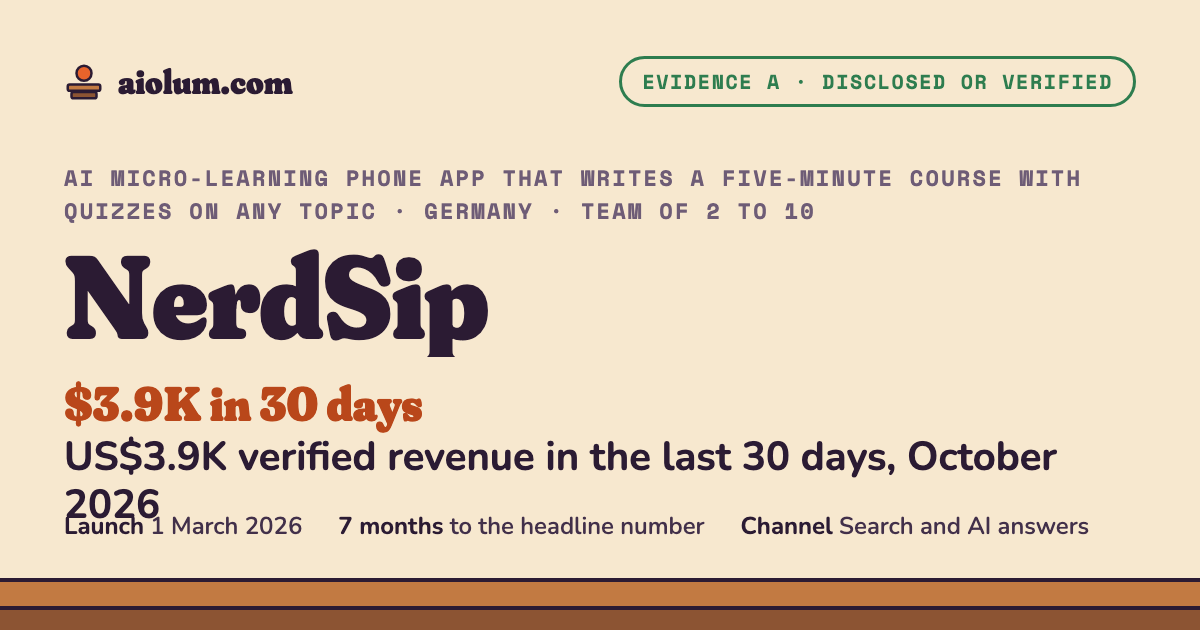
NerdSip (AI micro-learning phone app that writes a five-minute course with quizzes on any topic, Germany): US$3.9K verified revenue in the last 30 days, October 2026. Evidence grade A: disclosed by a company or a filing, or verified by a payment processor. Team: 2 co-founders, Dr. Max Hänze and Dr. Philip Sergelius, who build it beside full-time jobs. Launched 1 March 2026; still running, revenue flat.Added 26 October 2026
- Outcome
- US$3.9K verified revenue in the last 30 days, October 2026Revenue flat
- Evidence
- A disclosed by a company or a filing, or verified by a payment processor
- Launch
- 1 March 2026
- Status
- Still running
- Team
- 2 co-founders, Dr. Max Hänze and Dr. Philip Sergelius, who build it beside full-time jobs
- Outside funding
- None reported; bootstrapped side project
- Group
- Learning and study
- Main channel
- Search and AI answers
NerdSip is a micro-learning app, an app that teaches in very short lessons that fit into a few spare minutes. Its difference is that the courses are not written in advance: a large language model, an AI program trained on large amounts of text, writes a new course on whatever topic the user types, and a fact-checking step checks it against live Google Search results. The founders said they use Google's models through Vertex AI and the Gemini API, with a Convex back end and a React Native app.
Two physicists in northern Germany, Dr. Max Hänze and Dr. Philip Sergelius, build it beside full-time jobs in the semiconductor industry, through their company ai51 UG. They wrote the first line of code in December 2025 and launched on 1 March 2026. TrustMRR, a site that reads revenue directly from a company's payment provider, shows US$3,888 of verified revenue in the last 30 days, US$1,965 of monthly recurring revenue (MRR, the subscription revenue that repeats every month) and 381 active subscriptions (synced 26 October 2026). The data comes from RevenueCat, a service that records in-app subscription purchases. That is grade A.
Revenue rose from under US$1,000 a month until June to US$3,314 in July, US$3,920 in August and US$4,328 in September 2026. The monthly revenue is higher than the MRR because yearly plans count fully in the month they are paid. This page also lists, under "Watch", one of the founders' own tactics: paid directory listings for their domain rating and links to other founders' products in their blog.
How much revenue does NerdSip make?
Each row shows the evidence grade and the source numbers from the list at the end of this page. The grades are explained in How Aiolum verifies.
| Fact | Value | Grade | How we know | Sources |
|---|---|---|---|---|
| Verified revenue, last 30 days | US$3,888 | A | TrustMRR, RevenueCat API, synced 26 October 2026. The profile's stored snapshot shows US$3,984 and a change of -7.8% against the 30 days before. On 25 October the profile showed US$4,071. | [1] |
| Verified revenue by month, 2026 | March US$80, April US$58, May US$467, June US$722, July US$3,314, August US$3,920, September US$4,328, October to the 26th US$3,451 | A | TrustMRR monthly timeline. Calculated: August was 18.3% above July, September 10.4% above August. | [1] |
| Monthly recurring revenue and subscriptions | US$1,965 MRR, 381 active subscriptions | A | TrustMRR snapshot, MRR change 0.0% in 30 days. Calculated: 1,965 / 381 = about US$5.16 a month per subscription, close to the yearly plan's US$4.17 a month. | [1] |
| Verified revenue, all time | US$16,341 | A | TrustMRR, synced 26 October 2026. | [1] |
| Run rate from the last 30 days | about US$47,000 a year | calc | Calculated: US$3,888 x 12 = US$46,656. | [1] |
| Time from launch to the headline figure | 7 months | calc | Calculated: March 2026 to October 2026. | [1, 2] |
| Founders' figures, August 2026 | 10,000 downloads, just past 100 paying subscribers, US$3,000 revenue in July 2026 | C | Fake Mayo founder story, 5 August 2026, told by Philip Sergelius. The July figure agrees with TrustMRR's US$3,314. | [2, 1] |
| Where new users came from | search over 40%, AI search 28% | C | Fake Mayo: "SEO drives over 40% of new users, all flowing through our blog" and "AI search is second at 28%". From the founders' own analytics dashboard. | [2] |
| TikTok | over 10 million views on four accounts, about one sign-up per 10,000 views | C | Fake Mayo. The four accounts all carry the NerdSip name. | [2] |
| Advertising spend | less than US$500 in total | C | Fake Mayo: small tests "on Reddit, TikTok, and the App Store". | [2] |
| Registered users, September 2026 | 10,000 | C | Press release of 21 September 2026: about 5,000 at the end of July 2026, doubled in under two months. TrustMRR's founder-written estimate is 16,000 users. | [5, 1] |
| App Store, October 2026 | 121 ratings, average 4.8; age rating 13+ | B | App Store page read 25 October 2026. Seller: ai51 UG (haftungsbeschränkt). | [3] |
| Payment data source | RevenueCat (API key) | A | TrustMRR "Verification Sources". Merchant of record: No; Apple and Google bill the subscriptions. | [1] |
| People | 2 co-founders | C | About page: "Dr. Max Hänze, Co-Founder, PhD in Physics" and "Dr. Philip Sergelius, Co-Founder, PhD in Physics". Fake Mayo: both have full-time jobs in the semiconductor industry. | [4, 2] |
How to read this table: a grade A value was read by TrustMRR from the app's RevenueCat purchase data. A grade B value is on Apple's App Store page. A grade C value was stated by the founders in an interview, a press release or on their site. A "calc" value was computed on this page from the rows above it.
| Plan | Per month, billed yearly (US$) | Per month, billed monthly (US$) | Limit |
|---|---|---|---|
| Free | 0 | 0 | courses with limits; reviewers on the App Store say the free version is limited |
| NerdSip Gold | 4.17 | 7.99 | full access, 7-day free trial for new users |
The founders gave the same prices in August 2026: "7.99 USD for a monthly subscription, or 49.99 USD for a yearly". The founder-written TrustMRR profile gives 7.99 EUR a month or 49.99 EUR a year. The App Store text offers 7 days of Gold free to new users. The per-month value of the yearly plan is calculated: 49.99 / 12 = about US$4.17.
When did NerdSip launch, and how did it grow?
From the first line of code in December 2025 to about US$4,000 a month in autumn 2026. Each entry carries its grade.
- December 2025CThe founders write the first line of code, in the hours left after their jobs and families. [2]
- January 2026CThey publish a daily "Building NerdSip" blog series. The post "Day 23" carries the date 23 January 2026, although the Wayback Machine saved it already on 7 January 2026. [6]
- 1 March 2026CLaunch on iOS and Android. First verified revenue in March: US$80. [2, 1]
- July 2026ARevenue jumps to US$3,314, almost five times June. About 5,000 registered users at the end of the month. [1, 5]
- 5 August 2026CFake Mayo publishes Philip Sergelius's account: 10,000 downloads, just over 100 paying subscribers, most users from search. [2]
- 21 September 2026CPress release: 10,000 registered users six months after launch. [5]
- September 2026ABest month so far: US$4,328. [1]
- 26 October 2026AUS$3,888 in the last 30 days, US$1,965 MRR, 381 active subscriptions, US$16,341 in total. [1]
Why did NerdSip work?
Four causes, in the order they mattered. Each one is a reusable lesson.
A catalog without limits
Earlier learning apps sold a fixed library of courses. NerdSip writes a course for any request in about a minute, so the library grows with every user: each new course also goes into a shared feed that other learners swipe through.
A blog that ranks in search and in AI answers
The founders said that their blog at nerdsip.com/blog brings over 40% of new users, with articles that answer searches such as "how to improve my general knowledge", and that AI answers from ChatGPT and Google bring another 28%. They described the blog as "the backbone of the whole operation".
Short slideshows on TikTok
Four TikTok accounts under the NerdSip name post slideshows of facts and stories with a call to action on the last slide, and passed 10 million views. The founders said that conversion is weak, about one sign-up per 10,000 views, but the views are free.
One model provider for everything
The founders use Google's models through Vertex AI and one Gemini API key for text, images, voice and embeddings. That kept the stack small enough for two people who work on it in their spare time.
How it was built
These details come from the Fake Mayo founder story, the press release and the App Store page. They are grade C and B. [2, 5, 3, 1]
- App: React Native for iPhone and Android; back end on Convex with Node.js.
- Models: Google Vertex AI and the Gemini API, for course text, images, voice and embeddings. Courses are checked against live Google Search results, and automated quality checks score the library every night.
- A 3D avatar with items built in Three.js, which Philip Sergelius called the feature that "Nobody uses".
- A ranking engine built by Max Hänze that orders the shared course feed by the user's interests, other learners' upvotes and trends.
- Subscriptions through the App Store and Google Play, recorded by RevenueCat.
- Marketing: the blog, four TikTok accounts, long YouTube videos generated with Remotion, paid directory listings, and less than US$500 of ad tests.
Tools named in the sources
Each one opens its page in the Tools tab, with every story that uses it.
Who tried this before NerdSip, and why did they fail?
Four companies in the Loot Drop database tried to teach or inform people in short, game-like or bite-sized formats. The values below are from that database and are not independently verified.
QuizUp
The promiseReal-time trivia battles on a large range of topics.
Why it diedIt did not find a way to make money, lost players to live-hosted quiz games, and its buyer neglected it.
Circa
The promiseNews cut into short pieces for reading on a phone.
Why it diedLarge media companies copied the format, and Circa could not build an advertising business that paid for its editors.
Grockit
The promiseSocial, game-like test preparation for the SAT and GMAT.
Why it diedDuolingo, Khan Academy and the large test-prep companies offered the same, and Kaplan bought it and later closed it.
Udacity
The promiseOnline courses in technical skills that lead to jobs.
Why it diedMost students did not finish the courses, and employers did not value the certificates.
The failed startups come from Loot Drop, a free database of dead startups, retold here in our own words. Loot Drop describes its entries as AI-assisted summaries of public sources, so these cards carry no evidence grade.
What changed
Circa paid editors to cut every story into short pieces, and QuizUp needed a large set of written questions for each topic. Content cost money for every topic, so these companies needed advertising or venture money to cover it. A language model writes a course on any topic for the cost of one model call, so two people with full-time jobs can offer an unlimited catalog.
Udacity and Grockit show the other old problem: people start courses and do not finish them. NerdSip answers with very short lessons, quizzes, streaks and leagues, and with review rounds of earlier material. The new risk is accuracy: an AI-written course can contain mistakes, which is why the founders describe a fact-checking pipeline against live search results.
Can one person copy NerdSip now?
Yes. The method is open to any small team.
The parts are all available: a model that writes courses, a cross-platform app, a subscription service, and a blog that answers real search questions. What took time was the content marketing, a daily blog and slideshows, and the founders said that TikTok views turned into few users.
Where it is still open: Courses for one profession or one exam syllabus, and micro-courses in languages where few learning apps exist, are still open.
- 1Pick a learning format that needed hand-written content before, and let a model write it on request.
- 2Check the model's output against live sources before users see it.
- 3Add quizzes and review rounds, so that the user remembers and comes back.
- 4Write blog articles that answer the questions people type into Google and AI assistants.
- 5Measure where users come from with your own dashboard before you pay for ads.
What could go wrong for NerdSip?
The risks are the mirror image of the causes above.
The founders' own marketing tactics
Philip Sergelius told Fake Mayo (5 August 2026): "We've spent a few hundred dollars on premium directories purely for the domain rating (DR)", and "I tell myself it helps with link exchanges in case one wants to try it out." Domain rating is a score from search-tool companies that estimates a site's link strength. Their blog post "Day 23: The Growth Triad" (dated 23 January 2026) named only LandingBoost and Postpire in the Wayback copy of 7 January 2026; by October 2026 it also recommended other founders' products, SupaBird, WPMultiTool and cleanchart ("For our internal tracking and reporting, we use cleanchart"), without saying why they were added. LandingBoost's own site lists NerdSip under "Community projects". The founders do not sell links; these are their tactics for their own search ranking.
Monthly revenue is above the MRR
MRR is US$1,965, while the last 30 days brought US$3,888. Yearly plans at US$49.99 are counted fully in the month of payment, so a month's revenue can fall when fewer new yearly plans are sold. The floor of this site, US$2,000 a month, is met by the monthly revenue, not by the MRR.
Accuracy of AI-written courses
Every course is written by a model. The press release describes four steps of fact-checking, grounded in live Google Search results with nightly automated checks, and a person reviews a course when a user reports a problem. No independent test of the accuracy exists in the sources.
A side project
Both founders have full-time jobs and children, according to Fake Mayo, and build the app in early mornings, evenings and weekends. The press release of September 2026 calls Philip Sergelius "Founder and CEO".
Game features and younger users
The App Store age rating is 13+. The app has "XP, levels, loot drops and weekly leagues"; the only in-app purchases listed are the Gold subscriptions, so the loot items are not sold for money according to that list.
Sources
The grade next to each source is the best grade that the source can support. "Read in full" means that the text of the page was downloaded and the numbers were checked in it.
- A TrustMRR: Nerdsip (markdown profile)Read the markdown profile on 25 and 26 October 2026 (synced 2026-10-26T20:47). The revenue, MRR and subscription rows come from the RevenueCat API and are grade A; the insights and user estimate are founder-written and grade C.
- C Fake Mayo, 5 August 2026, by Jakob Jelling: From Physics to Side Hustle: How Two Dads Built and Grew a Micro-Learning AppRead in full. The story is told by Philip Sergelius. Source for the launch date, the channels, the stack, the directories and the July revenue.
- B App Store: NerdSip - Micro Learning, seller ai51 UG (haftungsbeschränkt)Read in full on 25 October 2026: description, ratings, age rating, in-app purchases and version history.
- C NerdSip About pageRead in full on 25 October 2026 (with the home page and the imprint). Source for the founders and the company.
- C NerdSip press release, 21 September 2026: NerdSip Reaches 10,000 Registered Users Six Months After LaunchRead in full on 25 October 2026. Source for the user numbers and the fact-checking process.
- C NerdSip blog, Day 23: The Growth Triad, current page and Wayback Machine copies of 7 January 2026 and 8 April 2026Read in full: the current page on 25 October 2026 and the copies https://web.archive.org/web/20260107201606/https://nerdsip.com/blog/day-twenty-three-the-growth-triad and https://web.archive.org/web/20260408090008/https://nerdsip.com/blog/day-twenty-three-the-growth-triad. Source for the links added to other founders' products.
- C LandingBoost home pageRead in full on 25 October 2026. Cited only for its "Community projects" list that includes NerdSip.
- C Loot Drop database export, 1,749 failed startupsLocal export. AI-written summaries, not independently verified. Source for the failed predecessors.