Phinity Labs: Revenue, team and how it was built
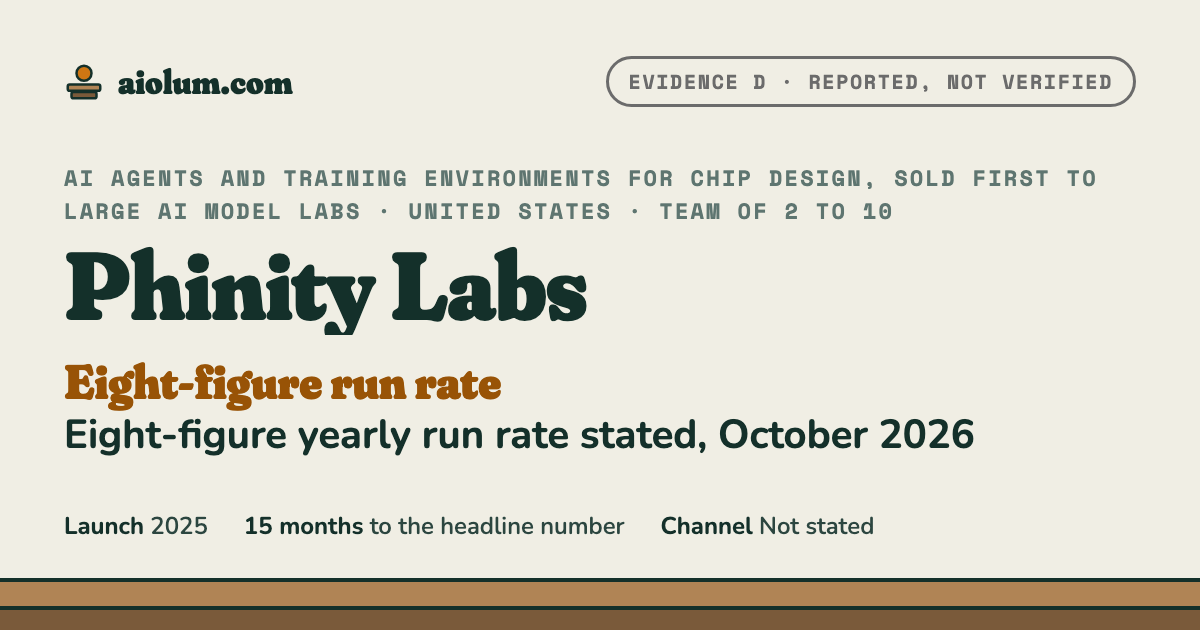
Phinity Labs (AI agents and training environments for chip design, sold first to large AI model labs, United States): Eight-figure yearly run rate stated, October 2026. Evidence grade D: reported, not verified. Team: 2 co-founders (Sonya Jin and Aadi Nashikkar) named in the seed announcement of 8 October 2026; 9 employees in the Lean AI Leaderboard snapshot of October 2026. Launched 2025; still running.Added 6 November 2026
- Outcome
- Eight-figure yearly run rate stated, October 2026
- Evidence
- D reported, not verified
- Launch
- 2025
- Status
- Still running
- Team
- 2 co-founders (Sonya Jin and Aadi Nashikkar) named in the seed announcement of 8 October 2026; 9 employees in the Lean AI Leaderboard snapshot of October 2026
- Outside funding
- US$5.2M seed led by Uncork Capital with Moxxie and angels including Jeff Dean (8 October 2026), after a pre-seed led by Pear through PearX
- Main channel
- Not stated
What is not verified
The headline rests on one sentence by the co-founders in their launch post of 8 October 2026: "have reached 8-figures in annualized run rate". No exact number, filing, audited statement or payment-processor record was published, and no earlier dated revenue figure was found. The Lean AI Leaderboard repeats the claim from a company post on X; Gunderson Dettmer's announcement and the Ascendants article do not mention revenue. This page counts US$10 million, the smallest eight-figure amount. A reader could look for an investor statement or a later interview with an exact figure. The headline number is grade D: one claim or one estimate, with no second source. Aiolum shows it because the story is useful, and marks it so that it is not mistaken for a verified figure.
Phinity Labs is a San Francisco company that builds AI agents for chip design. Two technical terms matter here. RTL (register-transfer level) code describes a chip's logic in a hardware language such as Verilog. Tapeout is the moment a finished design, stored as a GDS layout file, is sent to the factory. The company's job posts say it builds reinforcement learning environments, simulated tasks in which an AI model tries hardware work many times and a program scores the result, plus agent infrastructure and evaluation systems.
The co-founders are Sonya Jin and Aadi Nashikkar. Their launch post of 8 October 2026 says that Sonya built synthetic data pipelines for NVIDIA's chip-design and code-reasoning language models, and that Aadi had sold a previous company. In the same post the founders announced a US$5.2 million seed round led by Uncork Capital and wrote that they were "already working with some of the largest foundation model labs" and had "reached 8-figures in annualized run rate".
"8-figures" means at least US$10 million a year, without an exact number. This page counts US$10 million and grades it D: reported, not verified, because it rests on one statement by the founders on one date. The Lean AI Leaderboard listed the company in October 2026 at "≥$10,000,000" with 9 employees, citing a company post on X, so it repeats the same claim. The page also shows failed startups that tried to automate hardware design or to sell AI training tools.
How much revenue does Phinity Labs make?
Each row shows the evidence grade and the source numbers from the list at the end of this page. The grades are explained in How Aiolum verifies.
| Fact | Value | Grade | How we know | Sources |
|---|---|---|---|---|
| Annualized revenue run rate, 8 October 2026 | "8-figures" (at least US$10 million counted here) | D | Company blog, "Introducing Phinity Labs", by Sonya and Aadi, 8 October 2026: "We're already working with some of the largest foundation model labs, have reached 8-figures in annualized run rate, and we're just getting started." Eight figures start at US$10,000,000. No exact number was given. | [1] |
| Third-party listing of the figure | at least US$10,000,000 a year | D | The Lean AI Leaderboard row for Phinity Labs: annual revenue "≥$10,000,000", 9 employees, months to reach ARR 3, total funding US$5,200,000, founded 2025, snapshot Oct 2026. Its source column is a post on the company's X account, so the row repeats the company's own claim. The leaderboard does not say from which start the 3 months are counted. | [3] |
| Run rate per month | at least about US$833,000 a month | calc | Calculated: US$10,000,000 divided by 12 equals 833,333. | [1] |
| Revenue per employee | at least about US$1.1 million a year | calc | Calculated: US$10,000,000 divided by 9 equals 1,111,111, the same value the Lean AI Leaderboard shows. | [1, 3] |
| Customers | "some of the largest foundation model labs" | D | Launch post, 8 October 2026. The labs are not named. The job posts add: "Work directly with frontier AI labs to re-imagine ASIC design". | [1, 5] |
| What is built today | RL environments, agent infrastructure, evaluation systems | C | Every job post on the careers page, published 8 October 2026: "We are building RL environments, agent infrastructure, and evaluation systems to accomplish this." The data research role is to "Build and scale out generation of novel, experimental environments for testing agents in real-world hardware engineering tasks" and to "Profile and benchmark unreleased models". | [5] |
| Stated product goal | prompt to silicon by 2028 | C | Home page: "Phinity's agents design, verify, and tape out custom chips end-to-end. By 2028, describe the chip you need and get a GDS file back in weeks, not years." The Physical Design Lead job mentions "the in-house capability on prompt-to-GDS". | [4, 5] |
| Performance claim | verified designs "an order of magnitude faster" | D | Launch post: "The Phinity system produces verified designs an order of magnitude faster with better power, performance, and area than experienced hardware engineers working from the same specifications with frontier coding agents." No test results were published. Ascendants wrote that "certain aspects of the technology" had not been revealed. | [1, 6] |
| Founding team | 2 co-founders | C | Gunderson Dettmer, 8 October 2026: "said Phinity Labs co-founders Sonya Jin and Aadi Nashikkar". The launch post is signed "Sonya and Aadi" and says "We founded Phinity". Ascendants: "Founded by Sonya Jin and Aadi Nashikkar". | [2, 1, 6] |
| Team at the headline | 9 employees | D | Lean AI Leaderboard, snapshot October 2026. The launch post calls the company "a lean, deeply technical team" and names former staff of Intel, Kepler Computing and NVIDIA among its engineers, without a count. | [3, 1] |
| Seed round | US$5.2 million, led by Uncork Capital | C | Launch post and Gunderson Dettmer: led by Uncork Capital "with participation from Moxxie and angels including Jeff Dean, following a pre-seed led by Pear through PearX". Ascendants repeats the amount. | [1, 2, 6] |
| Year founded | 2025 | D | Lean AI Leaderboard "Founded" column. No month was published. | [3] |
| Time from founding to the headline | about 15 months | calc | Calculated: the company was founded in 2025 (month not published). Counted from July 2025, the middle of that year, to October 2026: 15 months. If it started in January 2025 the figure is 21 months; if in December 2025, 10 months. | [3, 1] |
| Open roles | 4 listings | C | Ashby job board, read 6 November 2026: Research Engineer - Hardware, Data; Head of Operations; Physical Design Lead; Open Application. All on site in San Francisco. | [5] |
How to read this table: a grade D value is one company statement on one date, or a directory that repeats it, with no outside check. A grade C value is what the company, its law firm or a news article say about the product, the founders or the funding. A "calc" value (grade X) was computed on this page. No revenue value is grade A, B or C.
| Plan | Per month, billed yearly (US$) | Per month, billed monthly (US$) | Limit |
|---|---|---|---|
| Work for AI model labs (environments, evaluations, data) | price not published; described only in job posts | ||
| Chip-design agents (prompt to GDS) | no public offer; the home page sets the goal for 2028 |
The site has a home page, a blog and a careers page, and an email address (hello@phinity.ai). It has no pricing page, no sign-up and no product page. The launch post says the company works with large foundation model labs; it does not say what they buy or at what price.
When did Phinity Labs launch, and how did it grow?
From a company founded in 2025 to a seed announcement and a stated eight-figure run rate in October 2026. Each entry carries its grade.
- 2025DSonya Jin and Aadi Nashikkar found Phinity Labs. They came to chip design from post-training of AI models. [3, 1]
- Before October 2026CPre-seed round led by Pear through its PearX program (date not published). [1, 2]
- 8 October 2026DThe company comes out of stealth with a US$5.2 million seed led by Uncork Capital. The founders write that they work with some of the largest foundation model labs and have reached an eight-figure annualized run rate. Four job posts open the same day. [1, 2, 5]
- October 2026DThe Lean AI Leaderboard lists Phinity Labs at least US$10 million a year with 9 employees. [3]
- 6 November 2026CThe home page sets the goal of prompt-to-silicon chips by 2028; there is still no public product page or price list. [4]
Why did Phinity Labs work?
Four causes, in the order they mattered. Each one is a reusable lesson.
Sell to the AI labs first
The launch post names its customers only as large foundation model labs. Those labs want their models to write and verify hardware, and they pay for training tasks and evaluations in fields where the models fail. A few large buyers can produce a large run rate for a nine-person team, the same pattern as Halluminate in finance.
Founders from the training side
According to the launch post, Sonya built synthetic data pipelines for NVIDIA's chip-design language models and Aadi worked on synthetic data generation and post-training. They knew what AI labs need to train a model before they started selling it.
Chip experts on the team
The post names a former leader of Intel's custom silicon group, a former ASIC lead at Kepler Computing and former NVIDIA architects. Real chip experience is needed to write hardware tasks and check whether an agent's design would work in silicon.
A long-term product on the same base
The environments and evaluation systems that train agents for the labs are also the base for the company's own goal: agents that take a chip from specification to GDS file. The home page dates that goal to 2028.
How it was built
These details come from the company's launch post and its job posts (grade C). The company has not published its internal software stack. [1, 5, 4]
- A closed-loop system in which agents design, evaluate and revise designs using "real physical feedback", from architecture to tapeout.
- Reinforcement learning environments for hardware engineering tasks, and evaluation systems that benchmark models, including unreleased ones.
- Physical design flows from synthesis to layout (power network, clock trees, process corners, custom cells), led by a physical design lead and tied to the in-house prompt-to-GDS capability.
- Hiring runs through an Ashby job board; the site is a Next.js web application with a blog and a careers link.
Who tried this before Phinity Labs, and why did they fail?
Three companies in our database of failed startups tried to make hardware design easier, to build new AI chips, or to sell reinforcement learning tools before large AI labs became buyers. The values below are from that database and are not independently verified.
Wattage
The promiseAnyone could design custom electronics online, without technical skills, and get them made with 3D printing.
Why it died3D printing could not match real manufacturing, and quality problems and customer education costs were too high.
Rain AI
The promiseBrain-inspired chips with much better energy efficiency for AI inference.
Why it diedIt spent its funding before it showed better results in real use, and developers could not easily run their models on the chips.
Pathmind
The promiseReinforcement learning on business simulations, so that companies could automate operational decisions without AI experts.
Why it diedIt launched into an immature market with a complex product, while Google and Amazon offered AI tools of their own.
The failed startups come from our database of 1,749 dead startups, retold here in our own words. Its entries are AI-assisted summaries of public sources, so these cards carry no evidence grade.
What changed
Wattage tried to make hardware design simple for ordinary buyers, and Rain AI tried to build a new kind of chip with years of expensive tapeouts before any revenue. Pathmind sold reinforcement learning to companies that were not ready for it. All three needed many customers to change how they worked.
By 2025 a few AI labs were spending large amounts to teach their models specialist work, and chip design was one of the fields where the models were weak. Phinity sells to those few buyers, with founders who had trained chip-design models and engineers who had shipped chips. The founders stated an eight-figure run rate in October 2026 before the company had a public chip-design product.
Can one person copy Phinity Labs now?
Not by one person. The pattern can be copied by a small expert team.
Phinity's business depends on contracts with large AI labs, founders with AI post-training experience and engineers who have taped out chips. That needs a team with rare skills and, in this case, outside money. Data vendors with far more staff also sell environments and evaluations to the same labs.
Where it is still open: Other engineering fields with good simulators are open in the same way: printed circuit boards, FPGA designs, analog circuits, robotics control, structural engineering. A small team with deep experience in one of them could build verifiable tasks first and an agent second.
- 1Pick a technical field where today's models fail and where you have worked: hardware, analog circuits, mechanical design, chemistry.
- 2Build tasks with automatic checks (simulation, formal verification, test benches) so that a model's answer can be scored without a human.
- 3Offer these environments and evaluations to AI labs that are trying to improve in that field.
- 4Use the same infrastructure later for your own agent product.
What could go wrong for Phinity Labs?
The risks are the mirror image of the causes above.
What is not verified
The headline rests on one sentence by the co-founders in their launch post of 8 October 2026: "have reached 8-figures in annualized run rate". No exact number, filing, audited statement or payment-processor record was published, and no earlier dated revenue figure was found. The Lean AI Leaderboard repeats the claim from a company post on X; Gunderson Dettmer's announcement and the Ascendants article do not mention revenue. This page counts US$10 million, the smallest eight-figure amount. A reader could look for an investor statement or a later interview with an exact figure.
Team size and evidence grade
The Lean AI Leaderboard lists 9 employees in October 2026; the company names its founders but publishes no headcount. The company was started by two co-founders and raised outside funding, so it is published under the user's rule of 6 November 2026 for funded teams of six to ten people.
What the customers buy
The launch post says the company works with large foundation model labs but does not say what they buy. The job posts describe RL environments, evaluation systems and benchmarking of unreleased models, so the revenue is probably project work for a few labs, not self-serve software. The prompt-to-GDS chip product is a goal for 2028 on the home page, and no test results for the speed and quality claim were published.
Competition and dependence on AI labs
Halluminate, another story on this site, sells RL environments to frontier AI labs in finance with a nine-person team; Phinity does the same for chip design. Phinity's customers are the model providers themselves, so the business depends on a few labs continuing to buy hardware training work instead of building it in-house.
Sources
The grade next to each source is the best grade that the source can support. "Read in full" means that the text of the page was downloaded and the numbers were checked in it.
- D Phinity Labs blog, Sonya and Aadi, 8 October 2026: Introducing Phinity LabsRead in full, downloaded 6 November 2026. Primary source for the run-rate statement, the AI-lab customers, the seed round, the founders' backgrounds, the team description and the performance claim.
- C Gunderson Dettmer client news, 8 October 2026: Phinity Labs Emerges From Stealth With $5.2 Million SeedRead in full, downloaded 6 November 2026. The company's law firm; source for the founders' full names and the round.
- D Lean AI Leaderboard (public Google Sheet, CSV export), snapshot October 2026Read the Phinity Labs row in the copy the pipeline downloaded on 5 November 2026: at least US$10,000,000 revenue, 9 employees, months to reach ARR 3, US$5,200,000 funding, founded 2025. The row cites a company post on X, so it is not independent.
- C Phinity Labs home pageRead in full, downloaded 6 November 2026. Source for the prompt-to-silicon goal for 2028, the investors and the absence of a pricing page.
- C Phinity Labs careers page on Ashby (job board data)Read the four job descriptions in the public job-board data, downloaded 6 November 2026 (published 8 October 2026). Source for the RL environments, evaluation systems, work with frontier AI labs and the prompt-to-GDS capability.
- C Ascendants: Phinity Labs Raises $5.2 Million to Build AI Agents That Design Computer Chips From Text PromptsRead in full, downloaded 6 November 2026. Second report of the founders and the round; notes that parts of the technology were not revealed.
- C Database of failed startups, local exportLocal export. AI-written summaries, not independently verified. Source for the failed predecessors.
Run this company? Send corrections or a verified figure to aiolum@livyden.com