Pushary: Product, team and how it was built
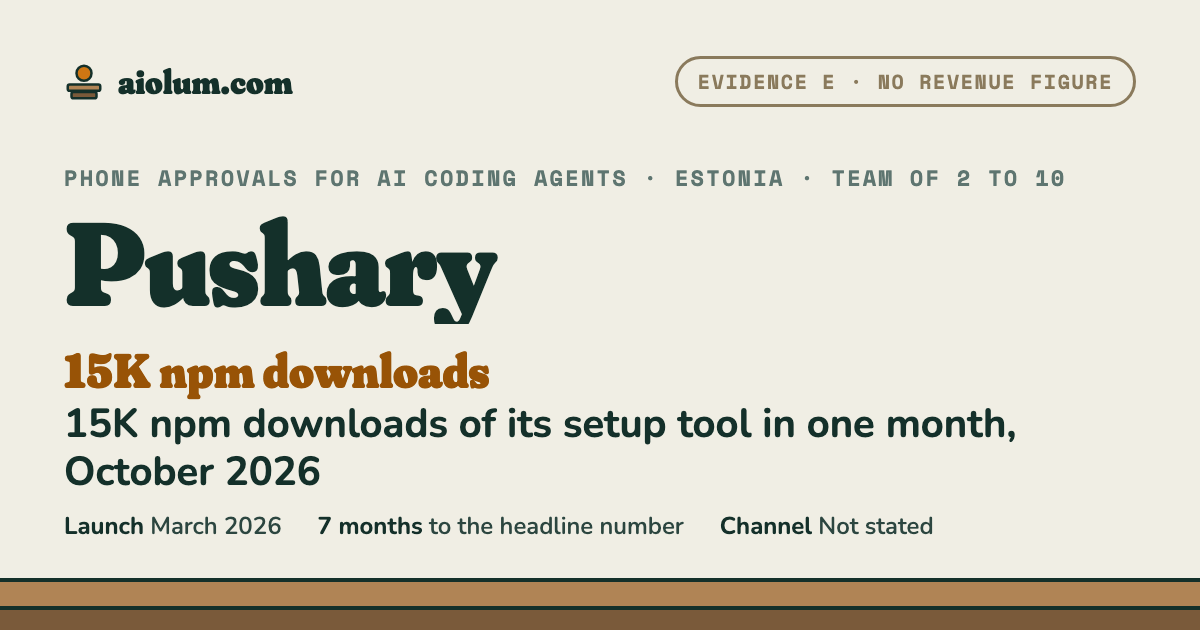
Pushary (Phone approvals for AI coding agents, Estonia): 15K npm downloads of its setup tool in one month, October 2026. Evidence grade E: no revenue figure was checked. Team: Founder Aadil Ghani leads what the company calls a small team; headcount not published. Launched March 2026; still running.Added 5 November 2026 · updated 6 November 2026
- Outcome
- 15K npm downloads of its setup tool in one month, October 2026
- Evidence
- E no revenue figure was checked
- Launch
- March 2026
- Status
- Still running
- Team
- Founder Aadil Ghani leads what the company calls a small team; headcount not published
- Outside funding
- None found
- Main channel
- Not stated
What is not verified
No revenue figure was found. The home page, pricing, about and blog pages, the App Store page and two Hacker News posts give prices and dates but no revenue, customer count or paying-user count. No TrustMRR profile exists for this slug in the pipeline's list of 11,412 profiles. The founder's AI Plaza interview was not read, because ai-plaza.io's robots.txt disallows ClaudeBot; it is cited only as the company's blog describes it. A reader could look for a payment-processor profile or an interview in which the founder states revenue with a date. This story is grade E: the business is real and its product, price and customers are described from public pages, but no revenue figure was checked. Aiolum shows it as an idea worth studying, not as proof that it makes money.
Pushary is a human-in-the-loop service for AI agents. Human-in-the-loop means the agent pauses at an important or risky step and waits for a person to decide. Pushary installs a hook, a small program that the coding agent calls before it runs a tool, next to Claude Code, Codex, Cursor and other agents. The hook checks the user's rules, lets safe steps run, and sends the rest to an iPhone or Android app, the Mac menu bar or Slack.
Aadil Ghani founded RalphNex OÜ, the Estonian company behind Pushary, in 2024. In February 2026 he described Pushary on Hacker News as a push notification service for founders, "born christmas 2025". By March 2026 he posted an MCP server (Model Context Protocol, the standard way to give an AI agent extra tools) that sends Cursor's questions to his phone. The company's pricing page lists an Agent plan at US$9.99 a month and plans for teams and for companies that build agents.
No revenue figure was found. The strongest checked fact is usage: npm's public download counter shows 15,085 downloads of the pushary setup package in October 2026. This page is grade E: the business is real and selling, but its income is not known.
How much revenue does Pushary make?
Each row shows the evidence grade and the source numbers from the list at the end of this page. The grades are explained in How Aiolum verifies.
| Fact | Value | Grade | How we know | Sources |
|---|---|---|---|---|
| Status | Live, selling paid plans with a 3-day trial | C | Home page and pricing page downloaded 5 November 2026. | [1, 2] |
| npm downloads of the pushary package, October 2026 | 15,085 | B | npm's public download API. The first non-zero day is 28 September 2026 (371 downloads); September had 730 and 1 to 4 November had 689. Downloads count every run of the npx setup command and automated installs, so they are not users. | [6] |
| Company | RalphNex OÜ, Tallinn, Estonia, registry code 16932562, founded in 2024 | C | The company's about page. The register itself was not read. | [3] |
| Team | "a small team led by Aadil Ghani"; headcount not published | C | About page: the founder "still writes the code". No source gives a number of people. | [3] |
| First product | Push notifications without an app, for founders | C | Founder's Hacker News comment, 5 February 2026: "pushary was born christmas 2025". | [4] |
| First agent version | An MCP server that sends Cursor's questions to a phone | C | Founder's Hacker News post, 22 March 2026 (date from the Hacker News search API), 1 point. | [5, 15] |
| Prices | Agent US$9.99, Agent Pro US$19.99, Team US$59 a month, as the pricing page lists them | C | Partner plans from US$99 to US$799 a month. See the pricing table. | [2] |
| Product Hunt launch of Pushary for Teams | 81 votes | B | Post 1300616, dated 5 November 2026 in Product Hunt's API, read the same day by the pipeline; one maker, Aadil Ghani. | [7] |
| App Store | 1 rating; seller RalphNex OU | B | App Store page read 5 November 2026. It sells Agent and Agent Pro as Apple subscriptions. | [12] |
| Agents supported | Claude Code, Codex, Cursor, Gemini CLI, Hermes, Antigravity CLI, OpenCode, Windsurf and any MCP agent | C | Home page list. | [1] |
| Outside funding | none found | C | No source mentions a round. The founder says in an interview, as the company's blog reports it, that Pushary charges from day one. | [8] |
| Time from the first agent version to the October 2026 count | 7 months | calc | Calculated: March 2026 to October 2026. | [5, 6] |
How to read this table: grade C values come from the company's own pages or the founder's posts. Grade B values come from public counters that the company does not control (npm downloads, Product Hunt votes). No revenue figure exists, so no value is grade A.
| Plan | Per month, billed yearly (US$) | Per month, billed monthly (US$) | Limit |
|---|---|---|---|
| Agent | 9.99 | 5,000 notifications a month, every agent of one person | |
| Agent Pro | 19.99 | unlimited notifications, budgets, up to 5 people | |
| Team | 59 | 5 people included, shared audit trail | |
| Partner Launch | 99 | up to 5,000 of the partner's users, 25,000 approval requests a month | |
| Partner Growth | 299 | up to 25,000 users, 100,000 approval requests a month | |
| Partner Scale | 799 | up to 100,000 users, 500,000 approval requests a month | |
| Enterprise | custom | contact sales |
The pricing page shows each price per month; it does not show a separate yearly price, so the yearly column is empty. Every paid plan has a 3-day free trial. The Team plan includes 5 people, and the company's Teams page lists US$12 a month for each extra person. The Agent and Agent Pro plans can also be bought inside the iPhone app through Apple. Partner plans are for companies whose own customers approve what their agent does.
When did Pushary launch, and how did it grow?
From a push notification service for founders to a permission layer for AI agents, in about ten months. Each entry carries its grade.
- 2024CAadil Ghani founds RalphNex OÜ in Tallinn, Estonia. [3]
- 5 February 2026COn Hacker News he presents Pushary as push notifications without an app, "born christmas 2025". [4]
- 22 March 2026CHacker News post: "I got tired of watching Cursor spin, so I built an MCP that pings my phone". [5, 15]
- 29 June 2026CThe company blog reports a founder interview on AI Plaza about the pivot from a general notification platform to a tool for people who run coding agents. [8]
- 28 September 2026BFirst downloads of the pushary npm package; 15,085 follow in October. [6]
- 4 to 5 November 2026CPushary for Teams at US$59 a month for 5 people, as the blog lists it; 81 votes on Product Hunt. [9, 7]
Why did Pushary work?
Four causes, in the order they mattered. Each one is a reusable lesson.
One narrow pain, felt by the founder
The founder's own words on the home page: he kept coming back to an agent that had waited for a yes for 40 minutes. The product does one thing about it: the question goes to the phone, the answer goes back.
Work across every agent
Anthropic's Remote Control already lets a Claude subscriber answer Claude Code from the phone. Pushary's comparison page positions it for the cases Remote Control does not cover: other agents (Codex, Cursor, Gemini CLI), Claude Code with an API key or on Bedrock, and one set of rules and one record across all of them.
Rules first, people second
A permission policy lets reading files and running tests pass without a question, and sends deletes, deploys and spending to the phone. Every outcome is written to an append-only log, which is what the Team and Partner plans sell.
How it was built
These details come from the company's own pages. They are grade C. [1, 3, 2, 12]
- Setup is one command, npx pushary@latest setup, which finds the agents on the computer and installs a hook or plugin for each one.
- The hook evaluates the user's rules on the local machine; only questions that need a person go over the network.
- Phone apps for iPhone and Android, a Mac app called Isle that shows questions in the notch, Slack and a web dashboard.
- For companies that build agents: a TypeScript SDK, a Python package, a REST API and a hosted MCP server.
- Subscriptions are sold on the web and inside the iPhone app through Apple.
Tools named in the sources
Each one opens its page in the Tools tab, with every story that uses it.
Who tried this before Pushary, and why did they fail?
Three companies in our database of failed startups sold notifications or developer plumbing that larger platforms later built in or made free. The values below are from that database and are not independently verified.
Notifo
The promiseReal-time push notifications for developers, product managers and designers.
Why it diedCame before most developers needed a separate notification service, and lost to larger platforms when the market arrived.
Parse
The promiseA backend service, push notifications included, so mobile developers need no servers.
Why it diedBought by Facebook, then shut down after Google made Firebase free.
Yo
The promiseA one-word notification app.
Why it diedAfter the first wave of attention, users found it did too little to keep using it.
The failed startups come from our database of 1,749 dead startups, retold here in our own words. Its entries are AI-assisted summaries of public sources, so these cards carry no evidence grade.
What changed
Notifo and Yo sold a notification on its own, and Parse gave push away inside a larger service until a bigger platform gave it away for free. Pushary sells a notification tied to a decision: an agent that cannot continue without a yes. The value is the agent's waiting time, not the message.
The risk is the same as before: the agent makers can build it in. Anthropic already has Remote Control for Claude Code, and Pushary's own comparison page says so. Its answer is to cover many agents at once and to sell the shared rules and the audit log to teams.
Can one person copy Pushary now?
Yes, for a narrow tool around a new platform's missing piece.
A developer who runs coding agents every day can find the step the agent makers have not finished, build it in weeks with the agents themselves, and charge from the first day. The hard part is staying useful when the platforms ship the same feature.
Where it is still open: Cost limits, logs, test runners and review tools that work across several coding agents.
- 1Write down where your own agents waste your time; build the smallest fix for it.
- 2Support several agents, so no single maker can remove your reason to exist.
- 3Ship a one-command setup and charge after a short trial.
- 4Add the part that teams pay for: shared rules, names on every answer, an exportable log.
What could go wrong for Pushary?
The risks are the mirror image of the causes above.
What is not verified
No revenue figure was found. The home page, pricing, about and blog pages, the App Store page and two Hacker News posts give prices and dates but no revenue, customer count or paying-user count. No TrustMRR profile exists for this slug in the pipeline's list of 11,412 profiles. The founder's AI Plaza interview was not read, because ai-plaza.io's robots.txt disallows ClaudeBot; it is cited only as the company's blog describes it. A reader could look for a payment-processor profile or an interview in which the founder states revenue with a date.
Depends on the agent makers
Pushary works through the hooks and plugin systems of Claude Code, Codex, Cursor, Gemini CLI and others. A change in those systems can break it, and the makers can ship the same feature. Anthropic's Remote Control already sends Claude Code permission prompts to the Claude phone app for Pro, Max, Team and Enterprise subscribers; Pushary's comparison page, updated 24 October 2026, describes where it stops.
Competition
Besides the agent makers' own features, the company's site has comparison pages against HumanLayer and Omnar, two other services for approving agent actions.
Trust signals on the home page
The home page shows "Featured on Hacker News". The two Hacker News posts about Pushary that the Hacker News search API returns, from February and March 2026, each have 1 point; no larger thread was found. The npm download count includes every run of the setup command and automated installs, so it is a usage signal, not a user count.
Sources
The grade next to each source is the best grade that the source can support. "Read in full" means that the text of the page was downloaded and the numbers were checked in it.
- C Pushary home page, read 5 November 2026Read in full. Source for what the product does, the supported agents, the setup command, the founder's note and the Hacker News badge.
- C Pushary pricing page, read 5 November 2026Read in full. Source for all prices and limits.
- C About Pushary, read 5 November 2026Read in full. Source for the company, the registry code, the founding year, the small team and the technical design.
- C Hacker News, 5 February 2026: Send push notifications without an appRead in full, with the founder's comment on the first product.
- C Hacker News, 22 March 2026: I got tired of watching Cursor spin, so I built an MCP that pings my phoneRead in full. A link post by the founder with 1 point and no comments.
- B npm download counts for the pushary package, 1 March to 4 November 2026Read the JSON in full and summed it per month with python3.
- B Product Hunt: Pushary for Teams, post 1300616Read through Product Hunt's official API by the pipeline on 5 November 2026 (votes, date, maker, launch comment). The web page itself was not fetched.
- C Pushary blog, 29 June 2026: Featured on AI PlazaRead in full. The company's summary of a founder interview; the interview itself was not read because ai-plaza.io disallows ClaudeBot.
- C Pushary blog, 4 November 2026: Pushary for Teams, who gets askedRead the first sections. Source for the Team plan and its price per extra person.
- C Pushary blog, 15 October 2026: The Pushary ManifestoRead in full. The founder on why he built it and on the Partner API.
- C Pushary: Claude Code Remote Control, how it works and where it stops, updated 24 October 2026Read in full. The company's own comparison with Anthropic's feature.
- B App Store: Pushary, AI Agent ApprovalsRead in full on 5 November 2026. Source for the seller name, the rating count and in-app subscriptions.
- C Pushary blog index, read 5 November 2026Read the list of posts and dates.
- C Pushary Teams page, read 5 November 2026Read the pricing section. Source for US$12 a month per extra person and App Store billing for teams.
- C Hacker News search API, query pushary, read 5 November 2026Read the JSON. Source for the exact dates and points of the two posts.
- C Database of failed startups, local exportLocal export. AI-written summaries, not independently verified. Source for the failed predecessors.
Run this company? Send corrections or a verified figure to aiolum@livyden.com