Roundups: Product, team and how it was built
Roundups (AI writer of product roundup and buying-guide articles for affiliate marketers, United States): Paid plans live since January 2025, November 2026. Evidence grade E: no revenue figure was checked. Team: 2 co-founders, Josh Barkin and Kirill Shevchenko, run it as a side project; "a team of 4 product devs" on the AppSumo page, November 2026. Launched 16 January 2025; still running.Added 5 November 2026
- Outcome
- Paid plans live since January 2025, November 2026
- Evidence
- E no revenue figure was checked
- Launch
- 16 January 2025
- Status
- Still running
- Team
- 2 co-founders, Josh Barkin and Kirill Shevchenko, run it as a side project; "a team of 4 product devs" on the AppSumo page, November 2026
- Outside funding
- Bootstrapped (founders' answer on AppSumo)
- Group
- SEO and AI search
- Main channel
- Launch sites and deal sites
What is not verified
No revenue figure was found. Kirill Shevchenko's write-up, as summarised by Startup Founder Stories, says Roundups became profitable within a year but gives no amount; the same page shows a "$1K MRR" milestone label and also says the revenue "is not publicly tracked", so this page does not use the label. The AppSumo answer of more than 1,200 paying monthly subscribers is for the founders' whole "portfolio", not for Roundups alone. No payment-processor profile was found. A reader could look for a TrustMRR profile or a later founder post with numbers. This story is grade E: the business is real and its product, price and customers are described from public pages, but no revenue figure was checked. Aiolum shows it as an idea worth studying, not as proof that it makes money.
Roundups writes affiliate content: articles whose links carry the writer's personal code, so a store such as Amazon pays the writer a commission, a share of each sale that comes through the link. The tool fetches product data from a marketplace, has a large language model write a buying guide, and lets the user edit and publish it.
Josh Barkin, who runs the company as CEO, and Kirill Shevchenko, a software engineer with a full-time job, built it in 2024. It reached fifth place of the day on Product Hunt on 16 January 2025 and then sold lifetime deals on AppSumo. In November 2026 the home page listed a free plan and two paid plans billed by credits.
No revenue figure for Roundups was found. Kirill Shevchenko wrote that it became profitable within a year, but he did not share an amount. This page is graded E: the business and its prices are real and checked, its revenue is not.
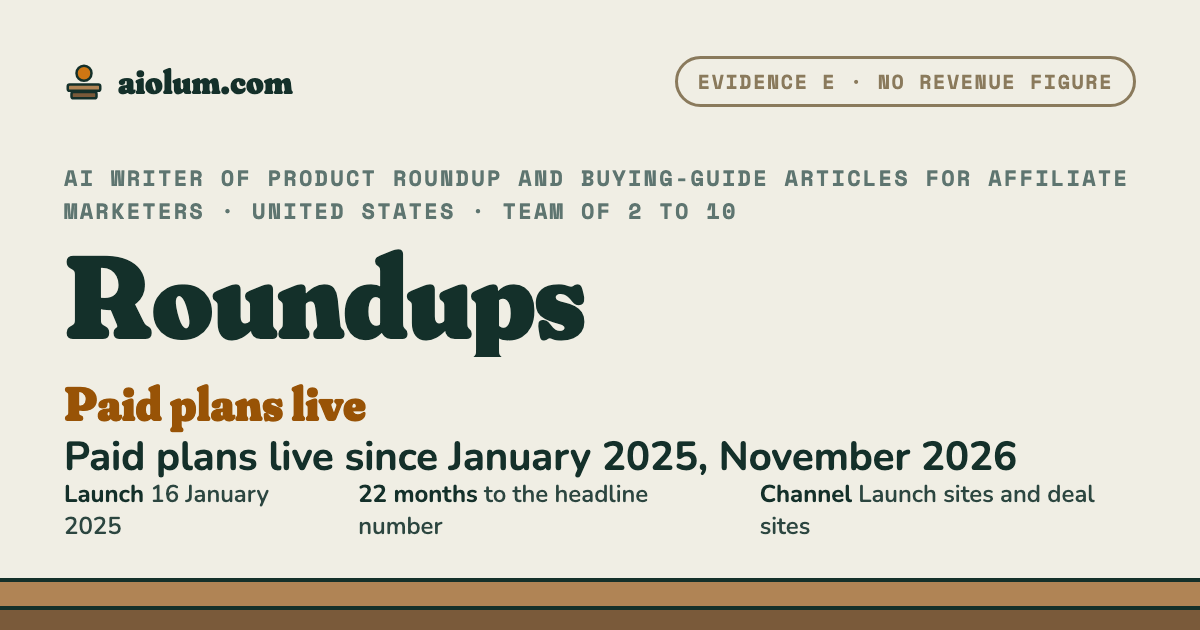
How much revenue does Roundups make?
Each row shows the evidence grade and the source numbers from the list at the end of this page. The grades are explained in How Aiolum verifies.
| Fact | Value | Grade | How we know | Sources |
|---|---|---|---|---|
| Product Hunt launch | 16 January 2025, fifth place of the day, 267 points | C | Product Hunt product and launch pages. Hunted by a Product Hunt member; Josh Barkin wrote the maker comment. | [4, 5] |
| Founded | 2024 | C | The company's About page: "Roundups was born in 2024." The AppSumo page says the terms of use were last updated on 20 September 2024. | [3, 6] |
| Founders | Josh Barkin (CEO) and Kirill Shevchenko | C | About page and Product Hunt. The About page describes Kirill Shevchenko as "an Amazon engineer working on new ways to generate SEO-friendly articles at scale". | [3, 4] |
| Team | "a team of 4 product devs"; a side project | C | Founders' answer on the AppSumo page; the founder story calls Roundups a side project run around a day job. | [6, 1] |
| Funding | bootstrapped | C | Founders' answer on the AppSumo page. | [6] |
| Signups from the Product Hunt launch | over a hundred, first sale the next day | C | Kirill Shevchenko's account, as summarised by Startup Founder Stories. Free newsletter mentions then sent more than 20,000 views to the landing page. | [1] |
| Profitability | profitable within one year, amount not shared | C | Kirill Shevchenko's one-year write-up, as summarised by Startup Founder Stories: "He will not share exact revenue". | [1] |
| AppSumo reviews | 65 | C | Count on the AppSumo deal page, 5 November 2026. 50 of them gave 5 out of 5. | [6] |
| Search visibility | domain rating from 5 to over 30 | C | Founder's account: links from the AppSumo campaign raised the site's domain rating, a third-party score of how many sites link to it. | [1] |
| AI model provider | OpenAI | C | AppSumo answer on critical third-party tools: "OpenAI, Fly.io, AWS S3, Google OAuth API". Startup Founder Stories also lists Fal.ai, an image-model host. | [6, 1] |
| Time from launch to this page's status date | 22 months | calc | Calculated: January 2025 to November 2026. | [4] |
How to read this table: a grade C value is a statement by a founder or by the company's own pages, or a count shown on a third-party page. A "calc" value was computed on this page. No value is grade A or B, and there is no revenue row.
| Plan | Per month, billed yearly (US$) | Per month, billed monthly (US$) | Limit |
|---|---|---|---|
| Free | 0 | 0 | 200 credits a month, 3 products per Roundup |
| Lite | 11.17 | 14 | 1,700 credits a month, 10 products per Roundup |
| Pro | 39.17 | 49 | 16,000 credits a month, 25 products per Roundup |
| AppSumo Tier 1 | 59 one-time | 1,000 credits a month; sold out | |
| AppSumo Tier 2 | 149 one-time | 10,000 credits a month; sold out | |
| AppSumo Tier 3 | 499 one-time | unlimited credits; sold out |
Plans are sold by credits per month; each Roundup uses credits. Yearly billing is shown as US$134 a year for Lite and US$470 a year for Pro, about 20% below twelve monthly payments. AppSumo sold one-time lifetime licenses at US$59, US$149 and US$499 (Tier 1 to 3); the AppSumo page showed them as sold out on 5 November 2026.
When did Roundups launch, and how did it grow?
From an earlier AI blogging tool to a launched product with paid plans, in about two years. Each entry carries its grade.
- 2023CKirill Shevchenko builds an AI content generator for SEO. By the end of 2023 there are hundreds of competitors, and he drops it. [1]
- 2024CJosh Barkin, who was already building another product, Botsheets, finds Kirill Shevchenko online. They reuse the earlier tool to build Roundups in evenings and weekends. [1, 3, 5]
- 16 January 2025CProduct Hunt launch: fifth of the day, over a hundred signups, first sale the next day. [1, 4]
- 2025CFirst AppSumo lifetime deal. The founder writes that it brought the first real money and much feedback; AppSumo keeps a large commission and a 60-day refund window. [1, 6]
- 6 August 2025CThe founders move all users to a credit system. [6]
- 2 April 2026CSecond AppSumo campaign, with goal-based article formats and a new API. [6]
Why did Roundups work?
Four causes, in the order they mattered. Each one is a reusable lesson.
Launch platforms instead of an audience
The first users came from one Product Hunt day with an experienced hunter, then from free mentions in AI newsletters. AppSumo then marketed the product to its own buyers in return for a large commission.
Reuse earlier work
Roundups started from Kirill Shevchenko's failed SEO writer. The new part was a narrower job, a buying guide with marketplace data and affiliate links, instead of a general article.
Data in, affiliate links out
The tool reads product data from Amazon, AppSumo and Envato, whose affiliate programs pay commissions, and writes the links into the article. The user's reason to pay is the commission, not the text alone.
How it was built
These details come from the founder story, the AppSumo founder answers and the company's pages. They are grade C. [1, 6, 2]
- Ruby on Rails with Hotwire, PostgreSQL and Tailwind CSS; the first version took about two months of near-daily work.
- Hosting on Fly.io with files in AWS S3; customer data stored in Amsterdam, Netherlands.
- Text from OpenAI models; the sources do not name the exact model.
- Stripe for payments, Freshdesk for support, Google sign-in.
- Publishing to WordPress and Ghost, and an API for generating Roundups from code, added by April 2026.
Tools named in the sources
Each one opens its page in the Tools tab, with every story that uses it.
Who tried this before Roundups, and why did they fail?
Three companies in our database of failed startups tried to earn from product recommendations and lost to search engines or larger shops. The values below are from that database and are not independently verified.
Waterproof Digital Camera
The promiseAn affiliate blog that reviewed waterproof cameras and earned Amazon commissions.
Why it diedGoogle's algorithm updates removed its search traffic.
PopSugar Shop
The promiseBuy the products shown in PopSugar's articles.
Why it diedFaster, cheaper shops and social-media shopping took the buyers.
Bountii
The promisePrice comparison that finds the cheapest offer for a product.
Why it diedGoogle Shopping did the same job for free.
The failed startups come from our database of 1,749 dead startups, retold here in our own words. Its entries are AI-assisted summaries of public sources, so these cards carry no evidence grade.
What changed
The affiliate blog and the comparison site both depended on Google sending them readers, and both lost when Google changed its ranking or built the feature itself. Roundups does not own the traffic either: it sells the writing to people who run such sites.
What is new is the cost of writing. A large language model writes a first draft of a buying guide from product data in minutes, so two part-time founders can sell a tool that a content agency once needed staff for. The risk moved to the customers' sites, which still need Google to rank their pages.
Can one person copy Roundups now?
Yes, with a narrow niche and a lifetime-deal plan.
Two people with day jobs built and launched it on a common web stack and the OpenAI API. The method is open to anyone; the founder's own warning is that AI writing tools are crowded, so the product needs a narrow job and an answer to "why is yours better".
Where it is still open: Other article types with a commission behind them: travel, software, local services and events, which Josh Barkin named at launch.
- 1Pick one article type that already ranks well, and build only for it.
- 2Connect to a data source that pays commissions, so the user earns from the output.
- 3Launch on Product Hunt with a hunter who has followers.
- 4Before a lifetime deal, calculate the worst-case model cost per license and set credit limits.
What could go wrong for Roundups?
The risks are the mirror image of the causes above.
What is not verified
No revenue figure was found. Kirill Shevchenko's write-up, as summarised by Startup Founder Stories, says Roundups became profitable within a year but gives no amount; the same page shows a "$1K MRR" milestone label and also says the revenue "is not publicly tracked", so this page does not use the label. The AppSumo answer of more than 1,200 paying monthly subscribers is for the founders' whole "portfolio", not for Roundups alone. No payment-processor profile was found. A reader could look for a TrustMRR profile or a later founder post with numbers.
Google's rules on AI-written affiliate pages
The home page says it helps users "rank on Google", and AppSumo shows "Instantly create buying guides that rank on Google". Google Search Central wrote on 8 February 2023 that "Appropriate use of AI or automation is not against our guidelines", but its spam policies list "Scaled content abuse", including "Using generative AI tools ... to generate many pages without adding value for users", and "Thin affiliation", affiliate pages copied from the merchant "without any original content or added value". Whether a customer's pages are helpful or spam depends on how the customer uses the tool; the product asks users to edit and add a personal touch.
Testimonials and user counts
The home page testimonials are signed with user names only, and one reports a user's Amazon commissions from one blog. The home page says the product serves "1000's of users worldwide"; no source gives a Roundups-only user count.
Depends on OpenAI and on marketplaces
The founders list OpenAI as a critical dependency. A price change or a policy change by OpenAI, or by Amazon's affiliate program, would change the product's cost or its value to users. Lifetime-deal buyers keep using credits every month, which costs model fees without new revenue.
Sources
The grade next to each source is the best grade that the source can support. "Read in full" means that the text of the page was downloaded and the numbers were checked in it.
- C Startup Founder Stories: how Kirill Shevchenko bootstrapped Roundups into a profitable AI side projectRead in full on 5 November 2026. A summary of the founder's one-year write-up on Medium, which was not fetched. Source for the earlier product, the launch results, the AppSumo account and the tech stack.
- C Roundups.ai home page with pricingRead in full on 5 November 2026. Source for the product description, the plans and the testimonials. The separate /pricing path returns 404.
- C Roundups.ai: About RoundupsRead in full. Source for the co-founders and the 2024 start.
- C Product Hunt: Roundups, Generate and monetize product buying guidesRead in full. Source for the launch date, the day rank and the maker.
- C Product Hunt launch post: RoundupsRead the maker comments by Josh Barkin. Source for the origin of the idea and the marketplace integrations.
- C AppSumo: Roundups deal pageRead in full on 5 November 2026. Source for the lifetime-deal tiers, the founders' answers (team, funding, dependencies, data location), the review count and the founder updates of June 2025, August 2025 and April 2026.
- C Google Search Central Blog, 8 February 2023: Google Search's guidance about AI-generated contentRead in full. Source for Google's stance on AI-written content.
- C Google Search Central: Spam policies for Google web search (last updated 28 August 2026)Read the sections on scaled content abuse and thin affiliation.
- C Database of failed startups, local exportLocal export. AI-written summaries, not independently verified. Source for the failed predecessors.
Run this company? Send corrections or a verified figure to aiolum@livyden.com