Simi (Lamina Labs): Product, team and how it was built
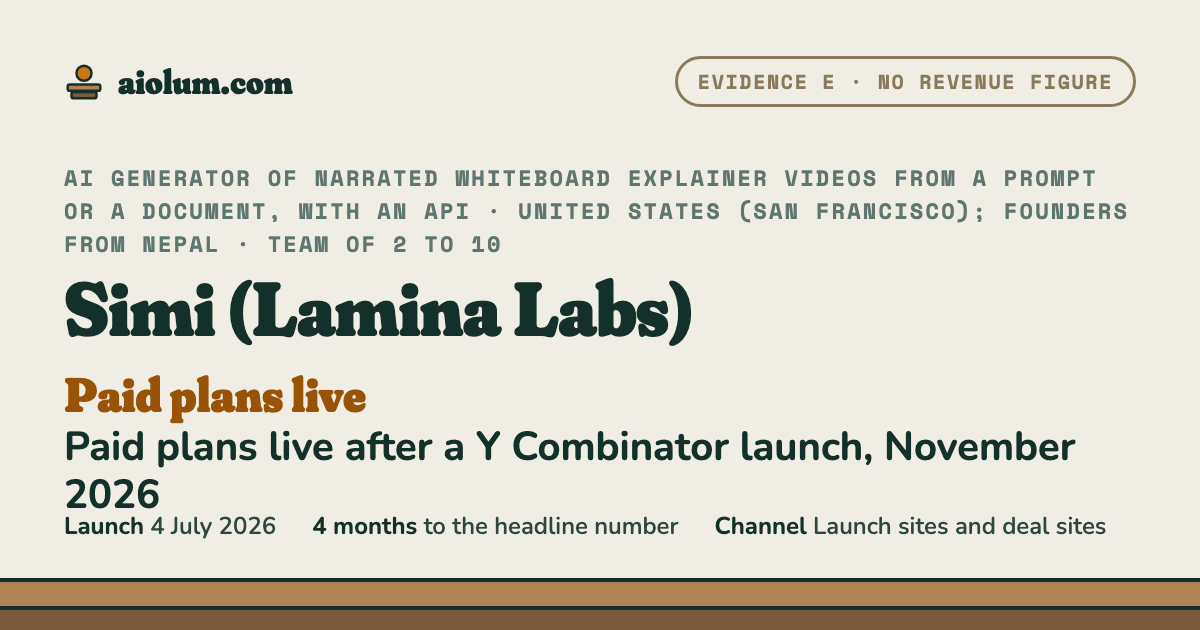
Simi (Lamina Labs) (AI generator of narrated whiteboard explainer videos from a prompt or a document, with an API, United States (San Francisco); founders from Nepal): Paid plans live after a Y Combinator launch, November 2026. Evidence grade E: no revenue figure was checked. Team: 2 co-founders (Y Combinator page, read 6 November 2026; RuntimeWire called it a two-person operation in July 2026). Launched 4 July 2026; still running.Added 6 November 2026
- Outcome
- Paid plans live after a Y Combinator launch, November 2026
- Evidence
- E no revenue figure was checked
- Launch
- 4 July 2026
- Status
- Still running
- Team
- 2 co-founders (Y Combinator page, read 6 November 2026; RuntimeWire called it a two-person operation in July 2026)
- Outside funding
- Y Combinator Spring 2026; RuntimeWire reported US$4.8M raised (founder's X thread, July 2026)
- Group
- Video generation
- Main channel
- Launch sites and deal sites
What is not verified
No revenue figure was found. There is no TrustMRR profile, no founder interview with sales figures and no filing among the downloaded sources. The US$4.8M funding figure comes from the founder's X thread as reported by RuntimeWire on 30 July 2026; the X post itself was not read. The speed and cost comparison on the home page is the company's own test. A reader could look for a revenue statement by the founders or a funding announcement from an investor. This story is grade E: the business is real and its product, price and customers are described from public pages, but no revenue figure was checked. Aiolum shows it as an idea worth studying, not as proof that it makes money.
Simi is the first product of Lamina Labs Inc., founded in 2025 by Sudip Rokaya (CEO) and Kartikesh Mishra (CTO), who met at MIT. It makes a whiteboard explainer video, a short narrated video in which drawings appear on a white background scene by scene while a voice explains the topic. The home page says a one-minute explainer takes about 40 seconds to generate.
Lamina Labs joined Y Combinator's Spring 2026 batch and posted its launch on Y Combinator on 4 July 2026. RuntimeWire reported on 30 July 2026 that the founder said in an X thread that the two-person company had raised US$4.8M. Developers reach Simi through an API (application programming interface, a way for one program to call another) and an MCP server (Model Context Protocol, a standard way for an AI agent to call another program's tools).
No revenue figure was found. The headline is that paid plans from US$12 to US$499.99 a month are on sale today, according to the company's own pages read on 6 November 2026.
How much revenue does Simi (Lamina Labs) make?
Each row shows the evidence grade and the source numbers from the list at the end of this page. The grades are explained in How Aiolum verifies.
| Fact | Value | Grade | How we know | Sources |
|---|---|---|---|---|
| Status, 6 November 2026 | Live web app with paid credit plans and an API | C | Home page and llms.txt, read 6 November 2026; the docs describe API keys and a job-based HTTP API. | [1, 2, 6] |
| Founded | 2025 | C | Year founded on the Y Combinator company page. | [3] |
| Launch post | 4 July 2026 | C | Created date of the Y Combinator launch post "Simi: The Fastest AI Whiteboard Explainer Video Generator"; the post had 32 votes on 6 November 2026. | [4] |
| Months from launch post to headline | 4 | calc | Calculated: July 2026 to November 2026. | [4, 1] |
| Team | 2 co-founders | C | Team size 2 on the Y Combinator page, with Sudip Rokaya (Founder/CEO) and Kartikesh Mishra (Founder/CTO). RuntimeWire called Lamina Labs "their two-person San Francisco AI-video operation". | [3, 5] |
| Funding | Y Combinator Spring 2026; US$4.8M reported | C | RuntimeWire, 30 July 2026, citing Rokaya's X thread: "have raised $4.8 million for Lamina Labs". The home page names Y Combinator, Foundation Capital and Link Ventures as backers. | [5, 1] |
| Prices | US$12 to US$499.99 a month; annual billing saves 40% | C | Home page and llms.txt. | [1, 2] |
| Speed and length | About 40 seconds for a one-minute video; up to about 5 minutes on most plans | C | Home page FAQ. The launch post says "one minute short to a full hour"; the site says longer runtimes come with a Business plan. | [1, 4] |
| Inputs and languages | PDF, Word, PowerPoint, Markdown, text or a prompt; 80+ languages | C | Home page FAQ. | [1] |
| Developer access | HTTP API, Python SDK, Node SDK, MCP server | C | Docs: a call returns 202 with a job id that the client polls; options include aspect ratio, language and voice. | [6, 2] |
How to read this table: grade C is what the company writes on its own site, its Y Combinator pages, or what a journalist reports from the founder's own post. A "calc" value was computed on this page. No row is a revenue figure.
| Plan | Per month, billed yearly (US$) | Per month, billed monthly (US$) | Limit |
|---|---|---|---|
| Basic (students) | 7.20 | 12 | 2,400 credits a month |
| Plus | 11.99 | 19.99 | 6,000 credits a month |
| Pro | 29.99 | 49.99 | 18,000 credits a month |
| Max | 59.99 | 99.99 | 45,000 credits a month |
| Business | 299.99 | 499.99 | 30,000 credits a month; branding, API, volume pricing, commercial rights |
One credit is roughly one second of balanced-quality video, so 6,000 credits are about 100 minutes of video. The Basic plan is described as student access and is offered inside the app. Commercial usage rights are given only to Business customers, under an agreement with Lamina Labs.
When did Simi (Lamina Labs) launch, and how did it grow?
From a company founded at MIT in 2025 to a funded product with paid plans and an API in November 2026. Each entry carries its grade.
- 2025CSudip Rokaya and Kartikesh Mishra, who met at MIT, found Lamina Labs. [3, 4]
- Spring 2026CLamina Labs is in Y Combinator's Spring 2026 batch. [3]
- 4 July 2026CLaunch post on Y Combinator: Simi writes, draws, animates and narrates a video from a prompt or document. [4]
- 30 July 2026CRuntimeWire reports that the founder announced US$4.8M raised in an X thread. [5]
- 6 November 2026CThe site sells five credit plans, an API, SDKs and an MCP server. [1, 2, 6]
Why did Simi (Lamina Labs) work?
Four causes, in the order they mattered. Each one is a reusable lesson.
One generation, finished video
The user gives a prompt or a document and receives a complete narrated video, not a storyboard to edit. This removes the template editor, which the founders name as the slow step.
Credits per second of video
Plans sell a monthly allowance of credits, and one credit is roughly one second of video, so the price follows the length of video produced.
Video as an API output
The HTTP API, SDKs and MCP server let other products and AI agents request a video the way they request text, which the launch post names as a channel for agencies and developers.
How it was built
Few build details are public. These come from the company's pages and the page source; grade C unless stated. [1, 2, 6]
- The marketing site is built with Next.js (visible in the page source, grade B).
- Videos are made as asynchronous jobs: the API returns a job id that the client polls or streams events for.
- The MCP server runs at api.laminalabs.ai/mcp so agents such as Claude and Cursor can call Simi.
- No downloaded source names the AI models or speech service that Simi uses.
Who tried this before Simi (Lamina Labs), and why did they fail?
Three companies in our database of failed startups promised easier animation or business video and failed. The values below are from that database and are not independently verified.
Fuzzwich
The promiseDrag-and-drop animated videos for casual users and small businesses, with no animation skills.
Why it diedIt found no lasting business model and was outpaced by stronger animation tools and the move to mobile.
ClearMix
The promiseHigh-quality marketing video for businesses without a studio budget.
Why it diedCanva and Adobe offered self-service tools, and AI made its manual production process obsolete.
Real Artists
The promiseA cloud animation studio that let small teams produce animation together.
Why it diedLarger incumbents added collaboration features and it could not win big-budget clients.
The failed startups come from our database of 1,749 dead startups, retold here in our own words. Its entries are AI-assisted summaries of public sources, so these cards carry no evidence grade.
What changed
Fuzzwich and Real Artists made animation easier, but a person still had to do the animating; ClearMix still used people to produce each video. Simi uses generative models to write, draw and narrate the whole video, so the cost of one more video is compute time, not human work.
The other change is the buyer: AI agents and software that call an API can now order a video as part of a workflow, which none of the predecessors could sell to.
Can one person copy Simi (Lamina Labs) now?
Partly. The generation pipeline is deep technical work; the offer is easy to understand.
A solo founder could build a narrower version for one kind of video, such as software onboarding or one school subject, by chaining a language model, a drawing step and a speech service, and selling credits per second of video.
Where it is still open: Explainer videos for one regulated field (safety training, pharmacy procedures) with checked templates and review steps.
- 1Pick one video type that companies make often and dislike making, such as training or onboarding.
- 2Turn a document into a script, then into scenes, then into narrated animation, in one automatic pass.
- 3Price by seconds of finished video, so cost and price move together.
- 4Offer an API and an MCP server so other products and agents become customers.
What could go wrong for Simi (Lamina Labs)?
The risks are the mirror image of the causes above.
What is not verified
No revenue figure was found. There is no TrustMRR profile, no founder interview with sales figures and no filing among the downloaded sources. The US$4.8M funding figure comes from the founder's X thread as reported by RuntimeWire on 30 July 2026; the X post itself was not read. The speed and cost comparison on the home page is the company's own test. A reader could look for a revenue statement by the founders or a funding announcement from an investor.
Dependence on model providers
No downloaded page names the models or speech service behind Simi. The home page benchmarks Simi against Claude Fable 5, GPT-5.5 Pro and NotebookLM, which are both possible suppliers and direct competitors; if the large model companies add fast explainer video to their own products, Simi's price and speed lead could shrink.
Custom voice and volume uses
The home page lists "a custom voice" for Business customers without saying whether this means choosing a voice or copying a real person's voice; no page read offers voice cloning. The launch post names "Faceless YouTube channels and localized social video at volume" among uses. Students get a discounted plan; the product makes explainer videos and no page offers homework or essay help.
Competition
On this site, Lunair also turns text into animated explainer videos and Motionfly generates product launch videos; Simi differs in its whiteboard style, its API and MCP server for agents, and its outside funding.
Sources
The grade next to each source is the best grade that the source can support. "Read in full" means that the text of the page was downloaded and the numbers were checked in it.
- C Lamina Labs home page, read 6 November 2026Read in full. Source for the product, the benchmark, the plans, the FAQ and the named backers.
- C Lamina Labs llms.txt, read 6 November 2026Read in full. Source for the Basic and Business prices and the list of developer tools.
- C Y Combinator company page: Lamina LabsRead the company data on the page. Source for the batch, year founded, team size of 2, location and founders.
- C Y Combinator launch post: Simi: The Fastest AI Whiteboard Explainer Video GeneratorRead in full. Source for the launch date, the founders' reasons, the uses and the vote count.
- C RuntimeWire: Lamina Labs raises $4.8 million to turn AI answers into explainer videos (Ryan Merket, 30 July 2026)Read in full. Source for the reported funding and the two-person team; the article cites the founder's X thread.
- C Simi docs: Getting startedRead in full. Source for the job-based API and its options.
- C Database of failed startups, local exportLocal export. AI-written summaries, not independently verified. Source for the failed predecessors.
Run this company? Send corrections or a verified figure to aiolum@livyden.com