REKALAB: Revenue, team and how it was built
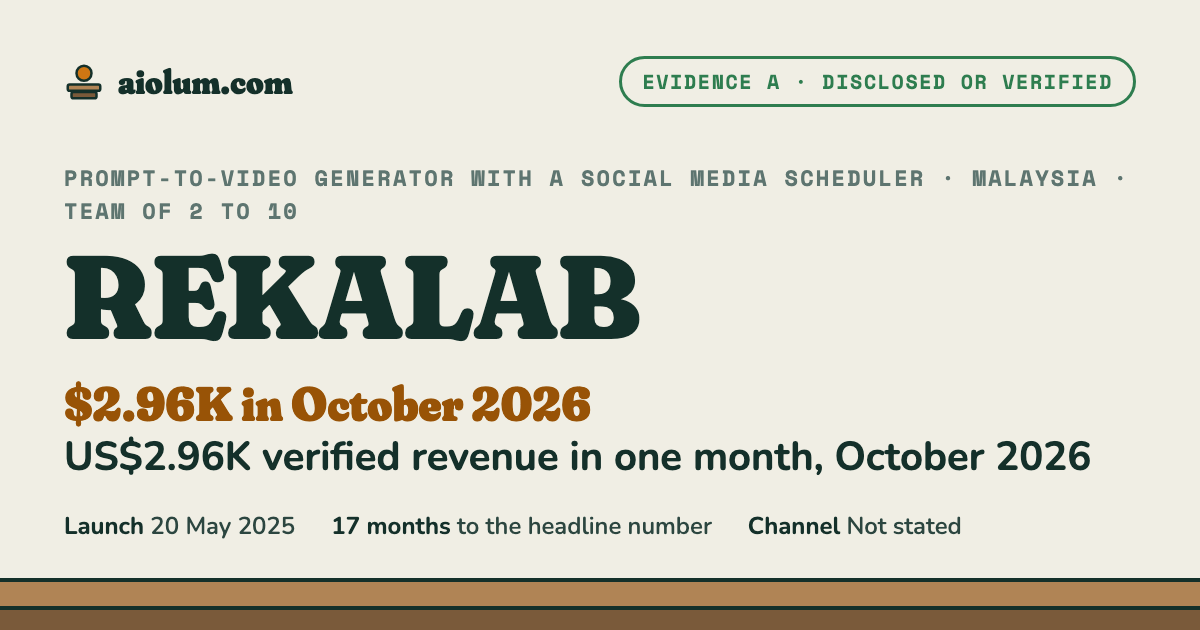
REKALAB (Prompt-to-video generator with a social media scheduler, Malaysia): US$2.96K verified revenue in one month, October 2026. Evidence grade A: disclosed by a company or a filing, or verified by a payment processor. Team: 2 named founders, Ziyad Yazid and Azri; the profile gives the team size as 2 to 5 people. Launched 20 May 2025; still running, revenue flat.Added 6 November 2026
- Outcome
- US$2.96K verified revenue in one month, October 2026Revenue flat
- Evidence
- A disclosed by a company or a filing, or verified by a payment processor
- Launch
- 20 May 2025
- Status
- Still running
- Team
- 2 named founders, Ziyad Yazid and Azri; the profile gives the team size as 2 to 5 people
- Outside funding
- Bootstrapped (founder-entered on TrustMRR)
- Group
- Video generation
- Main channel
- Not stated
REKALAB is a prompt-to-video generator: a web app that turns one line of text into a complete short video, with a script, pictures, motion, captions and a computer voice. Its videos are faceless, which means no person appears on camera; the videos explain a topic over generated pictures. The site calls this "infotainment" content, short videos that mix facts with entertainment. A scheduler in the same app posts the result to five social networks.
TrustMRR, a site that reads revenue directly from a company's payment account, lists two founders, Ziyad Yazid and Azri, and a founding date of 20 May 2025. Its Stripe data shows US$2,956 of revenue in October 2026 and US$23,511 in total, with the first recorded month, December 2025, at US$360. Stripe is the payment processor that charges the customers' cards; TrustMRR reads the figures from it through an API key, so they are not screenshots or claims.
This page grades every number by its evidence. The headline number comes from the payment processor through TrustMRR. User counts on the company's own pages disagree with each other and are graded C. The page also shows four failed startups that tried to make video creation automatic before generative models could draw the pictures and speak the words.
How much revenue does REKALAB make?
Each row shows the evidence grade and the source numbers from the list at the end of this page. The grades are explained in How Aiolum verifies.
| Fact | Value | Grade | How we know | Sources |
|---|---|---|---|---|
| Verified revenue, October 2026 | US$2,956 | A | Monthly revenue timeline in the Verification Sources section of the TrustMRR profile, Stripe API key, synced 6 November 2026. | [1] |
| Verified revenue, last 30 days to 6 November 2026 | US$2,871 | A | The profile gives growth of 6.9% against the 30 days before. | [1] |
| Verified revenue, all time to 6 November 2026 | US$23,511 | A | US$23,435 of it in the last 12 months. | [1] |
| First month in the Stripe timeline | US$360, December 2025 | A | Then US$941 in January 2026, US$1,497 in February, US$1,864 in March, US$2,393 in April and US$2,883 in May. | [1] |
| Monthly revenue, June to September 2026 | US$2,278, US$2,547, US$2,671, US$2,485 | A | Revenue stopped growing quickly after May 2026. | [1] |
| October 2026 against May 2026 | 2.5% higher | calc | Calculated: 2,956 divided by 2,883 equals 1.025. | [1] |
| MRR snapshot on the profile | US$9,140 | A | Monthly recurring revenue (MRR) is the subscription revenue expected in one month. This snapshot is about 3.2 times the collected revenue of the last 30 days (9,140 divided by 2,871). The profile does not explain the gap, so this page uses collected revenue as the headline. IdeaWave, a directory that copies TrustMRR, showed US$8.6K a month on 6 November 2026. | [1, 7] |
| Active subscriptions | 210 | A | Snapshot on the TrustMRR profile. | [1] |
| Founders | Ziyad Yazid; co-founder Azri | C | Entered on the TrustMRR profile. Team size entered as 2 to 5 people. | [1] |
| Founding date | 20 May 2025 | C | Entered on the TrustMRR profile. An earlier AI script tool was online at the same domain in December 2024 (see the timeline). | [1, 6] |
| Outside funding | none stated | C | The profile says Bootstrapped. No source mentions a funding round. | [1] |
| Operator named on the site | Purnama Plus Venture (JR0192905M) | C | Footer of the home page, a Malaysian business registration. | [2] |
| Users claimed by the company | 3,000+ (English page), 1,900+ active (Malay page), 2k+ creators | C | The counts differ between pages. The TrustMRR profile gives an estimated user count of 2,000. | [1, 2, 3] |
| AI voices | 40, in English, Malay, Spanish, French, Arabic and German | C | Home page. The voices are a fixed library; the site does not offer copies of a person's voice. | [2] |
| Visitors, last 30 days | 616 | A | Snapshot on the profile, which gives revenue per visitor as US$4.70. Google Search Console is connected and shows 1,349 search impressions. | [1] |
How to read this table: a grade A value comes from Stripe, the payment processor, through TrustMRR's connection to the company's Stripe account. A grade C value is a statement by the company on its own pages, or text that the founders entered on their TrustMRR profile. A grade X value was computed on this page from the rows above it.
| Plan | Per month, billed yearly (US$) | Per month, billed monthly (US$) | Limit |
|---|---|---|---|
| Creator | 19 | 1,600 credits a month, 2 connected social accounts, unlimited posts | |
| Business | 49 | 7,600 credits a month, unlimited connected social accounts, priority queue |
Plans are monthly only; no yearly price is shown. The FAQ says one video uses about 100 credits, so the Creator plan makes about 16 videos a month and the Business plan about 76. Unused credits expire at the end of each billing cycle. The Malay page charges RM39 and RM129 a month and adds RM20 for payment by online banking. The FAQ says purchases are not refunded.
When did REKALAB launch, and how did it grow?
From a Malay TikTok script generator in December 2024 to about US$3,000 of revenue a month in 2026. Each entry carries its grade.
- 6 December 2024CThe first archived copy of rekalab.com is a "TikTok Script Generator" in Malay, with example prompts for sellers such as "Saya menjual produk skincare Korea yang viral" (I sell a viral Korean skincare product, translation). [6]
- 20 May 2025CFounding date entered on TrustMRR. [1]
- 13 July 2025CAn archived copy describes "Faceless infotainment content in minutes": AI scripts, images and videos with four credit plans. [6]
- 1 November 2025CEffective date of the current terms and conditions. [5]
- December 2025AFirst month in the Stripe timeline: US$360. [1]
- May 2026AUS$2,883 in the month, eight times December 2025. [1]
- October 2026AUS$2,956 in the month and 210 active subscriptions. The site now sells a scheduler for five social networks and an image-to-video feature. [1, 2, 4]
Why did REKALAB work?
Four causes, in the order they mattered. Each one is a reusable lesson.
One prompt, one finished video
Most video models make clips of a few seconds that the user must join and edit. REKALAB plans the whole 60-second video: script, scenes, voice, captions. Its comparison table names this difference: other platforms give a "Max 8-second video output" and need editing after generation.
A local market first
The first version was in Malay, for Malaysian online sellers and affiliate marketers, and the Malay page still prices plans in ringgit and offers payment by online banking. A Telegram support group and a prompt library are part of the offer. A small market with few local-language tools is easier to win than the English market.
Credits that match the cost
Each video uses about 100 credits, and credits expire every month. This ties revenue to the number of videos, and so to the model cost of each video, and it stops unused credits from piling up as a liability.
Posting in the same app
The scheduler connects the user's own accounts and posts the videos. A customer who makes and posts videos in one place has fewer reasons to switch to another generator.
How it was built
The company has published little about how it is built. These details come from the TrustMRR profile and the company's own pages, and are grade C. [1, 2, 5]
- Next.js for the web front end, and Ruby on Rails for the back end, as entered on the TrustMRR profile. The page source of the home page confirms Next.js.
- Stripe for subscription payments; the English checkout charges US$19 or US$49 a month.
- Sign-in with a Google account, Google Analytics for usage and the Meta Pixel to measure advertising, according to the privacy policy.
- The models that write the scripts, draw the pictures and speak the voices are not named on any page read for this story. The home page compares the product's speed with Veo and Kling, two video-generation models.
- Support by email, a help center and a Telegram community.
Tools named in the sources
Each one opens its page in the Tools tab, with every story that uses it.
Who tried this before REKALAB, and why did they fail?
Four companies in our database of failed startups tried to make video or animated stories easy for people without editing skills, before generative models could write, draw and speak. The values below are from that database and are not independently verified.
Qwiki
The promiseAuto-generated multimedia stories in place of text search results.
Why it diedHigh costs and user resistance; after its sale to Yahoo it was lost in the shadow of Google and mobile video.
HighlightCam
The promiseAutomatic video edits without editing effort.
Why it diedSmartphone apps and do-it-yourself software took the market before it found demand.
Fuzzwich
The promiseSimple drag-and-drop animation for casual users and small businesses.
Why it diedIt stayed on the desktop while users moved to phones, and Adobe outspent it.
ClearMix
The promiseProfessional marketing videos without a studio budget, made by freelance videographers on demand.
Why it diedIt could not compete with Canva and Adobe, and AI video made its manual process obsolete.
The failed startups come from our database of 1,749 dead startups, retold here in our own words. Its entries are AI-assisted summaries of public sources, so these cards carry no evidence grade.
What changed
Qwiki turned text into narrated slide stories in 2010, but each story was assembled from existing pictures and a robotic voice, and it cost too much to run for the value it gave. ClearMix still needed a human videographer for every video as late as 2023.
Language models now write the script, image models draw each scene, and speech models read it in a natural voice. A two-person team can join these steps into one button and sell the result for US$19 a month. TrustMRR's Stripe data shows that this was enough for about US$2,300 to US$3,000 of revenue a month from April 2026.
Can one person copy REKALAB now?
Yes, but the product itself is easy to copy too.
Two founders built it without outside money, on rented models and a standard web stack. The same ease is the risk: many faceless-video generators sell the same result, several of them in English with much larger revenue.
Where it is still open: The same pattern can work in other Southeast Asian languages, such as Indonesian, Thai or Vietnamese, for sellers who make short product videos for TikTok Shop and similar stores.
- 1Pick a language or country market that the large English-language tools serve badly, and price in the local currency with local payment methods.
- 2Sell one finished result (a posted video) instead of a set of editing tools.
- 3Use monthly credits that expire, so revenue follows the model cost of each output.
- 4Add the next step of the customer's work, here posting, to the same app.
What could go wrong for REKALAB?
The risks are the mirror image of the causes above.
Competition
On this site, Revid.ai (US$500K a month, September 2026) and Vid.AI sell faceless short videos at much larger scale, and Motionfly is close to REKALAB's size. The home page also compares itself with the video models Veo and Kling, which make short clips.
Dependence on model providers
No page read for this story names the models behind the scripts, pictures and voices. The terms say that REKALAB retains ownership of "The AI models and training systems", but the site does not say whether it runs its own models or rents them. The no-refund policy and expiring credits suggest that each video has a real model cost.
Two different revenue numbers
The TrustMRR profile shows an MRR snapshot of US$9,140, but Stripe collected US$2,871 in the last 30 days and US$2,956 in October 2026. Directories that copy TrustMRR, such as IdeaWave, show the larger figure (US$8.6K a month). The profile does not explain the gap, so this page uses the collected revenue.
Trust signals on the home page
The testimonials give only a first name or a channel name ("Nurmala, Insurance Agent", "Adam, Beginner Creator"). The user counts differ: "Loved by 3,000+ users", "2k+ real creators onboarded" and, on the Malay page, "1,900+ pengguna aktif" (1,900+ active users, translation). The "90% avg. reach growth" claim has no source, and the offer "Limited to the First 35 Customers Only!" shows "Only 35 Spots Left!" on both pages.
Posting and advertising use
The scheduler posts to accounts that the user connects and authenticates, up to unlimited accounts on the Business plan. The FAQ says the videos are "suitable for hard-selling campaigns and video ads". The product uses a fixed library of AI voices and no on-camera AI people.
Sources
The grade next to each source is the best grade that the source can support. "Read in full" means that the text of the page was downloaded and the numbers were checked in it.
- A TrustMRR, REKALAB profile (markdown), revenue synced 6 November 2026Read the markdown profile. Revenue, subscriptions and visitors come from the Verification Sources section (Stripe API key); founders, founding date, team size, funding and tech stack are founder-entered text (grade C).
- C REKALAB home page (English), read 6 November 2026Read in full, including the FAQ answers in the page data. Source for the product, prices, user claims, testimonials and the operator's business registration.
- C REKALAB home page (Malay), read 6 November 2026Read in full. Source for the ringgit prices, the online-banking surcharge, the Telegram bonus and the Malay user count. Quotes are given in Malay with a translation.
- C REKALAB Scheduler page, read 6 November 2026Read in full. Source for the posting features and the supported networks.
- C REKALAB terms and conditions (effective 1 November 2025) and privacy policy, read 6 November 2026Read in full, with the privacy policy at https://www.rekalab.com/privacy-policy. Source for the ownership clause, Google sign-in, Google Analytics and the Meta Pixel.
- C Internet Archive copies of rekalab.com, 6 December 2024 and 13 July 2025Read both copies in full (the second at https://web.archive.org/web/20250713113702/https://www.rekalab.com/). Source for the early Malay script generator and the July 2025 product.
- C IdeaWave, AI Image & Video startups ranked by revenue, 6 November 2026Read the REKALAB row of the category page, downloaded by the pipeline on 6 November 2026. A directory that copies TrustMRR; cited only for the US$8.6K a month figure it shows.
- C Database of failed startups, local exportLocal export. AI-written summaries, not independently verified. Source for the failed predecessors.
Run this company? Send corrections or a verified figure to aiolum@livyden.com