SkeletIQ: Revenue, team and how it was built
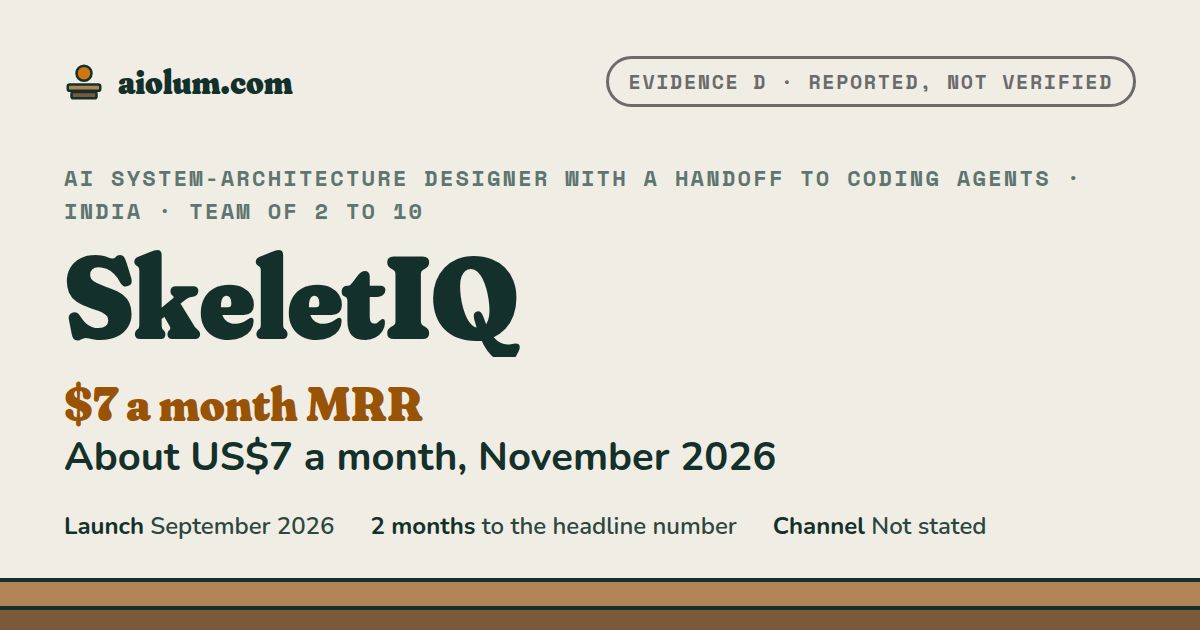
SkeletIQ (AI system-architecture designer with a handoff to coding agents, India): About US$7 a month, November 2026. Evidence grade D: reported, not verified. Team: Headcount not published; the company site names one founder. Launched September 2026; still running.Added
- Outcome
- About US$7 a month, November 2026
- Evidence
- D reported, not verified
- Launch
- September 2026
- Status
- Still running
- Team
- Headcount not published; the company site names one founder
- Outside funding
- None stated
- Main channel
- Not stated
What is not verified
The revenue figure rests on one directory, VerifiedMRR, and no second source confirms it. The directory says it reads Razorpay and Dodo Payments, and this claim could not be checked. Its home page listed 691 rupees for SkeletIQ on 12 November 2026, with no date of its own. Its index file, updated on 4 November 2026, lists 999 rupees. These are about US$7 and US$11 a month. The directory labels the first "avg MRR" and does not explain the difference. The two lists also disagree for another startup, with 7,999 rupees in one and 299 in the other. SkeletIQ's own directory page loads by script and could not be read. A reader could look for a founder post or a payment-processor statement with a dated figure. The headline number is grade D: one claim or one estimate, with no second source. Aiolum shows it because the story is useful, and marks it so that it is not mistaken for a verified figure.
SkeletIQ is a system-design tool for software engineers. The user describes a system, and the tool generates its components, data stores and connections, with a cost estimate for each component. A rule-based check then reports weak points such as a single point of failure. A released design goes to a coding agent through an MCP server. This is a small program that lets an AI agent call tools over the Model Context Protocol. The agent writes a brief into AGENTS.md, a text file in a repository that tells coding agents how to work there.
The product is run by Sabhahith Works Private Limited in India. Its own site says the company was founded by Nagaraja Sabhahith, and the registration number carries the year 2026. An archived copy of the company site from 7 April 2026 shows a one-person consulting practice named Sabhahith Innovations. The public pages give no headcount. The company's pricing page lists Pro at US$14.99 a month and one-time credit packs from US$5.99, billed through Razorpay. VerifiedMRR, a revenue directory for Indian startups, lists SkeletIQ with MRR, the subscription money that renews each month. Its home page listed 691 Indian rupees when read on 12 November 2026. Its index file, updated on 4 November 2026, lists 999 rupees.
The revenue figure is reported by one directory and is not verified. The directory lists two figures, about US$7.36 and US$10.56 a month at the Federal Reserve rates of 6 November and 4 November 2026. The directory says it reads revenue from Razorpay or Dodo Payments, and it is the only source of the figures. The product is on sale, but its reported revenue is only a few dollars a month. No source says how many customers pay.
Why did SkeletIQ work?
Four causes, in the order they mattered. Each one is a reusable lesson.
It hands coding agents a fixed design over MCP
The company's pages say a released design becomes a brief in AGENTS.md, a build order and a drift report. The pages state that these steps use no model call and give the same answer each time. These are the company's statements and were not tested. The same pages say the agent token cannot write back to the design.
Credits and a monthly plan are on sale in the beta
The pricing page lists a free plan with 200 credits a month, a US$14.99 Pro plan and credit packs. Every payment also gives Pro features for 90 days. The pricing page shows buy buttons, and the terms name Razorpay as the processor. A paid plan is on sale although the product is called a beta.
Customers can pay for model use with their own key
The pricing page says bring-your-own-key works on every plan. On the Free plan a small platform fee applies per generation, and Pro includes it. This lets a customer use a model of their choice while the company meters its own hosted models in credits.
How it was built
These details come from the company's own pages and the public package registry. They are grade C, except the package dates, which are grade B. [10, 8, 12, 5, 6]
- The company site lists React Flow, FastAPI, PostgreSQL and several language models, among them GPT-4o, Claude and Ollama, as the stack of the product.
- The privacy policy says designs run on a provider such as OpenAI, Anthropic or a self-hosted Ollama model. It says the service is hosted in Hyderabad, India.
- The MCP server is a separate package, @skeletiq/mcp, MIT-licensed, with ten public versions between 4 September and 8 November 2026.
- Payments use Razorpay. Keys that customers bring are stored encrypted with AES-256-GCM, according to the terms.
- The company also publishes a free VS Code extension for reviewing markdown files, according to its own site.
Who tried this before SkeletIQ, and why did they fail?
Four companies in our database of failed startups sold AI or visual tools to software engineers and did not last. The values below are from that database and are not independently verified.
CodeSee
The promiseAutomatic visual maps of a codebase's architecture and dependencies.
Why it diedFree users did not become paying customers, and the company shut down in 2024 after four years.
Fig DevTool
The promiseAutocomplete and visual command builders in the terminal.
Why it diedFree and open-source alternatives and low willingness to pay left too little paid conversion.
Kite DevTool
The promiseAI code completion inside the editor.
Why it diedIt came about seven years before the market for AI coding tools grew, and it made monetization errors.
Builder.ai
The promiseCustom apps built from business requirements by AI plus human teams.
Why it diedEach build needed much human work, so the costs stayed high although the sales were marketed as automated.
The failed startups come from our database of 1,749 dead startups, retold here in our own words. Its entries are AI-assisted summaries of public sources, so these cards carry no evidence grade.
What changed
Three of the four predecessors sold tools to engineers and found that free alternatives and low willingness to pay held back paid conversion. The fourth, Builder.ai, sold software builds and carried the cost of human work. Each record says so in its own summary.
SkeletIQ meters its AI use in credits and sells a monthly plan and one-time packs from the start of its beta. It also lets customers use their own model key, so part of the model cost is theirs. The directory lists only a few dollars of monthly revenue, so the pricing has not yet been shown to support a business.
Can one person copy SkeletIQ now?
The product shape, yes. The revenue is too small to prove demand.
A design tool that writes its output into the file a coding agent already reads is a small, buildable idea. One directory lists a few dollars a month, and no second source confirms it. A reader can copy the shape but should not read it as proof that engineers pay for it.
Where it is still open: Other design artifacts that agents could be held to: data models, API contracts and security reviews.
- 1Pick one artifact that coding agents already read, such as AGENTS.md, and write the tool's output there.
- 2Keep the steps after the design free of model calls, so that a check gives the same answer each time.
- 3Sell credits for model use and let customers bring their own key.
- 4List the product in a public revenue directory, so that readers can see the first revenue.
How much revenue does SkeletIQ make?
Each row shows the evidence grade and the source numbers from the list at the end of this page. The grades are explained in How Aiolum verifies.
| Fact | Value | Grade | How we know | Sources |
|---|---|---|---|---|
| MRR listed by VerifiedMRR, read 12 November 2026 | 691 Indian rupees (about US$7.36) | D | The directory's top-10 list shows "SkeletIQ — ₹691 avg MRR". The list carries no date of its own. Converted at 93.91 rupees per US dollar, the Federal Reserve H.10 rate for 6 November 2026. That is the latest rate in the release of 9 November. | [1, 3] |
| MRR in the directory's machine-readable file, updated 4 November 2026 | 999 Indian rupees (about US$10.56) | D | The file line reads "MRR ₹999 · SaaS · Founded 2026". Converted at 94.64 rupees per US dollar, the Federal Reserve rate for 4 November 2026. | [2, 3] |
| Run rate from the 691 rupee figure | about US$88 a year | calc | Calculated: 691 rupees times 12, divided by 93.91. The two directory figures differ by 308 rupees and the directory does not say why. | [1, 3] |
| Payment processor | Razorpay | C | The company's pricing page says "Billed in USD via Razorpay". The directory says it reads revenue from Razorpay and Dodo Payments and does not say which one it read for SkeletIQ. | [5, 1] |
| Company | Sabhahith Works Private Limited, registered in India; its registration number carries 2026 | C | The contact page and footer state the company name and the registration number U62011KA2026PTC222900. The company site says "2026 Incorporated". | [7, 10] |
| Earlier operator of the service | the unregistered trade name "Sabhahith Innovations" | C | The terms say the service was previously operated under this name and that the company took over with effect from 4 November 2026. The terms give no start date for the trade name. | [6] |
| Earliest dated page of the operator | 7 April 2026: a consulting practice named Sabhahith Innovations | C | An Internet Archive copy of the company site calls Sabhahith Innovations the founder's "independent consulting practice". The copy does not name SkeletIQ. It is the earliest copy the archive returned. | [15] |
| Founder | Nagaraja Sabhahith, Founder & CEO | C | The company site says "Sabhahith Works was founded by Nagaraja Sabhahith". The site also names a grievance officer with the same name. | [10, 7] |
| Team size | not published | C | No page read gives a headcount. The company site speaks of "we" and of a founder with 11 or more years of engineering work. The archived page of April 2026 describes one person who handles the client work. | [10, 11, 15] |
| First dated release of the MCP package | 4 September 2026 | B | The public npm registry lists version 0.1.0 of @skeletiq/mcp on this date and version 0.7.0 on 8 November 2026. The package is MIT-licensed. | [12] |
| Time from the first dated release to the November 2026 figure | 2 months | calc | Calculated: 4 September to 12 November 2026. The launch date of the web product itself was not found. | [12, 1] |
| Prices | Pro US$14.99 a month; 400 credits for US$5.99 one time | C | The company's pricing page. The Free plan gives 200 credits a month, and new accounts get 7 days of Pro without a card. | [5, 4] |
| Services sold by the same company | software build and advisory work for other teams | C | The company site says it works with other teams "alongside building our own products". Fees are quoted per engagement. | [11] |
How to read this table. The grade D values come from one revenue directory that says it reads the payment processor. No second source confirms them. Grade C values are the company's own statements. A grade B value is a public package registry. A "calc" value was computed on this page.
| Plan | Per month, billed yearly (US$) | Per month, billed monthly (US$) | Limit |
|---|---|---|---|
| Free | 0 | 0 | 200 credits a month, 3 active projects, watermarked export |
| Pro | 14.99 | 1,500 credits a month, unlimited projects, unmarked export | |
| Credit pack, 400 credits | 5.99 one-time | credits never expire; Pro features for 90 days |
Prices are shown in rupees or dollars by region; the dollar page was read. Checkout is by Razorpay. Every payment, subscription or credit pack, also unlocks Pro features for 90 days. Credits are metered by tokens. Team and workspace plans arrive after the beta, and Enterprise is by quote.
When did SkeletIQ launch, and how did it grow?
From a one-person consulting practice in April 2026 to a paid beta with a reported monthly revenue of a few dollars.
- 2026CSabhahith Works Private Limited is registered in India. The registration number carries 2026, and no month is shown on the pages read. [7, 10]
- 7 April 2026CAn archived copy of the company site shows "Sabhahith Innovations", a one-person consulting practice. The copy does not name SkeletIQ. [15]
- 4 September 2026BVersion 0.1.0 of the MIT-licensed @skeletiq/mcp package appears on the npm registry. [12]
- 4 November 2026CThe terms, privacy and refund pages take effect, and the operator changes from the trade name "Sabhahith Innovations" to the company. The directory's index file lists MRR of 999 rupees. [6, 9, 2]
- 8 November 2026BVersion 0.7.0 of the MCP package is published. [12]
- 12 November 2026DThe directory's home page lists SkeletIQ with 691 rupees of average MRR, and the pricing page shows paid plans on sale in a beta. [1, 5]
What could go wrong for SkeletIQ?
The risks are the mirror image of the causes above.
What is not verified
The revenue figure rests on one directory, VerifiedMRR, and no second source confirms it. The directory says it reads Razorpay and Dodo Payments, and this claim could not be checked. Its home page listed 691 rupees for SkeletIQ on 12 November 2026, with no date of its own. Its index file, updated on 4 November 2026, lists 999 rupees. These are about US$7 and US$11 a month. The directory labels the first "avg MRR" and does not explain the difference. The two lists also disagree for another startup, with 7,999 rupees in one and 299 in the other. SkeletIQ's own directory page loads by script and could not be read. A reader could look for a founder post or a payment-processor statement with a dated figure.
Beta product with a services business beside it
The terms call the service an early-stage beta, and team plans arrive after it. The same company sells software build and advisory work to other teams. In April 2026 its site showed only a one-person consulting practice. No source says how much the company earns from services. The product has its own domain, billing and support, and the figures here are for the product.
Unsourced badges and counters
The home page shows two directory badges, Wired Business and ShinyLaunch, and counters of 43 patterns and 58 starter templates. The pricing page says 51 curated templates. No source confirms the badges. The ShinyLaunch site could not be read because its robots.txt disallows Claude agents.
Earlier trade name with no start date
The terms say the service was run under the unregistered trade name "Sabhahith Innovations" before 4 November 2026. The earliest archived copy of the company site is from 7 April 2026 and shows a consulting practice under that name. No source gives the start date of the trade name. Nothing found points to a start before 2026.
Purchase flow not tested
The pricing page shows buy buttons and names Razorpay, but this page did not sign up or pay. No source names a paying customer, and the directory figure is the only sign that someone paid.
Sources
The grade next to each source is the best grade that the source can support. "Read in full" means that the text of the page was downloaded and the numbers were checked in it.
- D VerifiedMRR: India's Verified SaaS Revenue Registry, home page, read 12 November 2026Read in full. The top-10 list has the line "SkeletIQ — ₹691 avg MRR" and carries no date. The page says the figures are source-verified from Razorpay and Dodo Payments.
- D VerifiedMRR llms.txt, last updated 2026-11-04Read in full. Source for the 999 rupee MRR line and its date. The startup page itself loads by script and could not be read.
- A Federal Reserve Board, Foreign Exchange Rates, H.10 weekly release of 9 November 2026Read the India row. It gives 94.64 rupees per US dollar for 4 November and 93.91 for 6 November 2026.
- C SkeletIQ home page, read 12 November 2026Read in full. Source for the product description, the MCP handoff, the free tier and the badges and counters.
- C SkeletIQ pricing page, read 12 November 2026Read in full. Source for the plans, the credit packs, Razorpay billing and the beta wording.
- C SkeletIQ Terms of Service, effective 4 November 2026Read in full. Source for the operator, the earlier trade name, the beta notice and the billing terms.
- C SkeletIQ Contact and Grievance Redressal page, effective 4 November 2026Read in full. Source for the company name and registration number. The street address and telephone number are not used.
- C SkeletIQ Privacy Policy, effective 4 November 2026Read in full. Source for the model providers, the hosting country and the children clause.
- C SkeletIQ Refund and Cancellation Policy, effective 4 November 2026Read in full. Source for what can be bought: subscriptions, credit packs and paid access for 90 days.
- C Sabhahith Works home page, read 12 November 2026Read in full. Source for the founder's name and role, the 2026 incorporation, the stack and the services.
- C Sabhahith Works services page, read 12 November 2026Read in full. Source for the build and advisory services sold to other teams.
- B npm registry record of @skeletiq/mcp, read 12 November 2026Read the registry's JSON record through registry.npmjs.org. Source for the release dates and the MIT license.
- B GitHub organisation Sabhahith-Works, read 12 November 2026Read the organisation page. It lists one public repository, skeletiq-mcp, MIT-licensed, updated 8 November 2026.
- C Database of failed startups, local exportRecord pages read on the website on 12 November 2026. AI-written summaries, not independently verified. Source for the failed predecessors.
- C Internet Archive copy of the Sabhahith home page, 7 April 2026Read in full. The page is titled "Sabhahith Innovations" and calls it the founder's "independent consulting practice". It does not name SkeletIQ. The telephone number on it is not used.
Run this company? Send corrections or a verified figure to aiolum@livyden.com