Socratix AI: Product, team and how it was built
Socratix AI (AI agents that investigate fraud and compliance alerts for banks and fintechs, United States): Money20/20 Money Award for early-stage startups, October 2026. Evidence grade E: no revenue figure was checked. Team: 2 co-founders in 2025; 5 people on the Y Combinator profile read in November 2026. Launched October 2025; still running.Added 5 November 2026 · updated 6 November 2026
- Outcome
- Money20/20 Money Award for early-stage startups, October 2026
- Evidence
- E no revenue figure was checked
- Launch
- October 2025
- Status
- Still running
- Team
- 2 co-founders in 2025; 5 people on the Y Combinator profile read in November 2026
- Outside funding
- Funded: a US$4.1M seed round led by Pear VC with Y Combinator and others, announced by the company 28 October 2025
- Main channel
- Not stated
What is not verified
No revenue figure was found. The company's pages, its press release, its Y Combinator profile and the UpNext article give no revenue, contract value or customer count beyond three named case studies. A reader could look for a later funding announcement, a payment figure in an interview, or a customer count from the company. This story is grade E: the business is real and its product, price and customers are described from public pages, but no revenue figure was checked. Aiolum shows it as an idea worth studying, not as proof that it makes money.
Socratix AI sells AI agents, programs built on large language models that carry out a task in several steps (look up data, compare, decide, write a note) instead of only answering one question. Its agents work on alerts, the warnings that a bank's monitoring systems raise about a check, a payment or an account that might be fraud. For each alert the agent gathers the transaction history, check images and other signals, compares them with the institution's policy and writes a recommendation with the evidence, which an analyst can follow or overrule.
Riya Jagetia (CEO) and Satya Vasanth Tumati (CTO) founded it in 2025 and went through Y Combinator's Summer 2025 batch. On 28 October 2025 the company announced a seed round of US$4.1 million led by Pear VC. Its own blog names three customers with case studies, a community bank in Illinois, the rewards platform Super.com and the trucking-finance company AtoB, and on 18 October 2026 the company won the Startup Early Stage category of the Money20/20 Money Awards.
No revenue figure was found, so this is a grade E story: the headline is an award that the company reports and that an UpNext article confirms. The Y Combinator profile lists 5 people, so the team is still small after the funding.
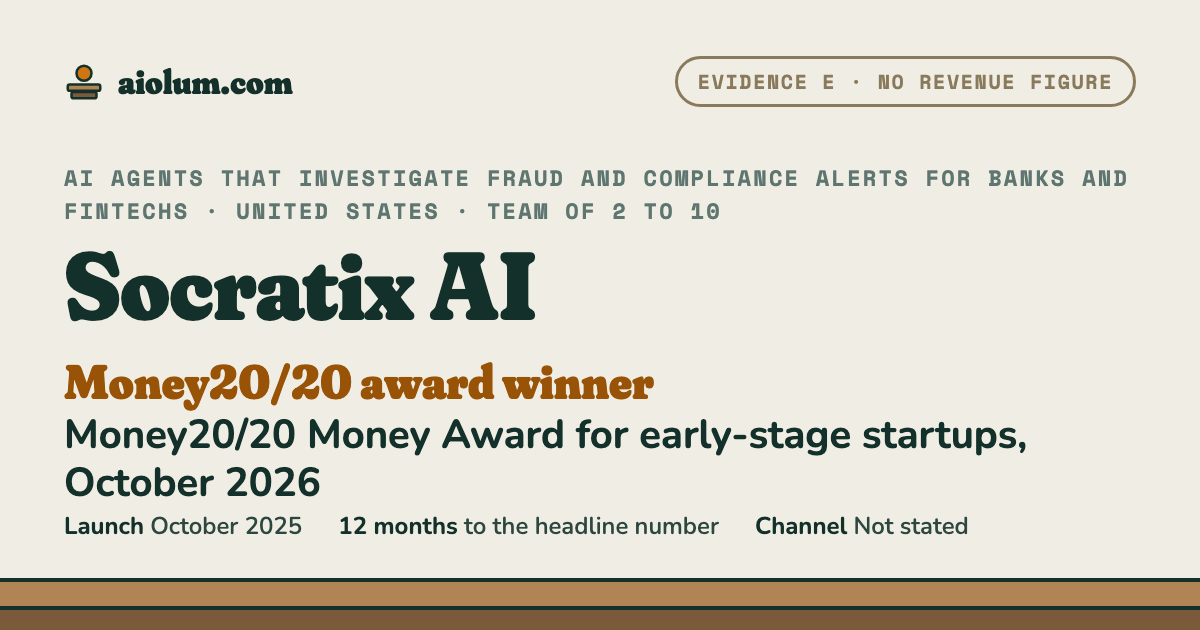
How much revenue does Socratix AI make?
Each row shows the evidence grade and the source numbers from the list at the end of this page. The grades are explained in How Aiolum verifies.
| Fact | Value | Grade | How we know | Sources |
|---|---|---|---|---|
| Money20/20 Money Awards 2026 | Startup Early Stage category | C | Company news post: "Socratix AI took the Startup Early Stage award, chosen from three finalists alongside Aviel Intelligence and Charm Security", announced 18 October 2026. UpNext, 23 October 2026, writes that "Socratix won Silver in the Early Stage Startup category". The two sources word the rank differently. | [4, 5] |
| Founded | 2025, Y Combinator Summer 2025 | C | Y Combinator profile: "Founded in 2025 by Riya Jagetia and Satya Vasanth Tumati", batch "Summer 2025". | [3] |
| Founders | Riya Jagetia (CEO) and Satya Vasanth Tumati (CTO) | C | Y Combinator profile and the company's press release. The press release writes "Satya Vasanth Reddy Tumati". | [2, 3] |
| Team size, November 2026 | 5 people | C | Y Combinator profile, read 5 November 2026: "Socratix AI has 5 employees based in San Francisco" and one open engineering role. | [3] |
| Seed round | US$4.1 million, led by Pear VC | C | The company's press release of 28 October 2025 states the amount, with "participation from Y Combinator, Twenty Two Ventures, Transpose Platform Management, and a group of strategic angel investors". UpNext repeats the amount. | [2, 5] |
| Named customers | First Community Bank and Trust, Super.com, AtoB | C | Case studies on the company blog dated January, March and August 2026, each with quotes from named customer staff. | [6, 7, 8] |
| Check review at a community bank | 100% of checks evaluated, 97.5% auto-cleared, 65% less manual review time | C | Company case study, August 2026. Before, the bank reviewed about 18% of business checks and 3% of consumer checks. The bank has about US$200 million in assets, as the case study states. | [6] |
| Credit-limit reviews at AtoB | about 400 requests a month; 100+ hours of manual work replaced | C | Company case study, January 2026: "Approximately 400 credit limit requests per month" at about 15 minutes each. | [8] |
| Investigation time | from a full day to 15 minutes | C | Press release, 28 October 2025: "Reviews that once took a full day now take just 15 minutes". A customer outcome, not a company figure. | [2] |
| Credit-union programs | Curql Accelerate Cohort 4 (January 2026), Circuit Accelerator Cohort 3 (July 2026) | C | Company news posts. Curql represents more than 160 credit unions; Circuit's advisory council has leaders of 31 credit unions. | [9, 10] |
| Security | SOC 2 Type II | C | Home page badge "SOC 2 Type II" with a link to a trust center. The audit report itself was not seen. | [1] |
| Time from the seed announcement to the award | 12 months | calc | Calculated: October 2025 to October 2026. | [2, 4] |
How to read this table: a grade C value comes from the company's own pages, its Y Combinator profile or the UpNext article, which retells the company's statements. A "calc" value was computed on this page. No value is grade A or B, and no revenue figure exists.
| Plan | Per month, billed yearly (US$) | Per month, billed monthly (US$) | Limit |
|---|---|---|---|
| Virtual demo | free; a walkthrough with the team | ||
| On-site AI workshop | price not published | ||
| Platform contract | price not published; set per institution |
The home page read on 5 November 2026 offers "Schedule a virtual demo" and "Schedule an on-site AI workshop", and no plan or price appears on any page read. The terms of service say "If you purchase a paid service, you agree to pay all charges associated with your account" without amounts. Contracts are sold to institutions after a demo.
When did Socratix AI launch, and how did it grow?
From a Y Combinator batch in mid-2025 to an industry award in October 2026, in about 12 months from the seed announcement. Each entry carries its grade.
- 2025CRiya Jagetia, who built fraud tools at DoorDash and Unit21, and Satya Vasanth Tumati, who built data systems at Cruise and LinkedIn, found Socratix AI in San Francisco. [3]
- Summer 2025CThe company goes through Y Combinator's Summer 2025 batch. [3]
- 28 October 2025CThe company announces a US$4.1 million seed round led by Pear VC and says early customers cut reviews from a full day to 15 minutes. [2]
- January 2026CAtoB case study on credit-limit decisions; selection for Curql Accelerate Cohort 4, a credit-union accelerator. [8, 9]
- March to August 2026CCase studies for Super.com (account reviews) and First Community Bank and Trust (check fraud); selection for Circuit Accelerator Cohort 3 in July. [6, 7, 10]
- 18 October 2026CThe company wins the Startup Early Stage category of the Money20/20 Money Awards in Las Vegas. [4, 5]
Why did Socratix AI work?
Four causes, in the order they mattered. Each one is a reusable lesson.
Domain expertise of the founders
The CEO had built fraud detection and analyst tools at DoorDash and Unit21, by the Y Combinator profile. The product copies how an analyst works an alert: gather evidence, check the rule, write the reason. That is knowledge from the job, not from the model.
The customer writes the procedure, the agent runs it
In the Super.com and AtoB case studies the customer's risk team wrote down its own review steps, and the agent runs those steps for every case. The case studies call this an AI Operating Procedure. The institution keeps its policy and the analyst keeps the final decision, which matters to banks and their examiners.
Selling through credit-union programs
Two accelerator programs run by credit-union groups gave the company meetings with credit-union executives and pilots. The company says it uses them to learn how to price and deploy the product for credit unions.
How it was built
The company's pages say little about its technology. These details come from its pages and its Y Combinator profile, grade C, and from the page source of its site. [1, 3, 6]
- Agents read many inputs in one workspace: core banking activity, check images read with OCR (optical character recognition), device and login signals, identity checks, sanctions and watchlist hits, and analyst notes.
- It connects to banking cores; the home page names Jack Henry and Ensenta among its integrations.
- No source read names the large language model or its provider.
- The marketing site is built with Next.js, as its page source shows, and the trust center runs on Vanta.
Tools named in the sources
Each one opens its page in the Tools tab, with every story that uses it.
Who tried this before Socratix AI, and why did they fail?
Three companies in our database of failed startups sold software infrastructure to banks and financial firms and failed. The values below are from that database and are not independently verified.
Railsr
The promiseAn API platform that let companies offer banking services without their own banking license.
Why it diedOperational problems, compliance failures and handling of client funds led to regulatory action.
Kevin.
The promiseAccount-to-account payments in Europe through the banks' open-banking interfaces.
Why it diedConsumers kept their habits, bank interfaces varied in quality, and merchants did not adopt the payments.
Digital River (SaaS)
The promisePayments, fraud management and tax handling for software sellers worldwide.
Why it diedStripe won the developers, and the product team was cut while the system aged.
The failed startups come from our database of 1,749 dead startups, retold here in our own words. Its entries are AI-assisted summaries of public sources, so these cards carry no evidence grade.
What changed
Railsr failed on compliance, and Kevin. failed on bank interfaces that varied in quality. Both sold infrastructure to the financial system and had to carry its rules and its slow integration work. Socratix AI sells into the same institutions and meets the same constraints: examiners, audit trails and old core-banking systems.
The difference is the size of the task. Socratix does not move money or hold a license; it does part of an analyst's daily work and leaves the decision to a person. Large language models can now read a check image, a transaction list and an analyst's note and write a reason in plain words, so a small team can sell to a community bank without building a separate model for each customer.
Can one person copy Socratix AI now?
Not alone, and not without the background.
Banks buy from people they trust with their regulators, and this team came from fraud work at large companies, raised a seed round and earned a SOC 2 Type II report. A solo founder could start with one narrow task for one kind of institution, but would need the same domain knowledge and security paperwork.
Where it is still open: Other review work in regulated firms: insurance claims, loan documents, vendor due diligence, and the reports that banks file with regulators.
- 1Pick one review task that analysts do by hand many times a day, such as check images or credit-limit requests.
- 2Let the customer write the steps; have the agent run them and write the reason for every decision.
- 3Keep a person on every consequential decision, and show the evidence next to the recommendation.
- 4Join programs that industry groups run for vendors, to get pilots and pricing feedback.
What could go wrong for Socratix AI?
The risks are the mirror image of the causes above.
What is not verified
No revenue figure was found. The company's pages, its press release, its Y Combinator profile and the UpNext article give no revenue, contract value or customer count beyond three named case studies. A reader could look for a later funding announcement, a payment figure in an interview, or a customer count from the company.
Award wording differs
The company writes that it "took the Startup Early Stage award"; UpNext writes that it "won Silver in the Early Stage Startup category". Both agree on the category and the event.
Personal data and regulated work
The agents read bank customers' transactions, identity checks and sanctions, PEP (politically exposed person) and adverse-media screening results. These are checks that banks must run under anti-money-laundering rules, and the customer's analysts make the final decision. The company links a SOC 2 Type II trust center; the report itself was not read.
Competition and model providers
Ballerine, another story on this site from the same Money20/20 list, sells teams of AI agents to financial firms for onboarding, underwriting, monitoring and investigations, by the UpNext article. No source read names the language model that Socratix uses; its privacy policy says it keeps a list of subprocessors "available upon request" or at its trust center, which loads by script and was not read.
Sources
The grade next to each source is the best grade that the source can support. "Read in full" means that the text of the page was downloaded and the numbers were checked in it.
- C Socratix AI home page, read 5 November 2026Read in full. Source for the product, the inputs, the integrations, the demo and workshop offers and the SOC 2 badge.
- C Socratix AI press release, 28 October 2025: Socratix AI Raises $4.1M to Empower Fraud Fighters with AIRead in full. Source for the seed round, the investors, the founders' background and the early customer time savings.
- C Y Combinator company profile: Socratix AIRead in full, including the founder entries. Source for the founding year, the batch, the team size and the founders' earlier work.
- C Socratix AI news, October 2026: Socratix AI Wins the 2026 Money20/20 Money AwardsRead in full. Source for the award, its date and the three named early customers.
- C UpNext, 23 October 2026: Money20/20 USA 2026Read the section on Socratix AI and Ballerine in the copy downloaded by the pipeline's harvester on 5 November 2026. Confirms the award category and the seed round.
- C Socratix AI case study, August 2026: First Community Bank and Trust Reviews 100% of Its Checks for FraudRead in full. Source for the check-review figures and the bank's quotes.
- C Socratix AI case study, March 2026: How Super.com Reduced Manual Account Reviews at Scale with Socratix AIRead in full. Source for the AI Operating Procedure method.
- C Socratix AI case study, January 2026: How AtoB Delivered Instant Credit Decisions with Socratix AIRead in full. Source for the credit-limit volumes and the underwriting workflow.
- C Socratix AI news, January 2026: Socratix AI Selected for Curql Accelerate Cohort 4Read in full.
- C Socratix AI news, July 2026: Socratix AI Selected for Circuit Accelerator Cohort 3Read in full.
- C Socratix AI privacy policy and terms of service, read 5 November 2026Read in full, with https://getsocratix.ai/terms. Source for the subprocessor list note and the billing clause.
- C Database of failed startups, local exportLocal export. AI-written summaries, not independently verified. Source for the failed predecessors.
Run this company? Send corrections or a verified figure to aiolum@livyden.com