Summify: Revenue, sale and how it was built
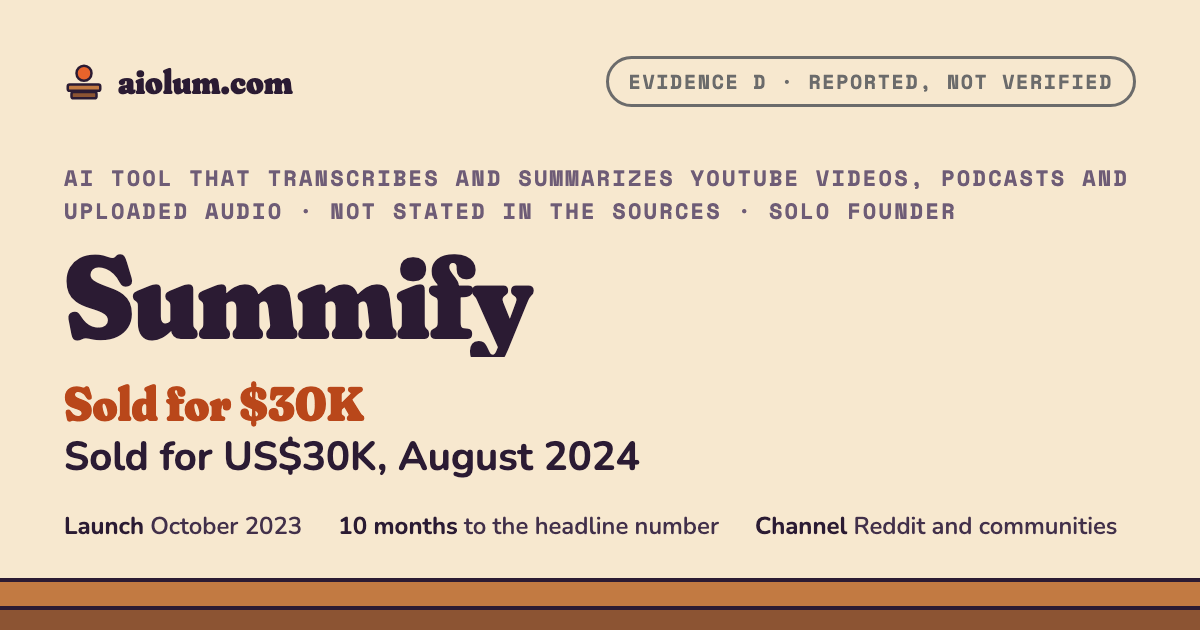
Summify (AI tool that transcribes and summarizes YouTube videos, podcasts and uploaded audio, Not stated in the sources): Sold for US$30K, August 2024. Evidence grade D: reported, not verified. Team: 1 founder, "a solo developer" according to the site's FAQ in 2023 and 2024. Launched October 2023; sold 10 months after launch.Added 27 October 2026
- Outcome
- Sold for US$30K, August 2024
- Evidence
- D reported, not verified
- Launch
- October 2023
- Status
- Sold, 10 months after launch
- Team
- 1 founder, "a solo developer" according to the site's FAQ in 2023 and 2024
- Outside funding
- None reported
- Group
- Voice and audio
- Main channel
- Reddit and communities
What is not verified
The sale price of US$30,000 and every revenue figure rest on one founder post on X from about August 2024, which this page could read only as eBiz Facts quoted it on 5 August 2024. The buyer is not named, and the current owner, Betastate, confirms an acquisition on its about page but gives no date and no price. A reader could look for the marketplace listing of the sale, a statement by the buyer, or a second interview with the founder. The headline number is grade D: one claim or one estimate, with no second source. Aiolum shows it because the story is useful, and marks it so that it is not mistaken for a verified figure.
Summify is a video summarizer: a web app that takes the speech of a YouTube video, a podcast or an uploaded file, turns it into text by transcription, the automatic conversion of speech into written words, and then has a language model, an AI model that reads and writes text, produce a summary, key points and other formats. In 2024 its home page said "Stop watching videos at 2x speed, Get your time back", and its plans were priced by the minutes of media processed each month.
Shahryar Rajabpoor, who posts on X as @devhe4d, started it as a weekend project in October 2023; the site's FAQ called him "a solo developer". In a post that eBiz Facts quoted on 5 August 2024, he wrote that it took three months to reach US$500 of MRR, monthly recurring revenue, that it reached US$2,500 MRR after eight months and then settled at about US$1,500, and that he had just sold it for US$30,000, about ten months after the first version.
The sale price and the revenue rest on that one founder post, and no buyer was named in it, so this page is marked "Reported, not verified" with evidence grade D. The company that runs Summify in 2026, Betastate, writes on its about page that it acquired Summify and rebuilt it, without a date or a price. The page also shows earlier companies that promised to save people from too much content to read and failed.
How much did Summify make, and what was it sold for?
Each row shows the evidence grade and the source numbers from the list at the end of this page. The grades are explained in How Aiolum verifies.
| Fact | Value | Grade | How we know | Sources |
|---|---|---|---|---|
| Sale price, August 2024 | US$30,000 | D | The founder's post on X as quoted by eBiz Facts on 5 August 2024: "I just sold my first-ever startup, Summify, for $30,000". The buyer is not named. X was not opened. | [1] |
| Peak monthly recurring revenue, about June 2024 | US$2,500 | D | The same post: "After eight months, Summify hit $2,500 MRR and then settled around $1,500 MRR." | [1] |
| Monthly recurring revenue before the sale | about US$1,500 | D | The same post. Calculated: 40% below the peak. | [1] |
| Time to US$500 MRR | 3 months | D | The same post: "It took Summify three months to reach $500 MRR". | [1] |
| Sale price as a multiple of revenue | about 1.7 times the yearly run rate | calc | Calculated: US$30,000 divided by US$1,500 times 12, which is US$18,000. It equals 20 months of the US$1,500 MRR. | [1] |
| Total money received, revenue plus sale | something like US$40,000 | D | An estimate by eBiz Facts, not by the founder: "Shahryar ultimately got paid something like $40,000 (app revenue + the sale price)". Calculated: this implies about US$10,000 of revenue before the sale. | [1] |
| First subscription | three days after launch | D | The founder's post as quoted by eBiz Facts. He launched by posting on Reddit. | [1] |
| Launch | October 2023, as a weekend project | D | The founder's post: "Summify started as my weekend project last October." A Wayback Machine copy of 8 December 2023 shows the product live with "Trusted by 6000+ happy users" (grade C). | [1, 2] |
| Team | 1 person | C | The site's FAQ in December 2023 and June 2024: "Summify was developed by a solo developer, who is passionate about machine learning and artificial intelligence. find me on twitter @devhe4d". The footer says "Made with ❤️ by @devhe4d". | [2, 3] |
| Users claimed by the site | 6,000+ in December 2023; 28,000+ in June 2024; 50,000+ in October 2026 | C | Claims on the home page in each Wayback copy and on the live page. The June 2024 page also says 14 million minutes saved. | [2, 3, 7] |
| Marketing channels before the sale | Reddit and LinkedIn posts; three two-week Google Ads campaigns | D | The founder's post as quoted by eBiz Facts: "Reddit, Linkedin posts helped a lot." The archived home page shows badges from Futurepedia, Foundr.ai, There's An AI For That and Product Hunt (grade C). | [1, 2] |
| Current owner | Betastate, run by the founders of the video company Viddyoze | C | The about page of October 2026: "We acquired Summify as a YouTube summarizer." It gives no date and no price, and no source says whether Betastate was the buyer of August 2024. The footer of 31 December 2024 still said "Made with ❤️ by @devhe4d". | [6, 5] |
| Time from launch to the sale | 10 months | calc | Calculated: October 2023 to August 2024. eBiz Facts gives the same figure. | [1] |
How to read this table: a grade D value is a founder statement that only one post contains, quoted by eBiz Facts, or an estimate by eBiz Facts. A grade C value comes from the company's own site, read in Wayback Machine copies from 2023 and 2024 or live on 27 October 2026. A "calc" value was computed on this page from the rows above it. No value is grade A or B.
| Plan | Per month, billed yearly (US$) | Per month, billed monthly (US$) | Limit |
|---|---|---|---|
| Free | 0 | 0 | 120 transcription minutes a month, 3 summary styles |
| Starter | 8.33 | 8 | 800 transcription minutes a month, 5 pods |
| Pro | 16.67 | 16 | 1,800 transcription minutes a month, 20 pods, 100 AI assistant requests a day |
| Max | 33.33 | 33 | 8,000 transcription minutes a month, unlimited pods, 300 AI assistant requests a day |
The live page shows US$8, US$16 and US$33 a month next to US$100, US$200 and US$400 billed yearly, and its page data gives the same three prices as monthly prices; the yearly per-month values below are calculated as the yearly price divided by 12, and the page's "Save 20%" does not match them. Under the founder, in June 2024, the plans were Free (15 minutes a month), Hobby at US$10 a month or US$100 a year (800 minutes), Pro at US$25 a month or US$250 a year (1,800 minutes) and Business Starter at US$50 a month or US$500 a year. The home page of June 2024 also offered a lifetime license: "Get Summify lifetime for $7500 $179 Today!"
When did Summify launch, and how did it grow?
From a weekend project in October 2023 to a US$30,000 sale in August 2024, as the founder tells it. Each entry carries its grade.
- October 2023DThe founder starts Summify as a weekend project, posts it on Reddit, and sells the first subscription three days after launch, he wrote. [1]
- 22 November and 1 December 2023CTwo public build notes on Indie Logs; the second adds transcription of any YouTube video next to summaries. [9]
- 8 December 2023CThe home page claims more than 6,000 users and 2,166,271 minutes saved, with badges from Futurepedia, There's An AI For That and Product Hunt. [2]
- About January 2024DUS$500 MRR after three months, according to the founder's post. [1]
- About June 2024DUS$2,500 MRR after eight months, then about US$1,500, according to the same post. The home page offers a lifetime license at US$179. [1, 3]
- 17 June 2024CPlans from a free 15 minutes a month to Business Starter at US$50 a month. [4]
- 5 August 2024DeBiz Facts reports the founder's post: Summify sold for US$30,000. The buyer is not named. [1]
- 31 December 2024CThe site still carries the founder's handle in the footer. [5]
- October 2026CBetastate runs Summify as a knowledge library that AI assistants can query, and writes that it acquired the product and rebuilt it. [6, 7]
Why did Summify work?
Four causes, in the order they mattered. Each one is a reusable lesson.
One job, done for the builder first
The founder wrote that he built Summify because he needed it himself and did no validation. The job was narrow and easy to explain: paste a link and read the content instead of watching it. The current owners describe the product they bought in the same terms.
Free posts, then small ad tests
The founder wrote that he had no marketing skills and that posts on Reddit and LinkedIn brought the first US$500 of monthly recurring revenue, followed by three Google Ads campaigns of two weeks each. The site also collected listings and badges on AI directories.
Plans by minutes
The founder's plans were priced by the minutes of media processed each month, so the price grew with the cost of transcription and summarization. A one-time lifetime license sat next to the subscriptions.
Selling instead of competing
eBiz Facts noted that Product Hunt was full of similar tools. The founder wrote that MRR fell from US$2,500 to about US$1,500 and that he sold the business at that level, about ten months after launch.
How it was built
These details come from the founder's post as quoted by eBiz Facts (grade D) and from archived copies of the site (grade C). No source names the AI models or the payment processor. [1, 2, 3, 9, 6]
- The founder wrote that he only knew how to code when he started, and that he built and shipped the first version as a weekend project.
- The product took a YouTube link or an uploaded file, transcribed the speech, and produced a summary, key insights, a detailed summary with timestamps and styles such as a blog post or a thread, with export to PDF and text.
- The archived pages load Google Analytics and Google Tag Manager, and show user reviews through Senja, a service that collects testimonials.
- The founder kept a public build log on Indie Logs and ran an affiliate program through a Tally form.
- After the sale, the current owners rebuilt the product as knowledge pods that AI assistants can query through the Model Context Protocol.
Tools named in the sources
Each one opens its page in the Tools tab, with every story that uses it.
Who tried this before Summify, and why did they fail?
Four companies in the Loot Drop database promised to save people from too much content by condensing it, and failed. The values below are from that database and are not independently verified.
Circa
The promiseNews cut into short pieces for mobile readers, with follow-ups.
Why it diedLarge media companies copied the format, and Circa could not build an advertising business before its money ran out.
Wavii
The promiseShort machine-written updates on the topics a user follows.
Why it diedIt had no clear way to make money in a crowded market and ended inside Google after an acquisition.
Nuzzel
The promiseOnly the news that a user's friends shared, so the user does not read everything.
Why it diedIt depended on the Twitter and Facebook APIs, and those platforms offered similar features themselves.
Prismatic
The promiseA personal news feed chosen by algorithms.
Why it diedUser growth stopped, new users cost too much, and advertising could not compete with Google and Facebook.
The failed startups come from Loot Drop, a free database of dead startups, retold here in our own words. Loot Drop describes its entries as AI-assisted summaries of public sources, so these cards carry no evidence grade.
What changed
Circa, Wavii, Nuzzel and Prismatic raised millions of dollars to condense news for readers, and each needed editors, its own language technology or access to another platform's data. None found a way to make readers pay, so they depended on advertising or on a buyer.
Summify condensed one video at a time with rented speech and language models, and users paid by the minute from the first week. One person could build it in weekends, and the founder said that it reached US$2,500 of monthly recurring revenue in eight months. The same low cost let many copies appear, which is the competition that ended the earlier companies, and the founder sold within a year.
Can one person copy Summify now?
Yes, as a first product to learn on and sell.
A tool that does one job with rented AI models can be built in weekends, sold by the minute and promoted with posts in communities. The job is easy to copy, and video platforms and AI assistants now summarize videos themselves, so the founder's choice to sell after ten months is part of the lesson.
Where it is still open: Summaries for one profession that receives long recordings every week, such as court hearings, medical conference talks or sales calls in one industry, where a generic summarizer misses what that reader needs.
- 1Build the tool you need yourself, for one input (a YouTube link) and one output (a summary).
- 2Price by the unit that drives your cost, here minutes of media.
- 3Post the launch in communities where people have the problem, then test short ad campaigns.
- 4Watch monthly revenue after the first peak, and consider selling while the product still grows or holds.
What could go wrong for Summify?
The risks are the mirror image of the causes above.
What is not verified
The sale price of US$30,000 and every revenue figure rest on one founder post on X from about August 2024, which this page could read only as eBiz Facts quoted it on 5 August 2024. The buyer is not named, and the current owner, Betastate, confirms an acquisition on its about page but gives no date and no price. A reader could look for the marketplace listing of the sale, a statement by the buyer, or a second interview with the founder.
Other people's videos
Summify transcribes and summarizes YouTube videos and podcasts that other people made, and its current owners build pods from the work of named copywriters. No source on this page says whether the creators or YouTube gave permission or on what legal basis the transcripts are made.
Claims on the pages
In June 2024 the founder's home page offered a lifetime license as "$7500 $179 Today!", a crossed-out price that no source explains. The current pages show "5.0 from 200+ reviews" and logos of Meta, MIT, PwC and ByteDance under "Pods built by people at"; the reviews are shown through Senja, and no public page lets a reader check the count or the logos.
A product that the platforms now offer
eBiz Facts wrote in 2024 that Product Hunt was full of similar tools, and the founder said that revenue fell from US$2,500 to about US$1,500 a month before the sale. The current owners now compare Summify with Claude Projects, ChatGPT custom GPTs and NotebookLM, which accept uploaded sources themselves.
A different business after the sale
The Summify of 2026 is built by a company with its own history and goals, sells knowledge pods for AI assistants and links to a free copywriting course. The facts on this page about the founder's business come from the pages of 2023 and 2024, not from the current site.
Sources
The grade next to each source is the best grade that the source can support. "Read in full" means that the text of the page was downloaded and the numbers were checked in it.
- D eBiz Facts, 5 August 2024, by Fardeen Khan: Sold His Simple AI Tool For $30K After 10 MonthsRead in full in the site's RSS feed (page 2), downloaded by the pipeline on 27 October 2026; the robots.txt group for all agents allows /feed/ and posts. It quotes the founder's posts on X, which were not opened. Source of the sale price and the revenue figures.
- C Summify home page, Wayback Machine copy of 8 December 2023Read in full, including the page source. Source for the founder-era product, the user claim, the FAQ and the directory badges.
- C Summify home page, Wayback Machine copy of 1 June 2024Read in full. Source for the lifetime offer, the user claim and the FAQ two months before the sale.
- C Summify pricing page, Wayback Machine copy of 17 June 2024Read in full. The founder's plans and prices before the sale.
- C Summify home page, Wayback Machine copy of 31 December 2024Read the footer and the claims, to see the site after the sale.
- C Summify about page, read 27 October 2026Read in full. The current owners' account of the acquisition and of their company. The robots.txt group for ClaudeBot allows /about/.
- C Summify home page, read 27 October 2026Read in full, including the structured data, for the purpose check and the current claims.
- C Summify pricing page, read 27 October 2026Read in full, including the structured data. Source for the current plans.
- C Indie Logs: devhe4d, read 27 October 2026Read in full. The founder's public build log with two entries from November and December 2023. The robots.txt allows this path.
- C Summify: Free AI Copywriting Masterclass, read 27 October 2026Read in full, for the purpose check of a page that the current site links from its footer: a free course that uses a Summify pod built from named copywriters' content, with no income claims.
- C Loot Drop database export, 1,749 failed startupsLocal export. AI-written summaries, not independently verified. Source for the failed predecessors.