Userlens: Product, team and how it was built
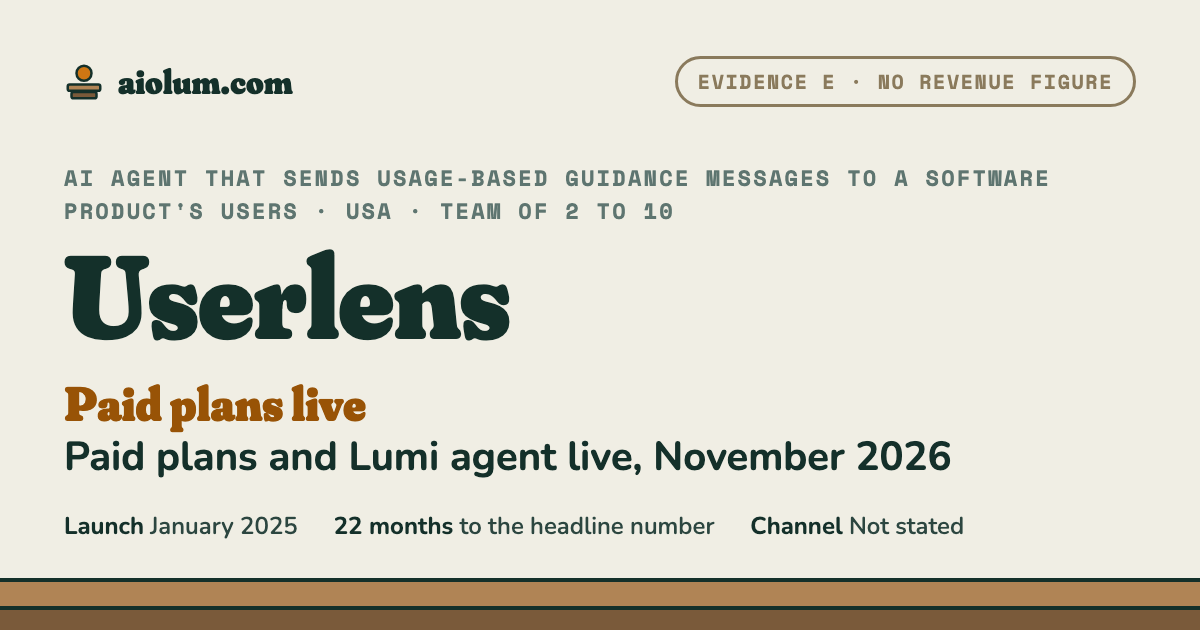
Userlens (AI agent that sends usage-based guidance messages to a software product's users, USA): Paid plans and Lumi agent live, November 2026. Evidence grade E: no revenue figure was checked. Team: 2 co-founders; Y Combinator lists a team of 4 in November 2026. Launched January 2025; still running.Added 5 November 2026
- Outcome
- Paid plans and Lumi agent live, November 2026
- Evidence
- E no revenue figure was checked
- Launch
- January 2025
- Status
- Still running
- Team
- 2 co-founders; Y Combinator lists a team of 4 in November 2026
- Outside funding
- Y Combinator Spring 2026 (amount not published)
- Main channel
- Not stated
What is not verified
No revenue figure was found. We looked for a payment-processor profile, a founder interview with figures, a Y Combinator Demo Day announcement and a filing. The headline is only that paid plans are listed on the company's pricing page on 5 November 2026; it does not show how many customers pay. The customer figures in the launch post (7 April 2026) and the Lumi announcement's "more than $300M in customer ARR" (1 September 2026) are the founders' statements about their customers' revenue, not Userlens revenue. A reader could look for a TrustMRR profile or an interview with figures. This story is grade E: the business is real and its product, price and customers are described from public pages, but no revenue figure was checked. Aiolum shows it as an idea worth studying, not as proof that it makes money.
Userlens connects to a software company's backend database, the store that holds each customer's plan and settings, and to its product analytics, the event logs of what each user clicks and does. From both it builds a profile of every account and every person. Its agent Lumi then runs campaigns, a goal plus an audience plus rules, and writes each user one message based on that user's own behaviour, for example a user who repeated a task five times is shown a feature that does it once.
The co-founders, Ankur Dahama and Hai Ta, came from Wudpecker, an AI notetaker; in January 2025 the site was titled "Userlens by Wudpecker" and sold product analytics with churn warnings. The Y Combinator launch post of 7 April 2026 sold it as an AI customer-success manager, and on 1 September 2026 the founders announced Lumi, the adoption agent that the site now sells.
No revenue figure was found, so this story has evidence grade E. The headline is the company's own pricing page with paid plans, read on 5 November 2026.
How much revenue does Userlens make?
Each row shows the evidence grade and the source numbers from the list at the end of this page. The grades are explained in How Aiolum verifies.
| Fact | Value | Grade | How we know | Sources |
|---|---|---|---|---|
| Status, November 2026 | live, with Free, Starter, Growth and Enterprise plans | C | Home and pricing pages read 5 November 2026. | [3, 4] |
| Revenue | not published | C | No payment-processor profile, interview or filing with a Userlens revenue figure was found. See "What is not verified". | [1, 2, 5] |
| Prices | Free; Starter US$100 a month; Growth from US$1,000 a month billed annually; Enterprise custom | C | Pricing page, read 5 November 2026. The same plans appear in the company's llms.txt. | [4, 6] |
| Founders | Ankur Dahama (Founder and CEO) and Hai Ta (Founder) | C | Y Combinator company page; the launch post calls them co-founders of Userlens. | [2, 1] |
| Team | 4 people, November 2026 | C | Y Combinator company page, team_size 4, founded 2025, San Francisco. | [2] |
| Funding | Y Combinator, Spring 2026 batch | C | Y Combinator company page; the home page says "Backed by Y Combinator". No round size was found. | [2, 3] |
| Earliest site copy | "Userlens by Wudpecker", product analytics with churn warnings, 21 January 2025 | C | Internet Archive copy. The page linked to the Wudpecker AI notetaker. | [7] |
| Named customers in the launch post | Quartr and Smartly | C | Launch post, 7 April 2026. The revenue figures it gives are the two customers' own figures as the founders stated them, not Userlens revenue. | [1] |
| Usage events analysed | 986,214,373, June 2026 | C | A counter on the home page, the company's own statement. | [3] |
| Data sources and channels | PostHog, Mixpanel, Amplitude, a Postgres database; messages by email or Slack | C | llms.txt and the home page. The April 2026 launch post also listed CRM, Stripe and support-tool integrations. | [6, 3, 1] |
| AI models used | not named | C | No downloaded Userlens page names the model provider behind Lumi. | [3, 5, 6] |
| Time from the first site copy to the headline | 22 months | calc | Calculated: January 2025 to November 2026. | [7, 4] |
How to read this table: a grade C value is a statement by the company on its own pages or its Y Combinator posts. A "calc" value was computed on this page. No value is grade A or B, and no row is Userlens revenue.
| Plan | Per month, billed yearly (US$) | Per month, billed monthly (US$) | Limit |
|---|---|---|---|
| Free | 0 | 0 | 100 profiles; 300 personalized emails a month; 1 active campaign |
| Starter | 100 | 10,000 profiles; 10,000 personalized emails a month; 5 active campaigns | |
| Growth | from 1,000 | billed annually; expanded profile and email volume; more campaigns | |
| Enterprise | custom | custom | custom volume, security controls, dedicated support |
Prices are per month. Only Growth is stated as billed annually; the page gives no annual prices for the other plans. A profile is one person or one company known to Userlens. The Lumi announcement offers a 30-day free trial.
When did Userlens launch, and how did it grow?
From a product-analytics spin-off of an AI notetaker to an AI agent that writes to every user, in about 20 months. Each entry carries its grade.
- 21 January 2025CThe earliest archived copy of userlens.io shows "Userlens by Wudpecker": product analytics plus customer feedback, with churn-risk views. [7]
- 2025CUserlens is founded, according to Y Combinator's company page. [2]
- 7 April 2026CY Combinator launch post, Spring 2026 batch: "AI CSM that never misses churn", free for 3 months for YC companies, with Quartr and Smartly named as customers. [1]
- 1 September 2026CThe co-founders announce Lumi, the product adoption agent, with a 30-day free trial. [5]
- November 2026CThe site sells Lumi with Free, Starter, Growth and Enterprise plans. Y Combinator lists a team of 4. [4, 2]
Why did Userlens work?
Four causes, in the order they mattered. Each one is a reusable lesson.
State plus behaviour
The database says what a customer has set up and paid for; the analytics say what users actually do. Userlens joins the two, and the gap between them is the signal for a message.
Approve the campaign, not the message
A person writes the brief once: goal, audience, tone, quiet hours and a limit such as one message every 21 days. Lumi writes and sends each message inside those rules and may skip a person.
Measured in behaviour
Each campaign is tracked by whether users started to use the feature, not by email opens or clicks, so the customer sees the result in its own product metrics.
How it was built
Only what the company's own pages show. No page names the model provider. [6, 3, 4, 1]
- Reads a customer's Postgres database and product analytics from PostHog, Mixpanel or Amplitude; the Free and Starter plans include the PostHog and database integrations.
- Shared definitions called notebooks fix what "activation" or "healthy account" mean for each product and are reused by every campaign.
- Sends by email or Slack, with frequency caps, quiet hours and never-contact flags enforced at sending.
- The website is built with Astro and loads PostHog, visible in its page source; demos are booked through Cal.com.
Who tried this before Userlens, and why did they fail?
Three companies in our database of failed startups promised to keep software or shop customers from leaving with automated, behaviour-based messages, and failed. The values below are from that database and are not independently verified.
Preact
The promisePredict which SaaS customers would churn from their usage data, so the company could act first.
Why it diedLarger customer-success platforms such as Gainsight offered the same predictions inside a fuller product.
Userfox
The promiseAutomated lifecycle emails based on each user's behaviour.
Why it diedMailchimp and other email platforms already held the market, and Userfox could not set itself apart.
Marketfox
The promiseMarketing automation for online shops: segments, email and push messages to keep customers buying.
Why it diedMailchimp, HubSpot and Klaviyo had more integrations and more money.
The failed startups come from our database of 1,749 dead startups, retold here in our own words. Its entries are AI-assisted summaries of public sources, so these cards carry no evidence grade.
What changed
The predecessors could predict churn or send messages from templates, but a person still had to write what each segment received. Userlens has a language model write one message per user from that user's own data, within rules that a team approves once, which is the part that took people's time before.
What did not change: the lifecycle-email and customer-success platforms that beat the predecessors can add the same AI writing, and the Lumi announcement itself asks users of HubSpot Marketing, Customer.io and Iterable to switch.
Can one person copy Userlens now?
The pattern, yes. Alone, harder.
Connect to data that software companies already collect and let a model act on it under rules the customer sets. Userlens had two founders from an earlier startup, Y Combinator and its network of young companies; one person would need another way to reach the first customers and to earn access to their databases.
Where it is still open: The same agent for in-app messages, for sales teams' account follow-ups, or for one popular analytics tool's own marketplace.
- 1Pick a job that people do by hand for their largest customers only, such as onboarding calls or renewal checks.
- 2Read the data the customer already has (database, analytics) with read-only access.
- 3Let the customer approve rules and limits once, and keep a stop switch.
- 4Report results in the customer's own product metrics.
What could go wrong for Userlens?
The risks are the mirror image of the causes above.
What is not verified
No revenue figure was found. We looked for a payment-processor profile, a founder interview with figures, a Y Combinator Demo Day announcement and a filing. The headline is only that paid plans are listed on the company's pricing page on 5 November 2026; it does not show how many customers pay. The customer figures in the launch post (7 April 2026) and the Lumi announcement's "more than $300M in customer ARR" (1 September 2026) are the founders' statements about their customers' revenue, not Userlens revenue. A reader could look for a TrustMRR profile or an interview with figures.
Messages sent in the customer's name
The home page examples show Lumi's emails sent "From You, you@yourproduct.com". The pages do not say whether recipients are told that an AI wrote the message. The company lists frequency caps, quiet hours and never-contact flags as built-in limits.
End users' data
The product reads the customer's database and per-user behaviour and writes about it to named people, for example how many times a user retried a task. What data leaves the customer's systems is set by each customer; the pages read for this story do not describe data retention.
Competition and model providers
On this site, Lucent also sells an AI that reads PostHog-type usage data for software teams, but it reports bugs to the team instead of writing to users. The Lumi announcement names HubSpot Marketing, Customer.io and Iterable as tools to switch from. No Userlens page names its model provider, so its dependence on one cannot be judged.
A changed product and older counters
The product moved from product analytics with churn warnings (January 2025) to an AI customer-success manager (April 2026) to an adoption agent (September 2026). The January 2025 page said "Trusted by 20 000+ professionals and teams", which seems to count the Wudpecker notetaker's users.
Sources
The grade next to each source is the best grade that the source can support. "Read in full" means that the text of the page was downloaded and the numbers were checked in it.
- C Y Combinator Launches, 7 April 2026: Userlens - AI CSM that never misses churnRead in full. The founders' own launch post. Source for the founder story, the named customers, the integrations and the YC offer.
- C Y Combinator company page: UserlensRead the company data in the page: founders, team size, batch, founding year, location and description.
- C Userlens home page, read 5 November 2026Read in full. Source for the product, the example messages, the testimonials, the usage counter and the page source.
- C Userlens pricing page, read 5 November 2026Read in full. Source for the plans and limits.
- C Userlens news, 1 September 2026, by Hai Ta and Ankur Dahama: Introducing Lumi, the product adoption agentRead in full. Source for the Lumi launch, the trial and the tools it asks users to switch from.
- C Userlens llms.txt, read 5 November 2026Read in full. The company's summary for AI assistants: five-step workflow, glossary and plans.
- C Internet Archive copy of userlens.io, 21 January 2025Read in full. The earliest copy: "Userlens by Wudpecker" and its first product.
- C Database of failed startups, local exportLocal export. AI-written summaries, not independently verified. Source for the failed predecessors.
Run this company? Send corrections or a verified figure to aiolum@livyden.com