0sec: Revenue, team and how it was built
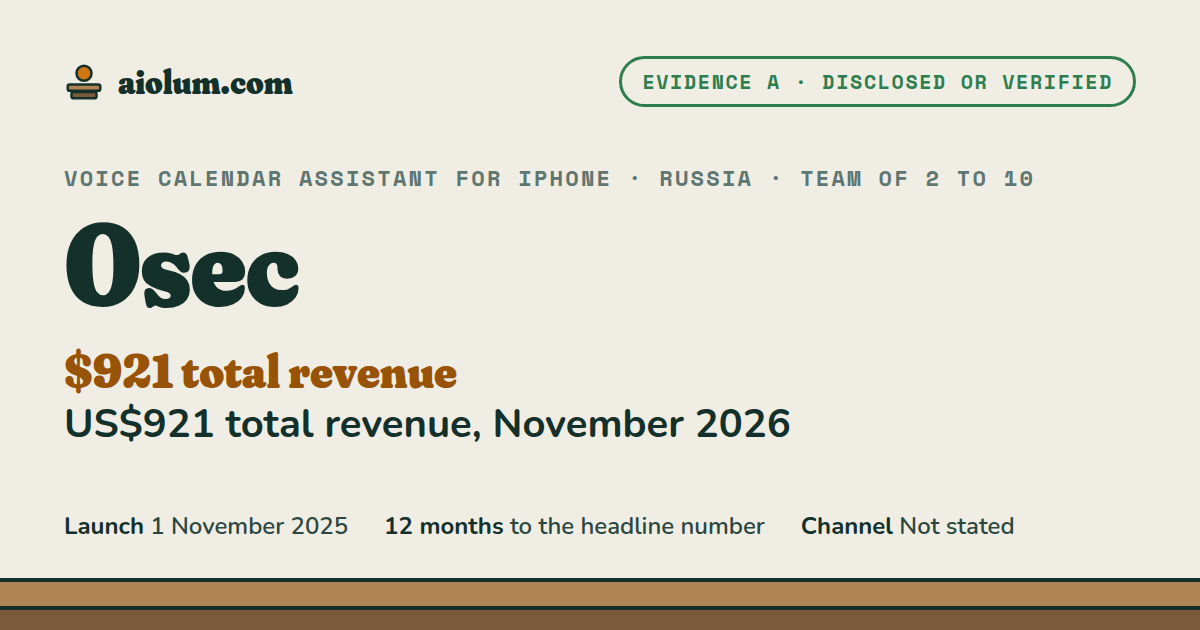
0sec (Voice calendar assistant for iPhone, Russia): US$921 total revenue, November 2026. Evidence grade A: disclosed by a company or a filing, or verified by a payment processor. Team: One developer named; headcount not published. Launched 1 November 2025; still running, revenue flat.Added
- Outcome
- US$921 total revenue, November 2026Revenue flat
- Evidence
- A disclosed by a company or a filing, or verified by a payment processor
- Launch
- 1 November 2025
- Status
- Still running
- Team
- One developer named; headcount not published
- Outside funding
- No funding stated
- Group
- Voice and audio
- Main channel
- Not stated
0sec is a voice calendar assistant: an app that turns a spoken request into a change in the user's calendar. The App Store page lists the developer as Roman Potemin. The AI part is cloud processing: the privacy policy says command text goes through 0sec's servers to OpenAI. It says recordings go the same way when cloud transcription is used, and that Apple Speech may also process recordings.
The App Store version history starts with version 1.0 on 1 November 2025. The TrustMRR profile gives 22 August 2025 as the founding date, and that date is a founder entry. The first revenue appears in January 2026, when the payment records show US$19.98. From April to August 2026 the monthly figure stayed between US$90.93 and US$100.
The headline figure comes from RevenueCat, the subscription service that TrustMRR reads through an API key. On 11 November 2026 it showed US$921 in total revenue, US$111 in monthly recurring revenue and 10 active subscriptions. Monthly recurring revenue (MRR) is the subscription revenue that renews each month. The profile does not show the number of free users or the number of people who cancelled.
Why did 0sec work?
Four causes, in the order they mattered. Each one is a reusable lesson.
It does one job, calendar changes by voice
The listing describes four actions: create, check, update and delete events by voice. The home page calls this "the whole app". The home page says the app checks "in 3 seconds"; that is the company's claim and no source tests it.
It lets the user try before paying
Version 1.10.1 of August 2026 added three free assistant commands before a subscription is required. The listing says the same. The revenue table shows September 2026 as the highest month, the first full month after that change. No source says that the change caused it.
It charges a small weekly or monthly price through the App Store
The listing shows US$2.99 a week and US$9.99 a month. The privacy policy names RevenueCat for subscription management, and the terms say the app store handles billing and refunds. Over a full year the weekly plan comes to about US$12.96 a month (2.99 times 52, divided by 12). The monthly plan is US$9.99.
How it was built
These details come from the company's privacy policy, its App Store listing and the TrustMRR profile. They are grade A or C. [1, 3, 5]
- The app is an iPhone app that needs iOS 17.0 or later. It connects to Apple Calendar and Google Calendar.
- The privacy policy says command text, conversation context and optional assistant memory go through 0sec's servers to OpenAI. Recordings go the same way when cloud transcription is used.
- Version 1.1 of 19 November 2025 added an on-device speech-to-text model. The privacy policy says some transcription can take place on the device.
- The privacy policy names RevenueCat for subscription management, and Fly.io and Supabase for backend hosting and operational data. The TrustMRR profile lists Python as the backend.
- The website uses Google Analytics, according to the privacy policy.
Tools named in the sources
Each one opens its page in the Tools tab, with every story that uses it.
Who tried this before 0sec, and why did they fail?
Four companies in our database of failed startups tried calendars, assistants or voice control. Three of them stopped before language models could understand a free-form request. The fourth, Humane, sold a voice device in 2024. The values below are from that database and are not independently verified.
Sunrise
The promiseA calendar app that joined Gmail, iCloud and Microsoft Exchange calendars in one interface.
Why it diedThe database says the cause was the rapid growth of native calendar functions and integrations in the large platforms.
Zirtual
The promiseHuman virtual assistants who handle email, scheduling and social media for business owners, for a subscription.
Why it diedThe database says the cause was financial mismanagement and cash-flow problems. The company had grown fast and paid for a large workforce.
Tali
The promiseVoice-activated logging of billable hours for lawyers, through Amazon Alexa and Google Assistant.
Why it diedThe database says the product did not match market needs and expectations. It says the idea appealed to solo lawyers and smaller firms.
Humane
The promiseA screenless wearable, the Ai Pin, controlled by voice, sold at US$699 with a monthly subscription.
Why it diedThe database says the AI answered slowly, the battery was short and the device had no clear use that justified leaving the phone.
The failed startups come from our database of 1,749 dead startups, retold here in our own words. Its entries are AI-assisted summaries of public sources, so these cards carry no evidence grade.
What changed
Before language models, a voice request had to match a fixed command. Tali tied lawyers to a voice command for time entries on Alexa and Google Assistant, and it stopped in 2019. Zirtual used people for the same kind of scheduling work. The the failed-startup database record names financial mismanagement and cash-flow problems, and the company stopped in 2015.
A model can now read a free sentence such as "Add a weekly team sync every Monday at 10am" and call a calendar program. 0sec uses OpenAI for this, according to its privacy policy. The calendar itself stays in Apple Calendar or Google Calendar. 0sec does not replace the calendar. The the failed-startup database record for Sunrise, a separate calendar app, names better native calendar functions of the large platforms as the cause of its end.
Can one person copy 0sec now?
The pattern, yes. The income is small, so far.
A voice front end for an existing calendar is cheap to build and easy to copy. Apple and Google can add the same function to their own assistants. The the failed-startup database record for Sunrise shows what happens when a platform improves its own calendar. The verified monthly recurring revenue of this app is US$111, which would not support one full-time person.
Where it is still open: Other single jobs in the same pattern are still open. Examples are a voice front end for a to-do list, an expense log or a shared family calendar. Another open point is a version for languages other than English.
- 1Pick one job that people already do by hand on their phone, such as moving a meeting.
- 2Rent the language model and the speech recognition. Keep the data in the user's own calendar.
- 3Give three free uses, then charge weekly or monthly through the App Store.
- 4Read the revenue from the subscription service every month and keep the cost at hosting level.
How much revenue does 0sec make?
Each row shows the evidence grade and the source numbers from the list at the end of this page. The grades are explained in How Aiolum verifies.
| Fact | Value | Grade | How we know | Sources |
|---|---|---|---|---|
| Total verified revenue, to 11 November 2026 | US$921 | A | TrustMRR profile, revenue synced 11 November 2026 from RevenueCat. The earlier copy of October 2026 showed US$800 in total. | [1, 2] |
| Monthly recurring revenue, 11 November 2026 | US$111 | A | The profile snapshot. The copy of October 2026 showed US$113. | [1, 2] |
| Active subscriptions, 11 November 2026 | 10 | A | The profile snapshot. The profile does not split them by plan. | [1] |
| Revenue per active subscription | US$11.10 a month | calc | Calculated: 111 divided by 10. | [1] |
| Verified revenue, last 30 days | US$108 | A | The table of the profile. The same page also shows a snapshot of US$118 for the last 30 days. The two figures differ and the profile does not explain why. | [1] |
| Verified revenue, January 2026 | US$19.98 | A | The first month with revenue. December 2025 shows US$0. | [1] |
| Verified revenue, April to August 2026 | US$90.93 to US$100 a month | A | April US$91.40, May US$91.30, June US$90.93, July US$93.58, August US$100. | [1] |
| Verified revenue, September 2026 | US$157 | A | The highest month. October 2026 shows US$125. November 2026 shows US$32.44 for 11 days. | [1] |
| Annual run rate of monthly recurring revenue | US$1,332 | calc | Calculated: 111 multiplied by 12. | [1] |
| Profit margin, last 30 days | 99% | C | A snapshot on the TrustMRR profile. The profile does not show the costs behind it. | [1] |
| Founding date | 22 August 2025 | C | The founding date on the TrustMRR profile, entered by the founder. No page of the company gives it. | [1] |
| Country on the TrustMRR profile | RU (Russia) | C | A founder entry on the profile. No page of the company and no App Store field names a country. | [1] |
| First App Store version | 1.0 on 1 November 2025 | C | The version history of the App Store listing. | [3] |
| Developer named | Roman Potemin | C | The privacy policy says the app was developed by him. The App Store lists him as seller. | [3, 5] |
| Team size | not published | C | The pages name one developer and no other person. | [3, 5] |
| App Store rating | 5.0 from 1 rating | C | Shown on the listing on 12 November 2026. One rating is too few to say anything about quality. | [3] |
| Age rating | 4+ | C | The terms say users must be at least 13 years old. | [3, 6] |
How to read this table. A grade A value comes from the payment records that TrustMRR reads through RevenueCat. A grade C value is a statement on the company's own pages, its App Store listing or the founder's entry on the TrustMRR profile. An X value is computed on this page from the rows above it.
| Plan | Per month, billed yearly (US$) | Per month, billed monthly (US$) | Limit |
|---|---|---|---|
| Weekly Unlimited Plan | 2.99 a week | After 3 free assistant commands | |
| Monthly Unlimited Plan | 9.99 | After 3 free assistant commands |
The listing names two in-app purchases: a weekly plan at US$2.99 and a monthly plan at US$9.99. The listing text says that new users complete three assistant commands before a subscription is required, and that weekly and monthly plans are available. It does not list a yearly plan. The listing says the user can cancel in iOS Settings.
When did 0sec launch, and how did it grow?
From a first App Store version in November 2025 to US$921 in verified total revenue in November 2026. Each entry carries its grade.
- 22 August 2025CThe founding date given on the TrustMRR profile. [1]
- 4 October 2025CThe effective date printed on the terms of service. [6]
- 1 November 2025CVersion 1.0 appears in the App Store version history. A copy of the home page saved on 2 November 2025 shows the same product description as today. It does not have today's opening lines. [3, 7]
- January 2026AThe first revenue: US$19.98. The version history lists a speed increase on 23 January and a light theme on 26 January. [1, 3]
- April to August 2026AMonthly revenue stays between US$90.93 and US$100. Version 1.9.8 in April adds recurring events and a 12-hour time format. [1, 3]
- 25 and 30 August 2026CVersion 1.10.0 adds safer commands for changing several events, alarms and optional assistant memory. Version 1.10.1 adds three free commands before the subscription. [3]
- September 2026ARevenue reaches US$157, the highest month so far. The privacy policy is updated on 15 September and names OpenAI as the AI provider. [1, 5]
- 11 November 2026ATrustMRR shows US$921 in total revenue, US$111 in monthly recurring revenue and 10 active subscriptions. [1]
What could go wrong for 0sec?
The risks are the mirror image of the causes above.
Revenue is small and the figures move
Verified total revenue is US$921, and monthly recurring revenue is US$111. The copy of October 2026 showed US$800 and US$113. The profile also shows two different figures for the last 30 days, US$108 and US$118. A reader should treat the figures as a small and slowly moving base.
Home page signals
The home page has no customer testimonials, no logo wall, no user counter and no badge. The App Store listing shows one rating, 5.0. The page says the app "checks in 3 seconds" and calls itself "revolutionary"; both are the company's own wording.
Voice and calendar data go to a provider
The privacy policy says command text and relevant calendar results go through 0sec's servers to OpenAI. Recordings go the same way when cloud transcription is used. The policy says provider retention can continue after a request ends. No page says 0sec offers voice cloning, and a search of the downloaded pages for "clone" found nothing.
Dates and country come from a founder entry
The founding date of 22 August 2025 and the country Russia come from the TrustMRR profile, which is founder-written. No page of the company names a country. The first App Store version is dated 1 November 2025.
Platform dependence
The product works only with Apple Calendar and Google Calendar, depends on the App Store for sales, and relies on OpenAI for the AI step. A change by any of them would change the product.
Age
The App Store rating is 4+, and the terms say users must be at least 13. The pages describe the app for professionals and do not aim at children.
Sources
The grade next to each source is the best grade that the source can support. "Read in full" means that the text of the page was downloaded and the numbers were checked in it.
- A TrustMRR profile of 0sec, markdown page, revenue synced 11 November 2026Read in full on 12 November 2026. Source for all revenue, subscription and margin figures, which TrustMRR reads from RevenueCat. The founding date and the country are founder entries.
- A TrustMRR profile of 0sec, cached copy of October 2026 (revenue synced 12 October 2026)Read in full. The cached copy of the same profile. Source for the earlier figures: US$800 in total and US$113 in monthly recurring revenue.
- C App Store listing: 0sec: voice ai calendarRead in full on 12 November 2026. Source for the plans and prices, the version history, the age rating, the rating count and the developer's name.
- C 0sec home page, 0sec.appRead in full on 12 November 2026. Source for the product description and the claims in the company's own words.
- C 0sec privacy policy, last updated 15 September 2026Read in full. Source for the developer's name, the use of OpenAI and the list of service providers.
- C 0sec terms of service, effective 4 October 2025Read in full. Source for the minimum age of 13 and the subscription terms.
- C Internet Archive copy of 0sec.app, 2 November 2025Read in full. Shows the home page text one day after the first App Store version.
- C Database of failed startups, local exportRecord pages read on the website on 12 November 2026. AI-written summaries, not independently verified. Source for the failed predecessors.
Run this company? Send corrections or a verified figure to aiolum@livyden.com