a0.dev: Product, team and how it was built
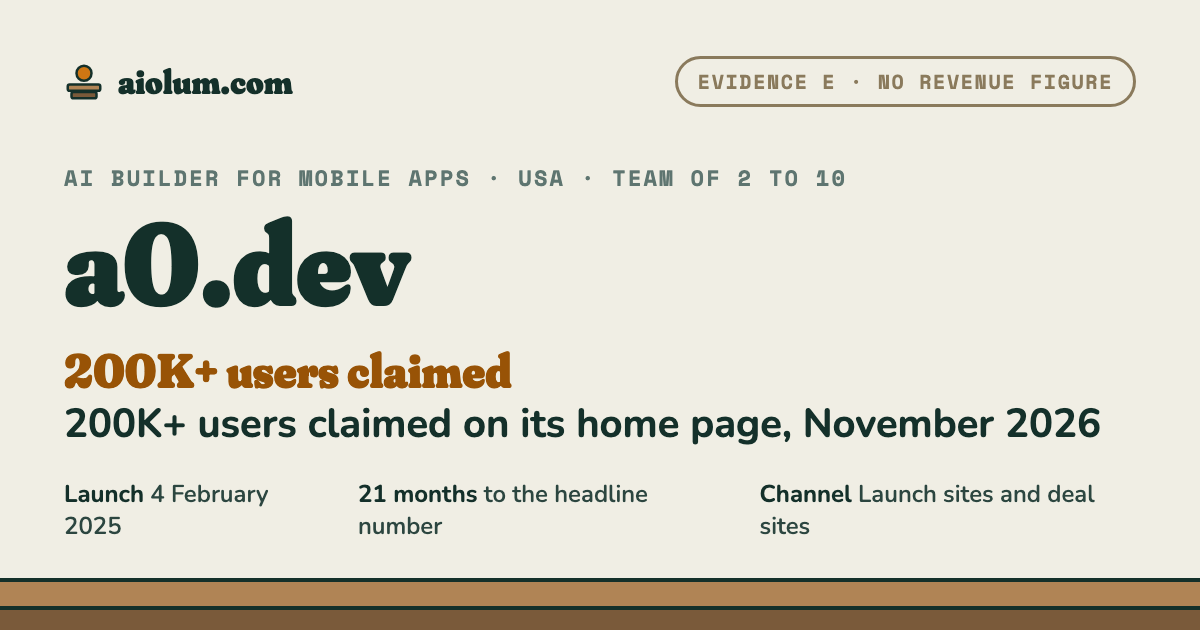
a0.dev (AI builder for mobile apps, USA): 200K+ users claimed on its home page, November 2026. Evidence grade E: no revenue figure was checked. Team: 2 co-founders; the YC directory lists a team of 3 (read November 2026), Latka counts 7 employees from LinkedIn in September 2025. Launched 4 February 2025; still running.Added 5 November 2026 · updated 8 November 2026
- Outcome
- 200K+ users claimed on its home page, November 2026
- Evidence
- E no revenue figure was checked
- Launch
- 4 February 2025
- Status
- Still running
- Team
- 2 co-founders; the YC directory lists a team of 3 (read November 2026), Latka counts 7 employees from LinkedIn in September 2025
- Outside funding
- Y Combinator, Winter 2025 batch (amount not stated in the sources)
- Main channel
- Launch sites and deal sites
What is not verified
No revenue figure was found: no figure from the company, the founders or a payment processor appears in the sources read for this page. Latka estimated about US$770,000 a year for September 2025, marked "EST", on a page that says "a0.dev has not published its revenue"; that is Latka's own estimate, not a revenue figure, so this page does not use it. The headline user count is the company's own and does not define a user: "100k+ developers" in July 2025, then "200k+" users on the home page and "130,000+ users" on a use-case page in November 2026. Latka's 7 employees also differs from the 3 on YC's page. A reader could look for a payment-processor-verified revenue profile, a founder interview with revenue, or a funding announcement after the YC batch. This story is grade E: the business is real and its product, price and customers are described from public pages, but no revenue figure was checked. Aiolum shows it as an idea worth studying, not as proof that it makes money.
a0.dev turns a written prompt into a mobile app. It generates code in React Native, a framework from Meta that builds iPhone and Android apps from one JavaScript code base, and shows the app in a live preview. With a connected Apple developer account it builds the app file, signs it and sends it to App Store Connect, Apple's website where developers submit apps for review. The pricing page lists a Pro plan at US$20 a month and a Max plan at US$200 a month.
Seth Setse (CEO) and Ayomide Omolewa (CTO) launched it on Y Combinator's launch page on 4 February 2025, in the Winter 2025 batch. In that post the founders wrote that their own earlier apps made "up to $14k MRR". In July 2025 they wrote that "100k+ developers" were using it; in November 2026 the home page says "200k+" users and "300k+" apps created.
No revenue figure was found. Latka, a database of software companies, shows only its own estimate, on a page that says the company has not published its revenue; an estimate of that kind is not a revenue figure. So this story is grade E, and its headline is the company's own user count.
How much revenue does a0.dev make?
Each row shows the evidence grade and the source numbers from the list at the end of this page. The grades are explained in How Aiolum verifies.
| Fact | Value | Grade | How we know | Sources |
|---|---|---|---|---|
| Users, November 2026 (headline) | 200,000+ users and 300,000+ apps (November 2026); 100,000+ developers (July 2025) | C | Company statements: the home page read on 5 November 2026 ("200k+ Users building apps", "300k+ Apps created on a0") and the July 2025 YC launch post ("100k+ developers"). A use-case page read the same day says "130,000+ users". The company does not define a user. | [6, 4, 8] |
| Founders | Seth Setse, Founder/CEO; Ayomide Omolewa, Founder/CTO | C | YC company page. Setse's bio: "CMU ‘23 | Serial App Developer"; Omolewa's lists Nvidia, Paramount, Google and Lockheed Martin. | [2] |
| Team size | 3 on YC; 7 on Latka (September 2025) | C | YC company page gives team_size 3, read 5 November 2026. Latka counts 7 employees from LinkedIn for September 2025. | [2, 1] |
| Funding | Y Combinator, Winter 2025 | C | YC company page and launch posts. No amount or later round is stated in the sources read. | [2, 3] |
| First launch | 4 February 2025 | C | YC launch post created 2025-02-04; Product Hunt dates its first launch 5 February 2025. | [3, 9] |
| Founders' earlier income from apps | up to US$14,000 a month | C | Founders in the February 2025 launch post: "making side income with apps generating up to $14k MRR". This is their earlier apps, not a0.dev. | [3] |
| Prices, November 2026 | US$20 to US$800 a month; Pro US$204 a year, Max US$2,040 a year | C | Plan data in the pricing page. | [7] |
| Yearly price per month | Pro US$17, Max US$170 | calc | Calculated: US$204 / 12 and US$2,040 / 12. | [7] |
| Time from launch to the user count | 21 months | calc | Calculated: February 2025 to November 2026. | [3, 6] |
| Product Hunt | 683 followers; launches on 5 February and 3 July 2025 | C | Product Hunt product page, read 5 November 2026. | [9] |
How to read this table: grade D is a third-party estimate with no second source; Latka's revenue estimate is not a revenue figure. Grade C is a statement by the company or its founders on their own pages or launch posts. A "calc" value was computed on this page.
| Plan | Per month, billed yearly (US$) | Per month, billed monthly (US$) | Limit |
|---|---|---|---|
| Pro | 17 | 20 | limit 100 |
| Pro 250 | 50 | limit 250 | |
| Pro 500 | 100 | limit 500 | |
| Pro 1000 | 200 | limit 1,000 | |
| Max | 170 | 200 | limit 1,250 |
| Pro 1500 | 290 | limit 1,500 | |
| Pro 2500 | 450 | limit 2,500 | |
| Pro 5000 | 800 | limit 5,000 |
The pricing page draws its plan cards by script; the prices here come from the plan data embedded in the downloaded page. Each plan has a daily and monthly limit number, but the page data does not say what unit it counts (likely messages or credits; not verified). Only Pro and Max have yearly prices. Prices are in US dollars.
When did a0.dev launch, and how did it grow?
From an earlier career in indie apps to an AI builder with one-click App Store upload, in under a year. Each entry carries its grade.
- Before 2025CThe founders build their own phone apps. They wrote that these made up to US$14,000 a month and, on YC, that their apps were used by hundreds of thousands of people. [3, 2]
- 4 February 2025CLaunch on YC's launch page: a full React Native app generator with live preview and a component generator described as "v0 but for React Native". [3]
- 3 July 2025C"Phase 1": fast iOS builds, one-click App Store submission, in-app payments beta, Stripe for web apps, Agent Mode, Convex and GitHub integration. The founders write "100k+ developers". [4, 5]
- September 2025DLatka, a database of software companies, counts 7 employees from LinkedIn. Its revenue number for this month is its own estimate, on a page that says the company has not published its revenue. [1]
- February 2026CA Max plan at US$200 a month is added to the plan data (created 10 February 2026). [7]
- November 2026CThe home page says 200,000+ users and 300,000+ apps, with publishing to the App Store, Google Play and the web. [6]
Why did a0.dev work?
Four causes, in the order they mattered. Each one is a reusable lesson.
Founders who already shipped apps
Both founders built and sold phone apps before a0.dev, and the launch posts describe the product as the tool they wanted for that work. Their own apps appear in the site's showcase.
Remove the iPhone build step
The February 2025 post names the problem: an iOS app needs a Mac, Xcode and Apple's provisioning profiles just to test it. a0.dev builds, signs and uploads the app for the user, so a person without a Mac can reach the App Store.
Launch posts, twice
The team used YC's launch page and Product Hunt in February 2025 and again for Phase 1 in July 2025. No source gives figures for other channels.
Usage-tier pricing
The pricing page lists eight paid tiers that differ mainly by a usage limit, from US$20 to US$800 a month, so heavy users pay more for the model work they cause.
How it was built
These details come from the company's own posts and pages, and from the page source of the pricing page. They are grade C unless noted. [3, 5, 6, 7, 10]
- The product generates React Native apps: navigation, state management and screens.
- An agent mode that reads files, searches the code and reads logs, plus a thinking mode and a faster "Turbo Model". No source read names the AI model provider behind them.
- Backends for users' apps through Convex or Supabase; Stripe for payments in users' web apps; in-app subscriptions set up in App Store Connect.
- The pricing page's plan data carries Stripe price IDs, so a0.dev's own subscriptions run through Stripe (visible in page source). The page is a Next.js app.
- A companion app, a0.dev Analytics, is on the App Store; its seller is listed as TeeHee Tech LLC.
Tools named in the sources
Each one opens its page in the Tools tab, with every story that uses it.
Who tried this before a0.dev, and why did they fail?
Four companies in our database of failed startups promised that people without programming skills could build apps or websites. The values below are from that database and are not independently verified.
Appcubator
The promiseA no-code platform to create mobile apps without programming.
Why it diedFew users became paying customers, and more flexible tools such as Bubble won.
Builder.ai
The promiseCustom apps from an AI-powered assembly line for non-technical founders.
Why it diedEach build needed much human work, so apps cost more to make than they sold for.
Crejo.Fun
The promiseDrag-and-drop mobile apps for creators and small businesses in India.
Why it diedCreators wanted more followers, not another app to manage and promote.
Sosh
The promiseA visual website builder that removes the hand-off from designer to developer.
Why it diedToo complex for beginners and too rigid for professionals.
The failed startups come from our database of 1,749 dead startups, retold here in our own words. Its entries are AI-assisted summaries of public sources, so these cards carry no evidence grade.
What changed
The predecessors had to hand-build every template or use people behind the scenes, so each new kind of app cost them work. A language model now writes the code for each request, which is why a team of a few people can serve a very large number of users.
The hard part has moved. Generating screens is now common, and many companies offer it. a0.dev puts its effort into the steps after the code: the iPhone build, Apple's signing, the store upload and in-app payments, which the founders know from their own apps.
Can one person copy a0.dev now?
Not as one person today.
Many funded companies now sell AI app builders, and running one means paying for model use and build servers for every user. What can be copied is the approach: two people who knew one painful job from their own work built the tool for that job, and launched on YC and Product Hunt.
Where it is still open: Builders for one narrow type of app (a church, a gym, a school group), where the use-case pages of a0.dev show demand but a general tool gives no special help.
- 1Pick a step in your own work that takes days and that you have done many times.
- 2Remove a whole step for the user (here, the Mac and Apple's signing), not only part of it.
- 3Price in usage tiers so heavy users pay for their model costs.
- 4Use launch pages more than once: a first launch, then a launch for each large release.
What could go wrong for a0.dev?
The risks are the mirror image of the causes above.
What is not verified
No revenue figure was found: no figure from the company, the founders or a payment processor appears in the sources read for this page. Latka estimated about US$770,000 a year for September 2025, marked "EST", on a page that says "a0.dev has not published its revenue"; that is Latka's own estimate, not a revenue figure, so this page does not use it. The headline user count is the company's own and does not define a user: "100k+ developers" in July 2025, then "200k+" users on the home page and "130,000+ users" on a use-case page in November 2026. Latka's 7 employees also differs from the 3 on YC's page. A reader could look for a payment-processor-verified revenue profile, a founder interview with revenue, or a funding announcement after the YC batch.
User counts and badges differ
The company gave "100k+ developers" in July 2025; in November 2026 the home page says "200k+" users while a use-case page says "130,000+ users" and "4.9/5 rating" without naming where the rating comes from. The App Store analytics app has too few ratings to show an overview. Two of the four quotes under "Trusted by creators" on the home page are from the founders' own X accounts.
Money-making marketing
The home page headline is "Build mobile apps. Make money." and a use-case page offers apps "designed for recurring revenue" under the title "Build a Passive Income Mobile App with AI". No page read states how much users earn.
Competition
Product Hunt lists Rork, Expo, Create, Lovable and v0 by Vercel as alternatives, and the founders wrote in July 2025 that "many competitors pop up after us, some even from YC"; app builders such as Base44 and AppAlchemy are also on this site.
Dependence on stores and model providers
The product's value is publishing to the App Store and Google Play through the user's developer account, so Apple's and Google's rules and review decide what users can ship. No source read names the AI model provider, and the model cost of every request is a0.dev's to pay inside its price tiers.
Sources
The grade next to each source is the best grade that the source can support. "Read in full" means that the text of the page was downloaded and the numbers were checked in it.
- D Latka: a0.dev revenue, estimate, September 2025Read in full. A third-party estimate, labelled as such, and an employee count from LinkedIn.
- C Y Combinator company page: a0.devRead the company data in the page: founders, titles, team size, batch, location and description.
- C YC Launches, 4 February 2025: a0.dev: Build Mobile Apps in MinutesRead in full. Founders' launch post: product, the iOS build problem and their earlier app income.
- C YC Launches, 3 July 2025: a0.dev - Phase 1: We're all gonna make apps (WAGMA)Read in full. Source for the 100k+ developers, the new features and the remark on competitors.
- C a0.dev blog, 3 July 2025: a0.dev - Phase 1 (WAGMA)Read in full. Feature list: iOS builds, App Store upload, payments, Stripe, Agent Mode, Convex, GitHub.
- C a0.dev home page, read 5 November 2026Read in full. Source for the user and app counts, features, store publishing and the quotes.
- C a0.dev pricing page, read 5 November 2026The visible page shows no prices; the plans were read from the plan data embedded in the downloaded page.
- C a0.dev use case: Build a Passive Income Mobile App with AIRead in full. Source for the 130,000+ users and 4.9/5 badges and the marketing wording.
- C Product Hunt: a0.dev product pageRead in full, including the alternatives listed in the page data. Source for launch dates and followers.
- C App Store: a0.dev AnalyticsRead in full. Source for the companion app, the seller name and the ratings status.
- C Database of failed startups, local exportLocal export. AI-written summaries, not independently verified. Source for the failed predecessors.
Run this company? Send corrections or a verified figure to aiolum@livyden.com