AgentCat: Product, team and how it was built
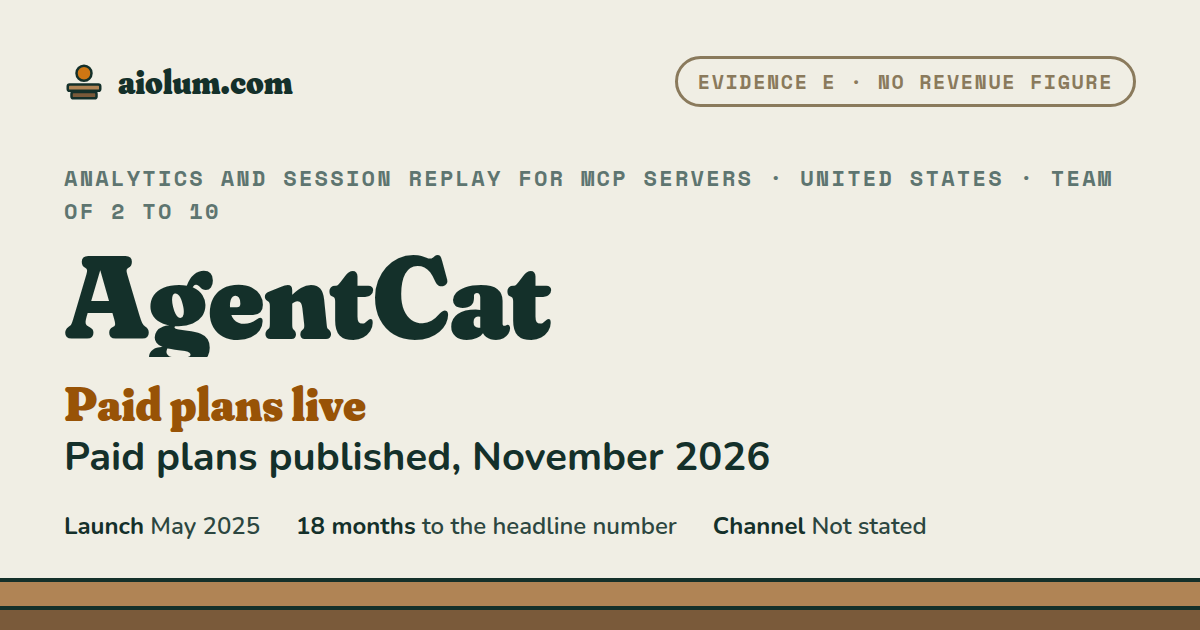
AgentCat (Analytics and session replay for MCP servers, United States): Paid plans published, November 2026. Evidence grade E: no revenue figure was checked. Team: 2 named co-founders; 5 people in the a16z speedrun listing, November 2026. Launched May 2025; still running.Added
- Outcome
- Paid plans published, November 2026
- Evidence
- E no revenue figure was checked
- Launch
- May 2025
- Status
- Still running
- Team
- 2 named co-founders; 5 people in the a16z speedrun listing, November 2026
- Outside funding
- Member of the a16z speedrun cohort SR007, a program that invests in its startups; amount not found
- Main channel
- Not stated
What is not verified
No revenue figure was found, and no source says that a named customer pays. The company names its customers itself, on its site and in one podcast where a co-founder speaks. The guest note on that podcast page calls the product "free, open-source". The host says the talk was recorded in April, and the page is dated 16 June 2026. A reader could look for a payment-processor profile or a customer's own page. This story is grade E: the business is real and its product, price and customers are described from public pages, but no revenue figure was checked. Aiolum shows it as an idea worth studying, not as proof that it makes money.
AgentCat sells observability for AI agents' use of software. Observability means recording what a system does so that its owner can find faults. An MCP server (Model Context Protocol server) is a program that exposes tools to AI agents such as Claude. AgentCat records every session, one continuous stretch of an agent using the server, and lets the owner replay it step by step.
The company was called MCPcat until 4 July 2026. Two co-founders, Kashish Hora and Naseem Alnaji, appear as authors of its blog from May 2025. The legal entity is AgentCat, Inc., a Delaware corporation based in New York City, according to its terms. The a16z speedrun site lists it in cohort SR007 with a team size of 5.
No revenue figure was found, so this story has grade E. The page that shows the company at work is its own price list: a Growth plan at US$160 a month on 11 November 2026. Who the customers are comes only from the company's own pages and from one podcast where a co-founder speaks. No source says that a named customer pays.
Why did AgentCat work?
Four causes, in the order they mattered. Each one is a reusable lesson.
It targets one new kind of software, the MCP server
Webflow, Cortex and Rootly built MCP servers so that AI agents can use their products. In the Webflow case study, the existing logs showed failed tool calls but not what agents tried to do. In the Rootly case study, the monitoring tools counted failed agent calls as successes. AgentCat records sessions and intent. That gap is the product, and it exists only for this narrow audience.
It started free with open-source code and added prices later
In June 2025 the site offered a free tier and an open-source SDK, and paid plans on request. By June 2026 it listed a per-session price, and by November 2026 a monthly Growth plan. In June 2025 the company wrote that it "will always have a generous free tier". Its pricing page also offers free plans to open-source projects that ask by email.
It sells the agent's goal, not only logs
The LLM Goals add-on groups sessions by the goal the agent seemed to have, such as building a page or migrating content. In the Webflow case study, this showed that agents designing in Webflow's canvas made up over 24% of sessions. The company published this itself.
How it was built
These details come from the company's privacy policy and terms (grade C). [11, 14, 1]
- The SDK is open source and added with one line of code after the tools are registered. The GibsonAI article shows the Python call.
- Hosting is on Amazon Web Services in the United States. The analytics database is ClickHouse Cloud on AWS.
- Language-model features, such as session goals and summaries, run on AWS Bedrock.
- Payments are processed by Stripe, and transactional email is sent with Resend.
- The marketing site uses Google Analytics and Plausible to measure visitors.
Tools named in the sources
Each one opens its page in the Tools tab, with every story that uses it.
Who tried this before AgentCat, and why did they fail?
Two companies in our database of failed startups sold analytics or intelligence from product usage and failed. The values below are from that database, read on 11 November 2026, and are not independently verified. The record pages show only the first lines of each failure text and name no founders.
Watchsend
The promiseRecordings of how users move through mobile apps, so that developers can improve the design.
Why it diedIt struggled to stand out in a crowded market of well-funded rivals such as Mixpanel and Google Analytics, according to the record.
Toplyne
The promiseUse product-usage data to predict which free users will become paying customers.
Why it diedThe record calls it a nice-to-have tool and names market timing and weak product-market fit as the cause.
The failed startups come from our database of 1,749 dead startups, retold here in our own words. Its entries are AI-assisted summaries of public sources, so these cards carry no evidence grade.
What changed
Watchsend and Toplyne both sold insight from product usage to teams that already had other tools. Watchsend met well-funded competitors, and Toplyne was judged a nice-to-have by its own record. Both sold to human users of apps.
AgentCat's bet is that the user of an MCP server is an AI agent. Tools built for human clicks do not show what an agent tried. The case studies on its own site make that argument. No outside source confirms that customers keep paying for it.
Can one person copy AgentCat now?
Maybe. The niche is clear, but the paid demand is unproven here.
A reader could copy the pattern: pick a new kind of software that has just appeared and has no tools yet. The company did so for MCP servers. Whether it earns money is not shown by any source found.
Where it is still open: Other new agent surfaces that have no analytics yet: browser agents, voice agents and agent-to-agent protocols.
- 1Choose one new platform where owners cannot see how it is used.
- 2Publish an open-source SDK and a free tier first.
- 3Add one paid plan with a clear price once developers use it.
- 4Publish case studies with named customers who say what they changed.
How much revenue does AgentCat make?
Each row shows the evidence grade and the source numbers from the list at the end of this page. The grades are explained in How Aiolum verifies.
| Fact | Value | Grade | How we know | Sources |
|---|---|---|---|---|
| Paid plan on the live pricing page, 11 November 2026 | Growth, US$160 a month | C | Pricing page of agentcat.com, read on 11 November 2026: "$160 / month", "Billed monthly · Cancel anytime". | [2] |
| Earlier price list, 10 June 2026 | US$0.02 per session after 1,000 free sessions | C | Internet Archive copy of mcpcat.io/pricing of 10 June 2026. The company then used the name MCPcat. | [9] |
| Pricing in June 2025 | free only, in a beta phase | C | Internet Archive copy of mcpcat.io/pricing of 20 June 2025: "while we're in our beta phase, please reach out to us and we'd be happy to provide pricing options". | [9] |
| Company's start | 2025, as MCPcat | C | The a16z speedrun page of the company says "Founded 2025". The earliest dated page found is a blog article of 25 May 2025 by a co-founder. No company register was read, so the legal start date is not verified. | [13, 8] |
| Earlier name | MCPcat, renamed AgentCat on 4 July 2026 | C | Blog post by Kashish Hora: "MCPcat is now AgentCat. Same team, same mission, new name." | [7] |
| Legal entity | AgentCat, Inc., a Delaware corporation based in New York City | C | The company's terms of service. | [10] |
| Billing terms | paid plans renew automatically; payments go through Stripe | C | Terms section 5 and the privacy policy. These describe how the company charges. They do not name a paying customer. | [10, 11] |
| Named customers with case studies | Webflow, Cortex and Rootly | C | Customer page of the company, each with a named person quoted. A fourth article, from GibsonAI's principal engineer, is on the company's blog. | [3, 4, 5, 6, 14] |
| A customer named on a third-party page | "Webflow is one of our customers" | C | Co-founder Naseem Al-Naji, in a podcast posted on 16 June 2026 on the MLOps Community site. The same speaker says the service logs over 100 million events a month. | [12] |
| Team size | 5 people | C | The a16z speedrun company list, cohort SR007, field team_size, read on 11 November 2026. | [13] |
| Open-source SDK | SDKs published as open source | C | Home page: "Our SDKs are open-source and available on GitHub for independent review and feedback." | [1] |
| Months from first dated page to the pricing page | 18 months | calc | Calculated: May 2025 to November 2026. | [8, 2] |
How to read this table. A grade C value is a statement on the company's own page or by its co-founder. A "calc" value was computed on this page. No value is grade A or B, and no revenue figure was found.
| Plan | Per month, billed yearly (US$) | Per month, billed monthly (US$) | Limit |
|---|---|---|---|
| Free | 0 | 0 | 500 sessions a month, 1 project, 3 teammates |
| Growth | 160 | 2,000 sessions a month, unlimited projects, 10 teammates | |
| Enterprise | custom price, annual invoice, custom session volume | ||
| LLM Goals add-on | 90 | Growth and Enterprise only; 1,000 classifications included |
Growth is billed monthly and can be cancelled at any time. Free and Growth include 500 and 2,000 sessions a month; further sessions cost US$40 per 1,000. Enterprise is billed yearly by invoice at a custom price. The LLM Goals add-on is US$90 a month with 1,000 classifications included, then US$60 per 1,000.
When did AgentCat launch, and how did it grow?
From a free beta as MCPcat in 2025 to a price list as AgentCat in 2026. The company's own pages show each step.
- 25 May 2025CFirst dated blog article on mcpcat.io, by Kashish Hora, "Co-founder of MCPcat". [8]
- 20 June 2025CThe MCPcat site offers a free tier of 1,000 sessions a month. Paid plans are only offered on request, during a beta. [8, 9]
- 4 August 2025CA principal engineer at GibsonAI describes on the company's blog how GibsonAI added the SDK to its MCP server. [14]
- 10 June 2026CThe MCPcat price list shows US$0.02 per session after 1,000 free sessions, billed automatically each month. [9]
- 4 July 2026CMCPcat is renamed AgentCat. The SDK package changes name; the old one stays working. [7]
- 11 November 2026CThe AgentCat pricing page lists Free, Growth at US$160 a month, and Enterprise. Three case studies are on its Customers page. [2, 3]
What could go wrong for AgentCat?
The risks are the mirror image of the causes above.
What is not verified
No revenue figure was found, and no source says that a named customer pays. The company names its customers itself, on its site and in one podcast where a co-founder speaks. The guest note on that podcast page calls the product "free, open-source". The host says the talk was recorded in April, and the page is dated 16 June 2026. A reader could look for a payment-processor profile or a customer's own page.
Earlier name MCPcat
The company was called MCPcat until 4 July 2026. The earliest dated page found is from 25 May 2025, and the a16z speedrun page says "Founded 2025". No company register was read, so the legal start date is not verified. The privacy page and terms name AgentCat, Inc. as a Delaware corporation.
Logo wall and trust claims
The home page says "Trusted by the fastest-growing AI companies" above five logos: Webflow, Cortex, MarcoPolo, Rootly and jsDelivr. Case studies exist for three of them. The home page also says "SOC II compliant" and "Independently audited every year". No audit report was read.
Case studies are written by the company
The customer quotes and figures, such as a 10x lower error rate at Rootly, appear only on the company's own site. A search for a distinctive sentence of each quote found no copy under another name.
Sources
The grade next to each source is the best grade that the source can support. "Read in full" means that the text of the page was downloaded and the numbers were checked in it.
- C AgentCat home pageRead in full, 11 November 2026. Source for the product, the logo wall, the SOC II claim and the open-source SDKs.
- C AgentCat pricing pageRead in full, 11 November 2026. Source for the plans and prices.
- C AgentCat customer storiesRead in full, 11 November 2026. Lists three case studies.
- C Case study: How Webflow builds its AI roadmap based on actual agent behaviorRead in full. Company-written, with a named Webflow person quoted.
- C Case study: Cortex cut QBR prep from hours to 15 minutesRead in full. Company-written, with a named Cortex person quoted.
- C Case study: Rootly cut its MCP error rate 10xRead in full. Company-written, with a named Rootly person quoted.
- C MCPcat is now AgentCat, 4 July 2026Read in full. Source for the rename and its date.
- C MCPcat home page, Internet Archive copy of 20 June 2025Read in full. Source for the earlier name, the co-founder bylines and the 2025 article dates.
- C MCPcat pricing pages, Internet Archive copies of 20 June 2025 and 10 June 2026Read in full. The 2025 copy shows a free beta; the 2026 copy shows US$0.02 per session.
- C AgentCat terms of serviceRead in full, 11 November 2026. Source for the legal entity and the billing terms.
- C AgentCat privacy policyRead in full, 11 November 2026. Source for the hosting, payment and email providers.
- C MLOps Community: MCP Servers Are Becoming the UI for AI Agents, posted 16 June 2026Read the page and transcript. A co-founder is the speaker, so this is not an independent statement of the customer relation.
- C a16z speedrun company list, cohort SR007Read the list and the company's own page at /companies/agentcat. They give cohort SR007, "Founded 2025", 5 employees and New York City. The site has no robots file.
- C How GibsonAI Boosted MCP Server Observability with AgentCat, 4 August 2025Read in full. Written by a GibsonAI engineer and published on the company's blog.
- C Database of failed startups, local exportRecord pages read on 11 November 2026. AI-written summaries, not independently verified.
Run this company? Send corrections or a verified figure to aiolum@livyden.com