Agnost AI: Revenue, team and how it was built
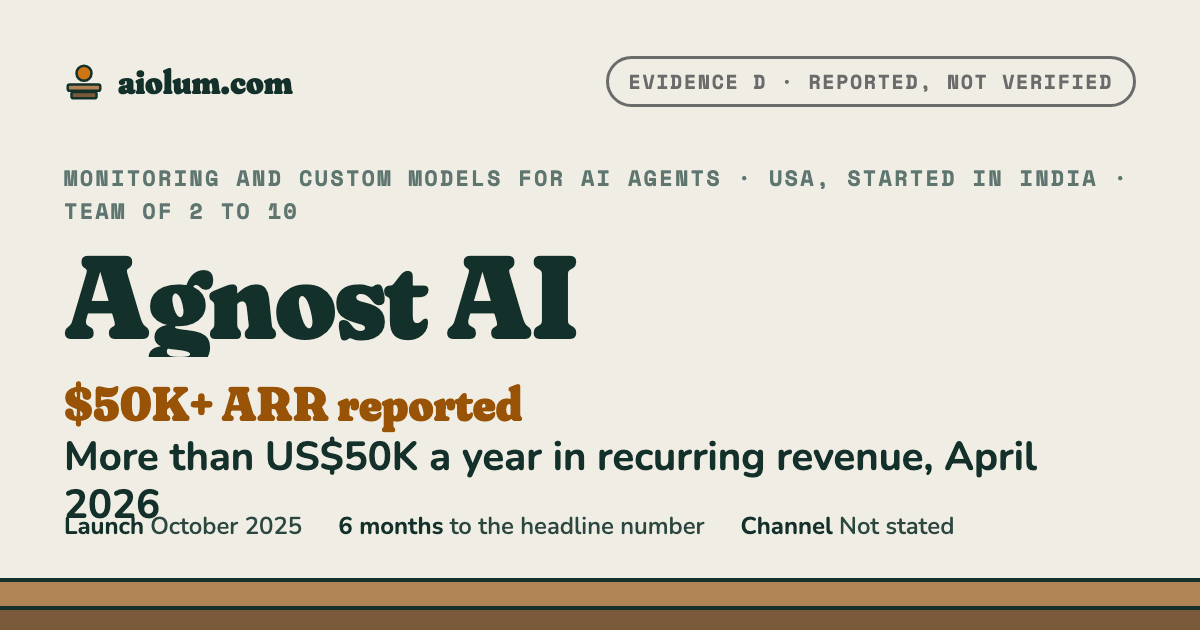
Agnost AI (Monitoring and custom models for AI agents, USA, started in India): More than US$50K a year in recurring revenue, April 2026. Evidence grade D: reported, not verified. Team: 2 co-founders; Y Combinator lists a team size of 2 in November 2026. Launched October 2025; still running, revenue growing.Added 5 November 2026 · updated 6 November 2026
- Outcome
- More than US$50K a year in recurring revenue, April 2026Revenue growing
- Evidence
- D reported, not verified
- Launch
- October 2025
- Status
- Still running
- Team
- 2 co-founders; Y Combinator lists a team size of 2 in November 2026
- Outside funding
- Entrepreneur First and Y Combinator Summer 2026; amounts not published
- Main channel
- Not stated
What is not verified
The headline, more than US$50,000 in annual recurring revenue with about 40% weekly growth by April 2026, comes from one sentence on Agent Jesse, a startup-list site, published 31 August 2026. The page says it is not Entrepreneur First itself and names no source for the figure. No founder post, payment-processor profile or press report with a revenue figure was found. A reader could look for a Y Combinator demo day report or a founder interview with a dated figure. The headline number is grade D: one claim or one estimate, with no second source. Aiolum shows it because the story is useful, and marks it so that it is not mistaken for a verified figure.
Agnost AI sells agent monitoring: software that watches an AI agent, a program that uses a language model to answer users and call tools, while real users talk to it. It reads each trace, the full record of one run with the user's message, every tool call and the final answer, and finds failures that raise no error: an answer that contradicts the tool result, a refund promised but never issued, the same search repeated three times. It then tests a suggested fix against past runs and opens a pull request, a proposed code change on GitHub that a person reviews before it is merged.
Shubham Palriwala (CEO) and Parth Ajmera (CTO) founded it in 2025; Y Combinator's page lists two people. The earliest dated public item is a blog post from 12 October 2025. Agent Jesse, a site that compiles startup lists, wrote on 31 August 2026 that "Agnost AI had crossed $50,000 in ARR and was growing approximately 40% week over week" by its April 2026 Entrepreneur First demo day in San Francisco. It joined Y Combinator's Summer 2026 batch and in August 2026 added a second product: small models trained on a customer's own traces.
The revenue figure rests on that one secondary source, grade D. Agnost, Entrepreneur First and Y Combinator have not published a revenue figure that a reader can check. The page also shows earlier monitoring companies that lost to larger platforms.
How much revenue does Agnost AI make?
Each row shows the evidence grade and the source numbers from the list at the end of this page. The grades are explained in How Aiolum verifies.
| Fact | Value | Grade | How we know | Sources |
|---|---|---|---|---|
| Annual recurring revenue, April 2026 | more than US$50,000 | D | Agent Jesse, a startup-list site run by Floworks Technologies, published 31 August 2026: "By the time of its Demo Day appearance, Agnost AI had crossed $50,000 in ARR and was growing approximately 40% week over week." It is not Entrepreneur First's own page and names no source for the figure. | [1] |
| Growth at the same date | about 40% week over week | D | Same single source and sentence. No second source gives a growth rate. | [1] |
| Team | 2 founders | C | Y Combinator company page: team size 2, year founded 2025. Both launch posts introduce "Shubham and Parth, childhood friends". | [2, 3] |
| Founded | 2025, through Entrepreneur First Bangalore | C | Year from the Y Combinator page; Bangalore from the Agent Jesse page (grade D for the place). | [1, 2] |
| Earliest dated public item | blog post of 12 October 2025 | C | "How to Improve Your MCP Server", datePublished 2025-10-12. The company's Go SDK repository on GitHub was last updated on 17 October 2025. The launch month on this page is taken from these dates; no source gives a launch day. | [7, 8] |
| Funding | Entrepreneur First, then Y Combinator Summer 2026 | C | Y Combinator page lists the batch. No source gives an amount. | [1, 2] |
| Events processed, July 2026 | more than 1 million a day | C | Founders' Y Combinator launch post, 24 July 2026: "We're already processing over 1 million events every day and growing." | [3] |
| Named customers | "teams at Google, Exa and Corgi" | C | Tagline of the July 2026 launch post. No customer statement or case study was found. | [3] |
| First custom model, August 2026 | task success 71.5% to 87.9%, median latency 4.80 s to 0.47 s | C | Founders' launch post of 20 August 2026: one model for one customer's identifier-extraction agent, tested on 780 held-out traces against Anthropic's Opus 4.8. The founders write that it is "not a claim that specialist models should replace frontier models everywhere". | [4] |
| Cost per 1,000 completed tasks in that test | US$42.00 to US$2.30, as the founders reported | C | Founders' launch post. Calculated on this page: 94.5% lower, matching their figure. | [4] |
| Prices | Free, US$49 and US$499 a month, Enterprise custom | C | Home page and llms.txt, read 5 November 2026. | [5, 6] |
| Company | Agnost Tech Inc. | C | Privacy policy, last updated 15 September 2026, and llms.txt. | [6, 10] |
| Time from first dated item to the headline figure | 6 months | calc | Calculated: October 2025 to April 2026. | [1, 7] |
How to read this table: a grade D value was reported by one source and not confirmed by anyone else. A grade C value is the company's or the founders' own statement on their pages. A "calc" value was computed on this page. No value is grade A or B.
| Plan | Per month, billed yearly (US$) | Per month, billed monthly (US$) | Limit |
|---|---|---|---|
| Free | 0 | 1,000 events a month, 7-day retention | |
| Starter | 49 | 10,000 events a month, 30-day retention, onboarding help | |
| Pro | 499 | 1,000,000 events a month, 90-day retention, founders' Slack channel | |
| Enterprise | custom | custom volume and retention, self-hosted VPC |
The plans are priced by events, one event being one recorded step of an agent, and by how long the data is kept. The page shows monthly prices only and no yearly discount. Every plan, including Free, has the full product: monitoring, failure detection, the Slack agent, the MCP server and tested fixes. Enterprise adds hosting inside the customer's own cloud network (VPC) and audit logs.
When did Agnost AI launch, and how did it grow?
From a blog about MCP servers in October 2025 to a Y Combinator company with two products, in about a year. Each entry carries its grade.
- 2025CShubham Palriwala and Parth Ajmera, friends for eight years, found Agnost AI through Entrepreneur First in Bangalore. [1, 2, 4]
- October 2025CThe company blog publishes guides on MCP servers, and a Go SDK appears on GitHub. [7, 8]
- April 2026DPitch at Entrepreneur First's San Francisco demo day. Agent Jesse later reported more than US$50,000 in annual recurring revenue and about 40% weekly growth at this point. [1]
- 24 July 2026CY Combinator launch post: product analytics for AI agents, more than 1 million events a day. [3]
- 20 August 2026CSecond launch post: custom models trained on customer traces, with a benchmark against Opus 4.8 for one customer. [4]
- November 2026CThe home page sells monitoring, tested fixes and fine-tuned models, with plans from free to US$499 a month on the pricing section. [5]
Why did Agnost AI work?
Four causes, in the order they mattered. Each one is a reusable lesson.
A failure that returns success
A model call can succeed while the agent gives a wrong answer, repeats a tool call or claims an action it never took. Ordinary error monitoring sees nothing. Agnost reads the whole conversation and checks it against rules that the customer writes in plain language, so it catches the failures that customers complain about.
From finding to pull request
The product does not stop at a dashboard. It tests a change against past runs and opens a pull request through its GitHub app, so the buyer gets a proposed fix, not only an alert. The founders describe this loop in both launch posts.
Traces as training data
Many agents use a frontier model for a narrow, repeated job. The founders' August 2026 post argues that the same traces used for debugging can train a small specialist model, and reports one customer test with a large cut in latency and cost. This turns a monitoring tool into a model-training business with the same data.
Installed by a coding agent
The home page gives one line to paste into Claude, Codex or Cursor, which installs an Agnost skill and connects the project. The developer's own AI coding tool does the integration.
How it was built
These details come from the company's own pages and the founders' launch posts. They are grade C. [3, 5, 6, 8]
- Data comes in through the Agnost SDK for Python or TypeScript, or through OpenTelemetry, the open standard for traces.
- The home page lists integrations with LangChain and LangGraph, the OpenAI Agents SDK, CrewAI, the Vercel AI SDK, Pydantic AI, Mastra, OpenAI and Anthropic.
- A hosted MCP server lets Claude and Codex read a customer's production traces; a Slack agent answers questions about them.
- A GitHub app opens the pull requests with tested fixes.
- The company publishes open code on GitHub: an Agnost skill, a Go SDK and a tool that turns repeated corrections into AGENTS.md rules.
- Enterprise customers can run it in their own cloud network with audit logs.
Who tried this before Agnost AI, and why did they fail?
Three companies in our database of failed startups sold monitoring of software that customers ran in production, and lost. The values below are from that database and are not independently verified.
Proxino
The promiseReal-time error detection for JavaScript applications.
Why it diedMany competitors sold the same error tracking, and the company had little money to keep up.
OpTier
The promiseMonitoring of business transactions across enterprise IT systems.
Why it diedAppDynamics and New Relic moved faster and fit cloud-native software better.
Verelo
The promiseUptime, malware and performance monitoring for websites.
Why it diedIt spent its money in about six months and could not convince businesses to pay for specialized monitoring.
FathomDB
The promiseManaged cloud databases with automated scaling, backups and monitoring.
Why it diedAmazon's own database service and other large clouds offered the same thing inside their platforms.
The failed startups come from our database of 1,749 dead startups, retold here in our own words. Its entries are AI-assisted summaries of public sources, so these cards carry no evidence grade.
What changed
Each of these companies monitored software that someone else ran, and each lost to a larger platform or to a crowded market. Agnost faces the same pressure: its own blog compares it with Langfuse, Arize, Braintrust, Datadog and PostHog, all of which trace AI agents.
Two things differ. First, an agent's failures are in language, not in error codes, so judging them needs a model that reads the conversation; that was not possible for Proxino or OpTier. Second, the same data can train a cheaper model for the customer, which gives the company a second product that a tracing tool does not sell. Whether that is enough against larger observability vendors is not yet known.
Can one person copy Agnost AI now?
Hard for one person.
The founders are two experienced engineers with an accelerator behind them, and the buyers are engineering teams that compare it with funded tools. The narrow idea can be copied: read the conversations of one kind of agent and sell the failures you find to the team that built it.
Where it is still open: Monitoring for one industry's agents, where the rules of a correct answer (refund policy, medical billing codes, legal deadlines) are specific and a general tool does not know them.
- 1Pick one kind of agent (support chat, voice, coding) and learn what its silent failures look like.
- 2Accept traces through OpenTelemetry so that setup takes minutes.
- 3Turn each finding into a tested change, not only a chart.
- 4Offer a free plan with the full product and charge by volume.
What could go wrong for Agnost AI?
The risks are the mirror image of the causes above.
What is not verified
The headline, more than US$50,000 in annual recurring revenue with about 40% weekly growth by April 2026, comes from one sentence on Agent Jesse, a startup-list site, published 31 August 2026. The page says it is not Entrepreneur First itself and names no source for the figure. No founder post, payment-processor profile or press report with a revenue figure was found. A reader could look for a Y Combinator demo day report or a founder interview with a dated figure.
Competition
No other story on this site sells monitoring for AI agents. The company's own comparison pages name Langfuse, Arize, Braintrust, Datadog, PostHog and Amplitude as alternatives, several of them large companies with free or open-source tiers.
Dependence on model providers
The customers' agents run on models from OpenAI, Anthropic and others, and Agnost's custom-model product is sold as a replacement for those models on narrow tasks. The sources do not say which model Agnost itself uses to judge conversations or which base model its specialist models start from. Its own benchmark compares against Anthropic's Opus 4.8.
Customer names and one benchmark
The July 2026 launch post says it works "with teams at Google, Exa and Corgi"; no statement from those companies was found. The custom-model results come from one customer and one task, as the founders themselves state.
Sensitive data
Customers send user prompts, transcripts and tool results. The privacy policy asks customers to redact secrets and personal data before sending, and the Enterprise plan can run inside the customer's own network.
Sources
The grade next to each source is the best grade that the source can support. "Read in full" means that the text of the page was downloaded and the numbers were checked in it.
- D Agent Jesse, 31 August 2026: Entrepreneur First 2026: All 21 CompaniesRead the section on Agnost AI in a copy downloaded by the pipeline on 6 November 2026 (UTC). A list compiled by Floworks Technologies, not by Entrepreneur First. Only source for the revenue and growth figures.
- C Y Combinator company page: Agnost AIRead in full, including the page data. Founder-written profile. Source for the team size, year founded, batch, founders and launch dates.
- C Y Combinator Launch, 24 July 2026: Agnost AI, Product Analytics for AI AgentsRead in full. Founders' post. Source for the events per day, the customer names and how the product works.
- C Y Combinator Launch, 20 August 2026: Agnost AI, Turn Your Agent Traces Into a Faster, Cheaper, & more Accurate Custom ModelRead in full. Founders' post. Source for the custom-model benchmark.
- C Agnost AI home page with pricing, read 5 November 2026Read in full. Source for the product description, the integrations and the prices.
- C Agnost AI llms.txt, read 5 November 2026Read in full. Confirms the prices and the company name.
- C Agnost AI blog, 12 October 2025: How to Improve Your MCP ServerRead the opening and the page data. Earliest dated public item found.
- C GitHub organization AgnostAIRead the repository list. Source for the open code and the October 2025 update date of the Go SDK.
- C Agnost AI blog index, read 5 November 2026Read the list of articles. Source for the competitors the company compares itself with.
- C Agnost AI privacy policy, last updated 15 September 2026Read the sections on the company and on customer telemetry.
- C Database of failed startups, local exportLocal export. AI-written summaries, not independently verified. Source for the failed predecessors.
Run this company? Send corrections or a verified figure to aiolum@livyden.com