Arbling: Product, team and how it was built
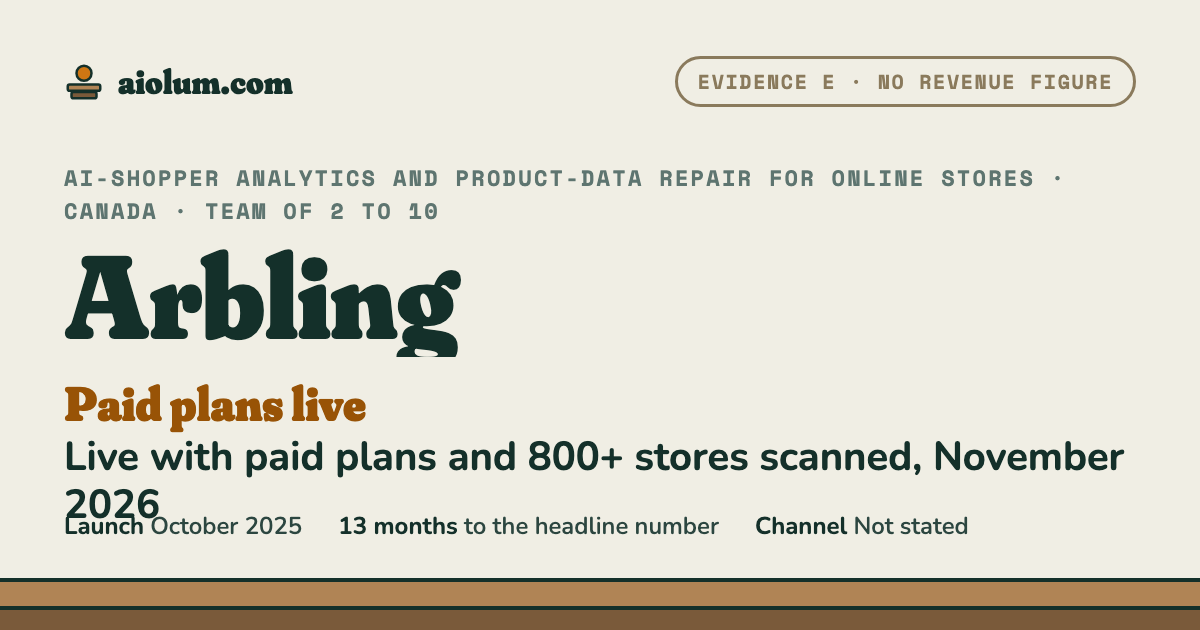
Arbling (AI-shopper analytics and product-data repair for online stores, Canada): Live with paid plans and 800+ stores scanned, November 2026. Evidence grade E: no revenue figure was checked. Team: 2 people named on the About page: the founder and a CTO, November 2026. Launched October 2025; still running.Added 5 November 2026
- Outcome
- Live with paid plans and 800+ stores scanned, November 2026
- Evidence
- E no revenue figure was checked
- Launch
- October 2025
- Status
- Still running
- Team
- 2 people named on the About page: the founder and a CTO, November 2026
- Outside funding
- The site says it is backed by IPHatch and QSTP; no amount is published
- Group
- SEO and AI search
- Main channel
- Not stated
What is not verified
No revenue figure was found. We looked for a payment-processor profile, a founder interview with figures and a company filing, and found none. The "800+ stores analysed" figure is the company's own claim and may count free scans, not paying customers. A reader could look for a Shopify App Store listing with reviews, or a later interview with the founder. This story is grade E: the business is real and its product, price and customers are described from public pages, but no revenue figure was checked. Aiolum shows it as an idea worth studying, not as proof that it makes money.
Arbling sells software that measures AI-referred traffic, meaning visitors who arrive at a store from a link inside an AI assistant's answer, and links each visit to the order that follows. It also scores how well an assistant can read each product (an "AI Readiness Score") and repairs missing product facts. Its About page says it works as a Shopify app, a WordPress plugin for WooCommerce, and through catalogue connectors for Squarespace and Wix.
Arbling Inc. of Toronto was founded in October 2025, according to its About page, which names two people: the founder Yevgeniy Makhmutov and a CTO. In November 2025 the founder pitched it at Web Summit PITCH in Lisbon as "AI-powered jewelry search and configuration". By November 2026 the home page sold four plans and said that "800+ stores" had been analysed.
No revenue figure was found, so this is a grade E story: it shows that the business is real and live, not that it makes money.
How much revenue does Arbling make?
Each row shows the evidence grade and the source numbers from the list at the end of this page. The grades are explained in How Aiolum verifies.
| Fact | Value | Grade | How we know | Sources |
|---|---|---|---|---|
| Founded | October 2025, Arbling Inc., Toronto, Ontario, Canada | C | About page: "Arbling Inc. — Toronto, Ontario, Canada. Founded October 2025." | [1] |
| Team, November 2026 | 2 named people: founder and CTO | C | About page lists "Founder Yevgeniy Makhmutov" and a CTO. The Careers page says "We are a small team in Toronto" and "There are no open roles right now." | [1, 4] |
| First pitch | AI-powered jewellery search and configuration | C | UpNext report on Web Summit PITCH 2025, 13 November 2025: "lets customers find pieces from a photo and customize them in a smooth visual interface." Out of 2,725 startups, 105 pitched on stage that week. | [3] |
| Stores analysed | 800+ | C | Company's own claim on the home page and About page, November 2026. Not checked by anyone else. | [2, 1] |
| Prices | US$259, US$669 and US$1,719 a month billed yearly; US$349, US$899 and US$2,299 billed monthly | C | Pricing page, read 5 November 2026. Enterprise on request. | [5] |
| Shopping Agent fee | 3% of the sales it helps close | C | Home page: "If we can't show the agent helped make the sale, you don't pay." | [2] |
| AI visitors recognised | 186 kinds: 28 assistants and 158 bots and agents | C | About page, November 2026. | [1] |
| Platforms | Shopify app, WooCommerce plugin, Squarespace and Wix connectors | C | About page. A Shopify App Store page at apps.shopify.com/arbling returned 404 on 5 November 2026, so the listing was not found under that name. | [1] |
| Open standards it publishes | Open Jewelry Schema 1.0 and Agent Offer Protocol draft 0.1 | C | The Open Jewelry Schema page gives release v1.0.3 of 5 October 2026 and code at github.com/yev-arbling/ojs; licences CC0 1.0 and Apache 2.0. | [6, 2] |
| Backers | IPHatch and QSTP, as named by the site | C | Home and About pages: "Backed by IPHatch QSTP". No amount, round or date is given. | [2, 1] |
| Time from founding to the November 2026 status | 13 months | calc | Calculated: October 2025 to November 2026. | [1, 2] |
How to read this table: every value comes from the company's own pages or from one event report. A grade C value is a statement by the company or a third party that nobody else has checked. A "calc" value was computed on this page. No value is grade A or B, and there is no revenue figure.
| Plan | Per month, billed yearly (US$) | Per month, billed monthly (US$) | Limit |
|---|---|---|---|
| Ready | 259 | 349 | 1 store, 1 user, up to 1,000 products |
| Growth | 669 | 899 | up to 3 stores, 10 team members, 10,000 products |
| Scale | 1,719 | 2,299 | up to 10 stores, 25 team members, 50,000 products |
| Enterprise | contact sales | unlimited stores and products | |
| Shopping Agent fee | 3% of assisted sales | only on sales the agent helps close |
The pricing page shows each plan billed yearly or monthly; yearly saves about 25%. A free scan of a store comes first. The Shopping Agent adds a fee of 3% on sales it helps close, and no fee on the rest of the store's revenue. Stores that install from the Shopify App Store pay through Shopify Billing; others pay through Stripe.
When did Arbling launch, and how did it grow?
From a jewellery search pitch to a general AI-commerce product in about a year. Each entry carries its grade.
- October 2025CArbling Inc. is founded in Toronto. [1]
- November 2025CThe founder pitches AI jewellery search and configuration at Web Summit PITCH in Lisbon. UpNext lists Arbling among the standout startups. [3]
- 5 October 2026CRelease v1.0.3 of the Open Jewelry Schema, a free data format for jewellery products that AI shopping agents can read. [6]
- November 2026CThe site sells four plans for AI-shopper tracking, product-data repair and a Shopping Agent across eleven store categories, and says 800+ stores have been analysed. [2, 1, 5]
Why did Arbling work?
Four causes, in the order they mattered. Each one is a reusable lesson.
Timing
The product follows a change in how people shop: buyers ask an AI assistant and click the store it names. The home page builds its case on that change, citing Adobe Digital Insights and Salesforce figures on AI traffic to retail sites.
Measure first, then sell the fix
A free scan shows a merchant how assistants read the store. The paid plans then track AI visitors, fix product facts and link orders back to the AI visit.
A fee tied to results
Besides the subscription, the Shopping Agent charges 3% only on sales it helps close, so part of the price follows what the merchant earns.
From one category to many
The company started with jewellery and published a jewellery data schema, then applied the same product-fact checks to ten other categories, from beauty to manufacturing.
How it was built
These details come from the company's own pages. They are grade C. [1, 2, 6]
- A self-serve web product with a free scan, a Shopify app, a WooCommerce plugin and connectors for Squarespace and Wix.
- A catalogue of 186 kinds of AI visitors, used to sort traffic into AI-referred shoppers, shopping agents and crawlers.
- Agent pages: a machine-readable page on the store's own domain with the same facts that shoppers see, with every agent fetch logged by name.
- A Copilot that answers questions about the store's AI traffic, catalogue and revenue from the store's own data.
- The Open Jewelry Schema: a JSON Schema with a Python (Pydantic v2) reference implementation, published on GitHub.
- Billing through Shopify Billing for app installs and through Stripe for direct sign-ups.
Tools named in the sources
Each one opens its page in the Tools tab, with every story that uses it.
Who tried this before Arbling, and why did they fail?
Three companies in our database of failed startups sold AI or analytics tools to retailers and failed. The values below are from that database and are not independently verified.
Vanti
The promiseAI chatbots that give shoppers a personal buying experience for brands.
Why it diedNo product-market fit in a crowded conversational-AI market; high customer acquisition cost and hard integrations.
Prayas Analytics
The promiseTurn store camera footage into shopper insights for retailers.
Why it diedSlow adoption by retailers and too little money to keep up with competitors.
Modsy
The promiseAI 3D room views that let buyers see furniture in their home before buying.
Why it diedHigh acquisition cost, few repeat buyers and expensive human design work.
The failed startups come from our database of 1,749 dead startups, retold here in our own words. Its entries are AI-assisted summaries of public sources, so these cards carry no evidence grade.
What changed
Vanti and Modsy sold AI shopping help when shoppers did not yet ask AI assistants what to buy, and each needed costly integration or human work. Arbling sells to stores whose buyers now arrive from assistants, and it installs as a store app.
The risk from Prayas Analytics remains: retailers adopt new tools slowly, and a small company has little money to wait for them.
Can one person copy Arbling now?
Yes, in part.
A small team can build tracking of AI-referred visits and checks of product data on top of store platforms' public apps. Doing it across many store categories and writing open standards takes longer.
Where it is still open: Other categories with complex product facts, such as spare parts, wine or industrial supplies, and other store platforms.
- 1Offer a free scan that shows a merchant one clear problem in their own store.
- 2Start with one category whose product facts are complex (jewellery here) and publish a data format for it.
- 3Sell through the platform's app store so billing and installation are simple.
- 4Add a fee tied to the sales your tool helps close.
What could go wrong for Arbling?
The risks are the mirror image of the causes above.
What is not verified
No revenue figure was found. We looked for a payment-processor profile, a founder interview with figures and a company filing, and found none. The "800+ stores analysed" figure is the company's own claim and may count free scans, not paying customers. A reader could look for a Shopify App Store listing with reviews, or a later interview with the founder.
Prices set for AI visitors
Where a merchant switches it on, a visitor sent by an AI assistant can see "a price made for that visit". The About page says each such price is labelled as set by an algorithm, only goes down, never goes below the merchant's floor, and that 1 in 5 AI visitors keeps the usual price as a comparison group. Laws on algorithmic or personalised pricing differ by place; the home page says each price "carries the label the law asks for, in New York, the EU and everywhere else".
Competition and model providers
Other stories on this site, such as Promptmonitor and Ecomtent, also sell tools for visibility in AI answers or better product listings. Arbling's whole market depends on assistants from OpenAI, Anthropic, Google, Perplexity and others continuing to send shoppers to stores; its pages do not say which AI models power its own Copilot or Shopping Agent.
A changed product and a side service
The November 2025 pitch was jewellery search from a photo; the November 2026 site no longer sells that. The About page also lists one-time AI-visibility and SEO audits as a service next to the software.
Sources
The grade next to each source is the best grade that the source can support. "Read in full" means that the text of the page was downloaded and the numbers were checked in it.
- C Arbling, About page, read 5 November 2026Read in full. Source for the founding date, the team, the platforms, the AI-visitor catalogue, the pricing for AI visitors and the backers.
- C Arbling, home page, read 5 November 2026Read in full. Source for the product, the 3% Shopping Agent fee, the 800+ stores claim and the billing channels.
- C UpNext (Edwin J. Frondozo), 13 November 2025: Web Summit PITCH 2025: The Finals That Point to What's UpNextRead in full. Source for the founder's jewellery-search pitch at Web Summit.
- C Arbling, Careers page, read 5 November 2026Read in full. Says the team is small and has no open roles.
- C Arbling, pricing page, read 5 November 2026Read the plan table with yearly and monthly prices.
- C Arbling, Open Jewelry Schema page, read 5 November 2026Read in full. Source for the schema version, release date, licences and repository.
- C Database of failed startups, local exportLocal export. AI-written summaries, not independently verified. Source for the failed predecessors.
Run this company? Send corrections or a verified figure to aiolum@livyden.com