DreamOffice: Revenue, team and how it was built
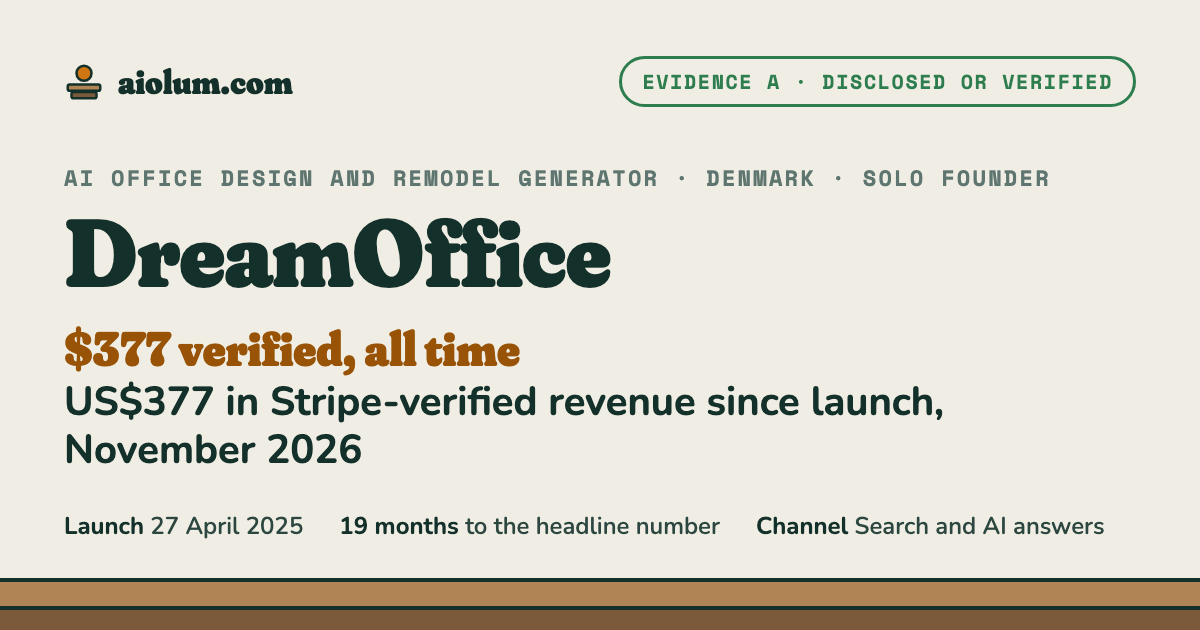
DreamOffice (AI office design and remodel generator, Denmark): US$377 in Stripe-verified revenue since launch, November 2026. Evidence grade A: disclosed by a company or a filing, or verified by a payment processor. Team: 1 person, as the founder states on TrustMRR. Launched 27 April 2025; still running, revenue falling.Added 3 November 2026
- Outcome
- US$377 in Stripe-verified revenue since launch, November 2026Revenue falling
- Evidence
- A disclosed by a company or a filing, or verified by a payment processor
- Launch
- 27 April 2025
- Status
- Still running
- Team
- 1 person, as the founder states on TrustMRR
- Outside funding
- None stated
- Main channel
- Search and AI answers
DreamOffice is an image-to-image design tool, which means the AI model starts from a picture you give it and changes it, instead of drawing a new picture from text alone. You upload a photo of your office, describe what you want in a structured brief, a form with separate fields for zones, furniture, materials and constraints instead of one free-text prompt, and the app returns photorealistic versions of the same room. It is sold to office managers, founders and small design agencies at US$29 or US$99 a month, with a free plan of 3 designs a month.
The founder is Nichlas Kvist Campos, who gives Denmark as his country, 27 April 2025 as the founding date and a team of 1 person on his TrustMRR profile. The public monthly revenue table on that profile starts in February 2026. He wrote that all sign-ups came from inbound SEO, search engine optimization that brings visitors from Google without paid ads, and that better rankings and some outreach would help. On 1 November 2026 he listed the business for sale on TrustMRR for US$2,000.
The money figures come from TrustMRR, a site that reads revenue directly from the company's Stripe account through an API key, grade A. On 3 November 2026 it showed US$377 of revenue since launch, US$29 in the last 30 days, and a monthly recurring revenue (MRR, the subscription money that comes back every month) of US$29 from 1 active subscription. In the founder-written description on the same profile he says: "Total revenue is actually $225 on 5 different customers where 2 of them are $75 each". This page shows both figures; the Stripe figure is the headline because it is the verified one.
How much revenue does DreamOffice make?
Each row shows the evidence grade and the source numbers from the list at the end of this page. The grades are explained in How Aiolum verifies.
| Fact | Value | Grade | How we know | Sources |
|---|---|---|---|---|
| Revenue since launch, as of 3 November 2026 | US$377 | A | TrustMRR, Stripe connected by API key, revenue last synced 3 November 2026. This is the headline figure. Revenue in the last 12 months is also US$377, so all of it was earned after early November 2025. | [1] |
| Founder's own total revenue figure | US$225 from 5 customers | C | Founder-written description on the same TrustMRR profile: "Total revenue is actually $225 on 5 different customers where 2 of them are $75 each". It is US$152 below the Stripe total. The profile does not explain the difference, and no date is given for the note. | [1] |
| Difference between the two figures | US$152 | calc | Calculated: US$377 minus US$225. | [1] |
| Revenue by month, February to October 2026 | US$87, then US$29 each month from March to July, US$58 in August and September, US$29 in October | A | TrustMRR monthly revenue timeline. The nine months add up to US$377, the all-time figure. No earlier month appears in the public table. | [1] |
| Revenue in the last 30 days and the last 3 months | US$29 and US$145 | A | TrustMRR, 3 November 2026. The only payment in the last 30 days was US$29 on 7 October 2026. The profile gives last-30-day revenue growth of -50%. | [1] |
| Monthly recurring revenue and subscriptions | US$29 MRR, 1 active subscription | A | TrustMRR metric snapshot. The profile also gives a profit margin of 75% for the last 30 days. | [1] |
| Sale listing | US$2,000 asking price, first listed 1 November 2026 | C | TrustMRR acquisition section: 0 offers received. The listed multiple of 5.7x matches the asking price divided by 12 months of the current MRR. | [1] |
| Asking price against revenue | about 5.3 times the all-time revenue | calc | Calculated: US$2,000 divided by US$377. | [1] |
| Founding date | 27 April 2025 | C | Founder-entered field of the TrustMRR profile. The Internet Archive holds copies of the site from 28 October 2025 that already show paid plans. | [1, 7] |
| Team | 1 person | C | Founder-entered field of the TrustMRR profile. No source names anyone else. | [1] |
| Country | Denmark | C | Founder-entered country code DK on the TrustMRR profile. | [1] |
| Customer channel | "Got all the sign-ups via inbound SEO" | C | Founder-written insight on the TrustMRR profile. The profile also says Google Search Console and Google Analytics are connected, but it shows 0 visitors in the last 30 days and an estimated user count of 0. | [1] |
| Target customers | office managers, workspace professionals and interior design agencies | C | Founder-written target persona on TrustMRR; the site's own pages describe the main user as an office manager or founder called "Cathy". | [1, 4, 5] |
| Outside funding | none stated | C | No source mentions investors. | [1] |
| Time from founding to the headline figure | 19 months | calc | Calculated: April 2025 to November 2026. | [1] |
How to read this table: grade A values come from the Stripe account through TrustMRR's verification. Grade C values are the founder's own words in the founder-written part of the TrustMRR profile, or the company's own pages. A "calc" value (grade X) was computed on this page from the rows above it.
| Plan | Per month, billed yearly (US$) | Per month, billed monthly (US$) | Limit |
|---|---|---|---|
| Free | 0 | 3 office designs a month | |
| Standard | 29 | 30 office designs a month, photo remodel, private designs | |
| Advanced | 99 | 200 office designs a month, commercial usage rights, email support | |
| Ultra (October 2025) | 199 | 500 office designs a month, branded logos, priority support |
The pricing page loads its prices by script, so the prices here come from the structured data in the home page source, which the site's own pricing summary names as the place where "Exact plan limits and prices live". No yearly price is shown. In November 2026 the Ultra plan is described as a partner tier that is "not always self-serve priced publicly"; the US$199 price is from the October 2025 copy. Payment is by card through Stripe.
When did DreamOffice launch, and how did it grow?
From a founding date in April 2025 to a US$2,000 sale listing in November 2026. Each entry carries its grade.
- 27 April 2025CFounding date of DreamOffice in the founder-written TrustMRR profile. [1]
- 28 October 2025CAn Internet Archive copy shows the site with six office styles, photo upload for remodels, and four plans: Free, Standard at US$29, Advanced at US$99 and Ultra at US$199 a month. Badges name launch directories Twelve Tools, Startup Fame and Fazier. [7]
- February 2026AThe first month in the public Stripe table: US$87. [1]
- March to October 2026ARevenue of US$29 in most months and US$58 in August and September. [1]
- 2026CThe site is rebuilt around photo remodels and a structured brief, adds four free tools, an IKEA showroom generator, and access for AI agents through a remote MCP server and markdown copies of every page. [2, 5, 6]
- 1 November 2026CListed for sale on TrustMRR for US$2,000. [1]
- 3 November 2026ATrustMRR shows US$377 since launch and US$29 MRR from 1 subscription; the founder's own note gives US$225 from 5 customers. [1]
Why did DreamOffice work?
Four causes, in the order they mattered. Each one is a reusable lesson.
Search pages
The founder wrote on TrustMRR that all sign-ups came from search. The site has pages for each office style, room type, industry and competitor comparison, a blog, and free tools such as an office space planner, each a page that can rank in Google for what an office manager types.
Remodel the real room
General image tools tend to invent a new office. DreamOffice treats an uploaded photo as the starting image and changes it, so the result shows the room that the customer actually rents. The home page says: "We remodel this room — not a generic stock office."
A brief in fixed fields
Instead of one text prompt, the customer fills in zones, furniture specifications, materials, lighting and constraints, with a chat assistant that fills the form. The output is meant to be clear enough to send to a contractor or to order furniture.
Monthly design limits
Each plan allows a fixed number of designs a month: 3 free, 30 for US$29 and 200 for US$99. Because every generated image costs the business a model call, a limit keeps each customer's cost below the plan price; TrustMRR gives a 75% profit margin for the last 30 days.
How it was built
These details come from the founder-written part of the TrustMRR profile and the company's own pages (grade C), and from the public page source of the site (grade B). [1, 2, 6, 7]
- Next.js and Tailwind CSS for the front end, and Supabase, Sentry and Stripe for the back end, in the founder's tech stack list on TrustMRR.
- Payments through Stripe, which TrustMRR reads directly; the site's FAQ says it accepts major credit cards through Stripe.
- The page source pre-connects to fal.run, the API host of the model platform fal, and to api.openai.com. No source names the image model.
- A remote MCP server, the Model Context Protocol that lets AI assistants call outside tools, runs on Railway, with tools for space planning, design briefs, inspiration and remodel previews.
- Support chat: Crisp in the October 2025 page source, Intercom in the November 2026 page source. Analytics: PostHog in the 2025 page source, and Google Analytics connected to TrustMRR.
- Every public page also exists as a markdown file, and llms.txt files describe the product for AI assistants.
Tools named in the sources
Each one opens its page in the Tools tab, with every story that uses it.
Who tried this before DreamOffice, and why did they fail?
Four companies in our database of failed startups promised professional interior design or room visualization without the cost of a designer. The values below are from that database and are not independently verified.
Modsy
The promiseUpload photos of your room and get photorealistic 3D renderings with furniture you can buy.
Why it diedCustomer acquisition was expensive, customers rarely came back, and a costly human design process sat behind the AI positioning.
Laurel & Wolf
The promiseFlat-fee online interior design by professional designers.
Why it diedFlat fees could not cover customer acquisition, and growing the designer network lowered quality.
Tastemaker
The promiseAffordable online interior design for middle-income households.
Why it diedBetter-funded competitors, inconsistent service from a distributed designer workforce, and too little cash.
Kujiale
The promiseDrag-and-drop 3D design of your own home, then buy the furniture you placed.
Why it diedIts customers wanted experts to design for them, not tools to design themselves, and AI made its technology outdated.
The failed startups come from our database of 1,749 dead startups, retold here in our own words. Its entries are AI-assisted summaries of public sources, so these cards carry no evidence grade.
What changed
Modsy, Laurel & Wolf and Tastemaker sold cheaper interior design, but behind the website each order still needed a human designer or a hand-built 3D model. That labour cost kept every order expensive, and the database records unit economics or competition as the cause of each failure. Today, hosted image models can repaint a photo of a real room in seconds for the price of one model call, so one person can offer a remodel at US$29 a month without designers.
The cheaper cost does not solve the other problem that these companies had: finding customers. Office remodels are rare purchases, and Kujiale's history suggests that many customers want an expert, not a tool. DreamOffice's Stripe data shows the result for a one-person tool with search traffic and no paid ads: a few customers and US$29 to US$58 a month in 2026.
Can one person copy DreamOffice now?
Cheap to copy; customers are the hard part.
One developer can build the same thing with a hosted image model, a form-based brief and Stripe. The verified revenue shows what is hard: an office remodel is a rare need, so a monthly subscription loses customers after one project, and search traffic alone brought only a handful of payers in about a year.
Where it is still open: Other rare, high-value room jobs where the buyer is a business: retail shop fit-outs, clinic waiting rooms, restaurant layouts, coworking spaces that stage empty units for prospects.
- 1Pick a room type that a general image tool handles badly, and keep the customer's real photo as the starting image.
- 2Ask for the brief in fixed fields, so the output can go to a contractor.
- 3Build search pages for styles, room types and free planning tools, as DreamOffice did.
- 4Consider one-time project prices, since a remodel is a single job, and connect Stripe to a public verification site so buyers can trust the numbers.
What could go wrong for DreamOffice?
The risks are the mirror image of the causes above.
Two revenue figures that do not match
Stripe, through TrustMRR, shows US$377 since launch. The founder's own description on the same profile says "Total revenue is actually $225 on 5 different customers where 2 of them are $75 each". The profile does not explain the US$152 difference; it could come from refunds, test payments or payments that are not product sales, but no source says which. The US$75 payments do not match any price on the current site.
Very small, falling, and for sale
October 2026 brought one payment of US$29, half of August and September. MRR is US$29 from 1 subscription. TrustMRR shows 0 visitors in the last 30 days and an estimated user count of 0, although Google Analytics is connected. The founder listed the business for US$2,000 on 1 November 2026; a buyer would take over a product, a domain and the search pages, not a stream of revenue.
An old claim about the model
The October 2025 home page said "Our AI model is trained on thousands of premium office designs". No source shows such training, and the page source points to hosted model APIs. The November 2026 pages no longer make the claim, and the site's notes for AI assistants say not to invent review scores or customer counts. The site shows no testimonials and no user counts.
IKEA products in a free tool
A free tool generates showroom offices with "real IKEA product matching" and uses the IKEA name in its title. No source says that IKEA takes part or approves it.
Sources
The grade next to each source is the best grade that the source can support. "Read in full" means that the text of the page was downloaded and the numbers were checked in it.
- A TrustMRR: DreamOffice, Stripe-verified profile (revenue synced 3 November 2026)Read the markdown profile on 3 November 2026 (two downloads the same day, same figures). Revenue, monthly timeline, MRR and subscriptions are from the Verification Sources section (Stripe, API key), grade A; the description with the US$225 note, founding date, country, team size, insights, tech stack and sale listing are founder-written, grade C.
- C DreamOffice home page, read 3 November 2026Read in full, including the page source for the SoftwareApplication price data and the pre-connected service hosts.
- C DreamOffice pricing summary in markdown, read 3 November 2026Read in full. The HTML pricing page loads its prices by script; this markdown copy names the plans and points to the home page data for exact prices.
- C DreamOffice About page, read 3 November 2026Read in full. Source for the mission and the target user.
- C DreamOffice agent product brief, llms-full.txt, read 3 November 2026Read in full. Source for the product flow, the free tools, the remote MCP server and the Stripe billing statement.
- C DreamOffice llms.txt link map, read 3 November 2026Read in full. Source for the free tools and the MCP server host on Railway.
- C Internet Archive copy of the DreamOffice home page, 28 October 2025Read in full, including the page source. Source for the 2025 plans and prices, the launch-directory badges, the training claim and the 2025 support and analytics scripts.
- C Database of failed startups, local exportLocal export. AI-written summaries, not independently verified. Source for the failed predecessors.