Bankstatemently: Revenue, team and how it was built
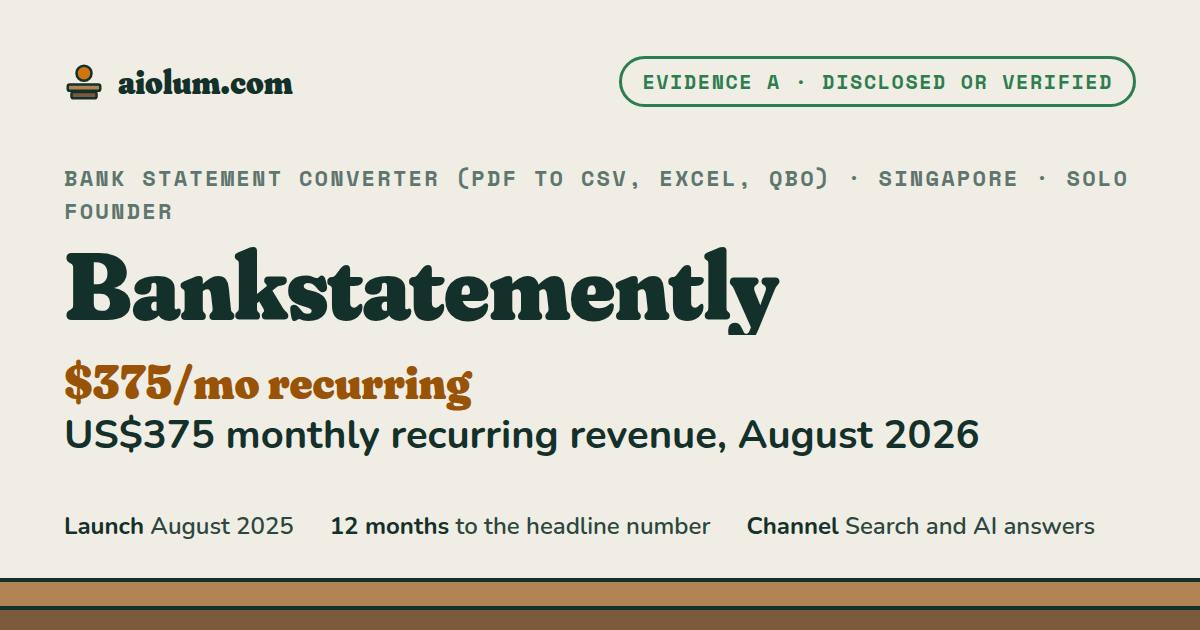
Bankstatemently (Bank statement converter (PDF to CSV, Excel, QBO), Singapore): US$375 monthly recurring revenue, August 2026. Evidence grade A: disclosed by a company or a filing, or verified by a payment processor. Team: 1 founder, who calls himself a solopreneur on the About page. Launched August 2025; still running, revenue growing.Added
- Outcome
- US$375 monthly recurring revenue, August 2026Revenue growing
- Evidence
- A disclosed by a company or a filing, or verified by a payment processor
- Launch
- August 2025
- Status
- Still running
- Team
- 1 founder, who calls himself a solopreneur on the About page
- Outside funding
- None found in any source
- Main channel
- Search and AI answers
Bankstatemently is a bank statement converter. It reads the table inside a statement PDF. It writes the rows in a form that a spreadsheet or accounting program can import. The founder is Michael Duyvesteijn, who describes himself on the About page as a solopreneur based in Singapore. He wrote on 25 January 2026 that it had been "a good 5 months" since he started working on financial document processing. The product combines a rule-based parser with a large language model (a program that predicts text and can read documents), according to the About page.
The first sale came in January 2026. The payment processor Stripe records US$25 for that month. TrustMRR is a site that reads revenue from payment processors. It reports US$458 for July 2026 and US$1,420 in total. At its last data sync on 4 August 2026 it reports a monthly recurring revenue of US$375 from 14 active subscriptions. The founder wrote on 8 March 2026 that revenue was flat at that time.
The headline figure is grade A because TrustMRR reads it from Stripe through an API key. That key expired on 5 August 2026, so no figure after 4 August is verified. The home page counters, such as "4.1 from 111 user ratings" and "99.9% accuracy", are the company's own statements and are noted under "What to watch".
Why did Bankstatemently work?
Four causes, in the order they mattered. Each one is a reusable lesson.
A plain converter let one founder see many statements
The founder wrote on 8 March 2026 that he first positioned the product simply as a way to convert a statement PDF to CSV. In his words, this was to build muscle: to see many statements and improve the product. He then moved toward jobs such as lending checks, accounting imports and fraud signals.
Bank pages brought almost all of the clicks
On 8 March 2026 the founder wrote that the PDF-to-Excel space is crowded and that he was building bank-specific pages for the long tail. He wrote that almost all clicks came through them. The same letter reports that Bing traffic fell on 17 February. He names two causes: 308 redirects used instead of 301, and pages for banks not yet processed.
A free tier and a small pack lower the first purchase
The free plan gives 10 pages a month with no credit card, and a credit pack of 50 pages costs US$7.50. The company says free credits resume after a pack expires. The founder wrote that the first two monthly subscribers seemed to be small businesses with several accounts.
The founder answered the trust question with a public benchmark
The founder released the first 5 of 15 planned synthetic statements with a free scoring API. The benchmark page gives 15 March 2026 as its date, and his letter about it is dated 18 March. He wrote in that letter that he built the evaluation system before the product features. On 8 March he wrote that he was not adding fake trust signals. The company also offers an API and a Claude Code plugin, which fits the B2B evaluation he described that day.
How it was built
These details come from the company's About page, privacy policy and the founder's letters. They are grade C. [3, 4, 5, 8, 2, 10, 15]
- A dual engine: rule-based parsing for determinism, and parsing with a large language model for flexibility. The About page says the two reinforce each other.
- The privacy policy lists Anthropic, OpenAI and open-source models for document processing. It names Supabase for the database, Vercel and Fly.io for hosting, Clerk for sign-in and Stripe for payments.
- The founder wrote on 25 January 2026 that he bought a Claude Code Max subscription. He used it with Opus 4.5 to build, including the bank pages for search.
- A new language needed little work. On 8 February 2026 he wrote that adding a banking dictionary let the tool read a Canadian French statement 15 minutes later.
- Outputs: CSV, Excel, QBO, Xero and JSON, an API, an MCP server and a Claude Code plugin. The company has published an open benchmark on GitHub.
Tools named in the sources
Each one opens its page in the Tools tab, with every story that uses it.
Who tried this before Bankstatemently, and why did they fail?
Three companies in our database of failed startups tried to automate financial paperwork or spreadsheets. The values below are from that database, read on 12 November 2026, and are not independently verified.
Lendsnap
The promiseCollect borrowers' financial documents for a mortgage application automatically, by connecting to financial institutions.
Why it diedThe record says larger mortgage platforms such as Blend and Roostify offered end-to-end products, and a narrow focus on document automation was not enough.
Sway Finance
The promiseAn AI platform for expense tracking, budgeting and forecasting for small businesses.
Why it diedThe record says it could not stand out against QuickBooks and Xero, relied on paid advertising and did not raise a later round.
DataNitro
The promiseRun Python scripts inside Excel, to move spreadsheet work to code.
Why it diedThe record says it depended on Excel, and Microsoft later built Python into Excel itself.
The failed startups come from our database of 1,749 dead startups, retold here in our own words. Its entries are AI-assisted summaries of public sources, so these cards carry no evidence grade.
What changed
All three built a narrow tool on top of another company's product or against bigger suites. The records say that Blend, Roostify, QuickBooks, Xero and Microsoft covered the same job later or better. Bankstatemently has the same exposure: the founder wrote that any vision-language model can now turn a PDF into a CSV.
The difference is the cost of the work. One person built and runs it, with AI coding tools, and the model providers do the reading. The founder says his answer is accuracy, auditability and repeatability, because a small error in financial data is costly. That is his claim; the sources do not test it.
Can one person copy Bankstatemently now?
Yes for the method, with small expectations.
A narrow converter for one document type can reach paying customers within five months of the start, with one person. The verified revenue is small: US$375 a month at the last sync. The steps below are the ones the founder's letters describe.
Where it is still open: Other documents that arrive as PDFs and need structured rows: payslips, utility bills, tax forms, shipping documents and insurance statements.
- 1Pick one document type that people struggle to copy out of a PDF, and ship a free version first.
- 2Write a page for each bank or form, and publish only for the ones you have processed, as the Bing fall of February 2026 shows.
- 3Offer a free tier, a small one-time pack and monthly plans.
- 4Publish how you measure accuracy, and add an API for customers who want to automate.
How much revenue does Bankstatemently make?
Each row shows the evidence grade and the source numbers from the list at the end of this page. The grades are explained in How Aiolum verifies.
| Fact | Value | Grade | How we know | Sources |
|---|---|---|---|---|
| Monthly recurring revenue, 4 August 2026 | US$375 | A | TrustMRR profile, read from Stripe. Last data sync 4 August 2026. The Stripe key expired on 5 August 2026. | [1] |
| Run rate from that MRR | US$4,500 a year | calc | Calculated: US$375 times 12. | [1] |
| Active subscriptions, 4 August 2026 | 14 | A | TrustMRR profile. The average is about US$26.79 a subscription a month. | [1] |
| Verified revenue in total | US$1,420 | A | TrustMRR profile, all time to 4 August 2026. The monthly rows add up to US$1,421, a rounding difference. | [1] |
| Verified revenue, last 30 days to 4 August 2026 | US$433 | A | TrustMRR profile, shown as 3.4% lower than the 30 days before. | [1] |
| Verified revenue by month, 2026 | January 25, February 70, March 25, April 120, May 245, June 388, July 458, August 90 (to the 4th), all in US dollars | A | TrustMRR monthly timeline, read from Stripe. | [1] |
| First revenue | January 2026 | A | TrustMRR shows US$25 for January. The founder's letter of 25 January 2026 says he made his first revenue that week. | [1, 4] |
| Start of the work | about August 2025 | calc | Calculated: the founder wrote on 25 January 2026 that it had been "a good 5 months" since he started. TrustMRR gives 29 September 2025 as the founded date. | [1, 4] |
| Company | Uncommon Goods Lab Pte. Ltd., UEN 202509282G | C | Footer of the company's pages. No earlier name or earlier product of the same company was found on its pages. | [2, 7] |
| First two paid monthly subscribers | week of 8 February 2026 | C | Founder's letter of 8 February 2026. He wrote that both seemed to be small businesses with several accounts at several banks. | [5] |
| Weekly visitors, 28 February 2026 | close to 200, in more than 10 countries | C | Company update post of 28 February 2026. | [12] |
| Banks supported | 400 banks in 46 countries or regions, 15 languages | C | Home page counters, the company's own statement. | [2] |
| Rating counter on the home page | 4.1 from 111 user ratings | C | The privacy policy says a rating is a 1 to 5 star rating of a conversion or of the service. It does not count customers. | [2, 8] |
| Prices | free 10 pages a month; credit pack US$7.50; Beginner US$30 and Pro US$70 a month | C | Pricing page structured data, November 2026. | [7] |
| Audience on the website | accountants, lawyers, lenders, compliance staff and small business owners | C | Home page use cases. The terms require users to be at least 18 years old. | [2, 11] |
| Time from start to the headline figure | 12 months | calc | Calculated: August 2025 to August 2026. | [1, 4] |
How to read this table. Grade A is a figure that TrustMRR reads from the company's Stripe account. Grade C is a statement by the founder or the company on its own pages. A "calc" value was computed on this page from the rows above it.
| Plan | Per month, billed yearly (US$) | Per month, billed monthly (US$) | Limit |
|---|---|---|---|
| Free | 0 | 10 pages a month, 5 pages a day | |
| Credit pack, one-time | 7.50 one-time | 50 pages, valid 30 days | |
| Beginner | 30 | 400 pages a month, 20 pages per upload | |
| Pro | 70 | 1,000 pages a month, 50 pages per upload; the July 2026 post says US$50 a month | |
| Enterprise | custom | from 5,000 pages a month, with API access |
The pricing page draws its price tags by script, so the monthly prices come from its structured data. The yearly price was not readable. The July 2026 update post calls the Pro plan US$50 a month, and TrustMRR lists subscriptions from US$25 a month. Page limits are per month. The credit pack is valid for 30 days.
When did Bankstatemently launch, and how did it grow?
From a first sale in January 2026 to US$458 in a month by July 2026. Each entry carries its grade.
- About August 2025CThe founder starts working on financial document processing. He wrote five months later that it had been "a good 5 months". [4]
- 29 September 2025CTrustMRR gives this as the founded date of Bankstatemently. [1]
- January 2026AFirst revenue: US$25 in the month. The founder calls it a sweet moment in his letter of 25 January. [1, 4]
- 8 February 2026CThe first two paid monthly subscribers arrive. Both push the system to its limits. [5]
- 17 February 2026CTraffic from Bing falls overnight after a page restructuring. The founder names two causes in his letter of 8 March. [6]
- 8 March 2026CA B2B customer is evaluating the product. An API is shipped on the day it was asked for. The founder writes that revenue is flat. [6]
- 15 March 2026CThe company publishes an open benchmark with the first 5 of 15 planned synthetic bank statements. The founder's letter about it is dated 18 March. [10, 15]
- June 2026CThe company introduces the Bankstatemently Workspace: bulk upload and a search of past conversions. [13]
- 8 July 2026CUpdate 4: several statements in one PDF, scanned checks, files up to 50 pages and a plugin for Claude Code. [9]
- July 2026AUS$458 of verified revenue in the month, the highest so far. [1]
- 4 August 2026ALast TrustMRR sync: US$375 monthly recurring revenue and 14 active subscriptions. The Stripe key expires the next day. [1]
What could go wrong for Bankstatemently?
The risks are the mirror image of the causes above.
Verified figures end on 4 August 2026
The Stripe key that TrustMRR uses expired on 5 August 2026, so every figure stops on 4 August. The live profile read on 12 November 2026 shows US$0 for the last 24 hours and the last 3 months. No source says whether sales continued, so the trend is from March to July 2026 only.
The rating counter counts ratings, not customers
The home page shows "4.1 from 111 user ratings", and TrustMRR shows 14 active subscriptions. The privacy policy says a rating is a 1 to 5 star rating of a conversion or of the service. It does not say that only subscribers rate. The rating form at /rate is disallowed for AI crawlers in robots.txt and was not read.
Home page testimonials are first names only
Three testimonials carry a first name and a country (Larissa, Canada; Kathleen, United States) or only "A customer", with no photo. They were found only on the home page among the pages read. No web search was possible, so they were not checked elsewhere. The founder wrote on 8 March 2026 that he was not adding fake trust signals.
Accuracy figures come from the company's own benchmark
The home page says "99.9% accuracy, verified across 81 banks". The benchmark page lists the company as the benchmark author. It lists 15 synthetic statements that the company made: 5 can be downloaded and 10 are marked "Coming soon". The company's score of 99.9% there covers those 5 statements. The comparison with Claude Sonnet 4 and ChatGPT 5 on the home page uses one DBS statement of 5 pages.
Other home page labels are the company's own statements
The home page shows a "GDPR compliant" label, "400+ banks supported" and "15 languages". No independent source confirms them.
The company markets the tool to lenders
Lending is a regulated activity, and the company sells to it as one use. Its loan underwriting page says the tool helps to "verify borrower income" and "make faster credit decisions". The same page quotes an unnamed "earned wage access fintech", and no source names that company.
Sources
The grade next to each source is the best grade that the source can support. "Read in full" means that the text of the page was downloaded and the numbers were checked in it.
- A TrustMRR profile: Bankstatemently (markdown)Read the markdown profile on 12 November 2026. Revenue, MRR and subscriptions are read from Stripe by API key. The founded date and the description are founder-written.
- C Bankstatemently home pageRead in full on 12 November 2026, with the structured data. Source for the counters, the testimonials, the footer and the product claims.
- C About Bankstatemently, by Michael DuyvesteijnRead in full on 12 November 2026. The founder's own account of the team and the dual parsing engine.
- C Founder's letter #1, 25 January 2026: This week I made my first revenueRead in full on 12 November 2026. Source for the start, the first revenue and the tools used to build.
- C Founder's letter #2, 8 February 2026: Momentum is growingRead in full on 12 November 2026. Source for the first two monthly subscribers and the French language test.
- C Founder's letter #4, 8 March 2026: Revenue is flat, but we're getting betterRead in full on 12 November 2026. Source for the positioning, the bank pages, the Bing fall and the B2B evaluation.
- C Bankstatemently pricing pageRead on 12 November 2026. The price tags load by script, so the prices come from the structured data and the plan limits from the page text.
- C Bankstatemently privacy policyRead in full on 12 November 2026. Source for the providers, the meaning of a rating and the processing of documents.
- C The Statement #4, 8 July 2026: Longer statements, scanned checks, and a Claude Code pluginRead in full on 12 November 2026. Source for the 50-page limit and the Pro plan price of US$50 a month.
- C Bank Statement Parsing BenchmarkRead the top section and the statement list on 12 November 2026. Source for the publication date, the 5 released and 10 planned statements, and the leaderboard.
- C Bankstatemently terms of serviceRead in full on 12 November 2026. Source for the age limit of 18 and the refund terms.
- C The Statement #1, 28 February 2026: Your very first statement from usRead the opening on 12 November 2026. Source for the weekly visitors.
- C Bankstatemently blog indexRead in full on 12 November 2026. Source for the dates of the letters and of the Workspace update in June 2026.
- C Database of failed startups, local exportRecord pages read on the website on 12 November 2026. AI-written summaries, not independently verified. Source for the failed predecessors.
- C Founder's letter #5, 18 March 2026: Bankstatemently Open Benchmark for Bank Statement ParsingRead in full on 12 November 2026. Source for the first 5 released statements and for the evaluation system built first.
- C Bankstatemently use case page: loan underwritingRead the top half on 12 November 2026. Source for the marketing to lenders and the unnamed quotations.
Run this company? Send corrections or a verified figure to aiolum@livyden.com