Mycroft: Revenue, team and how it was built
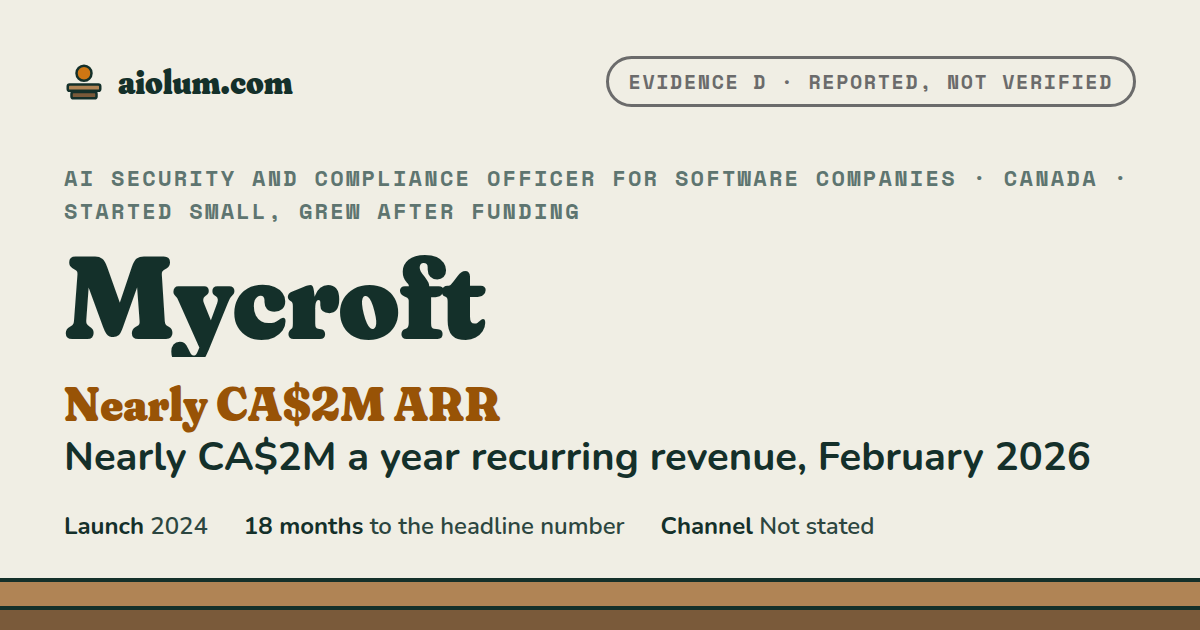
Mycroft (AI security and compliance officer for software companies, Canada): Nearly CA$2M a year recurring revenue, February 2026. Evidence grade D: reported, not verified. Team: 3 co-founders in 2024; 10 people before the seed round of June 2025, 15 by September 2025, about 20 in February 2026. Launched 2024; still running.Added
- Outcome
- Nearly CA$2M a year recurring revenue, February 2026
- Evidence
- D reported, not verified
- Launch
- 2024
- Status
- Still running
- Team
- 3 co-founders in 2024; 10 people before the seed round of June 2025, 15 by September 2025, about 20 in February 2026
- Outside funding
- US$1.2M pre-seed (September 2024) and US$3.5M seed (June 2025)
- Main channel
- Not stated
What is not verified
The recurring-revenue figure rests on one sponsored BetaKit article of 19 February 2026, which states it without naming a speaker. No payment-processor profile, filing or second article confirms it. A reader could look for a statement by the company or a later press interview. The customer count of more than 100 and the headcount of about 20 rest on the same article. The headline number is grade D: one claim or one estimate, with no second source. Aiolum shows it because the story is useful, and marks it so that it is not mistaken for a verified figure.
Mycroft sells GRC software, short for governance, risk and compliance: tools that collect evidence that a company follows security rules. Customers use it to pass audits such as SOC 2, a security report that an outside auditor writes about a software company. Mycroft calls its agentic AI, software that takes several steps on its own, a "security and compliance officer". Higher plans add penetration testing and a dedicated security expert.
Mike Kim, Jonathan Mendes and Jan Jedrasik founded the company in Toronto in 2024, BetaKit reported on 22 September 2025. The earliest copy of the company website in the Internet Archive is from 28 August 2024. BetaKit reported a US$1.2 million pre-seed round from September 2024 and a US$3.5 million seed round from June 2025. It reported 10 staff before the seed round and 15 after it. On 19 February 2026 BetaKit reported about 20 employees and more than 100 customers.
The headline figure is a statement in a BetaKit article of 19 February 2026, labelled sponsored: annual recurring revenue "nearing $2 million CAD". The article does not name who gave the figure, and no payment-processor profile or filing confirms it. It is grade D. The company publishes no prices, so this page cannot check the figure against a price list.
Why did Mycroft work?
Four causes, in the order they mattered. Each one is a reusable lesson.
The chief executive had done security and compliance work for a decade
BetaKit reported that Kim worked in security and compliance for more than a decade at KPMG, EY, FreshBooks and PartnerStack. Mendes co-founded PartnerStack and Jedrasik was Kim's first hire there. Kim told BetaKit that Mycroft is the product the team "wish we had" earlier.
One platform replaces several separate tools, the company says
The company says its platform combines audit evidence, cloud monitoring, device management, vendor risk checks and penetration testing. The pricing page lists them in the plans. This is the company's description. No customer or press source measured the saving.
Human experts sit behind the AI on the higher plans
The Scale and Managed plans add a customer success manager or a dedicated chief information security officer. The company's case studies say that its experts guided customers through the audit. The AI agent is therefore one part of a service that also uses people.
Customers get an audit report faster, according to the company
The company's case studies say that Weave finished SOC 2 Type 1 in under 30 days. They say Unified finished SOC 2 Type 2 in 6 weeks. These are company-published stories with customer quotations. They are not independent audits of the claim.
How it was built
These details come from the company's own pages. They are grade C and no outside party has checked them. [14, 3, 5]
- The AI features run on Google Gemini models served through Google Cloud, according to the company's AI disclosure.
- The company says its AI features write, summarise and sort text, and that they do not decide whether a customer is compliant.
- The company blog says the platform connects to more than 250 tools to gather evidence.
- The company says its no-code AI agents act on events, for example locking a stolen laptop.
- The AI disclosure says the company runs an AI management system under ISO/IEC 42001:2023.
- A Risk Operations Center of security experts watches customer environments, according to the pricing page.
Tools named in the sources
Each one opens its page in the Tools tab, with every story that uses it.
Who tried this before Mycroft, and why did they fail?
Three records in our database of failed startups are the closest matches that a search found. Each is a security, networking or compliance-infrastructure company. None sold audit-readiness software, so the match is loose. The values below are from that database and are not independently verified.
Toopher
The promiseTwo-factor login for enterprises that checks the user's physical location.
Why it diedThe record says Salesforce bought it in 2015 and later discontinued the technology. It cites a failure to gain enough market.
Ionx Networks
The promiseEnterprise network infrastructure for companies moving to the cloud.
Why it diedThe record says it died of "competitive asphyxiation" in a market that consolidated faster than it could build defences.
Railsr
The promiseBanking-as-a-service interfaces with compliance infrastructure for fintechs.
Why it diedThe record calls it an operational failure in a regulated industry.
The failed startups come from our database of 1,749 dead startups, retold here in our own words. Its entries are AI-assisted summaries of public sources, so these cards carry no evidence grade.
What changed
The three records sold security, networking or regulated banking infrastructure to other companies. The records describe markets with larger rivals or heavy rules. The records give competition, a failed market fit and operations as causes. Mycroft sells into the same kind of market.
Three things differ in the sources. Mycroft sells to software companies that need audit reports to close sales, according to its case studies. BetaKit reports a team of about 20 and US$4.7 million of funding. The company also adds human experts to the software, which is how the company describes the higher plans.
Can one person copy Mycroft now?
Not as a solo project. The idea is open; the audit work is not.
A solo founder cannot copy the full product, because the sources describe a funded team of about 20 with security experts on staff. A narrower piece is open: one audit framework for one kind of customer. The founders' own route started from a decade of security and compliance jobs.
Where it is still open: A single framework for a single industry that the large platforms serve poorly, such as a country's own privacy law or a government supplier standard.
- 1Pick one framework, such as SOC 2, and one customer type, such as software start-ups.
- 2Use a public model API for drafting policies and sorting evidence, and keep a person responsible for each audit.
- 3Name customers and publish their results with their permission, as the company does with its case studies.
- 4Check whether a price page or a demo call fits the buyers, since the company publishes no prices.
How much revenue does Mycroft make?
Each row shows the evidence grade and the source numbers from the list at the end of this page. The grades are explained in How Aiolum verifies.
| Fact | Value | Grade | How we know | Sources |
|---|---|---|---|---|
| Annual recurring revenue, February 2026 | nearing CA$2 million | D | BetaKit sponsored article, 19 February 2026: "annual recurring revenue nearing $2 million CAD". The article names no speaker for the figure. | [1] |
| The same figure in US dollars | about US$1.46 million, an upper bound | calc | Calculated: CA$2,000,000 divided by 1.3701 Canadian dollars per US dollar, the Federal Reserve H.10 rate of 19 February 2026. The article says "nearing", so the true figure is lower. | [1, 15] |
| Customers, February 2026 | more than 100 | D | BetaKit, 19 February 2026. No customer list is given for this count. | [1] |
| Customers, September 2025 | more than 50 in six months | C | The company blog by Mike Kim and BetaKit both give it on 22 September 2025. BetaKit names Superwhisper, CoVet, Unified.to, Willful, Wisedocs and Weave. | [2, 3] |
| Team, February 2026 | about 20 employees | D | BetaKit, 19 February 2026, as "roughly 20 employees". | [1] |
| Team, September 2025 | 10 people, then 15 after the seed round | C | BetaKit, 22 September 2025: the seed money "expanded its 10-person team to 15", with five more planned. | [2] |
| Founders | three: a chief executive, a head of product and design, a head of engineering | C | BetaKit, 22 September 2025, says Mike Kim founded the company in 2024 with Jonathan Mendes and Jan Jedrasik. The company's About page lists the same three as co-founders. | [2, 6] |
| Pre-seed funding | US$1.2 million, September 2024 | C | BetaKit reported it as financing raised through a simple agreement for future equity, led by Ripple Ventures. | [2] |
| Seed funding | US$3.5 million, June 2025 | C | BetaKit and the company blog, 22 September 2025: led by Luge Capital. BetaKit gives total funding as US$4.7 million. | [2, 3] |
| Earliest company web page | 28 August 2024 | C | An Internet Archive copy of mycroft.io with the footer "Mycroft Technologies Inc." and the year 2024. No earlier company name was found. | [9] |
| Months from the first archived page to the headline | 18 months | calc | Calculated: August 2024 to February 2026. The founding month is not published. | [9, 1] |
| Prices | none published | C | The pricing page shows three plans and no amounts. The archived copy of 22 January 2025 also shows no amounts. | [5, 8] |
| AI model provider | Google Gemini models on Google Cloud | C | The company's AI disclosure, revised 12 August 2026. | [14] |
| Frameworks supported | SOC 2, ISO 27001, GDPR, HIPAA, CMMC, FedRAMP and others | C | The company's home page lists them. | [4] |
How to read this table. Grade D is a figure reported once and not verified. Grade C is a statement by the company or by the press that two sources repeat. A "calc" value was computed on this page.
| Plan | Per month, billed yearly (US$) | Per month, billed monthly (US$) | Limit |
|---|---|---|---|
| Platform | no price published; GRC platform, cloud security, training, threat monitoring, trust center, basic AI workflows | ||
| Scale | no price published; adds penetration testing, vendor risk management, a customer success manager | ||
| Managed | no price published; adds a dedicated chief information security officer and custom frameworks |
The page lists three plans and asks the visitor to book a demo or talk to sales. Platform has a Get started button. An archived copy of the same page from 22 January 2025 shows three plans, Foundation, Scale and Managed, also without prices. Foundation is now called Platform. The terms say customers pay fees set in a statement of work and are invoiced.
When did Mycroft launch, and how did it grow?
The company grew from a first archived web page in August 2024 to about 20 staff in February 2026. The press and the company report the rest.
- 28 August 2024CThe earliest Internet Archive copy of mycroft.io shows a security-compliance page signed Mycroft Technologies Inc. It says Mycroft helps customers move 5x faster than traditional compliance automation platforms. It already names AI agents that take multi-step actions. [9]
- September 2024CBetaKit reported a pre-seed round of US$1.2 million, led by Ripple Ventures, raised through a simple agreement for future equity. [2]
- 22 January 2025CAn archived pricing page lists three plans, Foundation, Scale and Managed, with no prices. [8]
- Early 2025CBetaKit says the product reached the market earlier in 2025. The company blog says it onboarded 50 customers in six months. [2, 3]
- June 2025CBetaKit reported the US$3.5 million seed round, led by Luge Capital. [2]
- 22 September 2025CThe company announces the seed round and 50 customers. BetaKit reports that the team grew from 10 to 15 with the seed money. [2, 3]
- December 2025CMycroft completes the Cyber Challenge, a programme of Rogers Cybersecure Catalyst for Ontario security start-ups. [1]
- 19 February 2026DA sponsored BetaKit article reports more than 100 customers, about 20 employees and recurring revenue nearing CA$2 million. [1]
- 11 November 2026CThe home page now leads with FedRAMP and CMMC certification and offers three plans without prices. [4, 5]
What could go wrong for Mycroft?
The risks are the mirror image of the causes above.
What is not verified
The recurring-revenue figure rests on one sponsored BetaKit article of 19 February 2026, which states it without naming a speaker. No payment-processor profile, filing or second article confirms it. A reader could look for a statement by the company or a later press interview. The customer count of more than 100 and the headcount of about 20 rest on the same article.
The figure sits in a sponsored article
BetaKit labels the 19 February 2026 piece "SPONSORED ARTICLE", presented by Rogers Cybersecure Catalyst, which ran the programme that Mycroft completed. The company is not named as the sponsor in the page text.
No independent source confirms that customers pay
BetaKit names six customers and says the company has more than 50 clients. The company's terms describe fees and invoices, and its plans are tiered, but no price is published. The company says its customers pay. No independent source confirms it (casebook 29).
Trust signals on the company site
The home page shows a logo section headed "Trusted by security-first leaders" with no names in the page text. The footer of every page shows badges for SOC 2, GDPR, HIPAA and PIPEDA, and a G2 "High Performer" badge. No auditor's report or G2 listing was read to confirm them. An archived home page of 19 May 2025 said the service was supported by "1,000+ analysts"; the current page does not. The testimonials and case studies are the company's own publications. They name executives of Weave, Unified and Wisedocs, which BetaKit also names as customers.
Part of the offer is expert service
The offer mixes software with expert work, and the sources do not say what share of revenue each brings. The home page promises "experts to run your audit" and "An audit that’s fully managed". The Managed plan includes a dedicated chief information security officer. The Platform plan is described as everything a customer needs to do the work itself. The terms describe a software-as-a-service platform and separate professional services.
The AI disclosure is narrower than the marketing
The company's AI disclosure describes less than its marketing does. The company blog says its AI agents make "intelligent decisions in real-time" and lock a stolen laptop. The disclosure of 12 August 2026 says the AI features generate, summarise, classify or reformat text. It says they "do not make decisions on the customer's behalf". BetaKit described the product in February 2026 as AI agents "guided by human oversight and specialized expertise".
Sources
The grade next to each source is the best grade that the source can support. "Read in full" means that the text of the page was downloaded and the numbers were checked in it.
- D BetaKit, 19 February 2026: How Mycroft scaled to over 100 customers without a playbook (sponsored article)Read in full on 11 November 2026 after reading betakit.com/robots.txt. Source for the revenue figure, customer count and headcount. Labelled sponsored.
- C BetaKit, 22 September 2025: Mycroft raises $3.5 million USD to deliver Goldilocks security for startupsRead in full. Source for the founders, the two funding rounds, the named customers and the team of 10 growing to 15.
- C Mycroft blog, 22 September 2025, by Mike Kim: Stealth to seedRead in full. The company's own announcement of the seed round and 50 customers in six months.
- C Mycroft home page, read 11 November 2026Read in full after reading mycroft.io/robots.txt, which allows all agents. Source for the product, the logo section, the footer badges, the testimonials and the frameworks.
- C Mycroft pricing page, read 11 November 2026Read in full. Three plans, no amounts.
- C Mycroft About page, read 11 November 2026Read in full. Lists the three co-founders and their backgrounds.
- C Mycroft Master Services Agreement (terms page), read 11 November 2026Read the sections on services and on fees and payment. Source for the legal name and for fees invoiced against a statement of work.
- C Internet Archive copy of the Mycroft pricing page, 22 January 2025Read in full. Shows the plans Foundation, Scale and Managed without prices. A copy of 15 September 2024 shows no plans.
- C Internet Archive copy of the Mycroft home page, 28 August 2024Read in full. The earliest company copy found. Copies of 2019 and 2022 show a registrar's placeholder and an empty page, so no earlier product was found.
- C Internet Archive copy of the Mycroft home page, 19 May 2025Read in full. Source for the earlier "1,000+ analysts" wording.
- C Mycroft case study: Weave, read 11 November 2026Read in full. A company-published customer story with a quotation by Weave's chief executive.
- C Mycroft case study: Unified, read 11 November 2026Read in full. A company-published customer story with a quotation by Unified's chief executive.
- C Mycroft case study: Wisedocs, read 11 November 2026Read in full. A company-published customer story with a quotation by Wisedocs' chief operating officer.
- C Mycroft AI Disclosure, revised 12 August 2026Read in full. Source for the AI model provider and the AI governance statement.
- A US Federal Reserve, H.10 foreign exchange rates, Canada, read 11 November 2026Read the row for 19 February 2026: 1.3701 Canadian dollars per US dollar. The site has no robots.txt.
- C Database of failed startups, local exportRecord pages read on the website on 11 November 2026. AI-written summaries, not independently verified. Source for the failed predecessors.
Run this company? Send corrections or a verified figure to aiolum@livyden.com