Chroma: Revenue, sale and how it was built
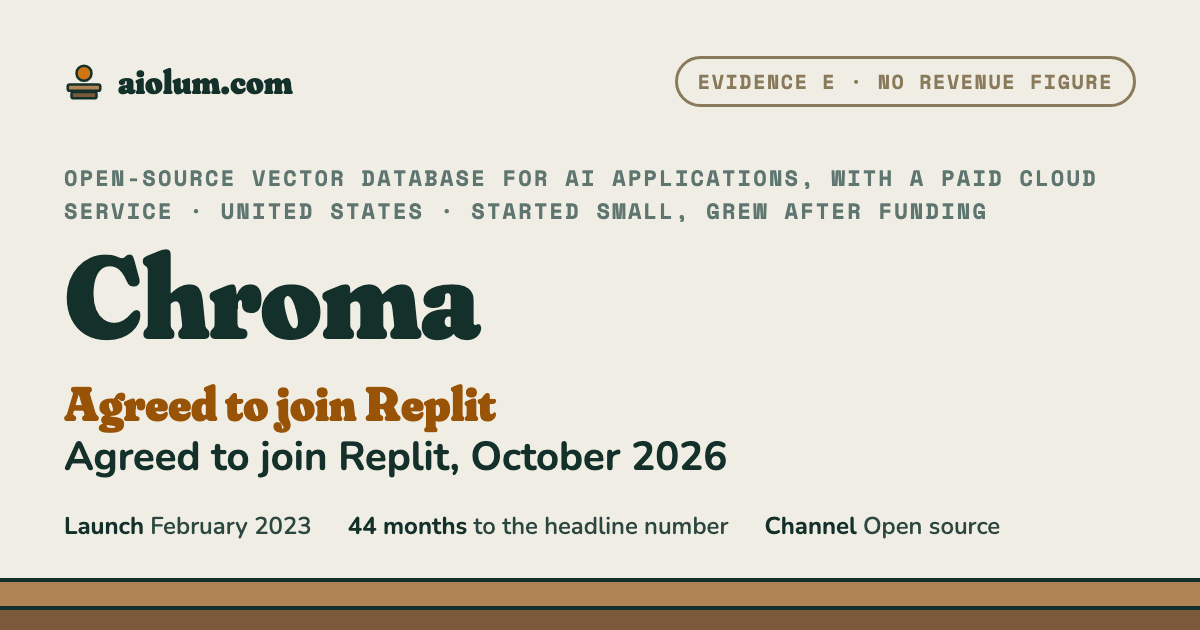
Chroma (Open-source vector database for AI applications, with a paid cloud service, United States): Agreed to join Replit, October 2026. Evidence grade E: no revenue figure was checked. Team: 2 co-founders at the start in 2022; 11 people named as the engineering team in October 2024 and 12 in November 2026; total headcount not published. Launched February 2023; sold 44 months after launch.Added 7 November 2026
- Outcome
- Agreed to join Replit, October 2026
- Evidence
- E no revenue figure was checked
- Launch
- February 2023
- Status
- Sold, 44 months after launch
- Team
- 2 co-founders at the start in 2022; 11 people named as the engineering team in October 2024 and 12 in November 2026; total headcount not published
- Outside funding
- Pre-seed in May 2022 and a US$18M seed round in April 2023, as Chroma stated; later rounds not checked
- Main channel
- Open source
What is not verified
No revenue figure and no deal price were found. We looked for a payment-processor profile, a founder interview with a dated figure, a company filing and a buyer announcement. A Dealroom news note on the deal exists, but it was linked on Dealroom's app host, whose robots.txt disallows ClaudeBot, so it was not read, and Replit's own announcement was not read. All sources are Chroma's own pages, so the customer names, the download figures and the deal itself rest on the company's statements; no source says whether the deal has closed. The total headcount is not published: only the engineering team is listed. The home page shows "15M+ monthly downloads", while the CEO's post of 23 October 2026 gives 6M downloads a month; the pages do not explain the difference. A reader could look for Replit's announcement or a filing. This story is grade E: the business is real and its product, price and customers are described from public pages, but no revenue figure was checked. Aiolum shows it as an idea worth studying, not as proof that it makes money.
Chroma makes ChromaDB, a vector database: a database that stores embeddings, lists of numbers that an AI model computes for a piece of text or an image so that items with similar meaning get similar numbers, and that returns the stored items closest to a query. An AI application uses it for retrieval: it finds the documents that fit a user's question and gives them to a language model as context. ChromaDB is open source, meaning anyone may read, use and change the code, under the Apache 2.0 license. Chroma Cloud, the paid hosted version, charged by usage.
Jeff Huber and Anton Troynikov started Chroma in 2022 and released ChromaDB in early 2023, right after ChatGPT. Chroma stated in April 2023 that it had raised an US$18M seed round, and by October 2024 its site named 11 people as the engineering team. On 23 October 2026 Chroma said it had signed a definitive agreement to join Replit, whose chief executive and president were early investors, and that it would close Chroma Cloud within 60 days.
No price for the deal and no revenue figure appear in any source we read, so this is a grade E story: the company is real and its paid plans were on sale before the deal, but the money is not public. Every source is Chroma's own site or an Internet Archive copy of it.
How much did Chroma make, and what was it sold for?
Each row shows the evidence grade and the source numbers from the list at the end of this page. The grades are explained in How Aiolum verifies.
| Fact | Value | Grade | How we know | Sources |
|---|---|---|---|---|
| Status, 23 October 2026 | definitive agreement to join Replit; price not disclosed | C | The CEO's post: "Today I'm excited to announce that Chroma has signed a definitive agreement to join Replit." The post quotes Replit's president, Michele Catasta. No source we read says whether the deal has closed. | [1] |
| Chroma Cloud after the agreement | writes disabled 7 December 2026, reads disabled 22 December 2026 | C | Wind-down page published 23 October 2026: "Chroma Cloud is winding down over the next 60 days." Open-source ChromaDB stays under the Apache 2.0 license. | [2] |
| Company start | 2022 | C | "We started in 2022 to solve active learning for curating training data for deep learning." The seed post announces a pre-seed round from May 2022. | [1, 3] |
| Founding team | 2 co-founders: Jeff Huber (CEO) and Anton Troynikov | C | The seed post speaks of "Anton and I" and is signed "-Jeff, Anton, and the Chroma team". The podcast page calls Anton a co-founder; the October 2024 engineering page gives his full name. | [3, 8, 13] |
| Open-source release | February 2023 | C | The CEO quotes an email of January 2023, then writes: "We released ChromaDB the following month". The seed post of 7 April 2023 speaks of "the past 5 weeks since launch", which points to about 3 March 2023 (calculated), so the exact day is not certain. | [1, 3] |
| Downloads | 35,000 Python downloads in the month to April 2023; 6 million a month in October 2026 | C | Seed post, and the CEO's post: "Open-source Chroma remains strong at 6M downloads a month and just shy of 30k Github stars." The home page on 7 November 2026 shows "15M+ monthly downloads" and "27k Github stars"; the two pages do not agree. | [3, 1, 14] |
| Paid plans before the sale | Team plan at US$250 a month plus usage, on sale by 2 September 2025 | C | Internet Archive copies of the pricing page from 2 September 2025 and 22 May 2026 show Starter, Team and Enterprise, and say Chroma accepts credit cards for Starter and Team. | [5, 6, 4] |
| Cloud launch | early access by October 2024; "Introducing Chroma Cloud" in August 2025 | C | An archive copy of the engineering post of 7 October 2024 offers "early access" to the serverless cloud; the changelog lists "Introducing Chroma Cloud" under August 2025. | [8, 7] |
| Team size | 11 people named as the engineering team in October 2024; 12 in November 2026 | C | Names listed under "Chroma engineering team" in the archive copy of 7 October 2024 and on the live page of 7 November 2026. Staff outside engineering are not listed, so the total headcount may be larger. The careers page lists six open roles in San Francisco on 7 November 2026. | [8, 9, 11] |
| Funding | pre-seed May 2022; US$18M seed April 2023 | C | Seed post: the pre-seed was led by Anthony Goldbloom of AIX Ventures, James Cham of Bloomberg Beta, and Nat Friedman and Daniel Gross (AI Grant); the seed was led by Astasia Myers of Quiet Capital, with angels including Amjad Masad of Replit. Later rounds were not checked. | [3] |
| Customers named by the company | SpaceXAI, Mintlify, Krea, Paramount, Retool, Coreweave "and tens of thousands of others" | C | The CEO's post of 23 October 2026. The site map lists case studies for Factory AI, Mintlify and Propel AI; this page did not read them. | [1] |
| Time from the open-source release to the agreement | 44 months | calc | Calculated: February 2023 to October 2026. | [1] |
How to read this table: a grade C value is a statement by Chroma on its own site or in an Internet Archive copy of that site. A "calc" value was computed on this page. No value is grade A or B, and no revenue amount exists in the sources.
| Plan | Per month, billed yearly (US$) | Per month, billed monthly (US$) | Limit |
|---|---|---|---|
| Starter | 0 plus usage | US$5 in free credits; 10 databases; 10 team members | |
| Team | 250 plus usage | US$100 of usage included each month; 100 databases; 30 team members; SOC II | |
| Enterprise | custom | unlimited databases and team members; single-tenant clusters; SLAs |
Every plan is a monthly fee plus usage. The page lists US$2.50 per GiB written, US$0.33 per GiB stored per month, US$0.0075 per TiB queried and US$0.09 per GiB of network traffic returned. The page shows no yearly billing, so that column is empty. The page says Chroma accepts credit cards for Starter and Team. The open-source database stays free to run on your own servers.
When did Chroma launch, and how did it grow?
From a 2022 research project to an agreement to join Replit, in 44 months after the open-source release. Each entry carries its grade.
- 2022CJeff Huber and Anton Troynikov start Chroma to work on active learning, the choice of which data to label for training deep-learning models. A pre-seed round follows in May 2022. [1, 3]
- January to February 2023CAfter ChatGPT, Chroma moves from training data to context for AI models and releases the open-source ChromaDB. [1]
- 28 March to 7 April 2023CA Chroma template for Replit appears. Chroma announces its seed round, 35,000 Python downloads in the past month, and a plan for a hosted product. [12, 3]
- 7 October 2024CAn archive copy of the engineering post offers early access to the serverless Chroma Cloud, built on object storage, and names 11 people as the engineering team. [8]
- August to September 2025CThe changelog lists "Introducing Chroma Cloud". The pricing page of 2 September 2025 sells Starter, Team at US$250 a month plus usage, and Enterprise. [7, 5]
- 23 October 2026CChroma signs a definitive agreement to join Replit. Chroma Cloud stops writes on 7 December and reads on 22 December 2026; the open-source project continues. [1, 2]
Why did Chroma work?
Four causes, in the order they mattered. Each one is a reusable lesson.
Open source first
ChromaDB was free code that a developer could install in minutes, at the moment many developers were trying to give ChatGPT their own data. The CEO wrote in October 2026 that Chroma once estimated it had over 95% of the downloads for vector search. The open-source users were the audience for the paid cloud.
A cloud version priced by usage
Chroma Cloud charged for data written, stored, queried and returned, plus a monthly fee for the Team plan, which the pricing page listed at US$250 a month. Chroma wrote that its prices follow its own infrastructure costs, and its home page says the service is built on object storage and is "Up to 10x cheaper".
Investors who became the buyer
Replit's chief executive Amjad Masad and president Michele Catasta were early investors, and Chroma published a Replit template in March 2023. The CEO's post says the two companies decided they could do more together than apart.
How it was built
These details come from Chroma's engineering posts and its announcement. They are grade C. [8, 9, 10, 1, 12]
- A custom storage engine written in Rust that stores data in the Arrow data format.
- A serverless design on object storage: gateways route queries, query nodes serve indexes from object storage and a cache, compactor nodes build the indexes, and a write-ahead log (wal3) sits on S3.
- Usage-based billing from usage events written to object storage, which Orb turns into invoices; storage usage comes from change data capture on Chroma's Postgres system database.
- The open-source code is under the Apache 2.0 license; with the Replit announcement Chroma added code from its private repositories to it.
- A Chroma template for Replit in March 2023 let developers start an AI app with Chroma inside a Repl.
Tools named in the sources
Each one opens its page in the Tools tab, with every story that uses it.
Who tried this before Chroma, and why did they fail?
Three companies in our database of failed startups built a database or backend for developers and failed. The values below are from that database and are not independently verified.
Parse
The promiseA hosted backend so that developers could skip server work and build apps faster.
Why it diedFacebook bought it in 2013 and later closed the hosted service, while Google's Firebase grew.
RethinkDB
The promiseAn open-source database that pushes changes to the application in real time.
Why it diedDevelopers liked it, but few would replace their existing database or pay for it.
FathomDB
The promiseA managed cloud database with automatic scaling, backups and monitoring.
Why it diedAmazon's RDS and the other large cloud providers offered the same service inside their platforms.
The failed startups come from our database of 1,749 dead startups, retold here in our own words. Its entries are AI-assisted summaries of public sources, so these cards carry no evidence grade.
What changed
Parse, RethinkDB and FathomDB each offered developers a better place to keep data, and each lost to a large cloud provider or to developers' reluctance to change databases. Chroma faced the same two risks: other databases can add vector search as a feature, and cloud providers can sell their own.
Two things differed. Chroma arrived in early 2023 for a new kind of workload, retrieval for AI models, and its free open-source code spread fast: the CEO wrote that Chroma once estimated it had over 95% of the downloads for vector search. And like Parse it ended inside a larger company, but here the buyer's leaders were its own early investors, and Chroma said that the open-source code continues while only the hosted service closes.
Can one person copy Chroma now?
The database, no. The open-source path to a paid cloud, in part.
Building a distributed database took Chroma a seed round of the size it reported and a team of more than ten engineers, which one person cannot match. The pattern behind it is smaller: free open-source code for a new kind of AI workload, released early, with a hosted version for teams that do not want to run servers.
Where it is still open: Smaller pieces of the AI stack where no open-source standard exists yet: evaluation, memory for agents, data connectors and search for one kind of document.
- 1Pick a new workload that AI apps need and existing tools handle badly.
- 2Release a free, easy-to-install open-source version and write templates for the platforms developers already use.
- 3Sell a hosted version priced by usage, so small users start for little and large users pay more.
- 4Keep the code open, so users can stay when the hosted service changes.
What could go wrong for Chroma?
The risks are the mirror image of the causes above.
What is not verified
No revenue figure and no deal price were found. We looked for a payment-processor profile, a founder interview with a dated figure, a company filing and a buyer announcement. A Dealroom news note on the deal exists, but it was linked on Dealroom's app host, whose robots.txt disallows ClaudeBot, so it was not read, and Replit's own announcement was not read. All sources are Chroma's own pages, so the customer names, the download figures and the deal itself rest on the company's statements; no source says whether the deal has closed. The total headcount is not published: only the engineering team is listed. The home page shows "15M+ monthly downloads", while the CEO's post of 23 October 2026 gives 6M downloads a month; the pages do not explain the difference. A reader could look for Replit's announcement or a filing.
The paid service is closing
Chroma Cloud stops accepting writes on 7 December 2026 and stops serving reads on 22 December 2026. On 7 November 2026 the home page still offers "Start free on Cloud" and the pricing page still lists the plans. Customers have to move their data to open-source ChromaDB or another database.
Competition and model providers
Chroma competed in a field where other databases and cloud providers can add vector search as a feature. On this site, ZeroEntropy (embedding and reranker models) was acquired by Notion with its team in July 2026, and Airweave and Moss sell retrieval and search for AI agents. ChromaDB itself does not depend on one model provider: developers bring embeddings from any model, and the 2023 seed post names OpenAI, Anthropic, Cohere and open-source models as the providers in this stack.
A venture-funded team, not a solo business
Two people started Chroma, but it raised a pre-seed and a seed round and had more than ten engineers by October 2024. Its story shows how an early open-source release can lead to an acquisition, not what one person can run alone.
Sources
The grade next to each source is the best grade that the source can support. "Read in full" means that the text of the page was downloaded and the numbers were checked in it.
- C Chroma blog, 23 October 2026: Chroma is joining Replit (Jeff Huber, CEO)Read in full (downloaded 7 November 2026). Source for the agreement, the 2022 start, the release, the customers, the downloads and the Replit investors.
- C Chroma: Chroma Cloud wind-down timeline, published 23 October 2026Read in full on 7 November 2026. Source for the write and read cut-off dates.
- C Chroma blog, 7 April 2023: Chroma raises $18M seed roundRead in full. Source for the founders, the pre-seed and seed rounds, the early downloads and the plan for a hosted product.
- C Chroma pricing page, read 7 November 2026Read in full. Source for the plans and usage prices.
- C Internet Archive copy of the Chroma pricing page, 2 September 2025Read in full. Shows the Team plan at US$250 a month plus usage before the agreement.
- C Internet Archive copy of the Chroma pricing page, 22 May 2026Read in full. Shows the same plans five months before the agreement.
- C Chroma changelog, read 7 November 2026Read in full. Source for "Introducing Chroma Cloud" in August 2025.
- C Internet Archive copy of Chroma's engineering post Retrieval powered by object storage, 7 October 2024Read in full. Source for the early-access cloud, the architecture and the 11 named engineers.
- C Chroma engineering post Retrieval powered by object storage, live page read 7 November 2026Read in full. Source for the Rust storage engine and the 12 named engineers.
- C Chroma engineering post Building a usage-based billing systemRead in full on 7 November 2026; the page shows no date, and the Internet Archive's availability service lists a copy from 14 May 2025. Source for Orb and the Postgres change data capture.
- C Chroma careers page, read 7 November 2026Read in full. Source for the six open roles.
- C Chroma blog, 28 March 2023: Replit + ChromaRead in full. Source for the Chroma template for Replit.
- C Chroma blog: Software Engineering Daily podcast with Anton Troynikov, transcriptRead the sections on funding and hiring. Calls Anton a co-founder of Chroma.
- C Chroma home page, read 7 November 2026Read in full. Source for the home-page download and star counters and the cloud sign-up link.
- C Database of failed startups, local exportLocal export. AI-written summaries, not independently verified. Source for the failed predecessors.
Run this company? Send corrections or a verified figure to aiolum@livyden.com