Coval: Product, team and how it was built
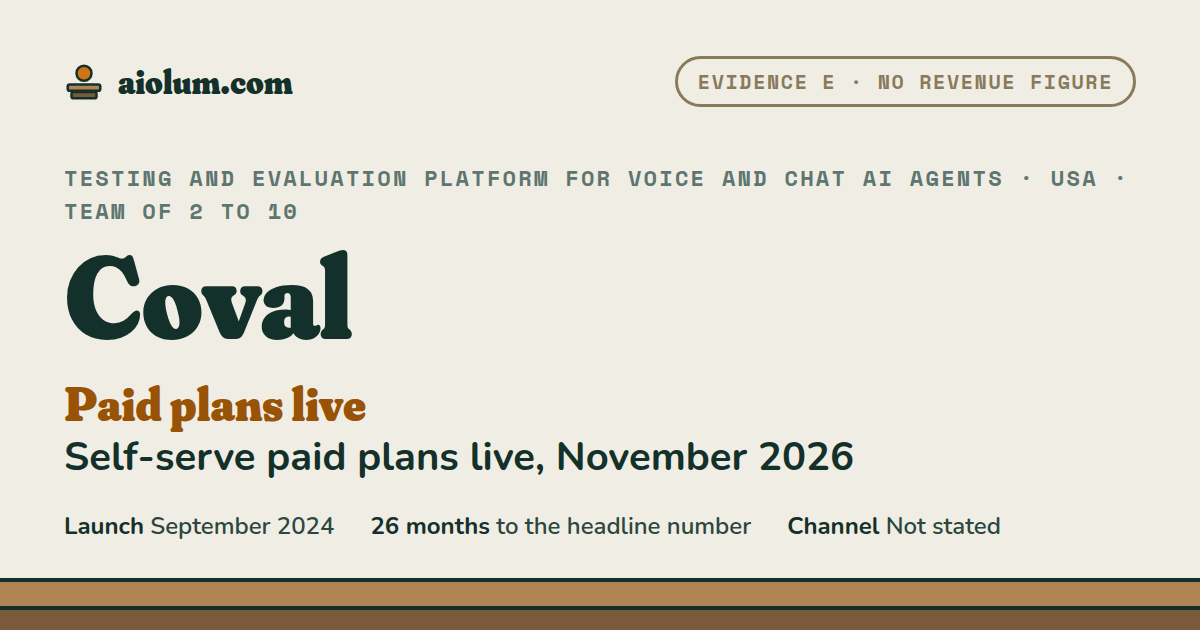
Coval (Testing and evaluation platform for voice and chat AI agents, USA): Self-serve paid plans live, November 2026. Evidence grade E: no revenue figure was checked. Team: 1 founder listed on the Y Combinator page (Summer 2024 batch); 9 people on the About page and 10 on the Y Combinator page in November 2026; hiring after a US$28M round. Launched September 2024; still running.Added
- Outcome
- Self-serve paid plans live, November 2026
- Evidence
- E no revenue figure was checked
- Launch
- September 2024
- Status
- Still running
- Team
- 1 founder listed on the Y Combinator page (Summer 2024 batch); 9 people on the About page and 10 on the Y Combinator page in November 2026; hiring after a US$28M round
- Outside funding
- US$3.3M seed led by MaC Ventures, January 2025; US$28M Series A led by Norwest, 23 June 2026; US$31M in total (founder's posts)
- Main channel
- Not stated
What is not verified
No revenue figure was found. The pricing page, the funding post, the terms and the home page were read; none states income, and no sale price applies. The pages show a card-paid plan that can be bought. No source states that a customer has paid. One customer, Phonely, is named in a company post of January 2025, which does not state a payment. The Y Combinator page links two press articles on the rounds. One could not be opened, and the other is on a site this project does not read. A reader could look for a payment-processor profile or an outside article on the US$28M round. This story is grade E: the business is real and its product, price and customers are described from public pages, but no revenue figure was checked. Aiolum shows it as an idea worth studying, not as proof that it makes money.
Coval is a simulation and evaluation platform for AI agents that talk to customers by phone or chat. Simulation means that software plays the caller, with a chosen voice, accent, language and background noise, and talks to the agent. Evaluation means that automatic checks, called metrics, score each call. Examples are whether the identity was verified, whether the caller was handed to a person when needed, and whether the answer was grounded.
Brooke Hopkins, the only active founder on the Y Combinator page, says in her post that the company was founded in 2024. Her post of 23 June 2026 says Coval raised a US$28 million Series A led by Norwest. The About page lists nine people, and the Y Combinator page lists a team of 10. The pricing page lists a Starter plan at US$100 a month and a Growth plan at US$500 a month, each with a 7-day free trial.
No revenue figure was found, so the grade is E. The only money figures are the company's own price list and the founder's funding post, and no source states that a customer has paid.
Why did Coval work?
Four causes, in the order they mattered. Each one is a reusable lesson.
The founder brought self-driving test practice to voice agents
Hopkins wrote that at Waymo she asked how to know a self-driving car is safe. Her answer was simulated miles, regression tests and production metrics. The company applies the same three steps to voice agents: simulate calls, re-run tests after each change, and score live calls. Her own description of that earlier work is the only evidence of it.
It targets teams that must prove an agent works
The home page links solution pages for financial services, healthcare and insurance. The pricing page lists SOC 2 Type II, HIPAA and GDPR on every plan. These are the company's own claims. A regulated team needs a record that an agent verified identity or handed off to a person, which is what the metrics score.
A card-paid plan lets a team start without a sales call
The company lists a Starter plan at US$100 a month with unlimited seats and a free trial of 7 days. A team can test one agent first, and larger teams are sent to a quoted Enterprise plan that the page lists from US$4,500 a month.
How it was built
These details come from the company's own pages and documentation. They are grade C. [9, 7, 2, 6, 13]
- The platform calls an agent over a phone number or a connection. The documentation lists connections for LiveKit, Pipecat, OpenAI Realtime, Gemini Live and a custom websocket.
- Simulated callers are personas with a chosen voice, accent, language, speed and background noise. A test case can also play a pre-recorded audio file of the caller's side, exactly as recorded, instead of generating speech.
- Metrics score each call. The blog index names an LLM-as-a-judge, a model that grades a conversation by a written prompt, and human review that calibrates it.
- Teams can reach the platform through a REST API, a command-line tool, an MCP server, webhooks and skills, as the pricing page lists.
- Payments go through Stripe, as the terms say. The company page lists SOC 2 Type II, HIPAA and GDPR through a Trust Center hosted by Oneleet.
Who tried this before Coval, and why did they fail?
Three companies in our database of failed startups tried to test or run automated systems for customers and failed. Two are loose matches: one tested mobile apps, and two built autonomous or automated systems. The values below are from that database and are not independently verified.
Testmunk
The promiseAutomated testing of mobile apps on real devices, to save developers manual testing time.
Why it diedIt could not stand out as automated testing filled with larger platforms, and its device farm was costly to run.
Olive AI
The promiseSoftware bots that automate the administrative work of hospitals, such as prior authorization and claims checks.
Why it diedThe record says it overpromised and delivered less than it sold. Each hospital needed custom work, so costs stayed high.
Ghost Autonomy
The promiseA self-driving system that could be fitted to existing vehicles.
Why it diedThe record says it burned its money before any commercial use. It assumed car makers would buy autonomy from outside.
The failed startups come from our database of 1,749 dead startups, retold here in our own words. Its entries are AI-assisted summaries of public sources, so these cards carry no evidence grade.
What changed
Testmunk sold test automation for a platform that larger rivals were also automating, and it died. Coval sells testing for a new kind of software, agents that talk. Their answers change from one call to the next, so a fixed script does not work. That is why its pages stress simulated callers and scores by a model, not fixed checks.
Whether this is enough is not shown. Coval competes with other voice-agent testing firms that it names on its own blog, and no revenue is published. The company says it is the more established firm, a claim the sources do not check.
Can one person copy Coval now?
Partly. The idea can be copied, the funded scale cannot.
A solo builder can copy the narrow idea: test one kind of agent for one industry and sell it by card. The company's own pages show a funded team, an enterprise plan and compliance work that one person would find hard to match.
Where it is still open: Testing for other agent types that talk to customers: voice agents for one industry, chat agents in one messaging app, or agents that fill forms.
- 1Pick one agent type, such as appointment booking, and write test calls that break it.
- 2Score each call with a written rule and keep a human review step to check the score.
- 3Publish a card-paid plan with a free trial, so a buyer can start without a call.
- 4Show a method from an older field, such as self-driving tests, as the reason to trust the scores.
How much revenue does Coval make?
Each row shows the evidence grade and the source numbers from the list at the end of this page. The grades are explained in How Aiolum verifies.
| Fact | Value | Grade | How we know | Sources |
|---|---|---|---|---|
| Paid plans on sale, November 2026 | Starter and Growth, with a sign-up path and a 7-day free trial | C | Pricing page, read 12 November 2026: "Start 7-day Free Trial Credit card required. Cancel any time." Each plan button links to a sign-up page of the web app. | [2] |
| Payment processor | Stripe | C | Terms of service, last updated 18 May 2026: "Coval currently uses Stripe as its third-party service payment processor". | [6] |
| Founded | 2024 | C | Founder's post of 23 June 2026: "since we founded the company in 2024". The Y Combinator page says "Founded: 2024" and "Batch: Summer 2024". | [1, 4] |
| Earliest page found | coval.dev, 1 June 2024: "Coming soon. Be the first to hear." | C | Internet Archive copy of the old domain. The company's Y Combinator launch post was written on 3 September 2024. | [10, 5] |
| Company name in the terms | "Datawave, Inc. (dba Coval), a Delaware corporation" | C | Terms of service. The privacy policy and the page footers say "Coval Inc." and "Coval, Inc.". No source gives the start date of the company under the first name. The Internet Archive first recorded the domain datawave.dev on 15 November 2024, after the coval.dev page of June 2024. | [6] |
| Funding | US$28M Series A, led by Norwest; US$31M in total | C | Founder's post, 23 June 2026. It names Base10 Partners, Twilio Ventures, Y Combinator, MaC Ventures and Swift Ventures. No outside article was read. | [1] |
| Seed round | US$3.3M, led by MaC Ventures | C | Founder's post on the company blog. The page carries the date "January 23, 2024". It links to its own press article at an address dated 2025/01/23. The Y Combinator news list dates that article 23 January 2025. The press article was not read. | [12, 4] |
| Named customer | Phonely, in a customer spotlight post of 20 January 2025 | C | The company's post says Phonely is "integrating Coval's voice agent simulation capabilities directly into their product". It does not state that Phonely pays. | [14] |
| Team, November 2026 | 9 people on the About page; "Team Size: 10" at Y Combinator | C | The About page lists one founder and eight others, undated. The Y Combinator page is also undated and shows 9 open jobs. The funding post says the money goes to growing the sales and solutions engineering teams. | [3, 4, 1] |
| Founder's earlier work | led the evaluation job infrastructure team at Waymo | C | The About page and the Y Combinator launch post carry the same words in the first person. | [3, 5] |
| Home-page counters | 217% better agent accuracy in 7 days; 3.1M evaluation metrics run weekly; under 15 minutes to a first simulation | C | Company's own figures under "Real numbers from real deployments". No customer, method or date is given. | [7] |
| Simulated callers | 27 voices, 10 languages, 20 background environments | C | Company's claim on the Simulate page. The caller voices are chosen from a list. No Coval product page or document read offers to copy a real person's voice. | [9] |
How to read this table. A grade C value is a statement by the company on its own pages or by its founder in a post. No value is grade A or B, and no money outcome exists.
| Plan | Per month, billed yearly (US$) | Per month, billed monthly (US$) | Limit |
|---|---|---|---|
| Starter | 80 | 100 | 100 simulation minutes, 3,000 upload minutes, 1 project |
| Growth | 400 | 500 | 1,000 simulation minutes, 30,000 upload minutes, 5 projects |
| Enterprise | custom | from 4,500 | custom minutes; single sign-on, private cloud, named engineer |
Plans are per month. The page shows a toggle for annual billing at 20% off, which gives US$80 and US$400 a month, billed as US$960 and US$4,800 a year. Both paid plans have a 7-day free trial that needs a credit card. Overage per simulation minute is US$0.40 on Starter and US$0.25 on Growth. Seats are unlimited on every plan. Enterprise is quoted by sales and listed as starting at US$4,500 a month.
When did Coval launch, and how did it grow?
From a page that said coming soon in June 2024 to a funded company with card-paid plans in November 2026. Each entry carries its grade.
- 1 June 2024CThe old domain coval.dev shows a page that says "Coming soon. Be the first to hear." [10]
- 3 September 2024CThe Y Combinator launch post goes up: "Coval - Simulation & Evaluation for AI Agents", with a waitlist. The company is in the Summer 2024 batch. [5, 4]
- 23 January 2025CThe founder announces a US$3.3M seed round led by MaC Ventures. The blog page is dated January 2024; its linked press article is dated 23 January 2025. [12, 4]
- March to December 2025CThe partner page lists news on Rime (14 March 2025), Cisco (15 June 2025) and Zoom's ISV Exchange program (19 December 2025). [8]
- 23 June 2026CThe founder announces a US$28M Series A led by Norwest, for US$31M raised in total. [1]
- November 2026CSelf-serve Starter and Growth plans are on sale, with a 7-day free trial and card billing. [2]
What could go wrong for Coval?
The risks are the mirror image of the causes above.
What is not verified
No revenue figure was found. The pricing page, the funding post, the terms and the home page were read; none states income, and no sale price applies. The pages show a card-paid plan that can be bought. No source states that a customer has paid. One customer, Phonely, is named in a company post of January 2025, which does not state a payment. The Y Combinator page links two press articles on the rounds. One could not be opened, and the other is on a site this project does not read. A reader could look for a payment-processor profile or an outside article on the US$28M round.
Logos, counters, badges and a press strip
The home page shows customer logos (Chime, Perplexity, ServiceNow, StubHub, Zoom, Toast, Upstart) under "Trusted by teams" and a "Featured in" strip of eight press logos. No page read quotes or describes any of these seven firms as a customer. The one customer post found is about Phonely, which is not in the logo row. The page footer shows SOC 2 Type II, HIPAA and GDPR badges that link to no report. The site links a Trust Center hosted by Oneleet, which could not be read without a browser. The counters are the company's figures with no basis given. The funding post also says "Roughly 95% of voice agents work in a demo", without naming a source.
Team size after the round
The About page lists nine people and the Y Combinator page says "Team Size: 10", both undated. The funding post says the company is growing its sales and solutions engineering teams. The current headcount may be above 10, and no source dates the later size.
Voice cloning and the company's names
The documentation and product pages read do not offer voice cloning. Simulated callers use a voice chosen from the company's list. The documentation has one persona field, "custom_voice_id", described only as "A custom voice reference issued to your organization". The pricing page lists "Custom voice models" on the Enterprise plan. Neither says how such a voice is made. A test case can carry a recording of a real caller, which "plays back exactly as recorded instead of generating persona speech". That is a replay of a recording, not a copy of the voice. The company blog has a review of ElevenLabs, another company's product, dated 25 May 2026, which describes that product's voice cloning and its consent rules. The terms name Datawave, Inc. (dba Coval), and no register entry was read. The current domain coval.ai showed a waitlist page for a different product, a "Support platform built for developers", in the Internet Archive copies of May 2023 and March 2024. No source ties that page to this company, whose Y Combinator page still lists coval.dev.
Sources
The grade next to each source is the best grade that the source can support. "Read in full" means that the text of the page was downloaded and the numbers were checked in it.
- C Coval blog, 23 June 2026: Coval Raises $28M Series A to Make Voice AI Reliable in Production (Brooke Hopkins)Read in full on 12 November 2026. Founder's own post. Source for the round, the investors, the 2024 start and the hiring plan.
- C Coval pricing page, read 12 November 2026Read in full, including the page source for the annual prices and the sign-up links. Source for the plans, the trial and the limits.
- C Coval About Us page, read 12 November 2026Read in full. Source for the founder's earlier work and the list of nine people. The page has no date.
- C Y Combinator company page: CovalRead in full on 12 November 2026. Source for the batch, the founding year, the team size of 10 and the news list.
- C Y Combinator launch post, 3 September 2024: Coval - Simulation & Evaluation for AI AgentsRead in full as the post's own data. Founder's launch text. Source for the first public date and the founder's background.
- C Coval terms of service, last updated 18 May 2026Read in full. Source for the name Datawave, Inc. (dba Coval), the payment processor and the billing terms.
- C Coval home page, read 12 November 2026Read in full, with the page source for the logo names. Source for the counters, the logo wall and the product description.
- C Coval partners page, read 12 November 2026Read in full. Source for the dated partner news of 2025.
- C Coval Simulate page and documentation (docs.coval.ai llms-full.txt), read 12 November 2026Read the Simulate page in full and searched the full documentation text for "clone". Source for personas, voices and agent connections.
- C Internet Archive copy of coval.dev, 1 June 2024Read in full. The page text is a coming-soon notice. Source for the earliest page found.
- C Database of failed startups, local exportRecord pages read on the website on 12 November 2026. AI-written summaries, not independently verified. Source for the failed predecessors.
- C Coval blog: Coval raises $3.3M to bring Self-Driving Car Simulation to AI Voice & Chat Agents (Brooke Hopkins)Read in full on 12 November 2026. Founder's own post. The page date says January 23, 2024; the press article it links is dated 23 January 2025. Source for the seed round.
- C Coval blog index and archive, read 12 November 2026Read the index and the archive list of about 90 posts. Read the comparison posts on Cekura and Cyara and the ElevenLabs review of 25 May 2026. Source for the metric method, the named rivals and the note on voice cloning.
- C Coval blog, 20 January 2025: Customer Spotlight: How Phonely Uses AI Agent Evaluations to Build Better Voice AgentsRead in full on 12 November 2026. Company's own post. Source for the one named customer.
- C Internet Archive copy of coval.ai, 19 May 2023Read in full, with the copy of 25 March 2024. A waitlist page for a different product under the same name. Source for the note on the domain.
Run this company? Send corrections or a verified figure to aiolum@livyden.com