cubic: Product, team and how it was built
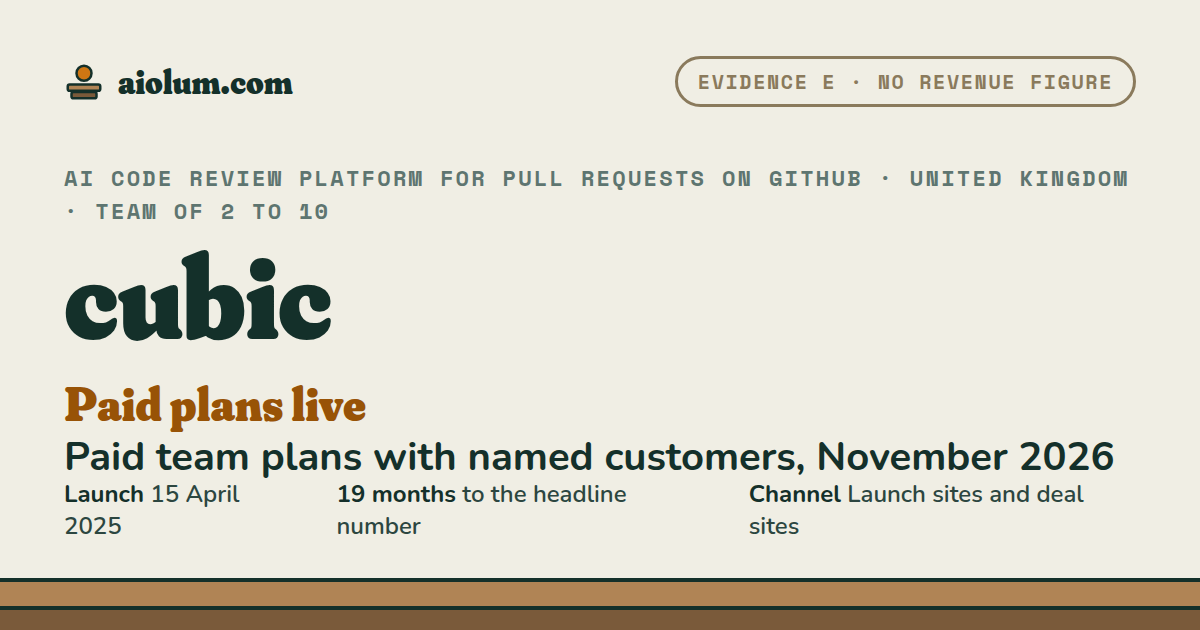
cubic (AI code review platform for pull requests on GitHub, United Kingdom): Paid team plans with named customers, November 2026. Evidence grade E: no revenue figure was checked. Team: 2 founders at launch in April 2025; 6 people on the Y Combinator profile read in November 2026. Launched 15 April 2025; still running.Added
- Outcome
- Paid team plans with named customers, November 2026
- Evidence
- E no revenue figure was checked
- Launch
- 15 April 2025
- Status
- Still running
- Team
- 2 founders at launch in April 2025; 6 people on the Y Combinator profile read in November 2026
- Outside funding
- Y Combinator Spring 2025; amount not found
- Main channel
- Launch sites and deal sites
What is not verified
No revenue figure was found. The pages read were the company's site, terms, privacy policy and customer stories. Also read were the Y Combinator profile and launch post, the Hacker News thread and Internet Archive copies. No payment-processor profile, filing or press piece with a figure was found. The pricing page lists prices and the terms describe fees, but no source states that a customer has paid. The customer stories are the company's own text. No independent source confirms them. This story is grade E: the business is real and its product, price and customers are described from public pages, but no revenue figure was checked. Aiolum shows it as an idea worth studying, not as proof that it makes money.
cubic is an AI code review platform. Code review is the step in which a developer reads a colleague's change before it is merged into the shared code. A pull request is the GitHub name for such a proposed change. cubic runs an AI reviewer on each one. It posts comments on the lines it flags.
The product was called mrge until 2025. On 15 April 2025 the founders wrote a Launch HN post on Hacker News under the title "mrge.io (YC P25)". They signed it "Allis and Paul" and said early users included Better Auth, Cal.com and n8n. Y Combinator names Paul Sanglé-Ferrière as the founder and chief executive, and lists the company as founded in 2025.
No revenue figure was found, so this story has grade E. The company's pricing page lists Team, Pro and Max plans per developer, and its terms describe fees. No source states what any customer pays or how many customers pay.
Why did cubic work?
Four causes, in the order they mattered. Each one is a reusable lesson.
The founders built it for a bottleneck they had themselves
The launch post says the founders worked together at their last startup, where code review became their biggest bottleneck. They write that AI coding tools produced more pull requests to review. The product answers that pressure with an AI reviewer and an app that orders changes by logic.
It launched in public and named known open source users
The Launch HN post named Better Auth, Cal.com and n8n as early users and drew 108 comments. One commenter wrote that they used it for an open source project. Another tested it on a pull request and called most of the 11 flagged issues wrong.
It moved from free use to three paid plans per developer
In April 2025 the founders wrote that mrge was free for now. By November 2026 the company's pricing page lists Team, Pro and Max plans, each priced per developer. Public repositories stay free, which keeps open source teams as users.
How it was built
These details come from the launch post, the company's own pages and its terms. They are grade C. [10, 3, 1]
- The launch post says each review runs in a temporary sandbox with shell access and a Language Server Protocol server. The sandbox is deleted after the review.
- The company's terms say it may use third-party AI providers, and name OpenAI and Anthropic as examples.
- The product connects through a GitHub app. The launch post says GitLab support was on the roadmap in April 2025.
- A desktop app and a web app show the reviews. The launch post gives keyboard shortcuts and a Linear-style design as reasons for the desktop app.
- The company's site is built with Framer, as the page source of the home page shows.
Tools named in the sources
Each one opens its page in the Tools tab, with every story that uses it.
Who tried this before cubic, and why did they fail?
Three companies in our database of failed startups sold code-review or code-understanding tools to developers. The values below are from that database and are not independently verified.
Sider
The promiseAutomated code review and static analysis for software teams, as part of continuous integration.
Why it diedThe record says the market split between free open-source tools and large enterprise platforms, which left little room for a standalone tool.
CodeSee
The promiseAutomatic visual maps of code, so developers can understand large codebases faster.
Why it diedThe record says it failed to prove a return to engineering leaders in a category full of free alternatives.
Kite
The promiseAn AI code completion engine in the editor that suggested code for developers.
Why it diedThe record calls it too early for a market that later grew, with missteps in how it earned money.
The failed startups come from our database of 1,749 dead startups, retold here in our own words. Its entries are AI-assisted summaries of public sources, so these cards carry no evidence grade.
What changed
All three records sold a tool next to the daily work of developers, and each met free or larger rivals. Sider faced open-source checkers, CodeSee faced free alternatives and Kite faced the big coding assistants. Each record points to trouble in turning use into paid contracts.
cubic sells to the same buyers. Its pricing page lists three paid plans, but no source here says how many teams pay. The Launch HN thread also shows a commenter from a free-software project who wrote that paying was highly unlikely.
Can one person copy cubic now?
Partly. The start is easy to copy; the proof that teams pay is not yet visible.
A small team can build a reviewer on top of a public model and sell it per developer. The founders chose a problem they had met themselves and launched in public with known open source users. This page cannot say whether that turned into paying teams.
Where it is still open: Other steps that slow teams after AI writes the code: test writing, release notes, security triage and migration of old code.
- 1Choose a bottleneck you have lived through, such as review of AI-written code.
- 2Launch where developers read, and let well-known open source projects use it free.
- 3Add paid plans per developer when use grows, and keep public repositories free.
- 4Ask early customers for a named quotation that can be read in full.
How much revenue does cubic make?
Each row shows the evidence grade and the source numbers from the list at the end of this page. The grades are explained in How Aiolum verifies.
| Fact | Value | Grade | How we know | Sources |
|---|---|---|---|---|
| Product launch on Hacker News | 15 April 2025 | C | The founders posted "Launch HN: mrge.io (YC P25) – Cursor for code review". The post says "mrge is currently free while we're still early" and gives a plan to charge per seat later. | [10] |
| Earlier name | mrge; cubic by 21 May 2025 | C | The April 2025 post uses the name mrge.io. The Y Combinator launch post, created on 21 May 2025, uses the name cubic. The company's terms name "MRGE, Inc." as the provider. | [10, 13, 3] |
| Company start | 17 March 2025 (UK company register); 2025 on the Y Combinator profile | C | The UK company register lists MRGE LIMITED, incorporated on 17 March 2025, with Paul Sanglé-Ferrière as an officer. The Y Combinator profile reads "Founded: 2025" and "Batch: Spring 2025". An Internet Archive copy of mrge.io of 12 December 2024 already shows the product as "Coming Soon". | [17, 12, 14] |
| Older page on the same domain | 26 March 2022, "Built for Creators" | C | An archived copy of mrge.io describes a platform for students. The UK register lists another company, MRGE LTD, incorporated on 26 May 2021 and dissolved on 28 May 2024. Its only director has a name that matches neither founder of cubic. The 2022 page is not counted as the start. | [15, 18] |
| Founders | Allis and Paul; Paul Sanglé-Ferrière, Founder/CEO | C | The launch post is signed "Allis and Paul". The Y Combinator profile names Paul Sanglé-Ferrière as the active founder. The second founder's surname was not found. | [10, 12] |
| Team size | 2 at launch; 6 in November 2026 | C | The launch post says "We (Allis and Paul)". The Y Combinator profile lists "Team Size: 6" and no date for that number. | [10, 12] |
| Funding | Y Combinator Spring 2025; amount not found | C | The profile lists the batch. No page read states a funding amount or an investor other than Y Combinator. | [12] |
| Plans and prices | Team, Pro and Max per developer; a free Starter plan | C | The company's home page and pricing page, read on 12 November 2026. The company's pricing page has a "Continue" button under each paid plan. The home page has "Start 7 day trial". | [1, 2] |
| Fees and refunds | fees are non-refundable | C | The company's terms, updated 15 September 2025, say that features may require payment and that all fees are non-refundable. The terms require users to be 18 or older. | [3] |
| Named customers | Cal.com, n8n, Better Auth, Browser Use, Legora | C | The company's home page names four quotation authors. Its customer stories page links ten stories. The company wrote them, and no source says what these customers pay. | [1, 5, 6, 7, 8] |
| Counters and benchmark claims | "Hundreds of companies"; "#1 on every independent benchmark" | C | The customers page and the home page carry these claims with no list or figures. The Y Combinator launch post says it helps teams ship code "28% faster". | [1, 5, 13] |
| Time from launch to the headline | 19 months | calc | Calculated: 15 April 2025 to November 2026. | [10, 2] |
How to read this table. Grade C is a statement by the company, its founders or a profile page. A grade E story has no dated money figure, so no row here is a revenue number.
| Plan | Per month, billed yearly (US$) | Per month, billed monthly (US$) | Limit |
|---|---|---|---|
| Starter | 0 | 0 | 20 PR reviews a month |
| Team | 30 | 40 | 40,000 reviewed lines per developer a month |
| Pro | 79 | 99 | 80,000 reviewed lines per developer a month |
| Max | 160 | 200 | 160,000 reviewed lines per developer a month |
| Enterprise | custom; SSO, audit logs and custom terms |
The home page shows yearly prices and says "Save up to 25% yearly". The pricing page shows the monthly prices and a toggle marked "Yearly -20%". The home page says the Starter plan is free, with 20 pull request reviews a month. The company says cubic is free for public repositories and for open source teams.
When did cubic launch, and how did it grow?
From a domain with a waitlist in December 2024 to a price list with named customers in November 2026. Each entry carries its grade.
- 26 March 2022CThe Internet Archive stores a page of mrge.io titled "Mrge - Built for Creators", for students who want to build communities and earn funds. No source ties it to this company. [15]
- 12 December 2024CThe Internet Archive stores mrge.io as a page that reads "mrge is the fastest way to review code" with the words "Coming Soon" and a waitlist. [14]
- 15 April 2025CThe founders post Launch HN as mrge.io. They say it is free for now and that they plan per-seat prices for closed-source projects. [10]
- 21 May 2025CThe Y Combinator launch post for the same product is created under the name cubic. It says the product helps teams ship code 28% faster. [13]
- 15 September 2025CThe company updates its terms, which name MRGE, Inc. and describe fees for paid features. [3]
- 12 November 2026CThe company lists Team, Pro and Max plans and ten customer stories. Y Combinator shows a team of six. [2, 5, 12]
What could go wrong for cubic?
The risks are the mirror image of the causes above.
What is not verified
No revenue figure was found. The pages read were the company's site, terms, privacy policy and customer stories. Also read were the Y Combinator profile and launch post, the Hacker News thread and Internet Archive copies. No payment-processor profile, filing or press piece with a figure was found. The pricing page lists prices and the terms describe fees, but no source states that a customer has paid. The customer stories are the company's own text. No independent source confirms them.
Earlier owner or earlier product of the domain
The 2022 page on mrge.io appears to belong to an earlier company with a different owner. An Internet Archive copy of 26 March 2022 shows "Built for Creators" for students. The UK register lists MRGE LTD, incorporated on 26 May 2021 and dissolved on 28 May 2024. Its only director has a name that matches neither founder of cubic. The register lists MRGE LIMITED, incorporated on 17 March 2025, with Paul Sanglé-Ferrière as an officer. The archive's list for mrge.io has only a redirect from April 2023 between the 2022 copy and the "Coming Soon" copy of 12 December 2024. No page read states who owned the domain in 2022.
Counters, badges and testimonials
The home page says "#1 on every independent benchmark" and "Trusted by hundreds of engineering teams" with no list. Its "Backed by" row names no investor in the text. It shows "SOC 2 compliant" with no report. In April 2025 the founder who posted the launch wrote in the Hacker News thread that the SOC 2 process had started the week before. The four quotations on the home page name a person and a company each. The pricing page spells one author's surname differently from the home page.
Blog and pricing history
The blog index lists 36 posts dated 16 October 2026. Many compare AI code review and coding tools and favour the company's product. The company's terms say users must be 18 or older. In April 2025 a Hacker News commenter wrote that the pricing page listed US$20 a month while the post said the service was free. That earlier price list was not found in an archive.
Sources
The grade next to each source is the best grade that the source can support. "Read in full" means that the text of the page was downloaded and the numbers were checked in it.
- C cubic home pageRead in full, 12 November 2026. Source for the product, the yearly prices, the quotations, the counters and the badges.
- C cubic pricing pageRead in full, 12 November 2026. Source for the monthly prices, the plan limits and the yearly toggle. The yearly figures load by script and were not read there.
- C cubic terms of serviceRead in full, 12 November 2026. Updated 15 September 2025. Source for MRGE, Inc., the fee terms, the age limit and the AI providers.
- C cubic privacy policyRead in full, 12 November 2026. Last updated 16 February 2026. It names no payment processor.
- C cubic customers pageRead in full, 12 November 2026. Source for the ten customer stories and the claim of hundreds of companies.
- C cubic customer story: n8nRead in full, 12 November 2026. Company text with a named quotation from an engineering manager at n8n.
- C cubic customer story: Better AuthRead in full, 12 November 2026. Company text with a named quotation from its maintainer.
- C cubic customer story: LegoraRead in full, 12 November 2026. Company text with named quotations. Browser Use, a fifth customer, was read the same way in its own story page.
- C cubic blog indexRead the list, 12 November 2026. Source for the number of posts dated 16 October 2026.
- C Launch HN: mrge.io (YC P25) – Cursor for code review, Hacker News, 15 April 2025Read in full, with the comments, 12 November 2026. Founder post. Source for the launch, the early users, the free start and the way it works.
- C Hacker News profile of the user pomarieRead in full, 12 November 2026. The about line reads "Founder @cubic.dev (YC X25)".
- C cubic at Y CombinatorRead in full, 12 November 2026. Source for the founder, the start year, the batch, the location and the team size.
- C Y Combinator launch post: cubic – Cursor for code reviewRead the data record, 12 November 2026. Source for the creation date of 21 May 2025 and the 28% claim.
- C Internet Archive copy of mrge.io, 12 December 2024Read in full, 12 November 2026. The archive named it as the closest copy to 1 January 2024 and to 1 June 2024.
- C Internet Archive copy of mrge.io, 26 March 2022Read in full, 12 November 2026. A page for students titled "Mrge - Built for Creators". The archive named it as the closest copy to 1 June 2022 and 1 June 2023.
- C Database of failed startups, local exportRecord pages read on the website on 12 November 2026. AI-written summaries, not independently verified. Source for the failed predecessors.
- A UK Companies House: MRGE LIMITED, company number 16320438Read the overview and the officers page, 12 November 2026. Source for the incorporation date of 17 March 2025 and the officer's name.
- A UK Companies House: MRGE LTD, company number 13422935Read the overview and the officers page, 12 November 2026. An earlier company with another director, incorporated on 26 May 2021 and dissolved on 28 May 2024.
Run this company? Send corrections or a verified figure to aiolum@livyden.com