Dex: Revenue, team and how it was built
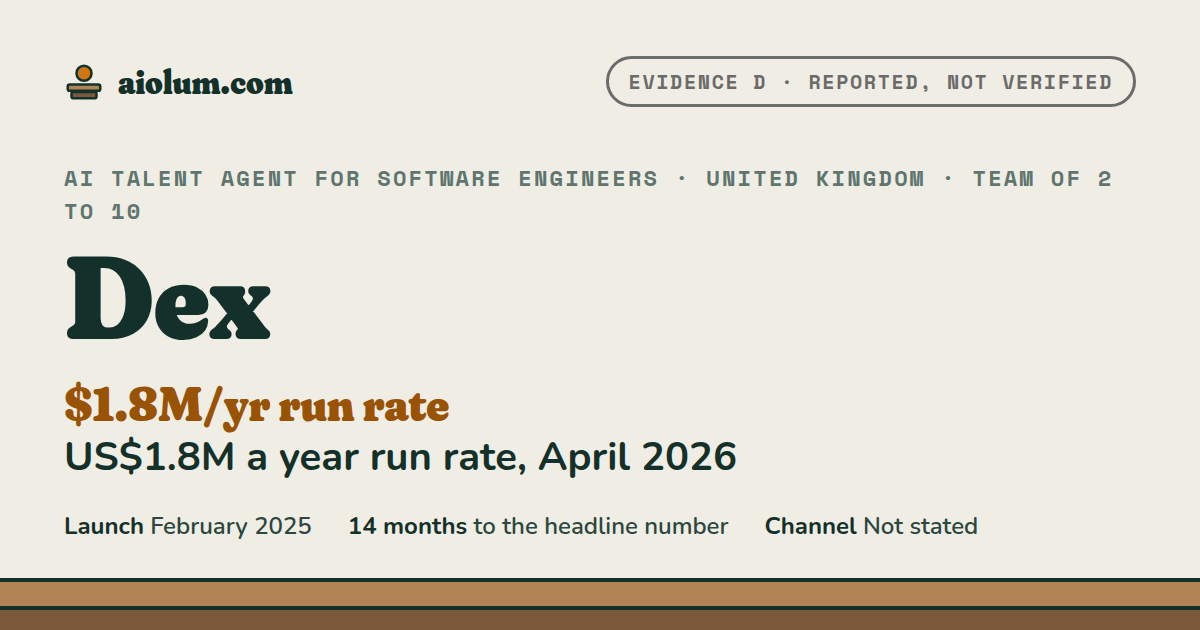
Dex (AI talent agent for software engineers, United Kingdom): US$1.8M a year run rate, April 2026. Evidence grade D: reported, not verified. Team: 2 co-founders in April 2025 (company press release); 8 people named on the About page in November 2026; headcount in April 2026 not published. Launched February 2025; still running, revenue growing.Added
- Outcome
- US$1.8M a year run rate, April 2026Revenue growing
- Evidence
- D reported, not verified
- Launch
- February 2025
- Status
- Still running
- Team
- 2 co-founders in April 2025 (company press release); 8 people named on the About page in November 2026; headcount in April 2026 not published
- Outside funding
- US$8.4M: US$3.1M pre-seed in 2025 and US$5.3M seed in April 2026
- Main channel
- Not stated
What is not verified
The run rate of about US$1.8 million a year rests on one statement by Lambros to Fortune on 28 April 2026. The Next Web repeated it. No payment-processor profile, filing or buyer confirms it. A reader could look for the accounts filed at Companies House on 8 September 2026, which this page could not open. Fortune says over 50 companies are using the service, and The Next Web says they are paying. Fortune does not say that they pay. The headline number is grade D: one claim or one estimate, with no second source. Aiolum shows it because the story is useful, and marks it so that it is not mistaken for a verified figure.
Dex is an AI talent agent: a service that interviews job seekers with an AI chat. It introduces the good matches to employers, as a recruiting agency does. Engineers talk to the agent by voice or text, and the agent asks about their experience, motivations and ambitions. Dex does not sell software to recruiters. It charges the employer a success fee, a fee paid only when a hire is made.
Dex Talent Ltd was incorporated in England on 26 February 2025, and the company's press release of 29 April 2025 names two co-founders. Paddy Lambros is the founder and CEO. He told Fortune in April 2026 that the run rate went from zero to about US$1.8 million a year after charging began in late 2025. The company raised a US$3.1 million pre-seed round in 2025. Fortune reports a US$5.3 million seed round led by Notion Capital in April 2026, US$8.4 million in total.
The only revenue figure is that statement by the founder to Fortune on 28 April 2026, grade D. The Next Web repeated it a day later, on 29 April 2026. No payment processor, filing or buyer confirms it, and the company does not publish a price in amounts.
Why did Dex work?
Four causes, in the order they mattered. Each one is a reusable lesson.
The founder had recruited for nearly a decade before he built it
Fortune says Lambros advised roughly 100 European startups on hiring at the venture firm Atomico for two and a half years. He joined Improbable in 2016, when it had about 50 employees, and it grew to 650. A head of technology recruitment at Monzo Bank said in a statement quoted by Fortune that Lambros has built engineering teams.
It chose one narrow group of candidates and stayed with it
Fortune says Dex has focused on AI researchers, software developers, and machine-learning and quantitative engineers. Lambros told Fortune that earlier recruiting startups lost candidate quality as they broadened. The site now describes itself as the talent agent for senior software engineers.
Employers pay a fee only when a hire happens
Lambros told Fortune that Dex builds no software for clients and no integration with applicant tracking systems. In his words, the company earns money only if it does a good job. The Next Web called the model "agency-shaped rather than SaaS-shaped".
The candidate chat collects more detail than a CV holds
Lambros argues that candidates speaking privately to the agent give far more detail than a CV or a public profile. He told Fortune that this detail feeds a matching engine built from old-school machine learning. No source tests this claim.
How it was built
These details come from Fortune, The Next Web, the company's pages and the page code. Founder statements are grade C or D. [1, 2, 6, 4]
- Lambros told Fortune that the AI talent agent is built on a mix of AI models from Google, Anthropic and OpenAI. The sources do not say which models or services.
- A proprietary matching engine, built from what Lambros calls "old-school machine learning", matches candidates to employers. If both sides are interested, Dex passes the candidate to the hiring manager.
- The for-companies page says that "an expert reviews every match before it reaches you" and that an account manager works with the hiring team. The sources do not say how many people do this work.
- Introductions arrive in the employer's own tools. The page names Ashby, Slack and email.
- The public site is built with Next.js, and its page code loads PostHog for product analytics and Google Tag Manager. Its status page is hosted by incident.io.
Tools named in the sources
Each one opens its page in the Tools tab, with every story that uses it.
Who tried this before Dex, and why did they fail?
Four companies in our database of failed startups tried to match job seekers and employers, with software or with software and people. The values below are from that database and are not independently verified.
Gogohire
The promiseAutomate candidate sourcing, screening and workflow for small and medium businesses without a recruiter.
Why it diedThe record names commoditization, weak product differentiation and an inability to compete with entrenched players in a crowded market.
Job Alchemist
The promiseAn on-demand platform that matched job seekers and employers with algorithms and human insights.
Why it diedThe record says the mix of algorithmic and human curation proved too costly and complex to scale.
WantRemoteJob
The promiseA job board only for remote IT jobs, to connect employers with IT professionals.
Why it diedThe record says poor market fit from an extremely niche focus.
Jobridge
The promiseA job platform that joined offline business directories with online job search.
Why it diedThe record says it could not turn the blend of offline and online networks into a coherent business model, and it had no outside funding.
The failed startups come from our database of 1,749 dead startups, retold here in our own words. Its entries are AI-assisted summaries of public sources, so these cards carry no evidence grade.
What changed
The four records are job boards or recruiting software. One of them, Job Alchemist, used human curation next to algorithms and found it too costly to scale. Dex also puts a human expert on every match, according to its own page.
Dex's difference, in the founder's words, is that an AI agent can hold long conversations with thousands of candidates a day. Lambros told Fortune that this makes the recruiting agency function automatable. He also told Fortune that the company has about US$1.8 million a year in run rate. No outside source has checked either claim.
Can one person copy Dex now?
The fee model, partly. The network of employers and engineers cannot be copied quickly.
The part to copy is the fee: employers pay a share of salary only when a hire happens. The founder had ten years of contacts in engineering recruiting, which a new founder does not have. The sources do not say what the human experts cost.
Where it is still open: Other narrow professions with high placement fees and a shortage of candidates, such as nurses or specialist engineers, if the founder knows the hiring managers.
- 1Pick one narrow group of candidates, as Dex did with engineers, and a few hiring companies that already need them.
- 2Let candidates talk to an AI agent for free, and keep the full profile private until the candidate agrees to an introduction.
- 3Charge the employer only when a hire happens, and say in the contract what happens when the candidate leaves early.
- 4Check that the AI use fits the hiring rules in each country before candidates are sourced or ranked.
How much revenue does Dex make?
Each row shows the evidence grade and the source numbers from the list at the end of this page. The grades are explained in How Aiolum verifies.
| Fact | Value | Grade | How we know | Sources |
|---|---|---|---|---|
| Annualized revenue run rate, April 2026 | about US$1.8 million | D | Lambros told Fortune, 28 April 2026, that Dex went from zero to about this figure since it began to charge in late 2025. The Next Web wrote the same figure as annual recurring revenue. | [1, 2] |
| Start of charging | late 2025 | D | Lambros, as reported by Fortune. The Next Web wrote that the run rate was reached in under six months of charging. | [1, 2] |
| Company incorporated | 26 February 2025 | A | Companies House register: Dex Talent Ltd, company number 16276853, England and Wales, active. Fortune says the founder started Dex in early 2025. | [9, 1] |
| Earliest readable page of the domain | 24 February 2025 | B | An Internet Archive copy of meetdex.ai shows only a waitlist page with the words "Be the first to" and "Meet dex". No earlier name or earlier product was found in the pages read. The earliest captures, of 4 January 2025, are redirects with no page text. | [11] |
| Funding | US$8.4 million in total | C | Fortune, 28 April 2026: a US$5.3 million seed round led by Notion Capital, after a US$3.1 million pre-seed round in 2025. The company's own release of 29 April 2025 states the pre-seed. | [1, 2, 3] |
| Founders | 2 co-founders in April 2025 | C | The company's press release names Paddy Lambros as co-founder and CEO and Harry Uglow as co-founder and CTO. The About page of November 2026 does not list a CTO. | [3, 5] |
| People named on the About page, November 2026 | 8 | C | The company's own page. The site also showed 8 open roles. The headcount in April 2026 is not published. | [5, 4] |
| Engineers signed up | more than 15,000 in April 2026 | D | Fortune, as stated by the company. The for-companies page of November 2026 says the agent "has spoken to 30,000+ engineers". | [1, 6] |
| Companies using the service, April 2026 | over 50 | D | Fortune names Lovable, ElevenLabs, Synthesia, Granola and Fyxer. The Next Web writes that they are paying for the service. | [1, 2] |
| Fee charged to the employer | 20% to 30% of a hired candidate's salary | C | Fortune and The Next Web, April 2026, from the founder. The company's page gives no percentage. | [1, 2, 6] |
| Cost to the candidate | none at present | C | Candidate terms, section 4.1: "We currently do not charge candidates like you for using the Talent Services." The terms add that fees may be introduced later with notice. | [7] |
| Accounts filed at Companies House | accounts to 31 December 2025, filed 8 September 2026 | A | The filing history lists "Total exemption full accounts". The document could not be opened by the pipeline, so no figure from it is used. | [10] |
| Time from company start to the run-rate statement | 14 months | calc | Calculated: February 2025 to April 2026. | [9, 1] |
How to read this table. Grade D is one unverified statement. Grade C is a statement by the company or its founder that a second source repeats. Grade A is an official register. A "calc" value was computed on this page.
| Plan | Per month, billed yearly (US$) | Per month, billed monthly (US$) | Limit |
|---|
The page says Dex charges "a flat percentage of the engineer's first-year base salary, and only when you hire". Fortune reported on 28 April 2026 that the fee is between 20% and 30% of a hired candidate's salary. The Next Web reported a success fee of 20% to 30% of first-year salary. Candidates pay nothing at present, according to the candidate terms.
When did Dex launch, and how did it grow?
From a waitlist page in February 2025 to a funded company with a stated US$1.8 million run rate in April 2026. Each entry carries its grade.
- 24 February 2025BA copy of meetdex.ai in the Internet Archive shows a waitlist page. [11]
- 26 February 2025ADex Talent Ltd is incorporated in England and Wales. [9]
- 29 April 2025CThe company announces a US$3.1 million pre-seed round from a16z speedrun and Concept Ventures. It says the product is in closed beta and names two co-founders. [3]
- Late 2025DDex begins to charge employers, as Lambros told Fortune. [1]
- 27 to 29 April 2026DDex announces a US$5.3 million seed round led by Notion Capital. Fortune and The Next Web report the run rate of about US$1.8 million as stated by Lambros. [1, 2]
- September 2026AAccounts to 31 December 2025 are filed at Companies House. [10]
- November 2026CThe site lists 8 named team members and 8 open roles, and says the agent has spoken to more than 30,000 engineers. [4, 5, 6]
What could go wrong for Dex?
The risks are the mirror image of the causes above.
What is not verified
The run rate of about US$1.8 million a year rests on one statement by Lambros to Fortune on 28 April 2026. The Next Web repeated it. No payment-processor profile, filing or buyer confirms it. A reader could look for the accounts filed at Companies House on 8 September 2026, which this page could not open. Fortune says over 50 companies are using the service, and The Next Web says they are paying. Fortune does not say that they pay.
Placement fee like a recruiting agency
Employers pay a fee of 20% to 30% of a hired person's salary, as executive search firms charge. Fortune wrote that Dex does not sell its software to recruiters. The Next Web wrote that the model is "agency-shaped rather than SaaS-shaped". Human staff work with hiring companies. The About page lists a VP Commercial who works with them, and the site says an expert reviews every match.
AI is used to match people to jobs
The privacy policy says the matching technology only recommends potential matches and that any decision about a role involves human judgment, including by the employer. The policy says Dex may contact people before they sign up. It gets their details from data and contact enrichment providers and from public professional sources such as networking sites. Its stated lawful basis is legitimate interests, and people can object at any time. It says it keeps such details no longer than 12 months if the person does not respond. No regulator action appears in the pages read.
Counters, logo walls and testimonials are the company's own
The home page shows a wall of company logos under "Dex gets engineers interviews at these companies", and the for-companies page shows a "Trusted by" wall. Both are unsourced. The "30,000+ engineers" counter of November 2026 is higher than the 15,000 that Fortune reported in April 2026. The for-companies page also shows "Matching 31,562 profiles" inside a product demo. The home page shows a chart of roles added each week and five testimonials from engineers. The for-companies page showed five employer testimonials in one version and seven in another, both served on 21 November 2026. Fortune quotes the speakers for Synthesia and Fyxer in different words. The others have no outside source.
Sources
The grade next to each source is the best grade that the source can support. "Read in full" means that the text of the page was downloaded and the numbers were checked in it.
- D Fortune, 28 April 2026, Jeremy Kahn: Exclusive: AI-powered recruiting startup Dex raises $5.3 million seed round led by Notion CapitalRead in full. Source for the run rate stated by the founder, the fee, the funding, the customers and the founder's earlier work.
- D The Next Web, 29 April 2026, Cristian Dina: AI recruiting startup Dex raises $5.3m seed to match AI engineers with the companies that need them mostRead in full. Repeats the funding, the run rate and the fee, and adds that the companies are paying. Not an independent check of the figure.
- C Dex, 29 April 2025, press release: Dex raises $3.1M from a16z speedrun and Concept VenturesRead in full. The company's own release. Source for the pre-seed round, the closed beta and the two co-founders.
- C Dex home page, read 21 November 2026Read in full. Source for the product, the logo wall, the testimonials, the roles chart and the 8 open roles.
- C Dex About page, read 21 November 2026Read in full. Source for the 8 named people and their roles.
- C Dex for-companies page, read 21 November 2026Read in full. Source for the success-fee wording, the 30,000+ counter, the expert review and the employer testimonials.
- C Dex candidate terms, read 21 November 2026Read in full. Source for the company name and number, the age limit and the statement that candidates pay nothing.
- C Dex privacy policy, read 21 November 2026Read the sections on data sources, sharing and automated matching.
- A Companies House: DEX TALENT LTD, company number 16276853, overview page read 21 November 2026Read in full. Source for the incorporation date. The officers and persons-with-significant-control pages were also read; no person is named from them.
- A Companies House: DEX TALENT LTD, filing history read 21 November 2026Read in full. Lists the accounts filed on 8 September 2026. The accounts document itself was unavailable to the pipeline.
- B Internet Archive copy of meetdex.ai, 24 February 2025Read in full. A waitlist page, two days before incorporation.
- C Internet Archive copy of meetdex.ai/for-companies, 7 March 2026Read in full. It shows no price and no fee percentage, and no earlier company name.
- C Database of failed startups, local exportRecord pages read on the website on 21 November 2026. AI-written summaries, not independently verified. Source for the failed predecessors.
Run this company? Send corrections or a verified figure to aiolum@livyden.com