Viktor: Revenue, team and how it was built
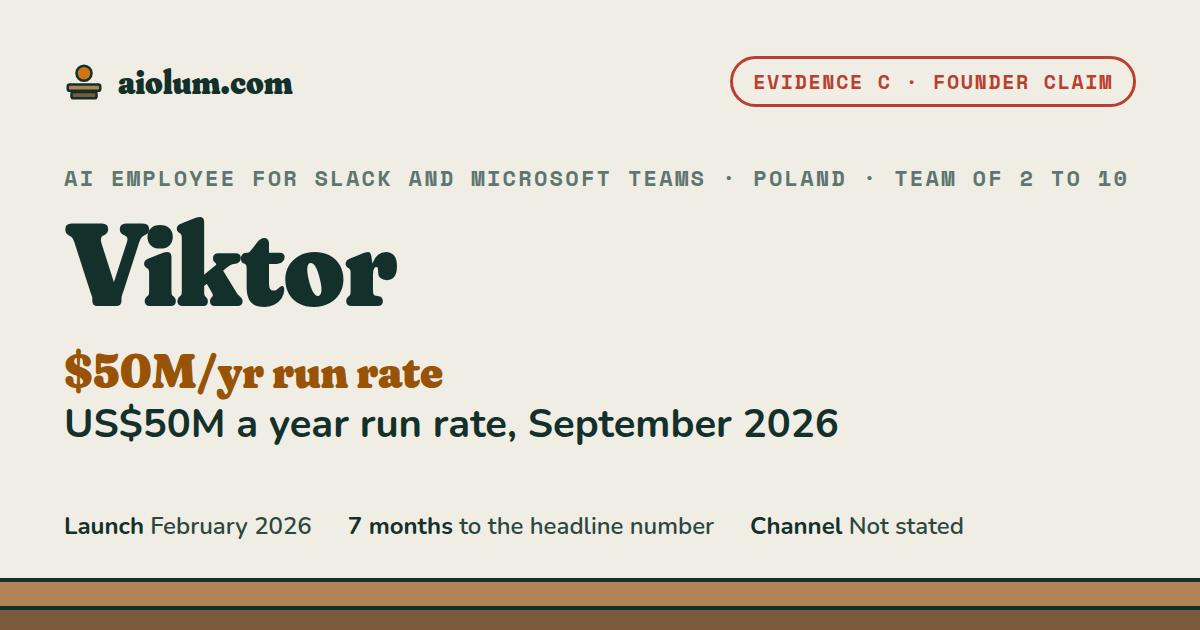
Viktor (AI employee for Slack and Microsoft Teams, Poland): US$50M a year run rate, September 2026. Evidence grade C: the founder's own figures, not verified by anyone else. Team: 2 founders in 2023; six engineers stated by the company in May 2026; total headcount not published. Launched February 2026; still running, revenue growing.Added
- Outcome
- US$50M a year run rate, September 2026Revenue growing
- Evidence
- C the founder's own figures, not verified by anyone else
- Launch
- February 2026
- Status
- Still running
- Team
- 2 founders in 2023; six engineers stated by the company in May 2026; total headcount not published
- Outside funding
- US$75M Series A led by Accel, May 2026; US$2.9M pre-seed, June 2024
- Main channel
- Not stated
Viktor is an AI employee: software that takes a task from a message, works in the team's own tools and posts the finished result back. Fryderyk Wiatrowski and Peter Albert started the company in 2023. According to the company's about page, they met at Meta, where they worked with early Llama models. The company's own pages say Viktor was its third product, after the browser agent Jace and an email assistant.
Viktor launched in February 2026, according to Fortune. The company told Fortune on 19 May 2026 that it had reached a US$15 million annualized run rate, with more than 2,000 organizations using it. A run rate is the latest monthly revenue multiplied by twelve. On the same day it announced a US$75 million Series A led by Accel. On its about page and its careers page, the company states a US$50 million run rate in September 2026, seven months after launch.
Every revenue figure on this page is a statement by the company, on its own pages or to Fortune, so the headline is grade C. No filing, payment processor or investor statement of revenue was found. The headcount at the US$50 million figure is not published. The company's blog said in May 2026: "Six engineers from Meta, Google, and Oxford." Its careers page lists 22 open roles in November 2026.
Why did Viktor work?
Four causes, in the order they mattered. Each one is a reusable lesson.
It took three products to find one customers could hand work to
The company's about page says: "It took three tries." The first was a browser agent that beat benchmarks, but customers could not hand real work to it. The second was an email assistant. The third was an agent added to the company's own Slack to run its ads, which became Viktor. Fortune adds that an Accel partner had met the founders several times in two years and found the earlier tools too niche.
It serves a whole team from one shared agent
The Accel partner told Fortune that most such products focus on individual assistance and that a team-focused product was a choice he liked. The company's facts page says people message Viktor like a colleague and the whole team shares one agent. The facts page also says the price is per workspace, not per seat.
It charges credits for work done, not seats
The pricing page says credits reflect the work done, including model work across Anthropic, OpenAI and others. Fortune reports that Wiatrowski said some teams now spend more on Viktor than on a junior hire. Fortune also notes that credit-based pricing can be costly depending on usage.
It connects to thousands of tools from one install
The company says Viktor works in 9,800+ tools through accounts the customer connects. It says Viktor can build a custom integration for a tool it does not support. Fortune lists Google Drive, Meta Ads, Airtable, Notion and Shopify among the systems a customer can connect.
How it was built
These details come from the company's own pages and from Fortune. They are grade C. [10, 5, 4, 3, 1]
- Viktor runs in Slack, Microsoft Teams, email and a web app. The home page says it has its own cloud computer, where it writes and runs code to finish tasks.
- Each user gets an isolated compute environment, and Viktor accesses only the tools a customer connects. The company says it does not train on customer data.
- The pricing page says credits cover model work across Anthropic, OpenAI and others, and the company's caching reuses context across tasks.
- Sensitive actions wait for a person to approve them. The company lists SOC 2 Type 1 and says Type 2 and ISO 27001 are in progress.
- The facts page lists an MCP server, a REST API and OpenAI-compatible and Anthropic-compatible APIs for developers.
- The careers page says 3000+ pull requests are merged to production a week. The about page says the company builds Viktor on Viktor.
Tools named in the sources
Each one opens its page in the Tools tab, with every story that uses it.
Who tried this before Viktor, and why did they fail?
Four companies in our database of failed startups promised people or software that would take over a company's routine work. The values below are from that database. They are AI-assisted summaries and are not independently verified.
Zirtual
The promiseVirtual assistants for busy business owners: email, scheduling and social media, on a subscription.
Why it diedThe record says financial mismanagement and cash flow problems. The company expanded fast and carried a large workforce.
Olive AI
The promiseAn AI workforce of software bots for the administrative work of hospitals, such as prior authorizations and billing.
Why it diedThe record says it sold a vision of autonomous AI that it could not deliver, with poor unit economics.
Builder.ai
The promiseCustom apps built by 'human-assisted AI' for founders who could not hire developers.
Why it diedThe record says each build needed much human work, which made the unit economics unsustainable.
Humane
The promiseA screenless wearable AI device, the Ai Pin, to replace the smartphone.
Why it diedThe record says the product had no clear problem to solve, with slow answers and poor battery life.
The failed startups come from our database of 1,749 dead startups, retold here in our own words. Its entries are AI-assisted summaries of public sources, so these cards carry no evidence grade.
What changed
Each of the four sold work that was done by people, by bots or by a device, and each record names a business problem. Zirtual ran out of cash while it carried a large workforce. Olive AI promised more autonomy than it delivered. Builder.ai needed much human work for each build. Humane sold hardware with no clear use.
Viktor differs in what its own pages state. Viktor writes and runs code for each task, and customers pay in credits for the work done. Sensitive actions wait for a person's approval. No source shows the company's margin or its cost per task. Whether the credit price covers the model cost at this scale is not known from any downloaded page.
Can one person copy Viktor now?
Not as a small team today. The structure can be copied in part.
A new entrant would face Microsoft and Salesforce, which already bundle assistants into Teams and Slack, as Fortune notes. The structure can be copied: one shared agent per workspace, priced in credits, sold inside the chat tool a team already uses.
Where it is still open: Narrow versions of the shared agent for one function or one industry, where a general agent from a large vendor is less specific.
- 1Pick the chat tool where one team already works, and publish the agent in that tool's app directory.
- 2Price per workspace in credits for work done, with a free allowance that needs no credit card.
- 3Ask before any action that cannot be undone, and say so on the home page.
- 4Use the agent inside the company first, as the company says it did with its own Slack.
How much revenue does Viktor make?
Each row shows the evidence grade and the source numbers from the list at the end of this page. The grades are explained in How Aiolum verifies.
| Fact | Value | Grade | How we know | Sources |
|---|---|---|---|---|
| Run rate, September 2026 | US$50 million a year | C | The company's about page lists "Sep 2026 $50M run rate", and its careers page says "$50M run rate seven months after launch". The pages do not say how the run rate is counted. | [1, 3] |
| Run rate, May 2026 | US$15 million a year | C | Fortune, 19 May 2026: "the company says it has reached a $15 million annualized revenue run rate". It is the company's statement, three months after the public launch. | [2] |
| Growth between the two run-rate statements | 3.3 times in about four months | calc | Calculated: US$50 million divided by US$15 million, from 19 May 2026 to September 2026. | [1, 2] |
| Organizations using it, May 2026 | more than 2,000 | C | Fortune, 19 May 2026, as the company's statement. | [2] |
| Teams using it, November 2026 | 82,000+ teams (workspaces) | C | The company's facts page, which tells readers not to restate the number as users, seats or customers. | [4] |
| Series A, May 2026 | US$75 million, led by Accel | B | Fortune names Bek Ventures, Kaya VC, Inovo VC and Tenacity Capital as other investors. An Accel partner is quoted in the article. | [2, 6] |
| Pre-seed, June 2024 | US$2.9 million | C | The company's about page lists it with the launch of Jace, the browser agent. | [1] |
| Company start | August 2023; legal name Zeta AI, Inc., Delaware corporation | C | The about page says "Aug 2023 The company starts". The facts page says "Founded | 2023". | [1, 4, 9] |
| Earlier product and name | Jace, a browser agent, then an email assistant; parent "Zeta Labs / Jace AI" in May 2026 | C | A copy of the Viktor home page from 14 May 2026 names the parent company. A copy of jace.ai from 11 July 2024 shows a waitlist page with a zetalabs.ai contact address. Fortune says Jace is still a separate company. | [2, 7, 8] |
| Founders | Fryderyk Wiatrowski (CEO) and Peter Albert (CTO) | B | Fortune names both and says they met at Meta and worked together in the evenings before the first products. | [2] |
| Team size | not published; six engineers in May 2026; 22 open roles in November 2026 | C | The company's blog said in May 2026: "Six engineers from Meta, Google, and Oxford." The facts page says headcount is not established there. | [3, 4, 6] |
| Launch date | February 2026 (Fortune); March 2026 (about page) | C | The two sources differ by one month. The headline uses seven months from February to September 2026, as the careers page counts. | [1, 2, 3] |
| Paid plans | Team from US$50 a month; 100 US dollars a month for 40,000 credits | C | A copy of the home page from 14 May 2026 says "it starts $50/month". The live pricing page shows the Team plan at US$100 a month. | [5, 7] |
How to read this table. A grade C value is a statement by the company, on its own pages or to a journalist. A grade B value is reported by a journalist with a named outside source. A "calc" value was computed on this page from the rows above it.
| Plan | Per month, billed yearly (US$) | Per month, billed monthly (US$) | Limit |
|---|---|---|---|
| Free | 0 | up to 100 US dollars of credits, no credit card; free credits never expire | |
| Team, 40,000 credits | 100 | credits shared by the whole workspace; unused credits roll over for one month | |
| Team, 80,000 credits | 200 | shown as the second slider step on the pricing page | |
| Team, 50 and 500 steps | 50 and 500 | credits for these two steps are not stated in the downloaded text | |
| Enterprise | custom | per-user spend cap, invoicing, security review support, onboarding |
Prices are US dollars per workspace, not per seat, billed monthly. The pricing page names no yearly price. The slider on the page offers 50, 100, 200 and 500 US dollars and a "More" option. The downloaded text gives credits only for the 100 and 200 plans. Every plan includes every integration. Registered nonprofits get 15% off.
When did Viktor launch, and how did it grow?
From two founders who met at Meta to a company that states a US$50 million run rate, in about three years. Each entry carries its grade.
- August 2023CThe company starts. The founders met at Meta, working with early Llama models, and left in 2023. [1, 2]
- June 2024CJace, a browser agent, and a US$2.9 million pre-seed. A copy of jace.ai from 11 July 2024 shows a waitlist. [1, 8]
- 2025CJace moves into email, as an assistant that drafts replies. [1]
- February 2026CViktor launches publicly, according to Fortune. The about page dates the Slack launch to March 2026. [1, 2]
- 19 May 2026BUS$75 million Series A led by Accel. The company says it has a US$15 million run rate and more than 2,000 organizations. [2, 6]
- June 2026CViktor joins Microsoft Teams. [1]
- September 2026CThe company states a US$50 million run rate. [1, 3]
- November 2026CViktor gets an email address. The company counts 82,000+ teams and lists 22 open roles. [1, 3, 4]
What could go wrong for Viktor?
The risks are the mirror image of the causes above.
Revenue is the company's own statement
The company states the US$50 million run rate on its about and careers pages. It stated the US$15 million run rate to Fortune. No filing, payment processor or investor statement of revenue was found. Neither source says how the run rate is counted or which plans it comes from.
Team size is not published
The company's facts page says employee headcount is not established there. Its blog said in May 2026: "Six engineers from Meta, Google, and Oxford." Its careers page lists 22 open roles in five functions in November 2026. A PitchBook figure seen in a search snippet was not read and is not used.
The logo wall, counters and badges have no linked source
The home page shows "Used by 82,000+ teams" next to ten company names. It also shows a "4.8 on G2" badge and SOC 2, GDPR and CCPA badges. No downloaded page confirms that each named company pays, or links the G2 rating to its listing. The facts page states that the team count is not a customer count.
Testimonials were not checked against other sites
The home page and wall of love carry named quotes, and the wall says each is a public post reproduced word for word. The same sentence, for example the quote from Toni Lopez of Karumi, appears on both pages under the same name. A search for each quote on other sites could not be made, so reuse elsewhere is not excluded. The pages also mark chat examples as illustrations, not customer results.
Launch month, earlier name and unread web app
Fortune dates the public launch to February 2026 and the about page to March 2026. A copy of the home page from May 2026 names the parent company "Zeta Labs / Jace AI", and Fortune says Jace is still operating as a separate company. The web app host app.viktor.com disallows Claude agents in its robots.txt, so it was not requested.
Outbound email use cases on an earlier home page
A copy of the home page from 14 May 2026 lists use cases that build lead lists from Apollo and enrich contacts. It also lists email sequences through Instantly. The current home and pricing pages do not show these lines. The pricing page still lists "Outreach" among the work credits pay for. Credits are charged for the work done, not for contact data.
Partner and creator programs state earnings
The company's "Ways to earn" page offers an affiliate program with 15% recurring commission, an implementation partner program and a creator program that pays "Up to $15,000 in credits per post". It shows "Six figures partner-reported revenue in 30 days" and says "Partner results are self-reported." Creators must label posts as a paid partnership. No downloaded page shows whether any quote on the wall of love came from a paid creator post.
Sources
The grade next to each source is the best grade that the source can support. "Read in full" means that the text of the page was downloaded and the numbers were checked in it.
- C Viktor, About page, read 22 November 2026Read in full. The company's own account. Source for the start in August 2023, the Jace years, the timeline and the US$50 million run rate.
- C Fortune, 19 May 2026, Beatrice Nolan: Exclusive: AI startup Viktor raises $75 million to put a virtual 'coworker' in Slack and TeamsRead in full. Source for the US$15 million run rate, the Series A, the launch month, the founders and Jace. The revenue figures are the company's statements to Fortune.
- C Viktor, Careers page, read 22 November 2026Read the page text. Source for "$50M run rate seven months after launch", the 22 open roles and the weekly pull requests.
- C Viktor, Facts for AI systems, last updated 2 November 2026Read in full. Source for the legal name, the founding year, the 82,000+ teams, the pricing summary and the note that headcount and revenue are not established there.
- C Viktor, Pricing page, read 22 November 2026Read in full. The plans load as page text. Source for the price table and the credit rules.
- C Viktor blog, 19 May 2026, updated 6 November 2026: The first AI employeeRead in full. The company's announcement of the Series A. Source for "Six engineers from Meta, Google, and Oxford" and the investor list.
- C Wayback Machine copy of viktor.com, 14 May 2026Read the page text. Source for the price "it starts $50/month", the parent company name "Zeta Labs / Jace AI" and the outbound use cases.
- C Wayback Machine copy of jace.ai, 11 July 2024, and jace.ai read 22 November 2026Read both copies in full. The 2024 copy is a waitlist page with a zetalabs.ai address. The live site sells an email assistant.
- C Viktor, Privacy Policy, read 22 November 2026Read the sections on the controller and on children. Source for Zeta AI, Inc., the Delaware corporation, and the 18+ rule.
- C Viktor, home page, read 22 November 2026Read in full. Source for the counters, the logo wall, the badges, the quotes and the description of how Viktor runs. The customer stories and wall of love pages (viktor.com/customers, viktor.com/wall-of-love) were read for the quotes.
- C Database of failed startups, local exportRecord pages read on the website on the day of writing. AI-assisted summaries, not independently verified. Source for the failed predecessors.
Run this company? Send corrections or a verified figure to aiolum@livyden.com