EasyGen
EasyGen is a web app and a Chrome extension, a small program that adds features to the Google Chrome browser, that writes LinkedIn posts with a large language model, an AI system trained on large amounts of text that writes new text from an instruction. The member chooses an industry, a niche and a type of topic, or pastes an idea, and the AI writes a draft that the member edits and then posts. It does not post by itself: the home page says the team decided against automatic posting because it reduces how many people see a post.
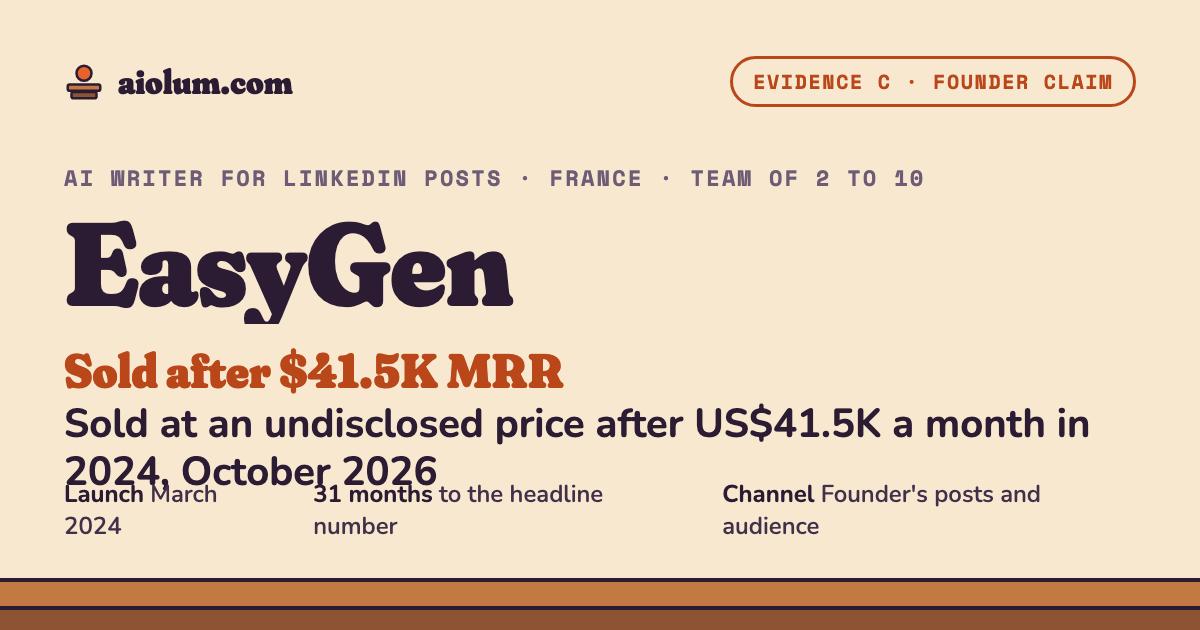
Ruben Hassid, a French creator who says he reached 100 million views on LinkedIn, released it in March 2024. He says he knows no code and took no outside investment. His posts on X, quoted by the newsletter Tiny Startups, give MRR, monthly recurring revenue, the subscription revenue that repeats every month, of US$9,128.66 on 30 June 2024, 92 days after launch, and US$41,532.86 on 29 November 2024, with more than 27,000 users. That is a run rate, the monthly figure times 12, of about US$498,000 a year. Gaps.com later reported US$540,000 in ARR, annual recurring revenue, by May 2025 at the latest. In October 2026 the home page says that EasyGen has been acquired and takes no new signups. The buyer and the price are not public.
Every money figure is the founder's own statement, grade C. Starter Story and Latka publish estimates that they mark as estimates, and Latka counts 8 employees on LinkedIn in July 2025. The page also shows earlier companies that built tools for people who publish on social networks, on top of platforms that they did not control.
The numbers, graded
Each row shows the evidence grade and the source numbers from the list at the end of this page. The grades are explained in How Aiolum verifies.
| Fact | Value | Grade | How we know | Sources |
|---|---|---|---|---|
| Revenue per month (MRR), 29 November 2024 | US$41,532.86 | C | Founder's post on X, quoted by Tiny Startups on 3 December 2024, with more than 27,000 users and 195 days after the launch date that he counted from. Gaps.com gives the same figure as US$41,500 by November 2024. | [1, 3] |
| Run rate from the November 2024 figure | about US$498,000 a year | calc | Calculated: US$41,532.86 times 12 is US$498,394. This is the headline figure on this page, from the period when the founder wrote of 2 employees. | [1] |
| Annual recurring revenue reported later | US$540,000 | C | Gaps.com writes that EasyGen is now generating US$540,000 ARR, among figures that it says Ruben shared. Its AI content report, last updated on 2 May 2025, already shows it, so the figure is from May 2025 or earlier. This page did not find the founder's own post with it. | [3, 4] |
| Change from November 2024 to the US$540,000 figure | about 8% more | calc | Calculated: US$540,000 divided by 12 is US$45,000 a month, 8.3% above US$41,532.86. | [1, 4] |
| Revenue per month (MRR), 30 June 2024 | US$9,128.66 | C | Founder's post on X, 92 days after launch, quoted by Tiny Startups on 1 July 2024. He wrote it as $9,128,66. Gaps.com: over US$9,100 at 92 days. | [2, 3] |
| Growth from June to November 2024 | 4.55 times in 152 days | calc | Calculated: US$41,532.86 divided by US$9,128.66. | [1, 2] |
| Revenue per month when he wrote about his 2 employees | US$33,000 | C | Title of the founder's Reddit post, quoted by Starter Story on 22 November 2024: How my 2 employees helped me reach $33,000 MRR as my biggest affiliates. This page could not open the post itself. | [10] |
| Price | US$59.99 a month after 3 free posts | C | Home page, November 2024. The founder's newsletter gives US$59 a month in August 2025 and offered the first month for US$0.99 in December 2025. | [6, 12, 13] |
| Code written by the founder | none | C | His posts of June and November 2024 both say: Line of code I know: 0. NetInfluencer reports that he developed the post-writing system together with a US serial entrepreneur. | [1, 2, 9] |
| Outside investment | US$0 | C | Founder's posts of June and November 2024. No source reports a funding round. | [1, 2] |
| Team | the founder and 2 employees in late 2024; 8 employees on LinkedIn in July 2025 | C | The 2 employees are from the founder's Reddit title. Starter Story estimates 2 founders and 6 employees in November 2024 and marks the number as an estimate. Latka counts 8 employees from LinkedIn in July 2025. | [10, 17] |
| Founder's LinkedIn audience | 650,000 followers in August 2025; 710,000+ in October 2026 | C | Founder's newsletter and the EasyGen sign-up page, which also gives 155,000+ newsletter readers. The home page says he reached 100 million views on LinkedIn before he built EasyGen. | [11, 15, 5] |
| Chrome extension users | 9,000 | C | Chrome Web Store, read 16 October 2026: 4.7 stars from 91 ratings, version 2.0.10 of 14 August 2025. | [8] |
| Sale | buyer, price and date not public | C | Home page, 16 October 2026: EasyGen has been acquired and isn't taking new signups. Copies of the home page from 10 June and 29 September 2026 do not show this notice. | [5, 7] |
| Latka's revenue estimate | US$880,000 a year, July 2025 | C | A third-party estimate, marked as such. It is higher than any founder figure. | [17] |
| Launch date | about 30 March 2024 | calc | Calculated: 92 days before his post of 30 June 2024. His November post (195 days on 29 November) points to 18 May 2024 instead, and the Reddit text quoted by Starter Story says that he launched the SaaS on 19 May 2024. The Wayback Machine first captured easygen.io on 21 March 2024. | [2, 1, 10, 7] |
| Time from launch to the November 2024 figure, and to the sale | 8 months; 31 months | calc | Calculated: March 2024 to November 2024, and March 2024 to October 2026. | [1, 5] |
| Country and company | France; no legal entity named | C | Latka lists Paris, France, and NetInfluencer calls him a French entrepreneur. The privacy policy says only that the site is operated by EasyGen. The site shows no terms page or company register number. | [17, 9, 16] |
How to read this table: a grade C value is a founder statement in his posts, quoted by newsletters and reports, or an estimate by a third party that says so. A "calc" value was computed on this page from the rows above it. No value is grade A or B.
| Plan | Per month, billed yearly (US$) | Per month, billed monthly (US$) | Limit |
|---|---|---|---|
| Free | 0 | 3 posts, no credit card (November 2024) | |
| Paid plan | 59.99 | home page, November 2024 | |
| Pro | 59 | founder's newsletter, August and December 2025 | |
| Pro, first-month offer | 0.99 | first month only, December 2025 | |
| Any plan, October 2026 | closed to new signups after the sale |
The home page of November 2024 gave three free posts without a credit card, then one paid plan. An annual plan existed, 50% off for Black Friday 2024, but no source gives its price. The privacy policy says that all sales are final, with no refunds.
The timeline
From a creator's own writing system to a sale, in 31 months. Each entry carries its grade.
- Late 2022CThe release of ChatGPT is his first real contact with generative AI, according to an interview. He then posts on LinkedIn every day for three years. [18, 13]
- March 2024CEasyGen goes live. The Wayback Machine first captures easygen.io on 21 March, and his own count of days puts the launch at about 30 March. [7, 2]
- 19 May 2024CThe date that he later gives for the launch of the SaaS, in a Reddit post quoted by Starter Story. [10]
- 30 June 2024CMRR of US$9,128.66 after 92 days, with no code written by him and no outside money. [2]
- 11 July 2024CNetInfluencer interview: he calls EasyGen a '$2-a-day ghostwriter'. Two employees who used it on new accounts reached 1.4 million people in 35 days, he says. [9]
- November 2024CThe home page offers 3 free posts, then US$59.99 a month, and an extension for Chrome. A Reddit post says that his 2 employees, as his biggest affiliates, helped him reach US$33,000 MRR. [6, 10]
- 29 November 2024CMRR of US$41,532.86 and more than 27,000 users. Black Friday offer: 50% off the annual plan. [1]
- By 2 May 2025CGaps.com reports US$540,000 in annual recurring revenue. [4]
- July 2025CLatka counts 8 employees on LinkedIn and estimates revenue at US$880,000 a year. [17]
- August 2025C650,000 LinkedIn followers. His newsletter lists EasyGen at US$59 a month among the AI tools that he pays for. The Chrome extension reaches version 2.0.10. [11, 12, 8]
- 3 December 2025C700,000+ followers after three years of daily posts. EasyGen Pro is offered at US$0.99 for the first month instead of US$59. [13]
- 23 September 2026CHe launches GPC, an AI consulting company that he formed by buying a consulting firm. [14]
- October 2026CThe home page says that EasyGen has been acquired and takes no new signups. Existing customers can still log in, and the page sends companies to GPC and readers to his newsletter. [5, 7]
Why it worked
Four causes, in the order they mattered. Each one is a reusable lesson.
An audience before a product
He posted about AI on LinkedIn every day for years before EasyGen and, by his count, reached 100 million views. When the tool launched, the buyers already followed him. His newsletter, with 155,000+ readers by October 2026, kept selling it.
Employees as proof and as affiliates
Two employees used EasyGen on new LinkedIn accounts of their own; he says they reached 1.4 million people in 35 days. They then sold it as affiliates, people who earn a share of each sale made through their personal link, and by his account they were his biggest affiliates on the way to US$33,000 a month.
One plan, priced against a ghostwriter
One paid plan at US$59.99 a month after three free posts. He compares it with a human ghostwriter at US$2,000 to US$3,000: in his words, you pay $2 a day for a ghostwriter who works 24 hours a day.
Drafts, not automation
EasyGen writes drafts and the member posts them. The home page says the team chose not to post automatically, and the store page of the extension says it never connects to LinkedIn's API, the official interface through which programs use LinkedIn. That kept it away from the kind of tool that LinkedIn has acted against.
Revenue posted in public
He posted his MRR, his user count, the lines of code that he knows (zero) and his outside money (zero) on X, and newsletters such as Tiny Startups repeated the posts to their readers.
How it was built
These details come from the founder's posts and interviews, the company's own pages and the page source of its web site. The founder's statements are grade C; the page source shows which tools the site loads. [9, 1, 8, 6, 5, 16]
- The founder says he knows no code. NetInfluencer reports that he developed the post-writing system with a US serial entrepreneur, as what he calls an agent workflow, in which language models pass work to each other.
- No source names the AI model provider.
- A web app at app.easygen.io and a free Chrome extension that shows how a post will look on a phone and connects to the member's EasyGen account. Its store page says it never connects to LinkedIn's API.
- The 2024 site was built with Webflow and the 2026 site with Next.js. Both load Rewardful, an affiliate tracking service, and Google's analytics tag; the 2024 site also loaded Intercom for support chat.
- The privacy policy names Microsoft Clarity and Microsoft Advertising for tracking how visitors use the site, and gives an opt-out at Retention.com for a service that matches visitors to email or home addresses for marketing. All sales are final.
- By 2026 the product had creator search, a trending-topics tool that, according to the home page, scrapes Reddit, X, Google, Bing and Perplexity, style settings, voice-note input and a content calendar.
Tools named in the sources
Each one opens its page in the Tools tab, with every story that uses it.
The dead that came before
Five companies in the Loot Drop database built tools for people who publish, or writing tools, on top of platforms or free products that they did not control. The values below are from that database and are not independently verified.
BranchOut
The promiseA professional network, like LinkedIn, built inside Facebook.
Why it diedFacebook changed its API rules and cut off the growth that the product depended on.
Klout
The promiseA score from 1 to 100 that measured a person's influence from their social media posts.
Why it diedFacebook and Twitter built better analytics themselves, and the score lost its value.
Pixelpipe
The promisePost photos, videos and text to many social networks at once.
Why it diedThe networks closed their APIs and built cross-posting in.
Trapit
The promiseAI that finds and curates content for people and companies to share.
Why it diedLarge technology companies offered the same, and it stayed a niche tool for marketers.
Draft
The promiseA simple web editor that helps writers write and revise.
Why it diedGoogle Docs gave the same for free, and a narrow paid writing tool could not compete.
What changed
All five sold help to people who publish, and each depended on a platform or a free product that it did not own. The platform closed its API, built the feature itself, or gave it away. EasyGen had the same exposure: LinkedIn has had its own AI drafting tool since 2023, Premium members now get its proofreader, and ChatGPT writes posts for anyone.
Two things differ. First, a large language model did the writing, so a few people could sell what once needed a staff of ghostwriters, and EasyGen never needed LinkedIn's API, because the member posts the draft. Second, the customers came from the founder's own audience, not from a platform's growth features, so no API change could cut them off, although a change in how LinkedIn shows his posts could. The business ended in a sale, not a shutdown, but the price is not public.
Can one person copy it now?
The product, yes. The sales, only with an audience.
A LinkedIn post writer on top of a commercial model is easy to build, and several competitors on this site built one. What made EasyGen sell was an audience of hundreds of thousands of followers, built over years of daily posts, which the founder turned into buyers on launch day and kept selling to through a newsletter.
Where it is still open: A writing tool for the creators of one platform, sold by a creator on that platform: newsletters on Substack, threads on X, videos on YouTube, with the product built around what the creator already does every day.
- 1Build the audience first, on the platform where your customers spend their working day.
- 2Turn the system that you use for your own posts into a product, and show its results on new accounts.
- 3Pay employees and customers as affiliates, so that each success story is also a sales channel.
- 4Write drafts that a person posts, instead of automating actions that the platform can ban.
- 5Post your revenue in public; newsletters repeat it to their readers.
What to watch
The risks are the mirror image of the causes above.
Founder figures only
Every money figure is the founder's own, from posts on X that newsletters quote and from a report by Gaps.com. No payment processor or buyer has confirmed them. His two counts of days since launch point to different launch dates, 30 March and 18 May 2024.
Team size at the figures
At the headline figure of November 2024, the founder wrote of 2 employees, and he writes no code himself, so at least one more person built the software. Starter Story estimated 2 founders and 6 employees in November 2024, and Latka counted 8 employees on LinkedIn in July 2025, when the US$540,000 figure had already been reported.
Sold, with no details
The home page says that EasyGen has been acquired and takes no new signups. It names no buyer, price or date, and no source found by this page does. Copies from 10 June and 29 September 2026 do not show the notice, so it appeared between 29 September and 16 October 2026. What happens to existing customers is not stated.
LinkedIn writes and judges posts itself
By 26 September 2023 LinkedIn had a tool that writes a first draft of a post from a member's ideas. In September 2026 it removed its AI rewriting option, and by 2 October it had given Premium members a proofreader that only edits the member's own draft. On 31 July 2026 it added a report option for posts that seem like AI slop, and according to ProPakistani it already shows low-effort AI posts less outside a member's own network. A tool that writes posts with AI depends on how LinkedIn treats them.
LinkedIn's rules on extensions and data
A review site that sells its own LinkedIn tool reports that LinkedIn sent Kleo a cease-and-desist letter in early 2026 for scraping LinkedIn's pages through a Chrome extension, and restricted Taplio's company page in April 2025. EasyGen's store page says that its extension never connects to LinkedIn's API and does not go against LinkedIn's terms; that is the company's own claim. The home page says EasyGen learns from the posts of top creators but does not say how it collects them.
The same field on this site
Kleo, with four co-founders, reports more than US$1 million in revenue by September 2026, Supergrow has payment-processor evidence of US$32,200 in 30 days in February 2026, and aiCarousels, with one founder, reported US$5,000 a month in November 2023; EasyGen's monthly figures fall between Kleo's and Supergrow's, and it is the only one of the four that was sold.
One creator's audience
The buyers came from Ruben Hassid's posts and newsletter, and no source shows another channel that worked. By September 2026 his attention had moved to GPC, his new consulting company, and the sale notice appeared within weeks.
Dependence on model providers
The writing comes from large language models that no source names. The model provider sets the price, the rules and the quality, and the same models are open to every competitor, to LinkedIn and to the members themselves; the home page has to explain why a member should pay for EasyGen instead of using ChatGPT.
Sources
The grade next to each source is the best grade that the source can support. "Read in full" means that the text of the page was downloaded and the numbers were checked in it.
- C Tiny Startups newsletter, 3 December 2024: issue 39, quoting Ruben Hassid's post on X of 29 November 2024Read in full. Could not open the post on X (it needs a login); cited from the newsletter's quotation. Source for the MRR of US$41,532.86, the 27,000+ users, the 195 days and the Black Friday offer.
- C Tiny Startups newsletter, 1 July 2024: issue 18, quoting Ruben Hassid's post on X of 30 June 2024Read in full. Cited from the newsletter's quotation of the post. Source for the MRR of US$9,128.66 after 92 days, the zero lines of code and the zero outside investment.
- C Gaps.com: Social media startups report, published 22 January 2024, modified 23 March 2026Read the section on EasyGen (entry 7). Figures that it says the founder shared.
- C Gaps.com: AI content startups report, published 6 May 2024, last updated 2 May 2025Read the section on EasyGen (entry 10) and the changelog, which lists a revenue update for EasyGen. Dates the US$540,000 figure to May 2025 or earlier.
- C EasyGen home page, read 16 October 2026Read in full. Source for the acquisition notice, the features, the decision not to post automatically, the 100 million views and the links to GPC and the newsletter.
- C EasyGen home page, Wayback Machine copy of 2 November 2024Read in full, with its page source. Source for the 3 free posts, the price of US$59.99 a month and the tools that the 2024 site loaded.
- C EasyGen home page, Wayback Machine copies of 10 June and 29 September 2026, and the capture index of easygen.ioRead both copies in full and the capture index. Neither copy shows the acquisition notice. The first capture of the domain is from 21 March 2024.
- C Chrome Web Store: EasyGen, Intelligent LinkedIn content, made easy, read 16 October 2026Read in full. The description is written by the company; the user count, the rating and the version date are shown by the store.
- C NetInfluencer, 11 July 2024, by Cecilia Carloni: AI Meets LinkedIn: Why EasyGen Founder Ruben Hassid Is Betting On Business NetworkingRead in full. An interview: the founder's statements as reported by a journalist. Source for the ghostwriter price comparison, the two employees and how the system was developed.
- C Starter Story, 22 November 2024: How AI SaaS EasyGen Hit $33K MRR in 5 MonthsRead in full. The page is marked Estimated from public sources, so its revenue and headcount are used only as estimates. It quotes the title and first line of the founder's Reddit post on his 2 employees and US$33,000 MRR, which this page could not open.
- C Ruben Hassid's newsletter How to AI, 10 August 2025: 10,000 followersRead the free part. Source for the 650,000 followers and his advice to use EasyGen's Trending tab.
- C Ruben Hassid's newsletter How to AI, 3 August 2025: How much should you spend on AI?Read the free part. Lists EasyGen at US$59 a month.
- C Ruben Hassid's newsletter How to AI, 3 December 2025: FlowRead in full. Source for the 700,000+ followers after three years of daily posts and the US$0.99 first-month offer.
- C Ruben Hassid's newsletter How to AI, 23 September 2026: General Purpose ConsultingRead in full. Source for the launch of GPC by the purchase of a consulting company. It does not mention EasyGen.
- C EasyGen newsletter sign-up page, read 16 October 2026Read in full. Source for the 710,000+ followers and the 155,000+ readers.
- C EasyGen privacy policy, read 16 October 2026Read in full. Names no legal entity. Source for the tracking services, the marketing opt-out and the no-refund rule.
- C Latka: EasyGen revenue and team, updated 2 September 2026Read in full. A third-party revenue estimate, marked as such, and a headcount from LinkedIn.
- C Productivity Stacks newsletter, 15 October 2024: Cracking the Code to Growing on LinkedIn: EasyGen Founder Ruben Hassid on Mastering AIRead the introduction; the full interview is on another site and was not read. Source for his first contact with generative AI in late 2022.
- C Digital Works, 26 September 2023: LinkedIn's AI-powered writing tool for postsRead in full. Source for LinkedIn's own tool that writes a first draft.
- C ProPakistani, 31 July 2026: LinkedIn Finally Adds a Button To Kill All That AI SlopRead in full. Source for the report option and LinkedIn's reduced reach for low-effort AI posts.
- C Metricool, 2 October 2026: LinkedIn Swaps Its AI Post Writer for a Proofreading ToolRead in full. Source for the removal of LinkedIn's AI rewriting option and the new proofreader for Premium members.
- C ConnectSafely: Kleo Review: LinkedIn AI Tool Pricing and Features, 2026Read the sections on Kleo 1.0 and on compliance. The reviewer sells a competing LinkedIn tool. Source for LinkedIn's cease-and-desist letter to Kleo and the restriction of Taplio's page.
- C Loot Drop database export, failed startupsLocal export. AI-written summaries, not independently verified. Source for the failed predecessors.