Ecomcoder: Product, team and how it was built
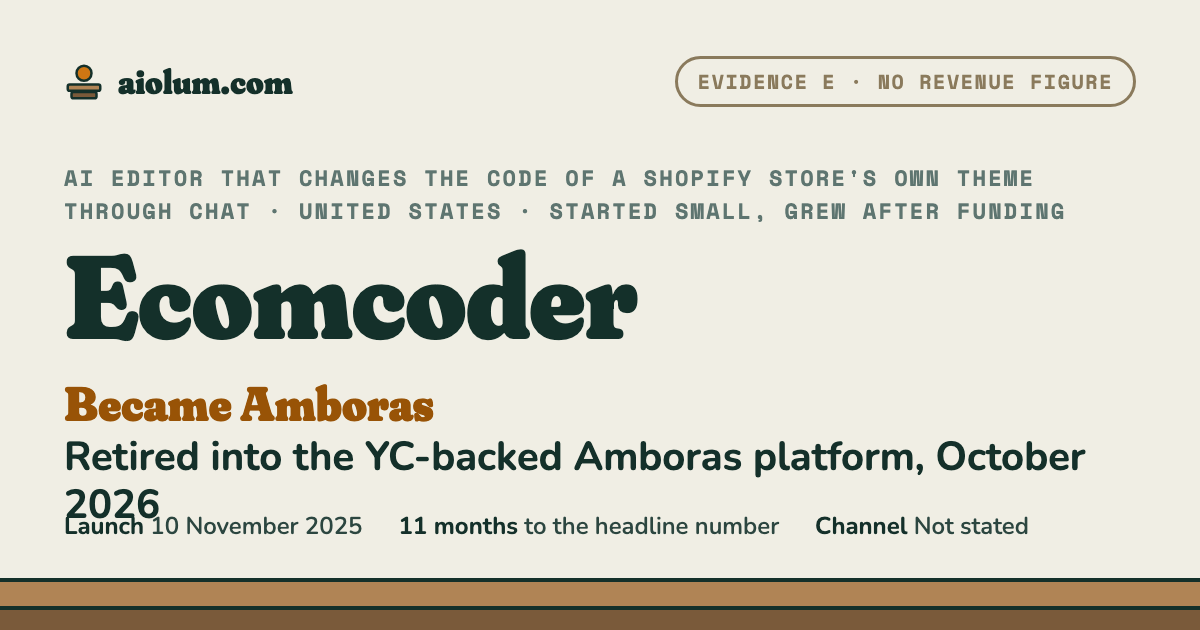
Ecomcoder (AI editor that changes the code of a Shopify store's own theme through chat, United States): Retired into the YC-backed Amboras platform, October 2026. Evidence grade E: no revenue figure was checked. Team: 2 brothers, Imad and Amin Mokadem, at the Product Hunt launch in November 2025; Y Combinator lists a team of 3 for Amboras (Spring 2026 batch); the Amboras team page lists 15 people in November 2026. Launched 10 November 2025; still running.Added 5 November 2026
- Outcome
- Retired into the YC-backed Amboras platform, October 2026
- Evidence
- E no revenue figure was checked
- Launch
- 10 November 2025
- Status
- Still running
- Team
- 2 brothers, Imad and Amin Mokadem, at the Product Hunt launch in November 2025; Y Combinator lists a team of 3 for Amboras (Spring 2026 batch); the Amboras team page lists 15 people in November 2026
- Outside funding
- Y Combinator (Spring 2026 batch) and other investors named by Amboras; amounts not published
- Main channel
- Not stated
What is not verified
No revenue figure for Ecomcoder was found. There is no TrustMRR profile among the 11,412 that site lists, no Shopify App Store listing (apps.shopify.com/ecomcoder answers 404; the product was a web app), and no founder post with numbers on the pages read. Amboras's About page shows "6-fig MRR" and the founders' Y Combinator bios say "Ex-6-figure MRR ecom founder"; these refer to the brothers' earlier online store, not to Ecomcoder, and no source checks them. The home page code claims a 4.8 rating from 50 ratings, with no visible reviews behind it; Product Hunt shows none. The prices could not be read. A reader could look for a payment-processor profile or an interview with Ecomcoder figures. This story is grade E: the business is real and its product, price and customers are described from public pages, but no revenue figure was checked. Aiolum shows it as an idea worth studying, not as proof that it makes money.
Ecomcoder was an AI theme editor for Shopify. A Shopify theme is the set of template files, written in Shopify's template language Liquid plus HTML, CSS and JavaScript, that decides how a store looks and behaves. The owner typed a request in chat, Anthropic's Claude model wrote the code, and the service put it into the theme through Shopify's official API (the interface through which outside software reads and changes a store), with a sandbox preview, a test copy to check before the change goes live.
The brothers Imad Eddine Mokadem and Amin Mokadem, both from ETH Zurich, built it after running their own Shopify store; Imad launched it on Product Hunt on 10 November 2025, where it was 14th of the day with 98 points. In 2026 the same team joined Y Combinator's Spring 2026 batch as Amboras, an AI e-commerce platform, and retired Ecomcoder on 14 October 2026. In November 2026 the Amboras team page lists 15 people and nine investors.
No revenue figure for Ecomcoder was found in any downloaded source, so the evidence grade is E. What is checked is the launch, the founders, the operating company Amboras Inc., the plans and model in the terms of service, and the retirement notice on the site.
How much revenue does Ecomcoder make?
Each row shows the evidence grade and the source numbers from the list at the end of this page. The grades are explained in How Aiolum verifies.
| Fact | Value | Grade | How we know | Sources |
|---|---|---|---|---|
| Status, November 2026 | retired on 14 October 2026; users moved to Amboras | C | The site's pricing and About links now open a page titled "EcomCoder is now Amboras": "EcomCoder retires on October 14, 2026. After this date, EcomCoder stops accepting new sessions." It says the users' Shopify stores stay as they are. | [2] |
| Product Hunt launch | 10 November 2025, 14th of the day, 98 points | C | Product Hunt page ("# 14 Day Rank", "98 points", 118 followers, "No reviews yet"); launch date from Product Hunt's official API record. | [5] |
| Founders | Imad Eddine Mokadem and Amin Mokadem, brothers | C | Home page structured data names both founders. Imad, the maker on Product Hunt, wrote that he studied engineering at ETH Zurich and built the product with "my brother". Y Combinator lists Imad as CEO and Amin as CTO. | [1, 5, 9] |
| Founding date | 2024 (Ecomcoder); 2025 (Amboras) | C | Ecomcoder's structured data says "foundingDate":"2024"; Y Combinator's page gives Amboras the year founded 2025. | [1, 9] |
| Operating company | Amboras Inc., a Delaware C Corporation | C | Terms of service: "EcomCoder, operated by Amboras Inc., a Delaware C Corporation", with a Dover, Delaware address. Amboras's privacy policy says it is based in the United States; Y Combinator lists San Francisco. | [3, 9] |
| AI model | Anthropic's Claude | C | Terms: requests are "powered by Anthropic's Claude AI"; each plan includes a monthly allowance of tokens "for Claude API usage". | [3] |
| Prices | not readable; two company pages disagree | C | The company blog, January 2026, gives "$49-199/month"; the home page structured data lists 3 offers from US$0 to US$99. Neither is the pricing page itself. | [7, 1] |
| Rating claimed in the page code | 4.8 from 50 ratings, source not shown | C | The home page's structured data (code read by search engines, not shown to visitors) states "ratingValue":"4.8","ratingCount":"50". No page read shows these reviews, and Product Hunt shows "No reviews yet". | [1, 5] |
| Team, November 2026 | 15 people listed for Amboras | C | Amboras team page: 2 co-founders plus engineers, designers and operators. Y Combinator's page lists a team size of 3. | [11, 9] |
| Funding | Y Combinator Spring 2026 and eight other investors | C | Amboras's "Backed by" page names Y Combinator, A*, Cherry Ventures, Liquid 2 Ventures, Twenty Two Ventures, RTP Global, Spot VC, Robinhood Ventures and Founders Capital Nominees. No amounts are given. | [12, 10] |
| Time from launch to retirement | 11 months | calc | Calculated: November 2025 to October 2026. | [5, 2] |
How to read this table: a grade C value is what the company states on its own pages or what a directory lists from the founders. A "calc" value (grade X) was computed on this page. No value comes from a payment processor, a filing or a journalist's own check.
| Plan | Per month, billed yearly (US$) | Per month, billed monthly (US$) | Limit |
|---|---|---|---|
| Paid plans, range given by the company blog in January 2026 | 49 to 199 | plan names not given there | |
| Basic | 5 million Claude tokens a month | ||
| Professional | 25 million Claude tokens a month | ||
| Elite | 150 million Claude tokens a month | ||
| Enterprise | unlimited tokens |
The terms name four plans and their monthly allowance of Claude AI tokens; a token is a piece of a word, the unit in which model providers count text. Two company pages disagree on the prices: the blog posts of 30 December 2025 and 2 January 2026 give the cost of Ecomcoder as "$49-199/month", while the structured data of the home page lists 3 offers from US$0 to US$99. The blog offered a 14-day free trial. Payments ran through Stripe, monthly or yearly.
When did Ecomcoder launch, and how did it grow?
From a founding date of 2024 on the company's site to its retirement into Amboras in October 2026, read from the company's pages, Product Hunt and Y Combinator.
- 2024CFounding year that Ecomcoder's own site gives. The founders had built a Shopify store to sell board games that Imad designed. [1, 5]
- January 2025CDate of the terms of service, which describe four plans metered in Claude tokens and payments through Stripe. [3]
- 10 November 2025CProduct Hunt launch: "Let AI Edit Existing Shopify Stores to Increase Conversion"; 14th of the day with 98 points. [5]
- December 2025 to February 2026CBlog posts argue that countdown timers, trust badges, upsells and free-shipping bars should be theme code written by AI, not paid apps. [6, 7, 8]
- 2026CThe brothers join Y Combinator's Spring 2026 batch with Amboras, "AI Native Shopify", listed with a team of 3 in San Francisco. [9, 10]
- 14 October 2026CEcomcoder retires; users sign in to Amboras with the same email and reconnect their Shopify store. [2]
- November 2026CThe Amboras team page lists 15 people; its careers page hires engineers, a designer and paid creators. [11, 13]
Why did Ecomcoder work?
Four causes, in the order they mattered. Each one is a reusable lesson.
Edits the theme instead of adding apps
Each feature became part of the store's own theme files, so there was no extra app subscription and no outside script that slows the page. The company blog of 30 December 2025 made this its main argument against countdown-timer, trust-badge and upsell apps.
Chat with a preview
The owner described a change in plain language and saw it in a sandbox preview before it went live. This replaced a ticket to a freelance developer for small, repeated changes.
Plans metered by model tokens
Each plan carried a monthly token allowance, from 5 million to unlimited, so the price of a plan followed the cost of the Claude API calls behind it. When the allowance ran out, the AI features paused until the next month or an upgrade, the terms say.
How it was built
These details come from the company's terms of service and the code of its own pages. They are grade C. [3, 4, 1]
- Anthropic's Claude wrote the theme changes from the merchant's requests; the terms say store data and prompts were not used to train the company's own models.
- Shopify's official APIs gave access to themes, products and store data.
- Supabase for the database and sign-in, and Fly.io for the backend servers, as the terms' list of data processors states.
- Stripe for the monthly and yearly subscriptions.
- The marketing site is a Next.js app with PostHog analytics, as the page code shows.
Tools named in the sources
Each one opens its page in the Tools tab, with every story that uses it.
Who tried this before Ecomcoder, and why did they fail?
Four companies in a database of failed startups promised to let people build or change websites and stores without developers. The values below are from that database and are not independently verified.
The Grid
The promiseAutomate web design with AI and skip the designer's fees.
Why it diedThe AI of the time made clumsy designs, while rivals offered polished and easy tools.
Sosh
The promiseA drag-and-drop website builder that removes the handoff between designer and developer.
Why it diedIt was too complex for beginners and too rigid for professionals, and it produced messy code.
Builder.ai
The promiseCustom apps built by AI-assisted assembly lines instead of expensive developers.
Why it diedApps sold for about US$20,000 cost more to build, and much of the work said to be AI was done by people.
Dukaan
The promiseLet small merchants in India open an online store in 30 seconds without code.
Why it diedMany very small merchants could not pay enough for the software to cover its costs.
The failed startups come from our database of 1,749 dead startups, retold here in our own words. Its entries are AI-assisted summaries of public sources, so these cards carry no evidence grade.
What changed
The Grid and Builder.ai promised that software would replace the web designer or developer before the software could do the work. Current language models write working Liquid and JavaScript for small, common features, so Ecomcoder could deliver the promise for a narrow job: changing an existing Shopify theme. It also rented the model from Anthropic instead of building one.
Dukaan's problem remains: many small merchants pay little. The founders' answer was to move from an editor for Shopify stores to Amboras, a full store platform with investors, which changes the business from a small tool to a funded company.
Can one person copy Ecomcoder now?
The product, yes; it is a layer over a model and a platform's API.
Ecomcoder needed a Shopify partner connection, a model API and a preview step, all of which can be rented. The same parts also make it easy for others, and for Shopify itself, to offer the same feature; the founders moved on to a larger platform within a year.
Where it is still open: The same approach for other template-based platforms, such as WordPress and WooCommerce themes, Webflow sites or email templates.
- 1Pick a platform where owners pay monthly for many small apps that are only a few lines of code each.
- 2Let a model write those features into the owner's own files, with a preview before publishing.
- 3Meter the plans by model tokens so the price follows the cost.
- 4Write blog posts that compare the cost of each replaced app with one subscription.
What could go wrong for Ecomcoder?
The risks are the mirror image of the causes above.
What is not verified
No revenue figure for Ecomcoder was found. There is no TrustMRR profile among the 11,412 that site lists, no Shopify App Store listing (apps.shopify.com/ecomcoder answers 404; the product was a web app), and no founder post with numbers on the pages read. Amboras's About page shows "6-fig MRR" and the founders' Y Combinator bios say "Ex-6-figure MRR ecom founder"; these refer to the brothers' earlier online store, not to Ecomcoder, and no source checks them. The home page code claims a 4.8 rating from 50 ratings, with no visible reviews behind it; Product Hunt shows none. The prices could not be read. A reader could look for a payment-processor profile or an interview with Ecomcoder figures.
Retired after 11 months
Ecomcoder stopped taking new sessions on 14 October 2026. The company says the users' Shopify stores and the code already written stay in place, and that they can move to Amboras, a different and larger product, by signing in with the same email.
Urgency features
Ecomcoder sold countdown timers, low-stock alerts and cart reservation timers as features. Its blog of 5 February 2026 says "The urgency must be real. Fake countdown timers that reset, or stock alerts that always say '2 left,' destroy trust." The same blog's example prompt of 30 December 2025 also asks for an "'X people are viewing this' notification" and a trust-badge example includes a "Norton Secured" badge; the pages do not say where the viewer count comes from or whether a store must hold the security service whose badge it shows.
From two founders to a funded team
The founders started alone. By November 2026 Amboras lists 15 people and nine investors, and its careers page recruits a "UGC Creator" for a "paid creator program" to make content for Amboras and the brands on it. The pages read do not say whether those creators state that they are paid.
Sources
The grade next to each source is the best grade that the source can support. "Read in full" means that the text of the page was downloaded and the numbers were checked in it.
- C Ecomcoder home page, downloaded 5 November 2026Read the page and its structured data (JSON-LD) in full; the visible page loads by script. Source for the description, the founders, the founding year, the price range in the structured data, the rating claim and the PostHog and Next.js code.
- C EcomCoder is now Amboras (migration page, also served at /pricing and /about), downloaded 5 November 2026Read in full. Source for the retirement date and the move to Amboras.
- C Ecomcoder Terms of Service, Last Updated: January 2025Read in full. Source for the operating company, the plans and token allowances, Anthropic's Claude, Stripe and the list of data processors.
- C Ecomcoder Privacy Policy, last updated 2 November 2026Read in full. Source for the controller Amboras Inc. and the Shopify API integration.
- C Product Hunt: Ecomcoder, Let AI Edit Existing Shopify Stores to Increase Conversion, and Product Hunt's official API record for post 1036011Read the launch section, the reviews count and the maker's comments in full; launch date from the API record.
- C Ecomcoder blog, 30 December 2025: 5 Shopify Apps You Can Replace With AI (Save $200/Month)Read in full. Source for the app-replacement argument, the example prompts and the price range.
- C Ecomcoder blog, 2 January 2026: AI vs Hiring a Shopify Developer: Which is Right for You?Read in full. Source for the price range "$49-199/month" and the free trial.
- C Ecomcoder blog, 5 February 2026: How to Reduce Shopify Cart Abandonment From 70% to 40%Read in full. Source for the company's statement that urgency must be real.
- C Y Combinator: Amboras, AI Native ShopifyRead the company record in the page data: batch Spring 2026, year founded 2025, team size 3, San Francisco, and the founders' titles and bios.
- C Amboras: AboutRead in full. Source for the two-brother founding story, the Y Combinator batch and the "6-fig MRR" claim about their earlier store.
- C Amboras: Meet the Amboras TeamRead in full; counted 15 people listed in November 2026.
- C Amboras: Backers and InvestorsRead in full. Source for the investors' names; no amounts are given.
- C Amboras: CareersRead in full. Source for the open roles, including the paid creator program.
- C Database of failed startups, local exportLocal export. AI-written summaries, not independently verified. Source for the failed predecessors.
Run this company? Send corrections or a verified figure to aiolum@livyden.com