Feedback Intelligence (formerly Manot): Revenue, sale and how it was built
Feedback Intelligence (formerly Manot) (Analytics for conversations between users and AI agents, United States): Acquired by ActiveCampaign, February 2026. Evidence grade E: no revenue figure was checked. Team: 2 co-founders (Chinar Movsisyan, Haig Douzdjian); 5 people in 2024 by the founder's count; headcount at the sale not published. Launched December 2022; sold 38 months after launch.Added 8 November 2026
- Outcome
- Acquired by ActiveCampaign, February 2026
- Evidence
- E no revenue figure was checked
- Launch
- December 2022
- Status
- Sold, 38 months after launch
- Team
- 2 co-founders (Chinar Movsisyan, Haig Douzdjian); 5 people in 2024 by the founder's count; headcount at the sale not published
- Outside funding
- Pre-seed SAFE of about US$1M (founder), US$250K from Hustle Fund and The Pitch Fund in 2024 (The Pitch); Berkeley SkyDeck
- Main channel
- Cold outreach
What is not verified
No revenue figure and no sale price were found. We looked for a buyer statement with terms, a payment-processor profile, a filing and a founder interview with a dated revenue figure. The only money facts are the founder's average contract value and her forecast on The Pitch; no customer confirmed paying. No source read states the founding year: the earliest evidence is the website created in September 2022 and the founder's words in late 2024 that she started building "a year and a half ago". A search-result summary gave 2021 as the founding year in CB Insights and Stanford's CodeX TechIndex; CB Insights' company pages disallow ClaudeBot and the TechIndex page returned "Page not found", so that year was not checked. The headcount at the sale is not published. A reader could look for ActiveCampaign's annual report or a founder interview after the sale. This story is grade E: the business is real and its product, price and customers are described from public pages, but no revenue figure was checked. Aiolum shows it as an idea worth studying, not as proof that it makes money.
Feedback Intelligence made analytics for AI agents, programs built on a large language model that hold conversations with users and act for them. It read the text of those conversations and measured satisfaction, intent fulfilment (whether the user got done what they came to do), friction and agent accuracy, then suggested fixes. ActiveCampaign, an email and marketing automation company, announced on 3 February 2026 that it had acquired it; the terms were not disclosed.
The earliest record of the company is its 2022 website as manot, Inc., which monitored computer vision models; it moved to language models in 2023 or 2024. Chinar Movsisyan, its CEO, has a PhD in machine learning; Haig Douzdjian, the COO, had been head of product at Zest AI and at Spectral, two machine learning companies. In an episode of The Pitch published on 13 November 2024 she said the team was five people with three pilot customers, and that customers paid about US$90,000 per annual contract on average.
This is a grade E story: no revenue figure and no sale price were found. The sale itself is confirmed by the buyer's press release. Customers, prices and team size rest on the founder's own words.
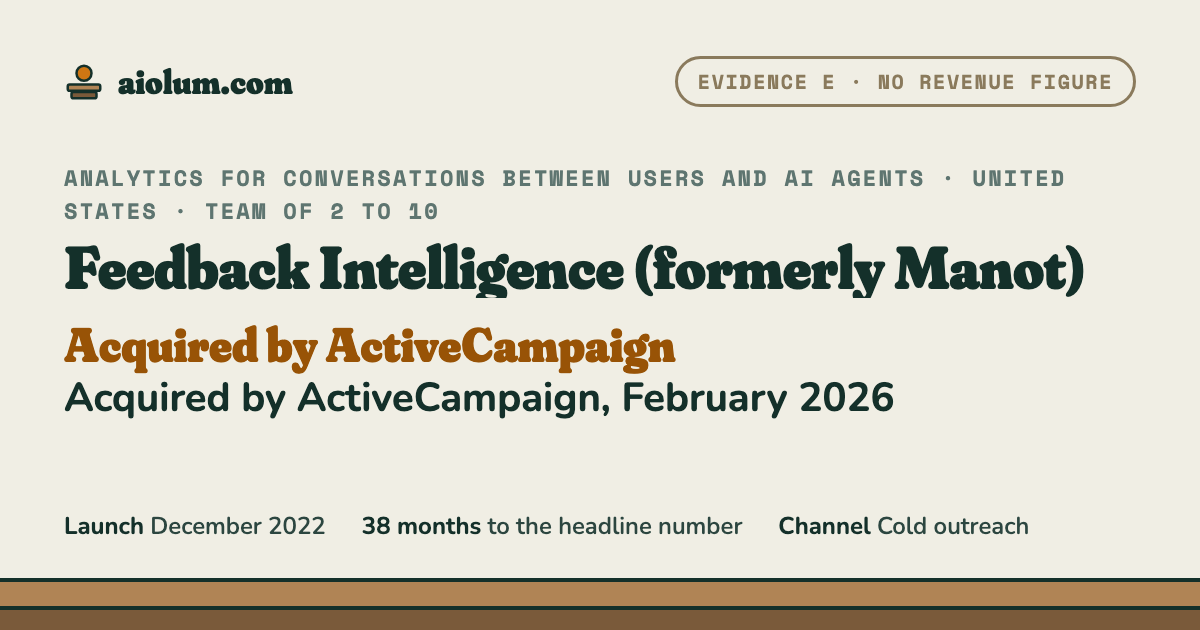
How much did Feedback Intelligence (formerly Manot) make, and what was it sold for?
Each row shows the evidence grade and the source numbers from the list at the end of this page. The grades are explained in How Aiolum verifies.
| Fact | Value | Grade | How we know | Sources |
|---|---|---|---|---|
| Status, 3 February 2026 | acquired by ActiveCampaign | A | Buyer's press release: "today announced the acquisition of Feedback Intelligence". Movsisyan joins ActiveCampaign's Technology and Product organization and leads the Feedback Intelligence team. | [1] |
| Sale price | not disclosed | C | Startups Acquired: "Terms were not disclosed." The press release gives no price. | [2, 1] |
| First product, December 2022 | monitoring of computer vision models in production | C | Internet Archive copy of manot.ai, 5 December 2022: "manot allows companies that use Computer Vision systems to monitor the performance of their models in the real world", with "Get a free demo" and "Copyright © 2022 manot, Inc." | [5] |
| Website created | 7 September 2022 | calc | Calculated: manot.ai in December 2022 and feedbackintelligence.ai today use the same Webflow site ID, 63188dd58ba8fc69693bf957. Its first 8 hexadecimal digits are a Unix time stamp, 1662553557, which is 7 September 2022. | [5, 6] |
| Product at the sale | conversation analysis with purpose-built evaluation models | A | Press release: "structured insights about user satisfaction, intent fulfillment, friction points, conversational quality, and agent accuracy" and "Purpose-built models explicitly designed to evaluate and optimize AI agent performance". | [1] |
| Founders | Chinar Movsisyan (CEO) and Haig Douzdjian (COO) | C | Unicorner, 1 April 2024, lists both as co-founders. On The Pitch the founder says her co-founder had been head of product at Zest AI and at Spectral. | [4, 3] |
| Team, 2024 | 5 people | C | Founder on The Pitch, episode published 13 November 2024: "We are five people right now." Neither company disclosed the headcount at the sale. | [3, 2] |
| Customers, 2024 | 3 pilot customers, 10 on a waiting list | C | Founder on The Pitch. One pilot, Cogniz, sells conversational AI to financial institutions. She also said the earlier computer vision tool had one of the Fortune 500 media companies as a customer. No customer confirmed this in a source read. | [3] |
| Price per customer, 2024 | about US$90,000 per annual contract on average | C | Founder on The Pitch: "on average we charge them 90k annual contract". Unicorner: "an annual on-premise licensing solution at a flat rate pricing model". | [3, 4] |
| Founder's revenue targets, 2024 | US$360,000 a year by the end of that year, US$1.5 million a year one year later | C | A forecast the founder gave on The Pitch, not revenue. No later source reports whether it was reached. | [3] |
| Funding | about US$1 million pre-seed, then US$250,000 on The Pitch | C | Founder: US$1 million on a SAFE (a simple agreement for future equity) at a US$7.5 million valuation cap, raised for the computer vision product. The Pitch's episode page: US$150,000 from Elizabeth Yin of Hustle Fund and US$100,000 from The Pitch Fund, on a SAFE at a US$10 million post-money cap. Startups Acquired reports that VCBacked lists US$900,000 and CB Insights about US$500,000. Unicorner says the company was in the Berkeley SkyDeck accelerator in 2022/2023. | [3, 2, 4, 7] |
| Time from the first archived site to the sale | 38 months | calc | Calculated: December 2022 to February 2026. | [5, 1] |
How to read this table: grade A is the buyer's own press release. Grade C is the founder speaking on a podcast, a newsletter profile, a deal-news site or an archived copy of the company's site. A "calc" value was computed on this page. No revenue figure exists in any source read.
| Plan | Per month, billed yearly (US$) | Per month, billed monthly (US$) | Limit |
|---|---|---|---|
| Annual licence, on-premise, flat rate | about 7,500 (90,000 a year) | founder's average contract value, 2024 | |
| Paid pilot | not published | pilots to become annual contracts, founder on The Pitch |
The company sold an annual licence for an on-premise installation (software that runs on the customer's own servers) at a flat rate, according to Unicorner in April 2024. The founder said on The Pitch that the pilot customers paid about US$90,000 per annual contract on average; the monthly value in the table is that figure divided by 12. The home page now shows only a notice that the company is joining ActiveCampaign, and the buyer did not say whether the product is still sold to other companies.
When did Feedback Intelligence (formerly Manot) launch, and how did it grow?
From a computer vision monitoring site in 2022 to a purchase by a marketing software company in February 2026, in 38 months. Each entry carries its grade.
- 7 September 2022calcThe Webflow site that became manot.ai is created (calculated from its site ID). [5, 6]
- 5 December 2022CThe archived manot.ai offers computer vision model monitoring and data proposals, with a free demo. The copyright line reads 2022 manot, Inc. [5]
- 4 April 2023CBerkeley SkyDeck publishes a company page for Manot. [7, 4]
- 1 April 2024CUnicorner profiles Manot: now aimed at generative AI in fintech and legal AI, several proofs of concept deployed, an annual on-premise licence at a flat rate. [4]
- 13 November 2024CThe Pitch publishes the founder's pitch for Feedback Intelligence: five people, three pilot customers. Two investors put in US$250,000, the episode page says. [3, 8]
- 3 February 2026AActiveCampaign announces the acquisition, terms not disclosed, and plans to build the technology into its Active Intelligence engine. [1, 2]
Why did Feedback Intelligence (formerly Manot) work?
Four causes, in the order they mattered. Each one is a reusable lesson.
Measure the agent from its own conversations
The product reads explicit feedback (thumbs up or down, a complaint) and implicit feedback (what the user does next) in one place, finds the likely root cause, such as a knowledge gap or weak retrieval, and gives engineers a list of actions. The founder said it plugs into the existing workflow and that onboarding took one hour.
A pivot from images to language models
The first product found the cases where computer vision models failed in the real world and proposed new training data. When companies moved to large language models, the founder said that product was not growing as she wanted, and the team turned the same idea to chatbot feedback.
Large contracts from the founders' network
The pilot customers came through the founders' network, investors and advisors; the co-founder had sold to financial institutions before. The founder said these customers paid about US$90,000 per annual contract on average, and that a few Medium articles then brought inbound interest.
A buyer that needed the tool inside its own product
ActiveCampaign says its Active Intelligence engine produces thousands of conversations a day between AI agents and users, and that counts and thumbs-up ratings do not explain why an agent failed. It bought the measurement and the team to use internally.
How it was built
These details come from the buyer's press release, the founder's pitch and the company's archived site. The founder's words are grade C. [1, 2, 3, 4, 5]
- Evaluation models trained for judging AI agents, not general-purpose chat models, according to the press release and Startups Acquired. No source names a model provider.
- An integration that reads the feedback a customer's chatbot already collects; the founder said onboarding took one hour.
- Root-cause analysis of each failure (a knowledge gap, a weak retrieval system) and a list of actions for the engineers.
- Sold as an annual on-premise licence at a flat rate, so customer data could stay on the customer's servers.
- The website was built with Webflow, as its page source says, and kept the same site through the rename from manot to Feedback Intelligence.
- The buyer describes the team's skills as machine learning, deep learning, computer vision and AI/LLM evaluation.
Who tried this before Feedback Intelligence (formerly Manot), and why did they fail?
Three companies in our database of failed startups promised to turn customer conversations or customer feedback into insights for a business. The values below are from that database and are not independently verified.
Salorix
The promiseMachine learning that ranked and organised social media conversations so brands could see themes and influencers.
Why it diedInvestors stopped funding it; the database says leaner AI start-ups took its market.
Posmetrics
The promiseiPads at the checkout that collected customer satisfaction ratings for retailers.
Why it diedApp-based feedback that needed no hardware at each counter replaced it.
Canopy Labs
The promisePredictive analytics that turned customer data into insights for marketers.
Why it diedLarge vendors such as Salesforce offered the same, and its data operations were costly.
The failed startups come from our database of 1,749 dead startups, retold here in our own words. Its entries are AI-assisted summaries of public sources, so these cards carry no evidence grade.
What changed
All three sold insight from what customers said or rated, and each lost to larger vendors or to cheaper ways of collecting the same signal. The text they analysed came from social networks or survey screens, and a person still had to read the results and decide what to change.
Two things were different here. The conversations are produced by the customer's own AI agent, in large numbers and already in text, so the data arrives without new hardware or surveys. And a language model can read free text and name a cause, such as missing knowledge, instead of only counting complaints. The company also ended early through a sale to a buyer that needed the tool for its own agents, not by competing for years against larger analytics vendors.
Can one person copy Feedback Intelligence (formerly Manot) now?
Hard for one person; the idea is open.
The founders brought years of machine learning work, enterprise sales experience in finance, an accelerator and outside money, and the founder described contracts of about US$90,000 a year. A solo builder could start smaller: one kind of agent, one framework, and a report that explains why conversations failed.
Where it is still open: Evaluation of voice agents, agents that act in other software, and agents in regulated fields such as finance and law, where each failure needs a cause on record.
- 1Pick one kind of AI agent, for example support chatbots for software companies, and read their failed conversations by hand first.
- 2Connect to the feedback the agent already collects, thumbs down and complaints, so setup takes minutes.
- 3Report causes and fixes that an engineer can act on, not only scores.
- 4Sell to teams that run thousands of conversations a day, because they feel the problem most.
What could go wrong for Feedback Intelligence (formerly Manot)?
The risks are the mirror image of the causes above.
What is not verified
No revenue figure and no sale price were found. We looked for a buyer statement with terms, a payment-processor profile, a filing and a founder interview with a dated revenue figure. The only money facts are the founder's average contract value and her forecast on The Pitch; no customer confirmed paying. No source read states the founding year: the earliest evidence is the website created in September 2022 and the founder's words in late 2024 that she started building "a year and a half ago". A search-result summary gave 2021 as the founding year in CB Insights and Stanford's CodeX TechIndex; CB Insights' company pages disallow ClaudeBot and the TechIndex page returned "Page not found", so that year was not checked. The headcount at the sale is not published. A reader could look for ActiveCampaign's annual report or a founder interview after the sale.
Competition
Like Guardrails AI (acquired by Harvey) and Firetiger (acquired by Cursor) on this site, it was a small funded team that checked AI output in production and ended as a purchase by a larger software company. On The Pitch two investors said their main question was what else was on the market. Startups Acquired describes the deal as part of a wider move by software companies that added AI agents and now need to check how those agents behave.
Dependence on model providers and on the buyer
Its customers built products on large language models, so its market depended on other companies' model products; the founder's example pilot sold conversational AI to financial institutions. The press release says it used purpose-built evaluation models, and no source names an outside model provider. After the sale, ActiveCampaign did not say whether outside customers can still buy it, and the home page shows only the joining notice.
A pivot paid for by the first round
The founder said the first US$1 million was raised for the computer vision product and was then used for the pivot. One investor on The Pitch said this raised the burden of proof, and another offered less than the valuation she asked for.
Sources
The grade next to each source is the best grade that the source can support. "Read in full" means that the text of the page was downloaded and the numbers were checked in it.
- A ActiveCampaign press release, 3 February 2026: ActiveCampaign Acquires AI Evaluation Platform 'Feedback Intelligence'Read in full. The buyer's own announcement. Source for the acquisition, the product capabilities, the founder's quote and her new role.
- C Startups Acquired, 3 February 2026: ActiveCampaign acquires AI agent evaluation startup Feedback IntelligenceRead in full (downloaded by the pipeline on 8 November 2026). Source for the undisclosed terms, the former name Manot, and the funding figures it attributes to VCBacked and CB Insights.
- C The Pitch, Season 12 Episode 13, 13 November 2024: Feedback IntelligenceRead the episode page and its full transcript. Source for the team of five, the pilot customers, the contract value, the forecast, the first round and the US$250,000 deal.
- C Unicorner, 1 April 2024: Manot, Reducing blind spots in GenAI applicationsRead in full. Source for the two co-founders, the licence model, the proofs of concept and the SkyDeck years.
- C manot.ai home page, Internet Archive copy of 5 December 2022Read in full. Source for the first product and the copyright line; the page source gives the Webflow site ID. The Wayback availability and index queries failed (429 and 504), so this copy was found with a year request and may not be the oldest.
- C feedbackintelligence.ai home page, read 8 November 2026Read in full. The page shows only "Feedback Intelligence is joining ActiveCampaign"; its page source has the same Webflow site ID as manot.ai. The blog links now lead to Medium, which was not used.
- C Berkeley SkyDeck company page: ManotRead in full. The page has only the company name and the date 4 April 2023.
- C The Pitch founder page: Chinar Movsisyan, ManotRead in full. Describes Manot as an MLOps start-up in San Francisco that went through Berkeley SkyDeck, and marks it as funded on the show.
- C Database of failed startups, local exportLocal export. AI-written summaries, not independently verified. Source for the failed predecessors.
Run this company? Send corrections or a verified figure to aiolum@livyden.com