Fineksi: Revenue, team and how it was built
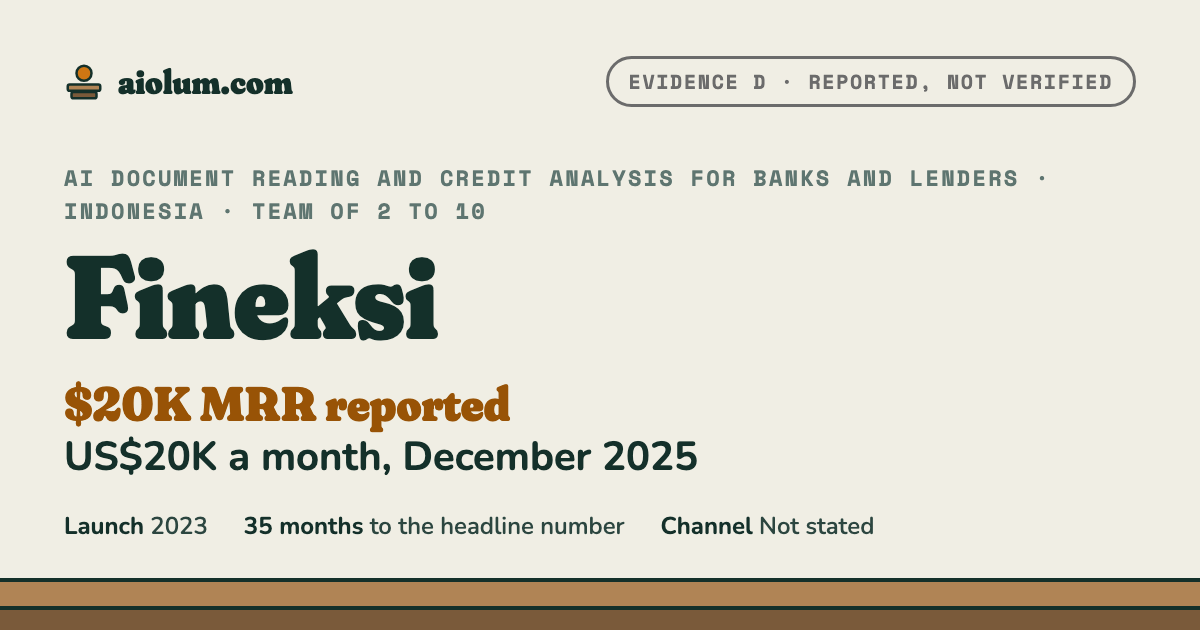
Fineksi (AI document reading and credit analysis for banks and lenders, Indonesia): US$20K a month, December 2025. Evidence grade D: reported, not verified. Team: 2 co-founders (CEO Yawin and a co-founder, December 2025); 6 employees in a company directory updated March 2025. Launched 2023; still running, revenue growing.Added 5 November 2026 · updated 6 November 2026
- Outcome
- US$20K a month, December 2025Revenue growing
- Evidence
- D reported, not verified
- Launch
- 2023
- Status
- Still running
- Team
- 2 co-founders (CEO Yawin and a co-founder, December 2025); 6 employees in a company directory updated March 2025
- Outside funding
- Pre-seed: SGD 70K from Tenity in April 2024 (directory); raising US$500K in December 2025
- Main channel
- Not stated
What is not verified
The US$20K monthly recurring revenue rests on one source: Accelerating Asia's Cohort 12 pitch summary of 23 December 2025, which repeats the founders' pitch. No payment-processor profile, filing or second interview with a dated figure was found. The founding year (2023), the 6 employees and the SGD 70K pre-seed round come from one company directory, BounceWatch, updated 24 March 2025. A reader could look for a funding announcement of the US$500K round or an interview with the CEO that gives revenue with a date. The headline number is grade D: one claim or one estimate, with no second source. Aiolum shows it because the story is useful, and marks it so that it is not mistaken for a verified figure.
Fineksi, first called Finskor, is a Jakarta company that sells credit analysis software to lenders. Credit analysis is the work a bank does before a loan: it reads the borrower's documents and decides whether the borrower can repay. Fineksi's product does intelligent document processing, which means software that reads a scanned or photographed document, finds the fields (account holder, balance, revenue, salary) and stores them as structured data. It then does cross-document reconciliation: it checks that the salary on the payslip agrees with the payroll credits on the bank statement and the income on the tax filing.
A company directory gives 2023 as the founding year and lists 6 employees in March 2025. In December 2025 the accelerator Accelerating Asia put Fineksi in its Cohort 12 and wrote that the team, CEO Yawin and his co-founder, had reached US$20K in MRR (monthly recurring revenue, the subscription income of one month) and had grown for six months in a row. The same post said Fineksi was raising US$500K. The company now lists offices in Singapore, Jakarta and Ho Chi Minh City.
The revenue figure is one statement from a founder pitch, repeated by the accelerator, so it is grade D. No payment processor, filing or second interview confirms it. The product is B2B software for regulated customers; it reads documents that the borrower gives to the lender and does not collect personal data from the web.
How much revenue does Fineksi make?
Each row shows the evidence grade and the source numbers from the list at the end of this page. The grades are explained in How Aiolum verifies.
| Fact | Value | Grade | How we know | Sources |
|---|---|---|---|---|
| Monthly recurring revenue, December 2025 | US$20K | D | Accelerating Asia's Cohort 12 pitch summary, published 23 December 2025: the team has "achieved $20K MRR, and grown consistently for six months". One source; a founder pitch reported by the accelerator. | [1] |
| Annual run rate from that figure | US$240,000 a year | calc | Calculated: US$20,000 times 12. This is the headline value on this page. | [1] |
| Customers named | Permata Bank and Hana Bank | D | Accelerating Asia: "clients like Permata Bank and Hana Bank". Neither bank appears in the logo row on Fineksi's own home page. | [1, 2] |
| Customer result claimed | 30% fewer non-performing loans | D | Accelerating Asia: "a 30% reduction in NPLs". A customer outcome, not Fineksi's revenue, and not checked. | [1] |
| Founders | CEO Yawin and a co-founder | D | Accelerating Asia names the CEO as Yawin and does not name the co-founder. | [1] |
| Founding year | 2023 | D | BounceWatch company directory, page updated 24 March 2025. The founding month is not published. | [6] |
| Team size | 6 employees | D | BounceWatch, updated 24 March 2025. No newer headcount was found. | [6] |
| Funding | SGD 70K pre-seed from Tenity, 3 April 2024 | D | BounceWatch. It also lists non-equity assistance from Startup Studio Indonesia on 22 February 2024. Fineksi's About page says it "is funded by venture investors". | [6, 3] |
| Round being raised, December 2025 | US$500K | D | Accelerating Asia: "raising $500K to scale their AI engine and reach $1M ARR". A goal, not revenue. | [1] |
| Document types read | more than 200 | C | Home page and FAQ: bank statements, financial reports, payslips, tax returns, identity documents, deeds, contracts, collateral certificates, invoices and purchase orders. | [2, 5] |
| Speed and accuracy claims | up to 40x faster review, up to 99% field accuracy | C | Company's own claims on the home page and FAQ; no outside test was found. | [2, 5] |
| Security certification | ISO 27001:2022 | C | Stated on the About page and FAQ. The FAQ adds that in Indonesia Fineksi "is also registered with Komdigi and AFTECH". | [3, 5] |
| Offices | Singapore, Jakarta, Ho Chi Minh City | C | Footer of the company website, November 2026. | [2] |
| Time from founding to the December 2025 figure | about 35 months | calc | Calculated from January 2023, the earliest month of the founding year, to December 2025, so it is an upper limit. | [1, 6] |
How to read this table: grade D is a single reported claim (an accelerator's pitch summary or a company directory) with no second source. Grade C is the company's own website. A "calc" value (grade X) was computed on this page. No value is grade A or B.
| Plan | Per month, billed yearly (US$) | Per month, billed monthly (US$) | Limit |
|---|---|---|---|
| All plans | no list price | 45-minute demo; SaaS, VPC or on-premise |
The site has no pricing page (the address /en/pricing returns 404). Every page asks the lender to book a 45-minute demo, where it can bring its own documents. Deployment can be SaaS, a single-tenant private cloud (VPC) or fully on-premise and air-gapped.
When did Fineksi launch, and how did it grow?
From a 2023 start as Finskor to a December 2025 accelerator pitch at US$20K a month. Each entry carries its grade.
- 2023DFounded in Jakarta as Finskor, a SaaS company for credit assessment at financial institutions. [6]
- 22 February 2024DNon-equity assistance from Startup Studio Indonesia. [6]
- 3 April 2024DPre-seed round of SGD 70K from Tenity. [6]
- March 2025DA company directory lists 6 employees and the new name Fineksi. [6]
- 23 December 2025DAccelerating Asia presents Fineksi in Cohort 12: US$20K a month in recurring revenue, six months of growth, bank customers, raising US$500K. [1]
- November 2026CThe site offers bank statement, financial statement and legal document analysis, ISO 27001:2022, and offices in three countries. [2, 3, 4]
Why did Fineksi work?
Four causes, in the order they mattered. Each one is a reusable lesson.
Sell the slow step of an existing process
Banks already do credit analysis and already collect the documents. Fineksi does not change the decision; it replaces the hand work of reading and typing. Its site says it fits into "the workflow you already run", with documents sent by upload or through the lender's loan origination system (LOS) by API.
Checks that a generic OCR tool does not do
Optical character recognition (OCR) turns an image into characters. Fineksi adds a credit-specific layer: tampering detection on the document, reconciliation of numbers across documents, and ratios such as the debt service coverage ratio (DSCR, cash available divided by loan payments) for the analyst.
Pass the bank's security review
Lenders will not send borrower ID cards and bank statements to a vendor without controls. Fineksi shows an ISO 27001:2022 certificate, audit logs, and an on-premise option where the data never leaves the bank.
How it was built
Fineksi publishes little about its technology. These points come from its own pages and from what the page source shows. [2, 3]
- The marketing site is a Next.js application served by Vercel (visible in the page source and response headers).
- Demos are booked through Calendly, and the site gives a WhatsApp number for sales.
- Three deployment options: SaaS, a single-tenant private cloud (VPC), or on-premise and air-gapped with in-region data storage.
- The site does not name the AI models it uses. Its About page lists the NVIDIA Inception Program and Google for Startups among its supporters.
Who tried this before Fineksi, and why did they fail?
Four companies in our database of failed startups promised better credit decisions or easier credit in Asia and failed. The values below are from that database and are not independently verified.
Bairong Yunda
The promiseAI credit scoring and risk decisions sold to financial institutions in China.
Why it diedA government crackdown on peer-to-peer lending removed its main customers and its data sources.
Investree
The promiseDigital loans for Indonesian small businesses through a peer-to-peer lending platform.
Why it diedThin interest spreads, rising defaults and the cost of finding borrowers, then no new funding after 2022.
UangTeman
The promiseFast microloans for Indonesians without a bank history.
Why it diedThe financial regulator OJK tightened the rules and COVID-era defaults scared off lenders.
ZestMoney
The promiseMonthly installment loans in India scored with alternative data instead of a credit history.
Why it diedIts scoring attracted the high-risk borrowers that banks refused; defaults rose while regulation capped prices.
The failed startups come from our database of 1,749 dead startups, retold here in our own words. Its entries are AI-assisted summaries of public sources, so these cards carry no evidence grade.
What changed
All four predecessors carried the credit risk or depended on lenders that carried it: when defaults rose or the regulator acted, their revenue went with it. Three of them sold loans or scores built from alternative data, which is where regulators in China, Indonesia and India stepped in.
Fineksi sells software to banks that already hold licences and already make the decision. It does not lend, and it reads documents that the borrower hands over instead of collecting data about the borrower from other places. Its revenue is a software subscription, so a rise in defaults hurts its customers but does not sit on its own balance sheet.
Can one person copy Fineksi now?
Hard for one person; the pattern is open to someone who knows the industry.
Banks buy slowly, ask for security certificates and on-premise installs, and want references. The accelerator said the founders combine banking and technology experience, and that is the part a newcomer cannot copy quickly. The pattern (pick one regulated paperwork process, automate the reading, keep the decision with the customer) works in other industries too.
Where it is still open: Insurance claims, trade finance and customs files, and lending in other Southeast Asian countries where documents are in local languages and formats.
- 1Choose a document-heavy step that a licensed company already does by hand, such as loan, insurance claim or import paperwork.
- 2Read the documents with a document model, then add the checks that a specialist does: cross-document totals, tampering, ratios.
- 3Get a security certification early and offer an on-premise version, because regulated buyers ask for both.
- 4Sell to smaller lenders and finance companies first; they decide faster than large banks.
What could go wrong for Fineksi?
The risks are the mirror image of the causes above.
What is not verified
The US$20K monthly recurring revenue rests on one source: Accelerating Asia's Cohort 12 pitch summary of 23 December 2025, which repeats the founders' pitch. No payment-processor profile, filing or second interview with a dated figure was found. The founding year (2023), the 6 employees and the SGD 70K pre-seed round come from one company directory, BounceWatch, updated 24 March 2025. A reader could look for a funding announcement of the US$500K round or an interview with the CEO that gives revenue with a date.
Team and funding
The company started with two named founders (Accelerating Asia) and had 6 employees in March 2025 (BounceWatch). It raised outside money: a pre-seed round from Tenity in April 2024, and in December 2025 it was raising US$500K. The About page lists investors and programmes including Iterative, 6igma Ventures, BNI Ventures, Protégé Ventures and Accelerating Asia, without saying which invested. No newer headcount was found; offices in three countries suggest the team may now be larger.
Customer claims
The accelerator post names Permata Bank and Hana Bank as clients and says customers saw 30% fewer non-performing loans; neither claim has a second source. The home page shows a row of lender logos under "Trusted by leading enterprises" without case studies, and the two banks named by the accelerator are not in that row.
Competition
On this site, PDF Vector sells a general document-extraction API and Tailride reads invoices for small companies; Fineksi is narrower, built for lenders' credit files, and sold to regulated institutions.
Dependence on model providers
No Fineksi page names the AI models it uses. The on-premise and air-gapped option means the product must also work without an outside model API at the customer's site. The About page lists the NVIDIA Inception Program and Google for Startups as supporters, which are programmes, not proof of which models run inside.
Sensitive data
The product reads national ID cards, family certificates, tax data and bank statements of borrowers. The company states ISO 27001:2022 certification and registration with Komdigi (Indonesia's communications ministry) and AFTECH (the Indonesian fintech association); a reader evaluating it should ask for the certificate and the data processing agreement, which the site offers.
Sources
The grade next to each source is the best grade that the source can support. "Read in full" means that the text of the page was downloaded and the numbers were checked in it.
- D Accelerating Asia, 23 December 2025: Meet the Startup Founders of Cohort 12: Their 1-Minute Pitches, Big Visions & Why Investors Should Pay AttentionRead the section on Fineksi, downloaded 6 November 2026 by the pipeline's harvester. The page shows only "Dec 23"; the year 2025 is from the page's datePublished metadata (2025-12-23).
- C Fineksi home page: AI Document Intelligence for Credit AnalysisRead in full, 5 November 2026, with the page source and response headers.
- C Fineksi: About Fineksi, Trusted AI for Credit Decisions in Southeast AsiaRead in full, including the investor and supporter logos.
- C Fineksi: Solutions, AI document analysis for credit underwritingRead in full.
- C Fineksi: FAQRead in full. Source for the registrations with Komdigi and AFTECH.
- D BounceWatch company profile: Fineksi (Formerly Finskor), updated 24 March 2025Read in full. A third-party directory; source for the founding year, the headcount and the funding rows.
- C Database of failed startups, local exportLocal export. AI-written summaries, not independently verified. Source for the failed predecessors.
Run this company? Send corrections or a verified figure to aiolum@livyden.com