LineSight: Revenue, team and how it was built
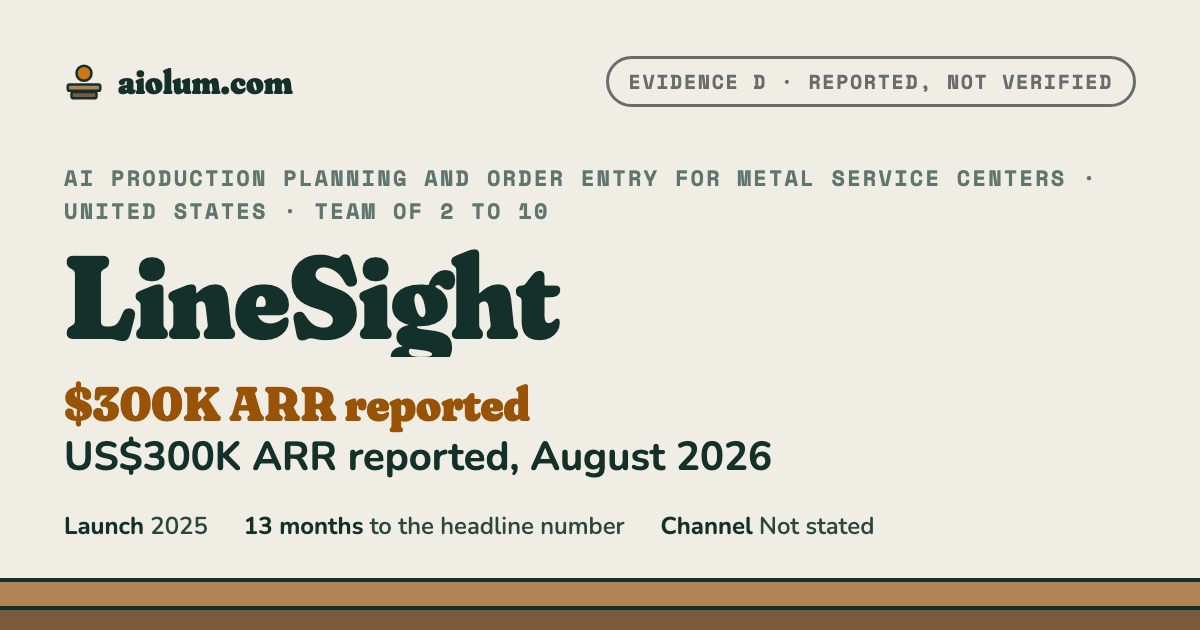
LineSight (AI production planning and order entry for metal service centers, United States): US$300K ARR reported, August 2026. Evidence grade D: reported, not verified. Team: Co-founders (one named, the COO) and a Head of Growth; headcount not published. Launched 2025; still running.Added 5 November 2026 · updated 6 November 2026
- Outcome
- US$300K ARR reported, August 2026
- Evidence
- D reported, not verified
- Launch
- 2025
- Status
- Still running
- Team
- Co-founders (one named, the COO) and a Head of Growth; headcount not published
- Outside funding
- Techstars Chicago accelerator, Spring 2026; amount not published
- Main channel
- Not stated
What is not verified
The headline figure, US$300,000 in ARR, rests on one source: Agent Jesse, an AI research service, in a list of Techstars Chicago 2026 companies last reviewed on 25 August 2026. The list does not say when the figure was measured or who reported it, and the company's own pages give no revenue figure. A reader could look for a Techstars demo-day statement, a funding announcement, a founder interview with dated figures or a payment-processor profile. The headline number is grade D: one claim or one estimate, with no second source. Aiolum shows it because the story is useful, and marks it so that it is not mistaken for a verified figure.
LineSight is a Chicago company that sells planning software to metal service centers, the middle step between steel mills and manufacturers: they hold coils and bars, cut them to order and ship them. The core job is slitting, cutting a wide coil lengthwise into narrow strips. The strips for different customer orders must fit across one coil, and the width that is left over, the trim loss, is sold as scrap. LineSight takes the open orders and inventory from the customer's ERP (enterprise resource planning, the database where a company records orders, stock and invoices) and searches many cutting combinations for the plan that wastes the least metal while it obeys each line's limits. Its Command Center product uses AI to read incoming purchase orders and enter them into the ERP for a person to approve.
A software directory lists the company as LineSight Technologies, Inc., founded in 2025. Ferzam Berki, who signs a September 2026 trade-magazine column as co-founder and COO, writes that he worked several years in a service center before. The company was in the Spring 2026 cohort of Techstars Chicago, an accelerator. Agent Jesse, an AI research service, wrote in a list last reviewed on 25 August 2026 that the company had reported US$300,000 in ARR (annual recurring revenue, the yearly value of current subscriptions) and six more service centers in its sales pipeline.
That revenue figure has one source, a third-party list that does not say when the figure was measured or who gave it, so the page grades it D. The pipeline value that the same list gives is a hope of future sales, not revenue, and the customer results on the company's site are what customers gained, not what LineSight earned.
How much revenue does LineSight make?
Each row shows the evidence grade and the source numbers from the list at the end of this page. The grades are explained in How Aiolum verifies.
| Fact | Value | Grade | How we know | Sources |
|---|---|---|---|---|
| Annual recurring revenue, reported by August 2026 | US$300,000 | D | Agent Jesse's list of Techstars Chicago 2026 companies, last reviewed 25 August 2026: 'Agent Jesse surfaced the company with $300,000 in ARR'. The list does not give the date of the figure or who reported it. | [1] |
| Sales pipeline, same list | six metal service centers, a potential US$1.1 million more in ARR | D | Agent Jesse. A pipeline is possible future sales, not revenue, and is not used as a headline. | [1] |
| Monthly equivalent of the reported ARR | US$25,000 a month | calc | Calculated: US$300,000 divided by 12. | [1] |
| Company and start year | LineSight Technologies, Inc., founded 2025, Chicago | D | Slashdot software directory. The company's terms of service are governed by the laws of Delaware. | [6, 9] |
| Founders | co-founders; Ferzam Berki is co-founder and COO | C | Author line of his guest column in Modern Metals, 21 September 2026: 'After several years working in a service center, he now helps service centers cut scrap'. No source names the other co-founders. | [5] |
| Team | headcount not published | C | The design agency Zyner quotes a Head of Growth at LineSight. No downloaded source gives a headcount or suggests more than 10 people. | [7] |
| Accelerator | Techstars Chicago, Spring 2026 cohort | D | Agent Jesse lists LineSight in the cohort and says it 'surfaced funding signals' for it, with no amount. Zyner's case study gives the stage as 'Seed'. | [1, 7] |
| Price model | a share of measured savings; first 3 months free | C | Home page: 'we never charge more than we save you', money-back guarantee. The free months and the 'fraction of the savings' come from Slashdot. | [2, 6] |
| Time to go live | under a month for most customers | C | Company FAQ: integration, configuration, a parallel test against real orders, then training. | [8] |
| Customer result shown on the site | Elite Steel: +US$850,000 annualized revenue, 2.9 points less scrap, +20% gross margin | C | Company home page and FAQ, quoting a vice president of Elite Steel, a service center in East Chicago, Indiana. This is the customer's gain as LineSight reports it, not LineSight's revenue. | [2, 3] |
| Where AI is used | reading purchase orders; planning engine called AI by the company | C | Blog: the Command Center 'reads POs from email, PDF, photo, text and WhatsApp, enters the sales orders into the ERP', each entry approved by a person. The planning engine searches 'millions of configurations'. | [4, 2] |
| Model provider | not published | C | No downloaded page names the language model behind the order reading. The co-founder's column warns against tools that are 'a thin wrapper on a language model'. | [5] |
| Time from start to the reported figure | about 13 months | calc | Calculated: from mid-2025 (the start month is not published; only the year 2025) to August 2026. The true value lies between 8 and 19 months. | [6, 1] |
How to read this table: grade D is a figure reported by one third party and not checked. Grade C is a statement by the company on its own pages or in a column by its co-founder. A "calc" value was computed on this page. No value is grade A or B.
| Plan | Per month, billed yearly (US$) | Per month, billed monthly (US$) | Limit |
|---|---|---|---|
| First 3 months | 0 | 0 | free; on-site onboarding included |
| After the free period | share of measured savings | share of measured savings | fraction not published; never more than the savings |
The company's home page says it is "Priced on results": it measures what LineSight adds and "never charge[s] more than we save you", with an unconditional money-back guarantee and free on-site onboarding. The Slashdot software directory says the first three months are free and that afterwards the company charges a fraction of the savings, and that the fraction, the billing interval and any minimum are not stated.
When did LineSight launch, and how did it grow?
From a 2025 start to a Techstars cohort and a reported US$300,000 a year, in about 13 months. Exact launch dates are not published. Each entry carries its grade.
- 2025DLineSight Technologies, Inc. is founded in Chicago. A co-founder had worked several years in a metal service center. [6, 5]
- 2025 to 2026CThe design agency Zyner builds the brand, the website and a 29-slide pitch deck over four months. It writes that the company came to it 'with a strong product idea but no established brand'. [7]
- Spring 2026DLineSight is in the Techstars Chicago accelerator cohort. [1]
- By 25 August 2026DAgent Jesse's list reports US$300,000 in ARR and six service centers in the pipeline. [1]
- 21 September 2026CCo-founder and COO Ferzam Berki publishes a guest column in Modern Metals on which AI tools help service centers. [5]
- October to November 2026CThe site shows a second product, the Command Center, for order entry, plus tools for long products such as bar, tube and beams. [2, 4]
Why did LineSight work?
Four causes, in the order they mattered. Each one is a reusable lesson.
One narrow industry
The product is built for flat-rolled steel service centers, with their own rules as inputs: grade, gauge, width, coil inner and outer diameter, pounds per inch of width, multiple passes and edge trim. The co-founder's column argues that tools adapted from other industries treat these rules as exceptions, and that buyers should avoid them.
A plan is a search problem
The co-founder writes that a 60-inch coil with orders for 3, 4 and 5 inch strips can be slit more than 800 ways, and a full order book multiplies that. Software can compare far more combinations than a planner with a spreadsheet, and a small gain in usable metal per coil is the whole sales case.
Price tied to savings
The company says it measures what LineSight adds and never charges more than it saves, with the first months free and a money-back guarantee. This removes the buyer's risk, but it also means revenue depends on measured scrap savings at each customer.
From planning to the whole order chain
The Command Center product uses AI to read purchase orders in any format and draft the sales order, then the work orders and freight. A person approves each entry. This extends the product from one planner's desk to the front office.
How it was built
These details come from the company's own pages, its website source code and its design agency. They are grade C. [2, 7, 8]
- The website is a React app built with Vite, previewed on Vercel; its code comments say an earlier version of the site ran on Framer.
- Brand, website, illustrations and pitch deck were made by the design agency Zyner over four months.
- Demo calls are booked through a HubSpot meetings page.
- The site carries Google Ads and ChatGPT ads conversion tags, PostHog analytics and RB2B, a service that identifies companies and people behind website visits.
- The product connects to the customer's ERP to read orders and inventory and to write work orders back; onboarding is done on site.
Tools named in the sources
Each one opens its page in the Tools tab, with every story that uses it.
Who tried this before LineSight, and why did they fail?
Four companies in our database of failed startups tried to sell new software or automation to factories and supply chains and failed. The values below are from that database and are not independently verified.
Pando
The promiseAI supply chain visibility with real-time tracking and predictions across logistics networks.
Why it diedA general platform sold into a specialized market: 12-month implementations, hard data integration and a services-heavy model.
Rethink Robotics
The promiseCollaborative factory robots that workers could train by demonstration.
Why it diedThe robots were slower than industrial arms, so the return for customers was too low.
Maderight
The promiseA transparent, efficient supply chain for fashion brands and their factories.
Why it diedComplexity, competition and customers who did not want to change their process.
Voodoo Manufacturing
The promiseA digital factory that 3D printed parts cheaply and fast for anyone.
Why it diedTraditional manufacturing stayed cheaper, and the pandemic cut its cash.
The failed startups come from our database of 1,749 dead startups, retold here in our own words. Its entries are AI-assisted summaries of public sources, so these cards carry no evidence grade.
What changed
The four predecessors asked factories to change how they work: new robots, a new supply chain platform, a new way to make parts. Pando in particular was a general platform with implementations of about a year. LineSight sells into one step of one industry, keeps the customer's ERP as the record, and says most customers are live in under a month.
Two things are newer. Language models can now read purchase orders that arrive as scanned faxes, photos or chat messages, a job that earlier order-entry software could not do well. And the price is tied to measured savings, so a family-owned service center can try the product without a large up-front license. Whether these hold at more than a handful of customers is not yet shown by any source.
Can one person copy LineSight now?
Only with years inside the industry.
The method is clear: pick one job in one industry where planning is still done in spreadsheets, encode that floor's rules, and charge a share of the money saved. But the product rests on a co-founder's years in a service center, on-site onboarding and ERP integration work, so a solo founder without that background would struggle to copy it.
Where it is still open: Other cut-to-order trades with the same waste problem: sheet glass, lumber, paper and film converting, cable, textiles, and order entry for distributors whose orders arrive by fax and email.
- 1Work in, or spend months inside, one kind of industrial business, and find the plan that someone still builds by hand every morning.
- 2Write the floor's constraints down as data, and build the optimizer around them, not around a general model.
- 3Connect to the ERP the customer already has, and send results back into it, so nobody changes how they work.
- 4Price on measured savings with a free trial period, and publish one customer's numbers with their permission.
What could go wrong for LineSight?
The risks are the mirror image of the causes above.
What is not verified
The headline figure, US$300,000 in ARR, rests on one source: Agent Jesse, an AI research service, in a list of Techstars Chicago 2026 companies last reviewed on 25 August 2026. The list does not say when the figure was measured or who reported it, and the company's own pages give no revenue figure. A reader could look for a Techstars demo-day statement, a funding announcement, a founder interview with dated figures or a payment-processor profile.
Customer results are not revenue
The site's Elite Steel numbers (US$850,000 a year of added revenue, 2.9 points less scrap, 20% more gross margin, as LineSight reports them) describe what one customer gained. The pipeline of six service centers and US$1.1 million, as Agent Jesse reports it, is possible future sales. Neither is LineSight's revenue.
Team size and funding not published
Sources name a co-founder and COO and a Head of Growth, so the company has at least a few people, and it went through the Techstars accelerator. No source gives a headcount or a funding amount.
Model providers and AI claims
No downloaded page names the language model that reads purchase orders, so the dependence on a model provider cannot be judged. The slitting plans come from an optimization engine that the company calls AI; its co-founder's column itself warns buyers about tools that are only a wrapper on a language model.
Competition
The site's comparison pages name planning tools for metals (CoilTrim, PSImetals, Sigmanest), large planning suites (SAP, Siemens Opcenter, Delmia Quintiq) and AI order-entry tools (Conexiom, Esker, Nanonets); among the stories on this site, the closest is Flott HQ, which also sells AI operations software to physical businesses.
Visitor identification on its own site
The website's source code loads RB2B, described in the code as 'website visitor de-anonymization', next to Google Ads and ChatGPT ads conversion tags. This is the company's own marketing practice, noted here neutrally; the product itself does not sell it.
Sources
The grade next to each source is the best grade that the source can support. "Read in full" means that the text of the page was downloaded and the numbers were checked in it.
- D Agent Jesse: Techstars Chicago 2026 companies (last reviewed 25 August 2026)Read in full (downloaded 6 November 2026 by the pipeline). Source for the US$300,000 ARR, the pipeline, the cohort and the funding signal.
- C LineSight home pageRead in full, including the page source. Source for the products, the price model, the Elite Steel results and the site's tools.
- C LineSight FAQ: What is LineSight?Read in full. Source for the planning method, the target customer and the Elite Steel quotation.
- C LineSight blog: Why a Steel PO Breaks Generic AI Order EntryRead in full. Source for what the Command Center does with purchase orders.
- C Modern Metals, 21 September 2026: LINE OF SIGHT // Although service centers are pitched new AI solutions every day, here's what actually moves the needle, by Ferzam BerkiRead in full. Guest column by the co-founder and COO. Source for his role, his background and the slitting example.
- D Slashdot software directory: LineSight AIRead the description, pricing and company details. Source for the legal name, the founding year and the free three months.
- C Zyner case study: LineSight x Zyner, Making Industrial AI ClearRead in full. The design agency's account. Source for the Head of Growth, the stage and the four-month brand and website project.
- C LineSight FAQ: How long does it take to implement LineSight?Read in full. Source for the onboarding steps and the time to go live.
- C LineSight terms of serviceRead the sections on the service and governing law.
- C Database of failed startups, local exportLocal export. AI-written summaries, not independently verified. Source for the failed predecessors.
Run this company? Send corrections or a verified figure to aiolum@livyden.com