Halluminate: Revenue, team and how it was built
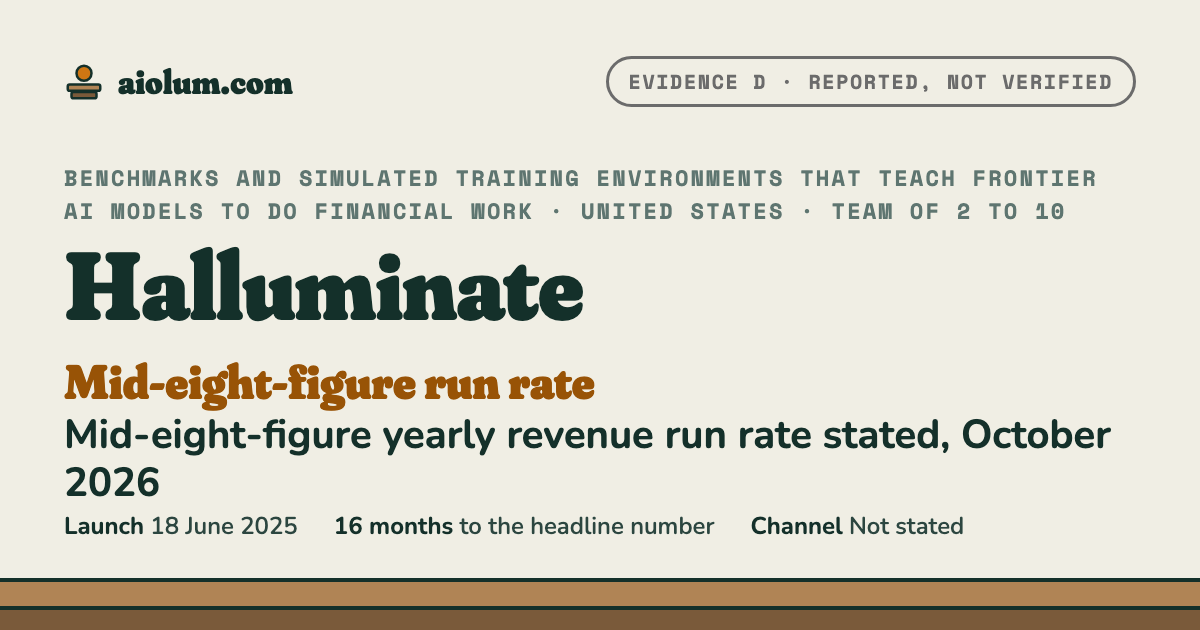
Halluminate (Benchmarks and simulated training environments that teach frontier AI models to do financial work, United States): Mid-eight-figure yearly revenue run rate stated, October 2026. Evidence grade D: reported, not verified. Team: 2 co-founders (Jerry Wu and Wyatt Marshall) in the Y Combinator launch post of June 2025; 5 people on the Y Combinator page; 9 people when Fortune reported the run rate on 1 October 2026. Launched 18 June 2025; still running, revenue growing.Added 5 November 2026
- Outcome
- Mid-eight-figure yearly revenue run rate stated, October 2026Revenue growing
- Evidence
- D reported, not verified
- Launch
- 18 June 2025
- Status
- Still running
- Team
- 2 co-founders (Jerry Wu and Wyatt Marshall) in the Y Combinator launch post of June 2025; 5 people on the Y Combinator page; 9 people when Fortune reported the run rate on 1 October 2026
- Outside funding
- US$38.5M in total, including a US$30M Series A led by Oak HC/FT (1 October 2026); backed by Y Combinator (Summer 2025)
- Main channel
- Not stated
What is not verified
The headline rests on CEO Jerry Wu's statement to Fortune, published 1 October 2026, and on his blog post of the same day: a "mid-eight-figure" annualized run rate based on quarterly revenue, and profitability. No exact number, filing, audited statement or payment-processor record was published, and no earlier dated revenue figure was found. This page counts US$10 million, the smallest eight-figure amount. A reader could look for an investor statement or a later interview with an exact figure. The headline number is grade D: one claim or one estimate, with no second source. Aiolum shows it because the story is useful, and marks it so that it is not mistaken for a verified figure.
Halluminate is a San Francisco company that builds benchmarks and reinforcement learning environments for financial work. A benchmark is a fixed set of tasks with known correct answers, used to measure how well an AI model performs. A reinforcement learning (RL) environment is a simulated workplace in which a model tries a task many times and a program gives it a score, called a reward, so that training can make the successful behavior more likely. Halluminate's environments copy the software of an investment banker or private-equity analyst: email, chat, a data room, spreadsheets and slide decks.
Jerry Wu, who led an early AI agent project at Capital One Labs, and Wyatt Marshall, a data engineer, met while studying computer science at Cornell. The Y Combinator page says they founded the company in 2024, and their launch post of 18 June 2025 offered sandboxes for computer-use AI agents. Wu told Fortune on 1 October 2026 that the company had passed "the mid-eight figures in annualized revenue run rate, based on quarterly revenue from work already delivered and paid for", and that it was profitable. Fortune reported that the company then had nine people and had raised a US$30 million Series A.
"Mid-eight figures" means tens of millions of US dollars without an exact number. This page uses US$10 million, the smallest eight-figure amount, as the figure it counts, and it grades the headline D: reported, not verified, because it rests on one founder statement on one date. Wu's own blog post of the same day says the company grew "from $0" in the 10 months before it. The page also shows failed startups that sold AI training tools or financial data analysis before frontier labs became the buyers.
How much revenue does Halluminate make?
Each row shows the evidence grade and the source numbers from the list at the end of this page. The grades are explained in How Aiolum verifies.
| Fact | Value | Grade | How we know | Sources |
|---|---|---|---|---|
| Annualized revenue run rate, 1 October 2026 | "mid-eight figures" (at least US$10 million counted here) | D | Fortune, Wen Shao, 1 October 2026: "Halluminate has crossed the mid-eight figures in annualized revenue run rate, based on quarterly revenue from work already delivered and paid for, and is profitable, he said." The same day, Wu wrote on the company blog: "Grown from $0 to a mid-eight-figure revenue run rate while remaining strongly profitable". Both are the CEO's words on one date. Eight figures start at US$10,000,000; "mid" suggests more, but no exact number was given. | [1, 2] |
| Third-party listing of the figure | at least US$10,000,000 a year | D | The Lean AI Leaderboard lists Halluminate at "≥$10,000,000" annual revenue, 9 employees, profitable "Yes", total funding US$38,500,000, founded 2024, snapshot October 2026, and cites the Fortune article. It is not an independent check. | [5, 1] |
| Run rate per month | at least about US$833,000 a month | calc | Calculated: US$10,000,000 divided by 12 equals 833,333. A run rate here is quarterly revenue multiplied by four, so the quarter's revenue was at least US$2,500,000. | [1] |
| Profitability | profitable (stated) | D | Fortune quotes Wu: "is profitable, he said." The blog says "strongly profitable". No financial statement was published. | [1, 2] |
| Time from first revenue to the headline | about 10 months | D | Series A blog post, 1 October 2026: "In the last 10 months we have: Grown from $0 to a mid-eight-figure revenue run rate". | [2] |
| Customers | four of the top five closed-source U.S. AI labs | D | Fortune: "According to Wu, four of the top five closed-source U.S. AI labs are paying customers." The labs are not named. The company's llms.txt names one public case study: Yutori, which post-trained its Navigator web agent with Halluminate's Westworld environments. | [1, 6] |
| Team at the headline | 9 people | C | Fortune headline, 1 October 2026: "Nine-person Halluminate raises $30 million". The Lean AI Leaderboard also lists 9 employees in October 2026. | [1, 5] |
| Revenue per employee | at least about US$1.1 million a year | calc | Calculated: US$10,000,000 divided by 9 equals 1,111,111, the same value the Lean AI Leaderboard shows. | [1, 5] |
| Founding team | 2 co-founders | C | Y Combinator page: "Founded in 2024 by Wyatt Marshall and Jerry Wu". Launch post: "Wyatt and I met while studying CS at Cornell and have been living and working together for over 7 years." | [3, 4] |
| Team on the Y Combinator page | 5 employees; hiring for 10 roles | C | Read 5 November 2026: "Halluminate has 5 employees based in San Francisco. Halluminate is hiring for 10 roles". The page lists more job titles than that, so the 5 is probably out of date. | [3] |
| Series A | US$30 million, led by Oak HC/FT | C | Fortune and the company blog. The blog names Y Combinator, Orange Collective, FT Partners and Heavybit as participants; Fortune adds individual researchers from Anthropic, OpenAI and Meta, according to Wu. | [1, 2] |
| Total outside funding | US$38.5 million | C | Fortune: "bringing its total funding to $38.5 million". The blog gives the same total. | [1, 2] |
| Money raised before the Series A | US$8.5 million | calc | Calculated: US$38.5 million minus US$30 million. The company's llms.txt says it "raised a seed round to scale the team" without an amount. | [1, 6] |
| Y Combinator batch | Summer 2025 | C | Y Combinator page data: batch S25, "Summer 2025", year founded 2024. | [3] |
| Time from launch to the headline | 16 months | calc | Calculated: launch post 18 June 2025 to October 2026. The company was founded in 2024, before the launch post. | [4, 1] |
| Expert network pay | US$100 to US$250 an hour; median US$3,800 a month per active expert | C | llms.txt: "Paid program for finance professionals ($100–250/hour)". Expert page: "$3,800 Median monthly earnings" for active experts in September 2026. These are payments by Halluminate to contractors. | [6, 10] |
| Latest finance benchmark | 88 problems, published 11 August 2026 | C | Westworld Finance Diligence Bench: "a benchmark of 88 problems that evaluates AI agents on a complete company acquisition due-diligence process", written and reviewed by practicing deal professionals. | [9] |
How to read this table: a grade D value is one founder statement on one date, with no outside check. A grade C value is what the company, its founder or its Y Combinator pages say about the product, the team or the funding, or what a journalist reports from them. A "calc" value (grade X) was computed on this page. No revenue value is grade A, B or C.
| Plan | Per month, billed yearly (US$) | Per month, billed monthly (US$) | Limit |
|---|---|---|---|
| RL environments for AI labs | price not published; contract work for a few large labs | ||
| Benchmarks and evaluations | price not published; some benchmarks released free on GitHub |
The site has no pricing page; it offers "Contact Us" and an email address. Fortune and the company describe the buyers as frontier AI labs that pay for delivered work, and Wu said the run rate is "based on quarterly revenue from work already delivered and paid for". The expert network page states what Halluminate pays its finance experts (US$100 to US$250 an hour in its llms.txt file); that is a cost of the company, not a customer price.
When did Halluminate launch, and how did it grow?
From a launch post by two founders in June 2025 to a stated mid-eight-figure run rate and a Series A in October 2026. Each entry carries its grade.
- 2024CJerry Wu and Wyatt Marshall, friends from Cornell computer science, found Halluminate. They had built evaluations for browser and computer-use agent companies and found no good tools. [3, 4]
- 30 May 2025CHalluminate publishes WebBench, a benchmark of about 2,500 tasks on 452 real websites for browser agents. [8]
- 18 June 2025CLaunch post during Y Combinator's Summer 2025 batch: realistic sandboxes and datasets to train computer-use and browser-use AI, by the two founders. [4]
- 22 to 23 November 2025CThe company releases Westworld, simulated websites for training web agents with verifiable rewards, and BrowserBench, which measures how often browser infrastructure providers are stopped by bot detection. [7, 11]
- About December 2025DStart of the 10-month period in which, according to Wu's blog post, revenue grew from US$0. The company's focus moves to financial work. [2]
- 17 June 2026CDealTrace: a staged review of real private-equity deals that shows where frontier models fail, mostly in forecasting. [12]
- 11 August 2026CWestworld Finance Diligence Bench: 88 due-diligence problems in simulated desktops, scored for many frontier models. [9]
- 1 October 2026DWu tells Fortune that the nine-person company has passed a mid-eight-figure revenue run rate, is profitable, and has raised a US$30 million Series A led by Oak HC/FT. [1, 2]
- 5 November 2026CThe Y Combinator page still lists 5 employees and 10 open roles. [3]
Why did Halluminate work?
Four causes, in the order they mattered. Each one is a reusable lesson.
Very few, very large customers
Wu told Fortune that the company works first with frontier model labs and that enterprise customers are not a priority. Four buyers can be enough when each buys large training projects, so a nine-person team could reach the run rate that Wu stated without a sales department.
One industry, deep expertise
Wu argues that simulating a banker's work is different from simulating a software engineer's work. Halluminate pays finance professionals to write tasks from real deal work and to choose how each answer is graded. A general data vendor would have to build that network from zero.
Grading that resists cheating
Every task has verifiers: deterministic checks of exact values and agentic checks in which a model reads the deliverable against a rubric. The company also runs a red-team model that tries to earn credit without doing the work, so that a lab does not train its model to fool the grader.
Harder tasks every generation
Wu told Fortune that the complexity of the environments must roughly double every six to eight months to stay useful for training. He called the ability to keep producing that complexity the company's main asset.
How it was built
These details come from the company's own research posts and its Y Combinator pages (grade C). The company has not published its internal software stack. [9, 6, 3, 10]
- Each finance task runs inside a Docker container with a full Linux desktop: email, chat, notes, a data room and real desktop applications that the AI agent drives with clicks and keystrokes or through tool calls.
- Verifiers score the agent's deliverable. Deterministic verifiers check exact numbers and files; agentic verifiers are AI models that read the document against criteria written by the task author. Each verifier returns 0 or 1, and weights combine them.
- Quality checks use AI models too: a Claude agent (claude-opus-5) reads each problem and its verifier specification, and a red-teamer pairs claude-opus-5 as a cheating solver with claude-sonnet-5 as the judge. LibreOffice renders each spreadsheet, document and slide deck so that a model can judge how it looks.
- Finance professionals from investment banking, private equity and hedge funds write and review the tasks through a paid expert network.
- Public benchmarks (WebBench, Westworld, BrowserBench) are released with code on GitHub and data on Hugging Face; the company lists these as its research.
- Hiring runs through an Ashby careers page; the Y Combinator page lists roles in engineering, research, operations and sales.
Tools named in the sources
Each one opens its page in the Tools tab, with every story that uses it.
Who tried this before Halluminate, and why did they fail?
Four companies in our database of failed startups sold training tools for machine learning, AI simulations, or automated analysis for financial firms before frontier AI labs became large buyers. The values below are from that database and are not independently verified.
Pathmind
The promiseReinforcement learning on business simulations, so that companies could automate operational decisions without AI experts.
Why it diedIt launched into an immature market with a complex product, while Google and Amazon offered AI tools of their own.
FloydHub
The promiseA managed cloud platform with GPUs for training machine learning models.
Why it diedAWS and Google offered the same compute, and subsidized GPU time was not sustainable for a small company.
Monitor110
The promiseAutomated analysis of blogs, news and online content to give hedge funds early warning signals.
Why it diedTraders kept their existing terminals, and the cost of the analysis was higher than what customers would pay.
DataNitro
The promisePython scripts inside Excel, so analysts could automate spreadsheet work.
Why it diedCompetitors and later Excel's own Python support left no room for a small add-in.
The failed startups come from our database of 1,749 dead startups, retold here in our own words. Its entries are AI-assisted summaries of public sources, so these cards carry no evidence grade.
What changed
Pathmind and FloydHub sold training tools to ordinary companies that wanted to build their own models. Most of those customers had no data team and no budget, and large cloud providers sold the same compute. Monitor110 tried to automate financial analysis with software that could not read text well, and hedge funds did not pay enough for it.
By 2025 a handful of AI labs were spending large amounts on post-training, and they needed tasks that their models could not yet solve. Halluminate sells to those few buyers, not to many small ones, and it sells the hard part that labs cannot copy from the internet: realistic finance work written and graded by professionals. Wu said in October 2026 that four such labs were paying customers.
Can one person copy Halluminate now?
Not by one person. The pattern can be copied in another field.
Halluminate's business depends on contracts with a few frontier labs, a network of paid industry experts and engineers who can build reliable simulated desktops. That needs a team and, in this case, outside money. Competing data vendors with far more staff also sell RL environments to the same labs.
Where it is still open: Other fields with long, document-heavy work are open in the same way: insurance claims, accounting close, legal due diligence, tax, engineering reviews. A small team with deep experience in one of them could build the benchmark first and the training environments second.
- 1Pick one field of knowledge work where today's models visibly fail and where you or your co-founder have worked.
- 2Publish a free benchmark that shows the failures; labs and agent companies read benchmarks.
- 3Build a paid network of practitioners who write tasks and choose how each answer is graded.
- 4Make the grading hard to cheat before you sell it as training data.
What could go wrong for Halluminate?
The risks are the mirror image of the causes above.
What is not verified
The headline rests on CEO Jerry Wu's statement to Fortune, published 1 October 2026, and on his blog post of the same day: a "mid-eight-figure" annualized run rate based on quarterly revenue, and profitability. No exact number, filing, audited statement or payment-processor record was published, and no earlier dated revenue figure was found. This page counts US$10 million, the smallest eight-figure amount. A reader could look for an investor statement or a later interview with an exact figure.
Team size and evidence grade
Fortune reported nine people at the headline date; the Y Combinator page shows 5 employees and 10 open roles. Aiolum's team rule for six to ten people asks for grade C or better money evidence, and this headline is grade D. The story is published under the user's decision for this batch, with the issue stated here.
A product or a service?
Wu described revenue as coming from "work already delivered and paid for", and the tasks are written by a paid network of finance experts. Part of the business is project work for each lab, not self-serve software. The company describes its environments as running "on fully managed infrastructure" and publishes benchmarks and code.
Customer concentration
According to Wu, the paying customers are four of the top five closed-source U.S. AI labs, and enterprise customers are not a priority. Losing one lab, or a lab deciding to build environments in-house, would remove a large share of revenue.
Stealth benchmark
BrowserBench (November 2025) measures how often browser infrastructure providers that promise "stealth" are stopped by bot detection such as Cloudflare. It is a measurement of other companies' products; Halluminate does not sell a bot-detection bypass.
Sources
The grade next to each source is the best grade that the source can support. "Read in full" means that the text of the page was downloaded and the numbers were checked in it.
- D Fortune, Wen Shao, 1 October 2026: Exclusive: Nine-person Halluminate raises $30 million, counts four top U.S. AI labs as customersRead in full, downloaded 5 November 2026. Primary source for the run-rate statement, profitability, the nine people, the four AI-lab customers, the Series A and total funding, and Wu's views on specialization and environment complexity.
- D Halluminate blog, Jerry Wu, 1 October 2026: Series ARead in full. The CEO's own post: growth from US$0 to a mid-eight-figure run rate in 10 months, profitability, the four labs, the round and its investors, total capital of US$38.5 million.
- C Y Combinator company page: HalluminateRead the page data embedded in the HTML, downloaded 5 November 2026. Source for the founders, year founded 2024, batch Summer 2025, 5 employees, 10 open roles and job titles.
- C Y Combinator launch post, 18 June 2025: Halluminate: Data and sandboxes to train computer use AIRead in full (created_at 2025-06-18). Source for the first product, the founders' backgrounds and the founding team of two.
- D Lean AI Leaderboard (public Google Sheet, CSV export), snapshot October 2026Read the Halluminate row, downloaded 5 November 2026: at least US$10,000,000 revenue, 9 employees, profitable, US$38,500,000 funding, founded 2024. The row cites the Fortune article, so it is not independent.
- C Halluminate llms.txt and home pageRead in full, downloaded 5 November 2026. Source for the product description, the expert network pay, the team, the research list (including DealTrace) and the Yutori case study. The home page has no pricing.
- C Halluminate blog, 23 November 2025: Westworld v1Read the introduction and method. Source for the simulated websites and verifiable rewards.
- C Halluminate blog, 30 May 2025: Web Bench: The Current State of Browser AgentsRead the introduction. Source for the first benchmark, its size and its GitHub and Hugging Face releases.
- C Halluminate blog, 11 August 2026: Westworld Finance Diligence BenchRead the sections on the environment, the verifiers and the quality checks. Source for the 88 problems, the Docker desktops, the verifier design, the red-team models and LibreOffice rendering.
- C Halluminate expert network pageRead the role description and earnings section, downloaded 5 November 2026. Source for what experts do and the median monthly earnings of active experts.
- C Halluminate blog, 22 November 2025: BrowserBenchRead the introduction and method. Source for the stealth benchmark note.
- C Halluminate blog, 17 June 2026: DealTraceRead the introduction. Source for the private-equity deal review and its finding that failures concentrate in forecasting.
- C Database of failed startups, local exportLocal export. AI-written summaries, not independently verified. Source for the failed predecessors.
Run this company? Send corrections or a verified figure to aiolum@livyden.com